
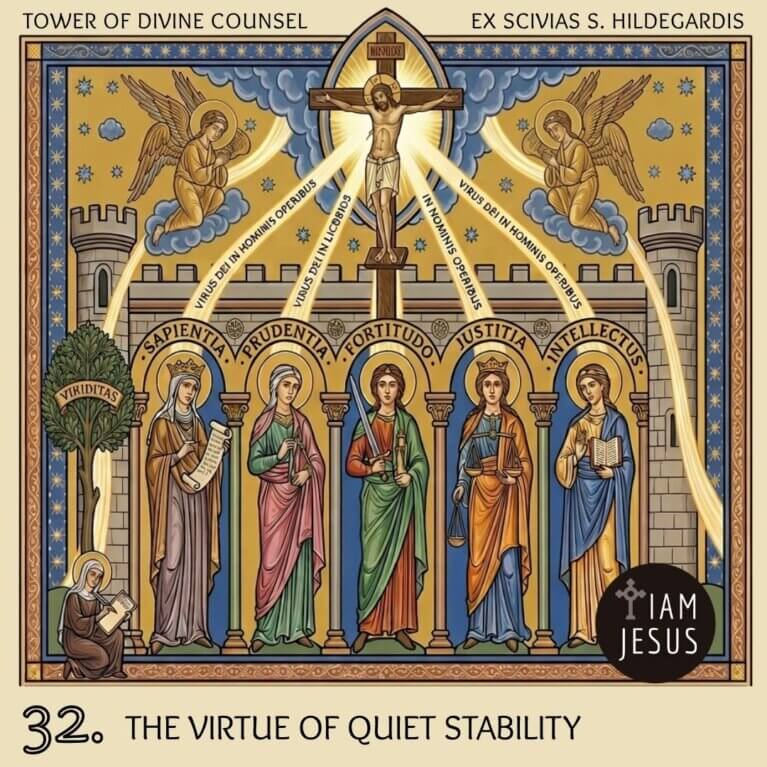
Overcoming Spiritual Aimlessness
Welcome to Part 5, Week 32 of our virtue meditation series. Today we will contemplate how the virtue of Quiet Stability keeps us from vain wandering in our lives. If you struggle with staying rooted in one vocation, one community, or one set of people that God has placed in front of you, you may be tempted by Aimlessness, St. Hildegard’s vice rooted in vainglory. Let’s take a look at this vice and her desire for recognition and the virtue that upholds the steadiness of our purpose in each of our vocations.
Opening Prayer
Lord, please direct me from aimlessness so that I can serve you with quiet stability. You know the weakness of my mind and how easily I get tempted to change course, lose my spiritual direction, and abandon my resolutions. Please grant me the virtue of quiet stability so that, by the grace of your Holy Spirit, I can remain firmly focused on what you have called me to, without being derailed by worldly anxieties, vanity, or a lack of faith.
Jesus, I am truly sorry for the times I have allowed myself to abandon people, places, or ministries when faced with difficulties and the lure of being seen. Forgive me for choosing instability, for scattering myself due to gossip, materialism, or my own misguided ambitions. I have gone from one place to another in search of peace and have not found any. It’s my own vanity that makes me wander from place to place, and the inability to stand ground has given me no rest. Forgive my past aimlessness, cleanse me of this inner restlessness, and grant me the discipline to live in humble, steadfast obedience to your holy will wherever you have placed me. I want to humbly and obediently love and serve you and my community in the vocation you have chosen for me.
Please give me the wisdom to recognize the cunning deceptions of the evil one who wants me entirely focused on myself. Fill my heart with a profound love for you so that I can remain stable and constant during times of adversity, producing a sweet aroma of holiness that pleases you. I promise to practice the virtue of quiet stability, anchoring my soul securely on the rock of your truth, and staying put when you call me to put down roots and bloom.
AMEN.
“The vocation of humanity is to show forth the image of God and to be transformed into the image of the Father’s only Son. This vocation takes a personal form since each of us is called to enter into the divine beatitude; it also concerns the human community as a whole.”
Catechism, 1877
What is the Virtue of Quiet Stability?
In Catholic moral theology, the virtue of quiet stability is a virtue of rootedness. It’s not staying still in the sense of doing nothing, but humbly and obediently staying planted firmly in place. When you have the virtue of quiet stability you are committed to one place, one community, one calling. In week two we learned about discipline in the spiritual life, a virtue focused on controlling our wants. This week we are meditating on the virtue that further disciplines us with a stick-to-it-ness in our vocations. Instead of constantly seeking a bigger stage for ourselves, the virtue of quiet stability helps us remain in place.
Quiet Stability stands opposed to Aimlessness, which St. Hildegard does not describe primarily as a wandering mind, but as a wandering life. Aimlessness is a restlessness with her own appointed place that is disguised as ambition. She is a soul that refuses to take root. She drifts, scatters, and uproots herself again and again, chasing a wider stage instead of settling into the one corner of the vineyard God has assigned. The aimless soul mistakes motion for purpose and visibility for vocation, forgetting that our calling was never to be seen everywhere but to be faithful tending the vineyard given by God. Quiet Stability answers this scattering with a single refusal. She says there is no glory in being everywhere, only in being planted where you are put, as we will learn in today’s reflection.
The Face Of Aimlessness
Aimlessness has a boy’s body but an old man’s face — no hair yet on her head, yet already a face and beard worn by age. She hangs in a bundle of cloth as if in a cradle, “swayed this way and that, as if by the wind… of these swaddling clothes” (Liber Vitae Meritorum, Part 5, Section 3, Para. 5, trans. Hozeski). It’s a striking, unsettled image: neither young nor old, never resting still, never coming to rest anywhere long enough to grow. Even her swaddling clothes are a counterfeit of the Nativity itself—the same tender image Luke uses for the Christ-child [Luke 2:12] worn here by a vice with nothing underneath it but an old man’s face and a body that never properly became anything at all.
Notice, too, what happens the moment we meet the next vice: Wrong Doing’s own description tells us “the winds roar in its ears,” and that this same fault “exalts the winds like they were its gods.” The very wind that idly sways Aimlessness in her cradle becomes, one vice later, something worshipped and followed to wherever it blows. What began as simple restlessness becomes, if left unanswered, active devotion to whatever voice happens to be loudest.
How this builds the foundation for what comes next:
A soul that never settles into a fixed purpose doesn’t stay neutral — it becomes exactly the kind of soul that will follow any wind at all, including the ones that lead it into deliberate wrongdoing.
Pray for Quiet Stability now.
Ask for the grace to find your true north in God rather than in circumstance, mood, or passing enthusiasm. A soul at rest in God cannot be blown about by every wind that comes along.
Concerning Aimlessness
by St. Hildegard of Bingen
The Words of Aimlessness
She says: ‘It would be foolish of me to remain in one place and with one people. If I show myself everywhere, have my voice heard everywhere, and have my face seen everywhere, I will spread my glory out more. Grass grows and blossoms appear: if this is the case, should man not have glory too? I am like grass with my power of reason and wisdom, and I am like a blossom with my beauty; therefore, I show myself everywhere.’
The Response of Quiet Stability
I heard a voice from the storm cloud respond to this image: ‘You, o diabolical cunning, will fall like the bloom of hay and you will be trampled under foot like the dirt of the road. You are the voice of vanity, you are the look of wickedness; you do not sift through the words of reason but instead walk unsteadily like locusts; therefore you will be scattered about like snow. You do not eat the food of wisdom and you do not drink the drink of discretion, but you imitate the ways of birds who have no stability in their nests. You are like ashes and rotting things. Therefore, I will not give you any rest.’
St. Hildegard of Bingen, Liber Vitae Meritorum (The Book of the Rewards of Life),
Part 5, Sections 4-5, Paras. 6-7 (Trans. Hozeski)
Reflection:
At the root of aimlessness, we find restlessness of the heart and a desire for validation and praise from others. We do good things, not for the praise and glory of God and as a way to love and serve him. We do them to be seen and known, and this desire causes us to move aimlessly from place to place, never putting down deep roots and growing in a community that will ground us and help us bloom.
When we live our lives like a bird with no stability in its nest, St. Hildegard warns that we end up walking unsteadily. We are constantly drifting because we are seeking to fill an interior void that longs for meaning, purpose, and truth within our very sense of being. Instead of surrendering control and resting in God’s stable plan, an aimless soul struggles against the will of God, constantly chasing after its own shifting wants, needs, and distractions to fill a need to be glorified by people for good works and special talents.
In Hildegard’s writing, Aimlessness wanders back and forth, trying to be seen everywhere to spread her glory; Quiet Stability answers her by saying, “I will not give you any rest.”
In this Fifth Part of Liber Vitae Meritorum, St. Hildegard shows Aimlessness speaking for herself:
“It would be foolish of me to remain in one place and with one people. If I show myself everywhere, have my voice heard everywhere, I will spread my glory our more…I am like the grass with my power and wisdom, and I am like a blossom with my beauty; therefore I show myself everywhere.”
Running Around in Error with Idols
The enemy knows this inner restlessness makes us weak, and he loves to exploit our tendency to drift. When our minds lose their anchor in Christ, we naturally begin to seek stability in the wrong places.
St. Hildegard explains the wisdom of quiet steadiness over the aimlessness of running around in error with idols:
“Wisdom also speaks to the Creator with loving love, as if she were speaking to her beloved, asking him where to bring food and where to bring the quietness of her virtues. She does not run around in error with idols who falsely claim the name of Divinity for themselves”
Liber Vitae Meritorum Part 5, Section 31, Para. 40
For a dedicated soul, an idol is rarely a golden statue. Instead, it is anything—a title, a platform, a wider audience—that we value above our fidelity to God and the people he is calling us to serve (Catechism, 1877). When you insist on wanting what you want for your own self-benefit, you are essentially treating your own desires as an end in themselves. In this state, we stop worshipping God in obedience and begin worshipping ourselves. When we elevate these personal “idols” above our own sanctification, we completely lose our spiritual orientation and end up never finishing anything because finishing requires staying, and staying is exactly what the aimless refuse to do.
Lord, Direct Me From Aimlessness and the Lure of a Bigger Stage
The Devil rarely tempts a faithful person to abandon God outright. Instead he will whisper to us that our actual calling in our current parish, or our marriage, or our existing job is beneath what we should be doing. He will flatter us by dressing up ambition as a veiled form of generosity. You may be tempted by thoughts like, “I wonder how much I could accomplish, if I wasn’t tied down here…. My talents are undervalued here, I need to find a place that will let me do what I need to be more successful and get more reach.”
Aimlessness even claims a kind of false humility about her gifts: “I am like grass with my power of reason and wisdom… I am like a blossom with my beauty.” The vice is using these gifts as a reason to refuse to stay in her current vocation. The enemy loves to use our specific vulnerabilities to trigger vocation drifting. When our good deeds are secretly fueled by vainglory, we become incredibly fragile and easily tempted to stray from our rightful place. The desire to be seen and praised for our good works creates a deep spiritual disorientation; we may begin to convince ourselves that a sinful relationship is actually “okay,” or talk ourselves out of a difficult, narrow path that we know is God’s authentic will for our lives.
Aimlessness Makes Us Quitters When Adversity Comes
St. Paul gives us two examples of what happens when aimlessness gets in the way of ministry. In 2 Timothy 4 we learn of Demas who “because he loved this world, has deserted me and gone to Thessalonica” and also about Mark, who deserted Paul in Pamphylia (Acts 15:36-39) and caused Paul and Barnabas to split up. Demas never reconciles with Paul or returns to ministry with him as far as we know. Mark, on the other hand, reconciles with Paul and returns to work with him years later as we can see in 2 Timothy 4:11 and Colossians 4:10. Imagine being remembered by name in scripture forever for that one time you bailed when you should have stayed?
Because aimlessness provides no solid foundation, and it lures us to focus on ourselves rather than others, it causes us to constantly change our minds the moment we are faced with adversity. God is constant, sure, and stable in all His ways, and He intends for us to complete the tasks the Holy Spirit gives us. Adversity is not our enemy, a lack of steadfastness leads to aimlessness, and this is the real enemy.
St. Hildegard calls this Aimlessness the “maiden of Disobedience” and the “servant of Luxury” not for sensual reasons, but basically because a soul that is unwilling to stay anywhere eventually becomes unwilling to answer to anyone (Liber Vitae Meritorum, Part 5, Section 45, Para. 61). Every commitment starts to feel like a cage. Every authority, whether it’s your pastor, your spouse, your religious community, or your job, starts to feel like it’s holding you back from your ambitions. You start to crave the glory that you believe you deserve and you start looking elsewhere to get it. This is how restlessness curdles into disobedience. It’s not through one dramatic refusal, but through a thousand quiet exits.
Aimlessness talks herself into believing that by using her gifts well, all her ambitions will result in being seen everywhere and spreading her glory. Notice the focus here. It’s on herself rather than on the love of God and neighbor. Do you see that distinction? Certainly God calls us to bigger stages and some of us are chosen for such vocations. What makes aimlessness so deadly for the soul is the focus on self and personal ambition over commitment to God and to the people he has placed in that soul’s care. St. Hildegard describes the struggle beautifully, warning that an aimless soul behaves like a “bird with no stability in its nest” that walks unsteadily around, beginning nothing correctly and ending nothing correctly.
We cannot abandon the sacred vocations or paths God has clearly shown us just because we temporarily enter a state of confusion, feel unvalidated, or unseen. In your darkest moments of inner drifting, the enemy will even tempt you to question your faith entirely, causing you to doubt the brilliant truths that God once revealed to you by grace when He unveiled His special purpose for your life and gave you the very vocation you are now seeking to flee. When you are tempted by the spirit of Aimlessness, you begin to seek being seen for the gifts you have, and in your mind you begin look for ambitious pursuits that help you leave for greener pastures. Notice what this vice actually wants. It’s not pleasure, not comfort, but reach. It wants to be known, seen, and praised in every place all at once. Aimlessness wants the status and the praise, not the criticism, lack of appreciation, or brick wall put up by superiors.
Let’s see how St. Hildegard actually teaches us the opposite is true. The real source of greener pastures, which in Liber Vitae Meritorum is referred to as viriditas, or greenness, is not through succeeding in our ambitions. True greenness is something God pours into our souls through the virtues, and this is given to us when we stay faithful to him in perfect charity, serving him as he has called us, and faithful to stay put even when in adversity. Let’s take a look at Part 6, Concerning the Air and the Virtues:
It also shows the dew of hope that moistens the minds of the faithful when they pant for heavenly things and when they hasten to do good in all things everywhere since they have the greenness of perfect charity.
Liber Vitae Meritorum, Part 6, Section 21, Para. 22
True charity, St. Hildegard tells us, hastens to do good “in all things everywhere”—but notice where that word, everywhere, lives! It is within your soul. Charity does good wherever obedience has already planted her, while the word everywhere takes on a completely different meaning for Aimlessness. Everywhere for Aimlessness is not found within her soul. This is why she is restless! She is looking for it on the outside, not within her heart and in her soul. Aimlessness wrongly thinks that abandoning her post when things get hard is justified because her real calling is waiting for her somewhere else.
This battle is something we face every single day, especially in a modern world that has lost its sense of belonging to our local communities. St. Hildegard reminds us to intentionally choose to ground ourselves in the present situation we have been called to and to serve there with magnanimity. When we practice quiet stability daily, we stop running after every opportunity to promote ourselves and instead we transform our hearts into a peaceful sanctuary where God’s grace can truly take root. The virtue of charity grows into magnanimity. The result, is being at peace in the place we are called to serve—no matter the ups and downs—and regardless of whether or not we are praised for it.
The Virtue of Quiet Stability: Stick-to-it-ness
So, what does it mean to live out the virtue of quiet stability? How can we be raised up to bloom and bear a sweet aroma that pleases God? This virtue isn’t something we master overnight; it is a grace we arrive at over time. Aimlessness naturally falls away as the soul begins to recognize the intimate, constant love of God and the daily gifts that come from staying in union with the Holy Spirit.
Of course, we cannot possess quiet stability without cultivating deep faithfulness. Stability requires us to firmly assent to the will of God even in our most difficult moments of trial, dryness, and tribulation. It means choosing to stick to our faith no matter what and continuing to obey the precepts God has given us, even when we don’t emotionally “feel” like it.
As your love for God grows stronger, it will completely transform your heart and mind. Your interior life is renewed the more you intentionally recognize God’s presence in your day-to-day routine. You will fall in love with God, and that love will completely change your disposition. Holy love fills the empty, restless spaces of the soul, flooding it with lasting meaning and steady purpose. Armed with this grace, you can lose every single earthly possession and still remain completely at peace, because your soul is anchored in the quiet stability of Christ.
Going Further:
If you want to dive deeper into this week’s meditation during your Holy Hour, spend some time prayerfully reading Psalm 131. This beautiful, short scripture is a profound prayer of complete trust, asking for the grace to abandon our self-sufficiency and restless anxieties.
As you read, try to picture your soul completely stilled, resting securely in the presence of the Lord without needing to figure everything out on your own. Take a few moments to journal about whatever word or phrase touches your heart, and then give the Lord space to respond to you by listening to Him in absolute silence.
Securing The Nest:
Take a moment to pause, drop your ambitions, and settle into the absolute stillness of this adoration chapel. Spiritual aimlessness is a quiet, dangerous erosion of the soul—an exhausting habit of vocational wandering where we behave like a restless cloud, beginning nothing correctly and ending nothing correctly. Before we open the Word of God, let us offer up a sincere prayer of petition—asking for the spiritual wisdom to stay rooted in our vocations with a magnanimous heart regardless of whether or not were are seen or validated.
For Quiet Stability and Steadfast Faith
Eternal Father, You are the sure foundation and the unshakeable rock who remains constant in all Your ways. Forgive me for the times I have been a quitter when adversity comes, doubting the brilliant truths You revealed to me by grace and the vocation you have called me to. I am too weak to conquer this inner scattering by my own fragile human energy. I desperately need the cleansing fire of Your grace so that I can have magnanimity in my soul. Help me to remain quietly stable in my calling and not abandon your path for me like Demas did.
Lord Jesus, grant me the supernatural virtue of quiet stability. Infuse my human weakness with Your divine Heart so that I may move past spiritual childhood and mature into a deeper, more steadfast faith full of magnanimity for souls in my care. When sudden distractions or shifting desires threaten to pull me away from my sacred vocation, help me to completely surrender my mind to you. Deliver me from the suffocating trap of ambition. Grant me an unyielding spirit of holy “stick-to-it-ness” to obey Your precepts even when I don’t emotionally feel like it. I want to stay planted where you have called me to serve and grow deep roots.
AMEN.
Take a slow, deep breath. Settle your mind, and for a few moments, lay down the exhausting habit of mental wandering. As you prepare to listen to Jesus speak in this monumental conclusion to the Sermon on the Mount, remember that true quiet stability is the inner greenness that gives your soul peace. The grass isn’t greener somewhere else, the greenness comes from total obedience to the will of God and deep love for him in your heart. This is where magnanimity is truly rooted.
Do not rush through these verses. Read the words slowly and let the absolute clarity of Christ’s warnings pierce through your ambitious desires. Watch how clearly He exposes the futility of empty talk (“Lord, Lord”) and external religious performance without true charity for others and fidelity to God. Notice the dramatic contrast between the wise man who builds his house on the unshakeable rock of truth and the fool who builds on the shifting, aimless sand of self-will. Ask Jesus to reveal exactly where you have scattered your focus like snow, beginning and ending nothing correctly, and where He is calling you to cultivate a spirit of holy “stick-to-it-ness” in your life. When you are ready, pick up your pen and write His promptings directly into your prayer journal.
The Quiet Stability of a True Disciple
[Jesus said] “Not everyone who says to me, ‘Lord, Lord,’ will enter the kingdom of heaven, but only the one who does the will of my Father in heaven. Many will say to me on that day, ‘Lord, Lord, did we not prophesy in your name? Did we not drive out demons in your name? Did we not do mighty deeds in your name?’ Then I will declare to them solemnly, ‘I never knew you. Depart from me, you evildoers.’
“Everyone who listens to these words of mine and acts on them will be like a wise man who built his house on rock. The rain fell, the floods came, and the winds blew and buffeted the house. But it did not collapse; it had been set solidly on rock. And everyone who listens to these words of mine but does not act on them will be like a fool who built his house on sand. The rain fell, the floods came, and the winds blew and buffeted the house. And it collapsed and was completely ruined.”
When Jesus finished these words, the crowds were astonished at his teaching, for he taught them as one having authority, and not as their scribes.
Let Us Pray:
Jesus, let me truly love you and obey your will all the remaining days of life. Let me be humble and obedient, possessing the virtue of quiet stability so that I will not be aimless and leave my vocation with false ambitions. I want to see you face to face at the end of my life and to hear you say you are pleased with me. I want to truly love you from my heart and put you above all the things of this world. Let me have no idols that I put above you, Lord, no unholy ambitions.
Please give me wisdom so that I can recognize all the deceptions of the devil and recognize that the greenness I am seeking is not found in distant pastures but within my soul when I am completely surrendered to your calling. With the virtue of quiet stability, you will fill my heart with holy charity and give me the stick-to-it-ness I need. Jesus, let me have an aroma of holiness and be pleasing in your sight.
AMEN.
A Prayer for an Increase in Virtue for Others
Lord Jesus Christ, you say that when two or more are gathered in your name, you are with us. Jesus, in your name I lift up every person who has joined this prayer challenge or will join it in the future. I ask you to give us all the grace we need to grow in virtue and holiness so that we may love and serve you in our lives and through the people we love and care for. Help us in our thoughts, our words, and our actions. Guide us all by your Holy Spirit and give us the strength to overcome every temptation from the evil one. We ask all this in the name of the Father, and of the Son, and of the Holy Spirit, AMEN.
Sure Foundation: Your Week 32 Send-Off
Thank you for your dedication to Week 32. Overcoming the restless cloud of spiritual aimlessness and choosing quiet stability requires deep interior maturity. Ask the Lord for the wisdom to stop measuring your worth by reach, and for the courage to stay rooted exactly where obedience has placed you. Reclaiming your focus is a daily process of surrender, not an overnight shift. Take immediate accountability when you drift, and let the Sacrament of Reconciliation restore your peace.
True quiet stability anchors your soul securely on the rock of truth. You are called to actively ground your wandering thoughts, drop your personal idols, and let your daily life become a peaceful sanctuary. To see how a quiet conscience prepares us to confidently face our ultimate mortality, let’s look at the Catechism:
“For if we continue to love one another and to join in praising the Most Holy Trinity —all of us who are sons of God and form one family in Christ —we will be faithful to the deepest vocation of the Church.”
Catechism, 959
Make a Resolution
Take a moment to reflect on the virtue of quiet stability. What are the ways you can freely practice this virtue this week? Ask the Lord to give you opportunities, and when you feel the Holy Spirit prompting you, take action. Write down your resolutions for this coming week in your prayer journal. Remind yourself to complete these resolutions daily for this entire week, and as the Spirit prompts you, feel free to write about your experiences with this virtue throughout the week.
In My Thoughts:
Jesus, this week I promise to take time daily to conform my thoughts by… (make your intention).
In My Words:
Jesus, this week I promise to take time daily to conform my words by… (make your intention).
In My Actions:
Jesus, this week I promise to take time daily to conform my actions by… (make your intention).
Pray the Litany of Virtues prayer.
Join our Virtue Meditation Prayer Challenge
Don't let spiritual overwhelm hold you back!
Let us guide you step-by-step through Saint Hildegard’s transformative path to holiness.
Receive one long-form meditation in your inbox each week—perfect for a powerful 35-minute holy hour.

One Response
Thank you for this 32nd week of meditation God Bless you-all