
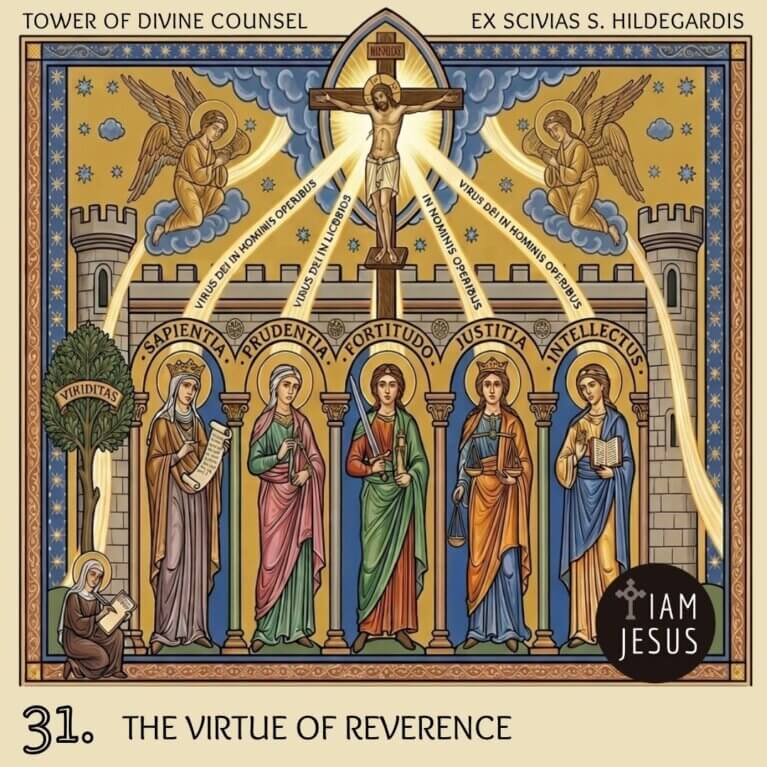
Overcoming The Need to Make Harsh Judgements
Welcome to Week 31 of our virtue meditation series. Today, we are exploring a gentle challenge that faces many of us who love the faith: the temptation to cultivate a beautifully pious devotion to God in prayer, while unintentionally letting our words become harsh or dismissive toward a neighbor. Through St. Hildegard’s insights on scurrility and the virtue of reverence, we will discover how the Holy Spirit invites us to look past the faults of others and honor the sacred presence of Christ hidden within every single soul in this Part 5 meditation.
Opening Prayer
Jesus, please increase in me the virtue of reverence and help me resist the spirit of scurrility. Please grant me a truly humble heart, so that I am not a hypocrite who proclaims to have love for God, whom I cannot see, while lacking love and reverence for my neighbor, whom I do see. Give me a strong distaste for irreverent, abusive behaviors, and help me overcome any hidden desire to attack the dignity of another person through denigrating thoughts, words, or actions.
Lord, you know my heart and all the ways I can displease you with my lack of true charity. Help me combat the spirit of scurrility so that I may have reverence for my fellow man and be pure of heart. Give me the virtue of reverence so that I might respect and honor every human being with charity and dignity. Let me be salt and light and a reflection of your love in the world. Lord, grant me the grace to love and honor others in the same reverent way you love me.
Forgive me for all my pride, my harsh judgments, and the vice of scurrility. Help me combat my evil inclinations to belittle or discredit others, and remove the log from my own eye before I look at the sawdust in my brother’s. May my words be salt and light, and may the virtue of reverence form a pure heart within me so that I am always a reflection of your divine charity.
AMEN.
The desire for God is written in the human heart, because man is created by God and for God; and God never ceases to draw
man to himself. Only in God will he find the truth and happiness
he never stops searching for:The dignity of man rests above all on the fact that he is called
to communion with God. This invitation to converse with God is addressed to man as soon as he comes into being. For if man exists, it is because God has created him through love, and through love continues to hold him in existence. He cannot live fully according to truth unless he freely acknowledges that love and entrusts himself to his creator.Catechism, 27
What is the Virtue of Reverence?
Reverence isn’t just about “not fighting”; it is the supernatural unity of believers reflecting the perfect unity of the Holy Trinity. In the opening chapters of the Fifth Part of her moral masterpiece, Liber Vitae Meritorum, St. Hildegard stages a dramatic battle between the vice of Scurrilitas (the vice of scurrility) and Reverentia (the virtue of reverence). In Catholic moral theology, scurrility is having coarse, abusive, or vulgar language to mock, demean, or defame another person. It is not just simple rudeness; it is a spiritual sickness rooted in hidden pride that seeks to destroy the God-given dignity of our neighbor. Hildegard exposes this spirit of mockery as something that actively cuts us off from divine charity, turning our hearts bitter, while the virtue of reverence acts as the holy medicine that restores our respect for God and His creation.
For us, this spiritual battle is no longer confined to cloister walls; it plays out daily across our text messages, comment sections, and online social feeds. The contemporary spirit of scurrility thrives on digital anonymity, fueling a culture of toxic internet harshness, witty mockery, and instant, biting judgments designed to diminish others to lift ourselves up. St. Hildegard warns us that using our words to tear down another soul is a form of spiritual destruction that ruptures our communion with the Trinity. True reverence demands that we put down our digital weapons, look past outward appearances, and recognize the reflection of the Creator in every single soul. By choosing authentic charity over online cruelty, we allow a pure heart to form within us, transforming our daily communications into a living witness of Christ’s gentle and restorative love.
The Face Of Scurrility
St. Hildegard sees Scurrility youthful from the crown of her head down to her loins—and shaped like a crab from the loins down. She tells us exactly why. The youthful upper half is incontinence: wantonness, mocking words spoken without restraint, praise given only to flatter and slander given only to wound. But the crab-shaped lower half is her own diagnosis of where that incontinence ends up: “the ones choosing this fault descend from incontinence into changeableness… they are headed toward a depraved end.” (Liber Vitae Meritorum, Part 5, Section 29, Para. 37, trans. Hozeski). Scurrility is not simply mockery. She is mockery already halfway transformed into the very next vice waiting to receive her.
How this builds the foundation for what comes next:
A soul that mocks what deserves reverence doesn’t merely lose respect for sacred things—it loses its own footing. Once nothing is treated as serious, nothing can serve as a fixed point to stand on. That instability is not a separate problem arriving later. It is already present, already growing, in Scurrility’s own crab-shaped legs.
Pray for Reverence now
Ask the Holy Spirit for the grace to see the sacred image of God in every person and every truth you’re tempted to mock or belittle. If this grace never takes root, the ground is already prepared for the next vice to grow.
Concerning the Fault of Scurrility
by St. Hildegard of Bingen
Scurrility is filled with the forgetfulness of God and is anxious to tear truth to pieces with false words, because it is like a stinking cloud that makes all the fruit dry up. It does not germinate in honesty and it is not covered by discipline with the mantle of modesty, but it tries to destroy everything that is true with the shadow of its playful works.
It makes a hissing sound like a snake, and with its bad habits it entangles itself in blasphemous words against God and man. It attacks the established law, just as a worm destroys a garment; it deceives man by mocking him and thus attacks him through death. Let those who want to choose God with a pure heart and with a disciplined soul cast out the poison of this scorn so that they do not weep later when they really want joy.
These things, however, have been spoken concerning the atonement for the cleansing and saving of souls, and they are faithful things. A faithful person pays attention to these things and remembers them well.
St. Hildegard of Bingen, Liber Vitae Meritorum (The Book of the Rewards of Life),
Part 5, Section 42, Para. 57 (Trans. Hozeski)
A Familiar Face, Grown Larger: Remembering Week 3
If this vice feels oddly familiar, it should. Twenty-eight weeks ago, in Week 3, we met her smaller cousin: Jesting, the restless figure who couldn’t bear to be thought serious, always reaching for one more laugh at someone else’s expense. We learned then that Modesty—Verecundia—was the one virtue St. Hildegard sent to guard against her, protecting the quiet dignity of the soul.
Scurrility is that same flippant spirit, no longer confined to one person’s undisciplined tongue. St. Hildegard tells us plainly what she does:
She “takes the shyness and modesty out of men’s minds and makes them foul and unclean.”
Liber Vitae Meritorum, Part 5, Section 29, Para. 37, trans. Hozeski
Notice—she names modesty directly, the very virtue we prayed for back in week 3. What was once a private struggle to guard your own dignity has become, here in Part 5, a warning about what happens when an entire community or culture stops taking anything sacred seriously at all.
And St. Hildegard shows us exactly where that road leads. She tells us Scurrility is directly followed by Aimlessness—”it leads each and every thing that was disposed correctly into immoderation” (Section 30). A soul that jokes its way past what’s sacred eventually loses its bearings entirely; a culture that does the same eventually forgets what it was ever supposed to be aiming for. This is why St. Hildegard shows that changeableness in her very body, a crab-shape growing from the waist down. Week 3 asked your to guard your own heart. This week asks something bigger: are you contributing, in any way, to a world that has stopped believing anything deserves reverence at all? If so, you are at risk of developing vices that will thwart your spiritual growth.
St. Hildegard gives both figures their own voice in Liber Vitae Meritorum itself. Scurrility says:
“I will stretch out nets with my words and will catch everything I can, for the more I catch, the more I will have… I will also stretch out my bow with its arrows of words. I will not hide anything, I will not be silent about anything, and I will give whatever I have to each and every man according to his measure”
Liber Vitae Meritorum, Part 5, Section 2, Para. 3, trans. Hozeski
Reverence answers her directly:
“If I can renew all the things the Creator made, what am I?… The mountains sustain me and I walk on the floor of the valleys; these things do not despise me either. I do not hurt anything, but I do trample you under foot like the dirt under my shoes, for you are not worthy since you injure everything you can.”
Liber Vitae Meritorum, Part 5, Section 3, Para. 4, trans. Hozeski
Reflection:
Have you ever had to forgive a really bad offense, an evil that was done to you? Our ability to forgive and be forgiven always comes to the same place, love. Our capacity to love comes from God. How deeply we are able to love and honor God is how deeply we are able to love our neighbor. The more we can love God with a pure heart, the more love we will naturally have for our neighbors, especially the marginalized and those hard to love.
God is the source of all our goodness, and the reason we have any ability to love at all. So we can logically conclude that those who lack love and are hard to love have difficulty knowing God and loving him. If we can be the light of Christ to others then we can help them learn to love God and grow in virtue. Love covers a multitude of sins [1 Peter 4:8].
It’s difficult to love someone who makes our lives difficult. Everyone has experienced abusive relationships. We all know someone who is difficult to love. In our brokenness we turn away from unlovable people. Our pride wants to tell us we are better than them, and so we compare ourselves to them and tell ourselves we are more holy and righteous and more lovable as a result. We may deride them and tell their faults to others so as to justify our unforgiveness and validate our pain. Some of us may publicly shame them, pointing out their inadequacies. But this is committing the very same kind of offenses that were committed against us and for which we struggle to forgive. Two wrongs do not make a right. Any form of rudeness that is intended to hurt someone is an example of the spirit of scurrility.
Am I Judging Others Harshly, in a Spirit of Scurrility?
We are merely humans and we lack the omnipotence of God. We see ourselves and our lives in a very narrow finite way. We do not know the future, no matter how much we seek it through various prophecies or subject matter experts we consult. We simply can’t know if the person who most deeply offends us right now and has deep hatred for God will one day praise his holy name for eternity in heaven. We have to recognize that we know nothing and therefore our irreverence toward the sinner is a total lack of charity and an offense to God.
When we lack reverence for both God and our fellow man, we see what we hate in others and we turn away in disgust. Our pride tells us we are better, and we may even like to tell them how so. I am reminded that Jesus taught us that no man is good except God [Mark 10:19].
We all fall short. We are guilty of the spirit of scurrility when we speak abusively to and about our brothers and sisters in Christ.
The Virtue of Reverence forms in a Pure Heart
Reverence is a matter of the heart, it is an interior disposition and not an external one. You may dress correctly, recite your prayers perfectly, bow, genuflect, and act in a most honorable way in Church before God and others. But do you act the same way in your home to your family when no one is watching? Are you reverent toward those who are under your charge? Do you do your prayers also when you are alone with God, or do you skip them because there is something else you would rather do? Can you show charity toward those who have nothing to give you and to those who look repugnant to you? Are you able to kiss the leper like St. Francis of Assisi did when the Holy Spirit bid him to?
Reverence to God means respect for every single human being on this planet, even those who are untouchable and those who proclaim themselves to be your enemy.
I heard it once said that when we speak ill of someone its a form of ‘killing’ because our words are a form of destruction against their soul. While it is important to instruct those who God has placed in our care and under our authority, we must not harm their souls through the vice of scurrility. We read in 1 Thessalonians 2:7 that we ought to be gentle with them like a nursing mother caring for her child. We need to be firm, yet soft. We have to be salt and light, a lampstand that guides them toward the love of God. Our actions speak the depth of our love and when we act with the spirit of scurrility we are harming them.
Going Further:
If you’d like to go further and meditate on the virtue of reverence, read Hebrews 12:1-13. Pause over a word or phrase that touches your heart. Spend a few moments in silence, asking the Holy Spirit to speak to your heart. Is something calling out to you? You may want to journal about it.
It begins: “Therefore, since we are surrounded by so great a cloud of witnesses, let us rid ourselves of every burden and sin that clings to us and persevere in running the race that lies before us while keeping our eyes fixed on Jesus, the leader and perfecter of faith. For the sake of the joy that lay before him he endured the cross, despising its shame, and has taken his seat at the right of the throne of God. Consider how he endured such opposition from sinners, in order that you may not grow weary and lose heart” [Hebrews 12:1-13].
Putting Down Our Digital Weapons:
Take a moment to pause, drop your defensive walls, and settle into the absolute, healing stillness of this adoration chapel. The spirit of scurrility is a dangerous, toxic infection of the soul—an exhausting habit of using coarse, mocking, or abusive language to tear down others, whether face-to-face or behind the anonymity of a digital screen. When we give in to biting judgments and sharp-witted sarcasm, our hidden pride tries to diminish our neighbor’s God-given dignity just to lift ourselves up. Before we open the Word of God, let us offer up a sincere prayer of petition—asking for the profound humility to remove the log from our own eye and receive a spirit of authentic reverence.
Prayer for Reverence and Charity toward Others
Crucified Lord Jesus, You are the King of Glory who bore our ultimate rejection with silent dignity, yet You know the harsh, critical, and judgmental corners of my heart. I confess that I have often succumbed to the vice of scurrility—using my tongue and my keyboard to demean others, exposing their flaws to justify my own bitterness, and treating Your creation with cheap irreverence. Forgive me for the hypocrisy of proclaiming love for You in prayer while treating my neighbor with cold contempt. I cannot tame my critical thoughts or my wounding words by my own human power. I desperately need the cleansing fire of Your grace.
Lord Jesus, grant me the supernatural virtue of reverence. Send the Holy Spirit to purify my heart so that I may recognize Your sacred image hidden inside every single human being on this planet—even those who make my life difficult, and those who proclaim themselves to be my enemy. When a biting remark or a harsh online judgment flares up this week, catch my thoughts and make my words a source of healing salt and light. Grant me a gentle, nurturing disposition, teach me to guard the dignity of the broken, and let my daily communications become an authentic reflection of Your divine charity.
AMEN.
Take a slow, deep breath. Settle your mind, put down your daily anxieties, and completely open your heart to the presence of God. As you prepare to listen to Jesus teach in this monumental passage from the Sermon on the Mount, remember that true reverence is an interior reality of a pure heart, not an external performance of rules.
Do not rush through these verses. Read the words slowly and let Christ’s radical standard pierce directly through your defenses. Notice how He connects outward legalism with interior reality, warning that simple anger or dismissing a brother as a “fool” makes us liable to fiery Gehenna. Watch how strictly He commands us to value reconciliation, telling us to leave our very gifts at the altar and run to make peace with our opponent first before offering worship. Ask Jesus to reveal exactly where your words have acted as a tool of destruction against another’s soul, and where He is calling you to practice a soft, firm charity this week. When you are ready, pick up your pen and write His promptings directly into your prayer journal.
We are Called to have a Deep Respect for God and Man
from the Gospel of Matthew Chapter 5:17-26
[Jesus began to teach them:] “You are the salt of the earth. But if salt loses its taste, with what can it be seasoned? It is no longer good for anything but to be thrown out and trampled underfoot.
You are the light of the world. A city set on a mountain cannot be hidden. Nor do they light a lamp and then put it under a bushel basket; it is set on a lampstand, where it gives light to all in the house. Just so, your light must shine before others, that they may see your good deeds and glorify your heavenly Father.
Do not think that I have come to abolish the law or the prophets. I have come not to abolish but to fulfill. Amen, I say to you, until heaven and earth pass away, not the smallest letter or the smallest part of a letter will pass from the law, until all things have taken place.
Therefore, whoever breaks one of the least of these commandments and teaches others to do so will be called least in the kingdom of heaven. But whoever obeys and teaches these commandments will be called greatest in the kingdom of heaven. I tell you, unless your righteousness surpasses that of the scribes and Pharisees, you will not enter into the kingdom of heaven.
You have heard that it was said to your ancestors, ‘You shall not kill; and whoever kills will be liable to judgment.’ But I say to you, whoever is angry with his brother will be liable to judgment, and whoever says to his brother, ‘Raqa,’ will be answerable to the Sanhedrin, and whoever says, ‘You fool,’ will be liable to fiery Gehenna.
Therefore, if you bring your gift to the altar, and there recall that your brother has anything against you, leave your gift there at the altar, go first and be reconciled with your brother, and then come and offer your gift. Settle with your opponent quickly while on the way to court with him. Otherwise your opponent will hand you over to the judge, and the judge will hand you over to the guard, and you will be thrown into prison. Amen, I say to you, you will not be released until you have paid the last penny.”
Let us Pray:
Jesus, please guide my heart and mind to be always reverent. Let me show love for you in my heart and let my love for others be a light. No one is good but God alone, but if I can be a Temple of the Holy Spirit, I can bring your love to those that you have given me authority over. Let me nurture them with gentleness and kindness, showing them reverence and respect so that when they look at me they see you.
I ask all this in the name of the Father, and of the Son, and of the Holy Spirit. AMEN.
A Prayer for an Increase in Virtue for Others
Lord Jesus Christ, you say that when two or more are gathered in your name, you are with us. Jesus, in your name I lift up every person who has joined this prayer challenge or will join it in the future. I ask you to give us all the grace we need to grow in virtue and holiness so that we may love and serve you in our lives and through the people we love and care for. Help us in our thoughts, our words, and our actions. Guide us all by your Holy Spirit and give us the strength to overcome every temptation from the evil one. We ask all this in the name of the Father, and of the Son, and of the Holy Spirit, AMEN.
The mirror of Faith: Your Week 31 Send-Off
Thank you for your incredible dedication to Week 31. Confronting the spirit of scurrility—shattering the urge to use coarse language or harsh online judgments and choosing a heart of authentic reverence—takes deep interior humility. When you feel a critical attitude flare up or catch yourself using mocking sarcasm to diminish someone this week, do not let discouragement take root. Overcoming a judgmental spirit is a slow process of daily conversion, not an overnight shift. Take immediate accountability when your charity wavers, and run straight to the Sacrament of Reconciliation to let His mercy reset your peace.
True reverence isn’t an external performance of rules; it is an act of spiritual power that recognizes the sacred image of the Creator hidden within every single soul. You are called to actively put down your digital weapons, guard the dignity of the broken, and let your daily communications become a reflection of divine charity. Let’s look at what the Catechism says:
Believing in God, the only One, and loving him with all our being has enormous consequences for our whole life. It means coming to know God’s greatness and majesty:
“Behold,
God is great, and we know him not.” Therefore, we must “serve
God first.”It means living in thanksgiving: if God is the only One, everything we are and have comes from him: “What have you that you did not receive?”
“What shall I render to the Lord for all his
bounty to me?”It means knowing the unity and true dignity of all men: Everyone is made in the image and likeness of God.
Catechism, 222-225
Make a Resolution
Take a moment to reflect on the virtue of reverence for others. What are the ways you can freely practice this virtue this week? Ask the Lord to give you opportunities, and when you feel the Holy Spirit prompting you, take action. Write down your resolutions for this coming week in your prayer journal. Remind yourself to complete these resolutions daily for this entire week, and as the Spirit prompts you, feel free to write about your experiences with this virtue throughout the week.

In My Thoughts:
Jesus, this week I promise to take time daily to conform my thoughts by… (make your intention).
In My Words:
Jesus, this week I promise to take time daily to conform my words by… (make your intention).
In My Actions:
Jesus, this week I promise to take time daily to conform my actions by… (make your intention).
Pray the Litany of Virtues prayer.
Join our Virtue Meditation Prayer Challenge
Don't let spiritual overwhelm hold you back!
Let us guide you step-by-step through Saint Hildegard’s transformative path to holiness.
Receive one long-form meditation in your inbox each week—perfect for a powerful 35-minute holy hour.

2 Responses
I want to ask something not related to the virtues. The catholics are sometimes labelled as a dénomination that worships idols(the crucifix, and the statues of Holy Saints and our Lady). What can I use and defend my faith
Ogoo, as a former Protestant believer in Jesus, I understand their beliefs about idolatry. I recognize where they fail to see the truth about Catholic belief in venerating saints as intercessors in heaven. Much of what some sects are taught are inaccurate descriptions of Catholic worship and belief, but they are also taught not to look into Catholicism itself because it is not Christian, so many believe without looking to see what the Catholic Church teaches in the Catechism.
In the online world, there are a lot of influencers who are paid to promote content, and so you may experience aggressive pushback from some of these influencers. It is always wise to pray before we pick up our weapons and begin making a battle against heresy online. They know their verses well and they are taught to anticipate our response and refute it. It is even more difficult when the aggressor is a beloved member of your family, so a gentle response is always best and one done with kindness and charity.
I Am Jesus website began as a tool for users to use while in the Adoration chapel during a Holy Hour. When it began in 2020 there were a handful of users. Over the years we have evolved to include excerpts from the Catechism and a couple expanded multi-week meditation series that use Lectio Divina. We began these prayerful scripture meditations to help Catechize those who are coming into the faith and those who are returning back to the faith after a long time.
We have been feeling a need for some time to add some kind of prayerful ‘apologetics’, especially since our user base has tripled in 2024 and includes people from every faith all over the world. Nearly half of the visitors to our website in 2024 are either new to the faith or have been gone for so long that they remember little or were poorly catechized to begin with. Another half of our users are very devout Catholics with tremendous prayer habits, like yourself.
While in prayer last week I began to ask the Lord what we should focus on next after the virtue meditations. I believe he wants our next series to be prayerful reflections on the dogmas of the Church. Your request seems to confirm that this would be a good idea, and perhaps the direction we should go in next. I believe the Lord wants us to take the Divine Praises prayer and do a deep dive with each praise of each of the Dogmas represented. Your request fits exactly into this next series as one of the meditations we would include, “Blessed be God in his angels and in his saints.”
Thank you for your inquiry. It was a divinely inspired nudge, for sure!