
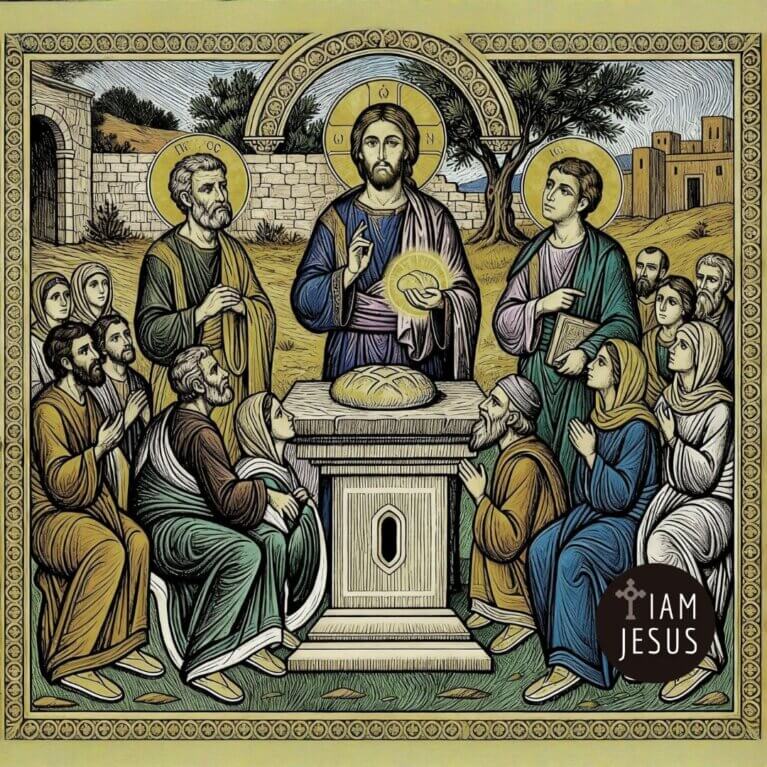
When Jesus declares ‘I Am the Bread of Life,’ He invites us into a profound mystery that sustains our spiritual existence. Just as our physical bodies require nourishment, our souls require the supernatural food of the Holy Eucharist. Explore the depths of John 6, discover the fullness of the seven ‘I Am’ statements, and learn how remaining on the True Vine transforms our daily walk with Christ.
The Eucharist is “the source and summit of the Christian life.”136 “The other sacraments, and indeed all ecclesiastical ministries and works of the apostolate, are bound up with the Eucharist and are oriented toward it. For in the blessed Eucharist is contained the whole spiritual good of the Church, namely Christ himself, our Pasch.” Catechism, 1324
Understanding the Hard Saying: Why John 6 is Literal
Many of our Protestant brothers and sisters read these passages and conclude that Jesus was speaking purely in symbols or metaphors, much like when He calls Himself a “door” or a “vine.” However, the historical and biblical context of John 6 shows us something entirely different.
When Jesus told the crowd they must eat His flesh, His listeners understood Him completely literally—and they were deeply scandalized. If Jesus had merely been using a metaphor for “believing in Him,” He would have corrected their misunderstanding to save them from walking away. In Jewish culture, the metaphor “to eat the flesh and drink the blood” of someone already had a specific symbolic meaning: it meant to bloody, persecute, or destroy an enemy (as seen in Psalm 27:2 and Isaiah 49:26). If Jesus was speaking metaphorically here, He would have accidentally been commanding His disciples to hate and destroy Him!
Instead of softening His words or explaining them away as a figure of speech, Jesus did the opposite. He switched from the standard Greek word for eating, phago, to the incredibly vivid word trogo—which translates literally to “gnawing” or “munching.” He allowed the crowds to leave Him over this “hard saying” because the truth of His Real Presence is absolute. To learn how to sit with this profound reality, discover our step-by-step guide on How to Pray during your time before the Blessed Sacrament.
The Bread of Life is the Source of Christian Life
Let’s Look at What Jesus Teaches in John 6: 51-59: “I am the living bread that came down from heaven; whoever eats this bread will live forever; and the bread that I will give is my flesh for the life of the world.”The Jews quarreled among themselves, saying, “How can this man give us [his] flesh to eat?”
Jesus said to them, “Amen, amen, I say to you, unless you eat the flesh of the Son of Man and drink his blood, you do not have life within you.
Whoever eats my flesh and drinks my blood has eternal life, and I will raise him on the last day. For my flesh is true food, and my blood is true drink. Whoever eats my flesh and drinks my blood remains in me and I in him. Just as the living Father sent me and I have life because of the Father, so also the one who feeds on me will have life because of me. This is the bread that came down from heaven. Unlike your ancestors who ate and still died, whoever eats this bread will live forever.”
This is the defining turning point of the Bread of Life discourse. Notice the dramatic shift in how Jesus speaks: He moves from inviting belief to demanding a physical eating and drinking of His Body and Blood. To the Jewish audience listening in the synagogue at Capernaum, drinking blood was strictly forbidden by Mosaic Law (Leviticus 17:14), making Christ’s declaration sound not just radical, but impossible.
Yet, Jesus offers no compromise. He uses the phrase “Amen, amen, I say to you”—a formal, solemn oath indicating that what follows is an unalterable divine truth. He establishes that the Eucharist is not a luxury or a mere symbolic reminder, but a supernatural necessity for salvation, explicitly stating: “unless you eat the flesh of the Son of Man and drink his blood, you do not have life within you.” He ties our future resurrection directly to the consumption of this True Food.
“The first announcement of the Eucharist divided the disciples, just as the announcement of the Passion scandalized them: ‘This is a hard saying; who can listen to it?’ The Eucharist and the Cross are stumbling blocks. It is the same mystery and it never ceases to be an occasion of division: ‘Will you also go away?'” Catechism, 1336
Jesus is the Bread of Life
Jesus is your living Bread, your Light, the only Gate to Heaven, your Guide in dark times, the very One who has the power to Resurrect you and give you Life. He is the only Truth you will ever know and be certain of in this life. And to have all this, you must stay on the Vine.
What is the Vine? It is the Sacramental life of the Christian through the ministry of God’s Church.
This is why when you try to be a Christian without the Eucharist, you have no life in you. You literally lack the Bread of Life that feeds you supernaturally and sustains you. Just having that longing, and seeking to come into full communion will give you grace. If you orient your entire life around the Bread of Life — the new manna from heaven (John 6:58) — Jesus will give you tremendous graces. It all begins with the Eucharist, and when be live a Sacramental life of grace in Jesus, we remain on the vine.
The Seven "I Am" Statements of Jesus
“What material food produces in our bodily life, Holy Communion wonderfully achieves in our spiritual life. Communion with the flesh of the risen Christ, a flesh ‘given life and giving life through the Holy Spirit,’ preserves, increases, and renews the life of grace received at Baptism.” Catechism, 1392
The number ‘seven’ in the Bible represents “fullness” or “completion” – so this means any time you see something said seven times or in seven ways you have to take notice. Jesus is saying that He and He alone completes you and fulfills you. In John’s Gospel, we see it all begins with the Eucharist (Bread of Life) and it is consummated through the Sacramental life of the Church (the True Vine).
This is why attempting to live a Christian life apart from the Eucharist leaves us spiritually starving. We simply lack the supernatural Bread of Life that sustains us. If you are currently carrying the weight of serious sin or find yourself away from full communion with the Lord, we encourage you to prepare your heart through a thorough examination of conscience and seek His mercy in the Sacrament of Reconciliation. Turning away from sinful habits opens the floodgates to tremendous sacramental grace, allowing us to remain firmly grafted onto the True Vine.
Want to learn more about what Catholics believe about Jesus the Bread of Life in the Eucharist? We invite you to join our prayer community and discuss this mystery with others in our Learning the Faith group.