

Saint Hildegard of Bingen's Book of the Rewards of Life:
A Complete Guide
If you’ve ever felt so anxious, so stuck, or so far from God that you didn’t know where to begin praying — you’re exactly who this is for. Nine hundred years ago, a Benedictine abbess named Hildegard of Bingen received a vision that mapped the interior life of every soul who has ever felt this way. She saw thirty-five battles between vice and virtue, and she saw, in every single one, that grace was already winning.
This is a free, 35-week prayer journey through her Book of the Rewards of Life — one Holy Hour a week, walking with a saint who understood exactly what you’re carrying.
Table of Contents
Everything you need for your 35-week long journey lives on this one page. Use the links below to jump to any section or link. You may want to bookmark this page in your browser and return to it weekly.
St. Hildegard reveals that the interior life is a dynamic landscape where 35 specific vices and virtues debate for ownership of your heart. She shows us that sin isn’t just a failure of rules; it is a heavy, suffocating fog that blinds us, breeds intense anxiety, and strips away our peace.
If your heart desires this healing, and you have the willingness to show up, that is all Jesus needs. Let us explore the magnificent framework of her books so you can step onto this personal battlefield with a firm understanding of the cosmic landscape ahead.
What this Book is Really About
St. Hildegard teaches us that growing closer to God isn’t a random thing—it is like building a sturdy home for your soul. In her visions, she sees virtues as living stones that we place on top of each other to build a protective fortress around our hearts, keeping out the confusion, sin, and shame that trap us.
If we try to find deep peace in prayer while still holding onto secret selfishness or a hard heart, our spiritual house will quickly fall apart. St. Hildegard teaches us how to surrender our hearts and wills to God. She shows us how offering our lives to God actually gives us true freedom. When we discover our true purpose in this life, a purpose that only comes through the grace of God, we finally experience true Heavenly Joy.
St. Hildegard teaches us in her writings that the virtues are like living stones, stacked intentionally upon one another to build a solid fortress that affects our interior lives as well as the world in which we live. Viriditas feeds our bodies and souls with the living light of the Holy Spirit and this sparks growth, fertility, and renewal in our bodies, minds, souls, and spirits.
Most importantly, St. Hildegard shows us how viriditas in our interior lives will lead us to make profound positive changes in the communities where we live. Our inner transformation in the life of virtue leads us to build the Celestial City of God with other souls full of viriditas. This happens when we are filled with the greenness of God’s life-force energy; As virtuous people of God, we naturally develop harmony with other Christians because we are attuned to the will of God.
Are You Ready for an Interior Life full of Viriditas?
You don’t have to fix your entire life overnight; you only need to commit to one Holy Hour each week, letting Jesus meet you in your weakness and transform your heart one virtue at a time. We also encourage you to pray daily for these virtues using our unique Litany of Virtues prayer inspired by St. Hildegard and composed specifically for this St. Hildegard Virtues series.
Who Was Saint Hildegard of Bingen?
She was a 12th-century German Benedictine abbess, mystic, composer, healer, and Doctor of the
Church — one of the most extraordinary figures in the entire history of Catholic Christianity. Born in 1098, St. Hildegard entered a Benedictine monastery as a child of about eight years old and lived under its Rule until her death at eighty-one. She received her first major vision at around age forty-two and spent the rest of her life writing, preaching, composing, healing, and corresponding with popes, emperors, and ordinary people who sought her counsel. Pope Benedict XVI declared her a Doctor of the Church in 2012 — one of only four women ever to receive that title.
But what made St. Hildegard remarkable wasn’t only her visions. It was the extraordinary depth of her interior life — formed over decades of Benedictine prayer, silence, and scripture — that gave her visions their theological precision and their pastoral power. She didn’t just see extraordinary things. She understood what she saw, and she was given the words to share it.
St. Hildegard writes as a bride of Christ who has loved her Bridegroom for a lifetime—her devotion is no less ardent than the intimate, tender mysticism of saints like Gertrude the Great, but it has expanded outward to encompass all of creation and every soul within it. Where other mystics linger in the sweetness of the bridal chamber, St. Hildegard maps the entire Kingdom her Beloved governs—and invites you to find your place within it.
What Is the Liber Vitae Meritorum?
The Latin title Liber Vitae Meritorum — is translated into English as The Book of the Rewards of Life. This book is her sustained, systematic vision of the interior moral life of the human soul.
In this book, St. Hildegard receives a series of visions in which she sees a great man — identified in the book’s final section as God depicted in human form — looking out across the world in different directions. Around him, in the landscape of her vision, she sees thirty-five pairs of personified figures: thirty-five vices and their opposing virtues, each one speaking in turn. The vices speak first, justifying themselves in vivid and often disturbingly recognizable language. The virtues answer, exposing the vice’s self-deception and naming what true virtue actually looks and feels like.
What makes this book so extraordinary — and so relevant for us today — is that the vices don’t present themselves as obviously evil. They argue. They sound reasonable. They use the language of nature, of freedom, of self-care, of simply enjoying life. St. Hildegard shows us what self-deception actually looks like from the inside: not a monster but a mirror, reflecting our own most comfortable rationalizations back at us, and asking whether they hold up in the light of God’s truth.
Why Meditate on This Book Today?
The Book of the Rewards of Life was written over eight hundred years ago, in Latin, by a German nun who had never seen a smartphone, a streaming service, or a social media feed. And yet if you read the vices’ speeches carefully, you will find yourself recognizing the arguments. Worldly Love sounds like every voice that has ever told you that what you want is simply what you deserve.
Falseness sounds like every public conversation that has learned to dress dishonesty in the clothes of nuance. Destruction of Souls sounds like the place a soul arrives when it has told itself for long enough that there is no point in trying anymore.
St. Hildegard was not writing for academics. She was writing for the living faithful — for people who are trying to be good, who go to Mass and pray and still find themselves struggling with the same patterns year after year. Her book is not a list of sins to avoid. It is a portrait of what the soul looks like when it is being slowly drained of the grace of God — and a portrait of what it looks like when that grace is genuinely present and working. She gives us eyes to see the difference.
What’s in the Book?
Six Parts and Thirty-Five Pairs
The Book of the Rewards of Life is organized in six parts, the first five parts each contain a chain of of vices and their opposing virtues. These pairs are not random groupings — they take us on a journey from a lack of love for God and a self-centered mindset to loving surrender to God. She walks us on a path of re-orientation of our hearts to God. And once we trust God and are able to surrender our will to him, the Holy Spirit becomes very active in our lives and our relationships with others. Eventually she shows us how to find our eternal purpose in life through this virtue journey to the Celestial City.
Think of Parts 1–5 as St. Hildegard showing us every way the human heart can go wrong. Then in Part 6 she shows us how our world will dramatically change when we are full of the virtues and in union with God’s will for our lives.
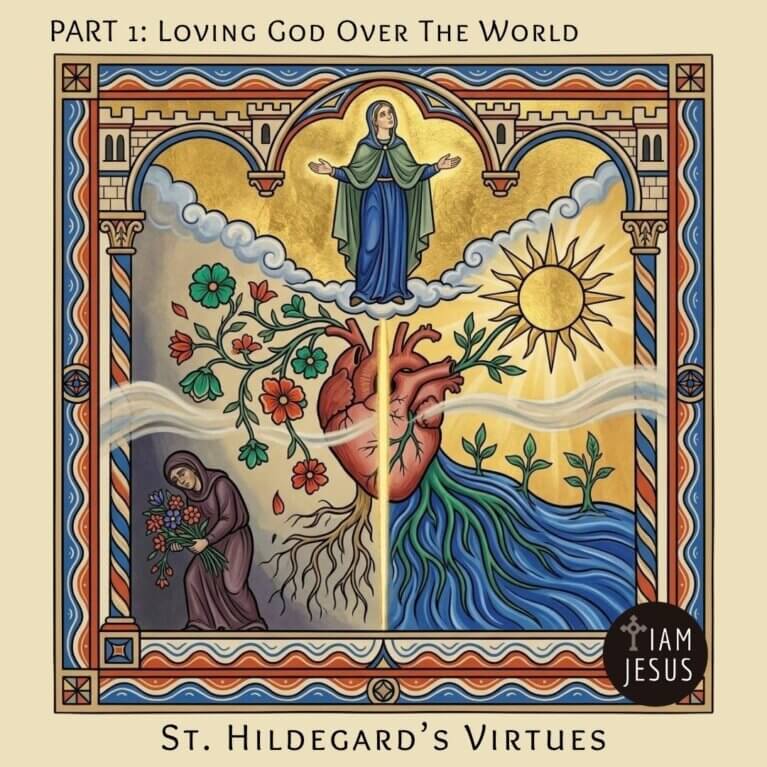
Part 1
Loving God Over the World
Where Your Heart Is, There is Your Life.
Every soul is built to love. The question St. Hildegard asks in Part 1 is not whether you love, you do, deeply and constantly, but where that love is aimed. In these 7 meditations, St. Hildegard shows us what a heart aimed at God actually looks like from the inside and what happens when it wanders.
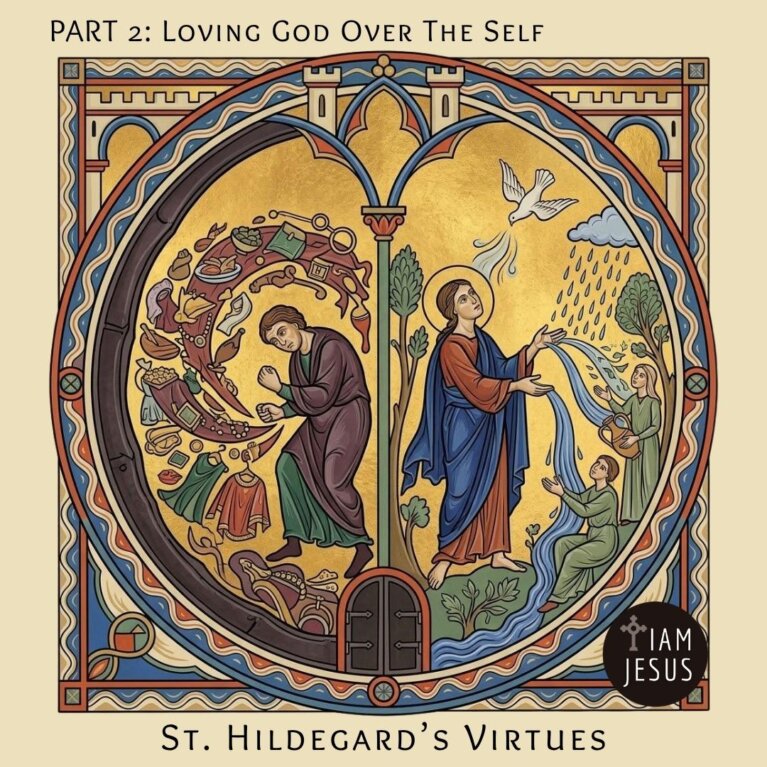
Part 2
Loving God Over the Self
Making Room for Something Greater.
There is a love more fundamental than love of the world and St. Hildegard names it in Part 2: the disordered love of self that quietly becomes the center of everything. In these 8 meditations we learn to put God and the needs of our neighbors first, and discover something much bigger.
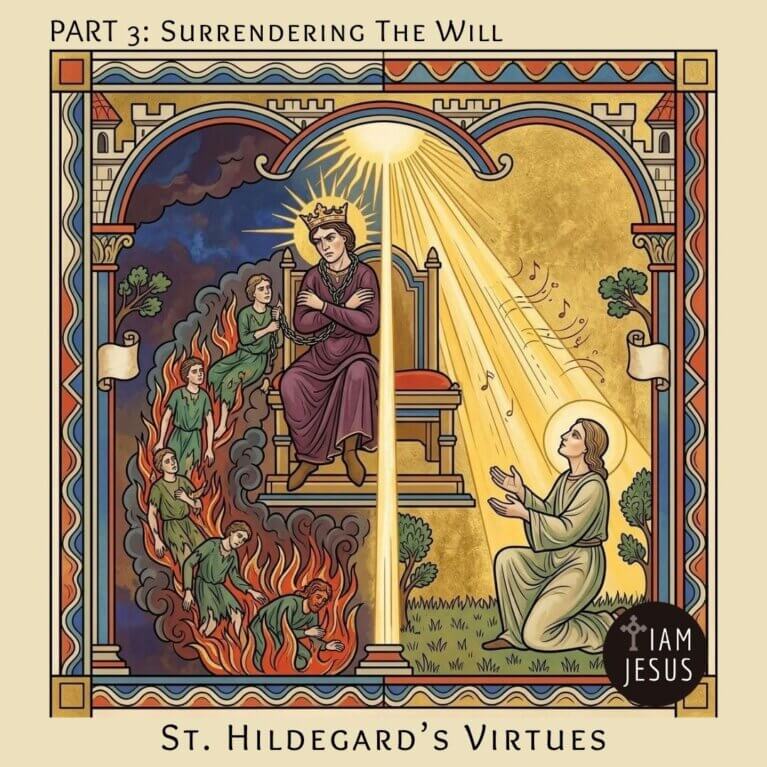
Part 3
Surrendering the Will to God
The Freedom That Comes from Letting Go
In Part 3, St. Hildegard shows us how failing to surrender our will to God begins with Pride and ultimately ends with Luxury surrendering to all kinds of sensual desires. In these seven meditations we discover that by surrendering our will we gain tremendous freedom and are filled with light.
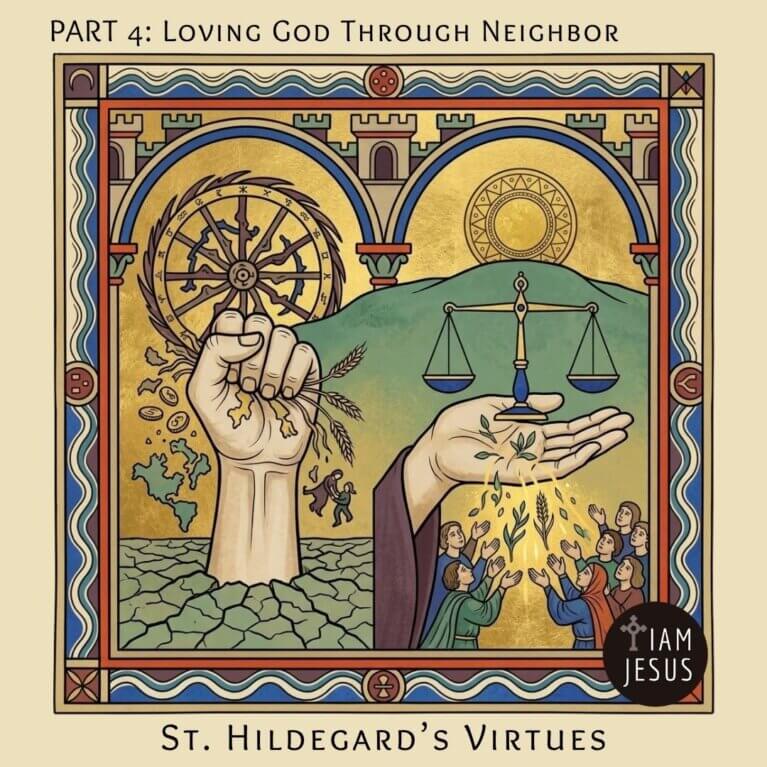
Part 4
Loving God Through Our Neighbor
The Soul that Gives What It Has Been Given.
Everything we have is entrusted to us. Our gifts, our time, our resources, our relationships, our positions are given to us for a purpose and in Part 4 we contemplate 8 virtues that help us remember how to be of service to something greater than our own desires.
Part 5
Living with
an Eternal Purpose
The Soul that Knows Why it is Here.
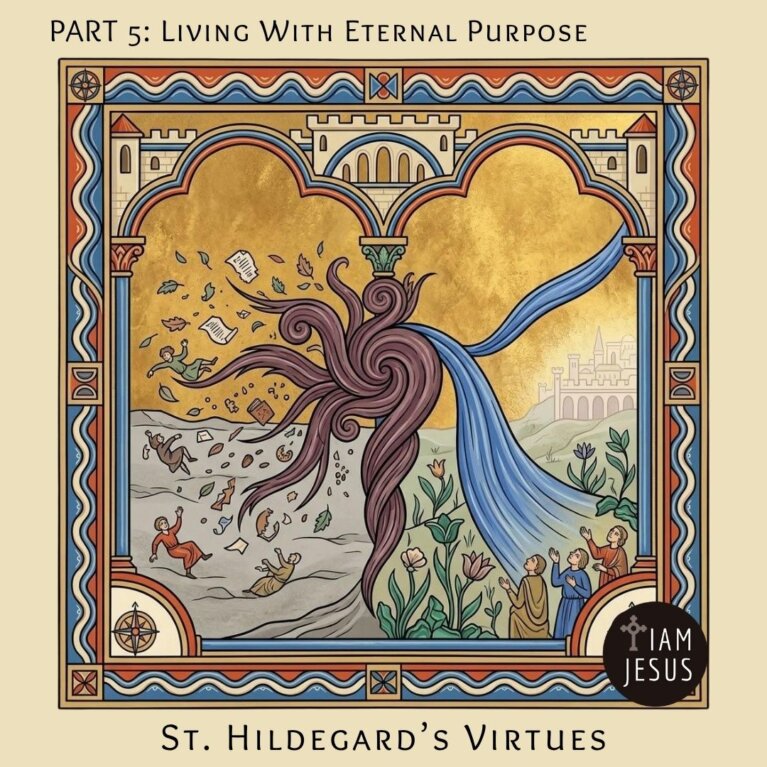
The deepest question we can ask is, "What is the point of my existence?" In Part 5 St. Hildegard shows us through 5 meditations, what it is like when a soul and a community is oriented toward its true end, and it discovers its true purpose in life: that it was made for God.
Part 6
The Vision of Heaven: God's Intention
The Soul Enters into Harmony with God.
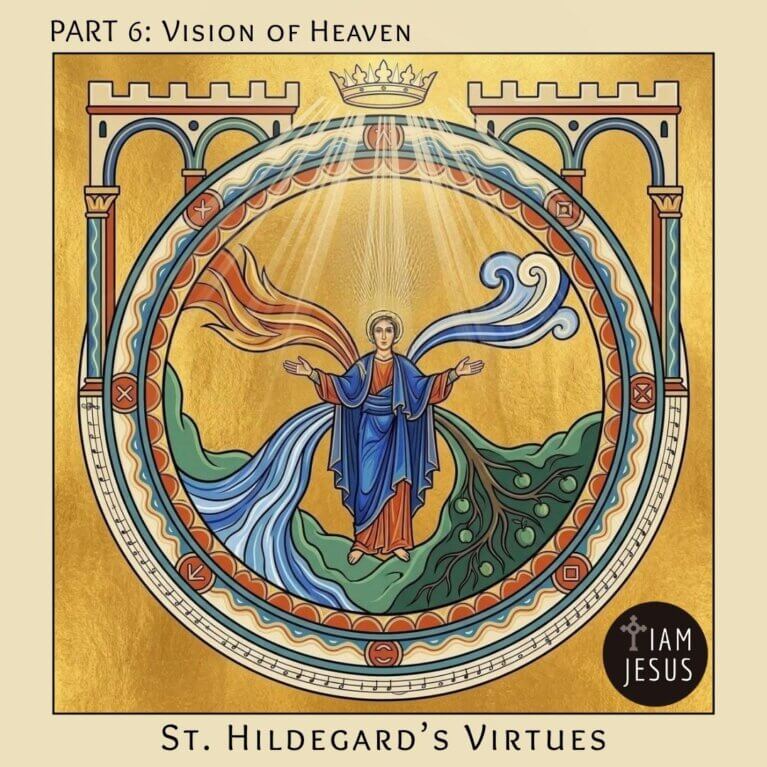
After contemplating how a drifting heart, self-absorption, rebelliousness, poor stewardship & a lack of purpose harm us, we finally come to understand in Part 6 that when we are enflamed with holy love, the 4 elements of creation will work as God designed them.
Uncovering Counterfeit Virtue
St. Hildegard isn’t warning you about obvious sin. She’s warning you about something quieter: the soul’s own ability to mistake its patterns of sin for growth—to believe it’s flourishing when it’s actually drying up.
Throughout the book, she uses fire, air, water, and earth as a kind of spiritual diagnostic. Every vice shows one of these elements corrupted or missing. Every virtue restores exactly what was stolen. The question underneath every single week is the one she was trained from childhood to ask:
Is the greenness I feel real growth from the Spirit—or a dry root wearing the colors of spring?
Go Deeper
Want the fuller story? Check out these additional resources on St. Hildegard of Bingen:
St. Hildegard's Visionary Art
The miraculous survival of her illuminated visions, saved from the ashes of WWII.
The Theology Behind the Book
How St. Augustine's City of God influenced St. Hildegard's Celestial City of God
Sources and Permissions
Our translations, our artwork, and further reading about this Series.