

Stepping into a regular rhythm of prayer can feel overwhelming if you are just starting out. You might wonder: What do I say? How long should I stay? Am I doing this right?
The truth is, prayer is simply a conversation of love, and it doesn’t require a complex formula. To help simplify your spiritual journey, this guide breaks prayer down into four essential types—easily remembered by the acronym ACTS—and three traditional methods of prayer. Whether you are visiting an Adoration chapel for the first time or looking to enrich your daily devotions, let’s explore these beautiful pathways to growing closer to Jesus.
For beginners, it can seem overwhelming when trying to learn about prayers and ways to pray. There are four types of prayers and each has a specific purpose in our worship of God. There are many methods of prayer, but I am going to focus on three main methods of prayer in this post. I’m hoping to simplify prayer and break things down for visitors who are new to prayer. If you want to learn about prayers and ways to pray to grow in your relationship with Jesus, let’s begin.
If you have never been taught the four types of prayers that Christians pray, let’s begin with a short list and brief description.
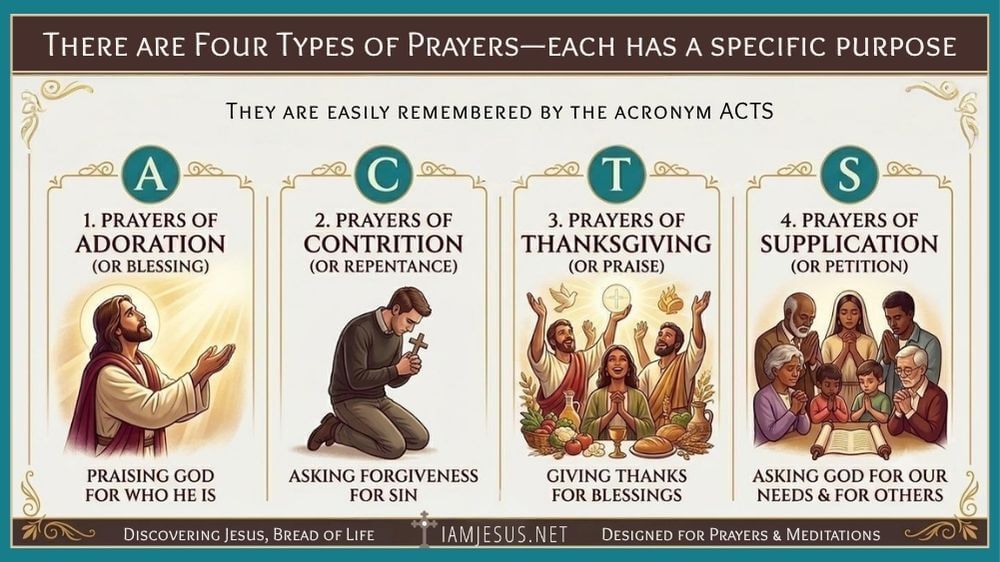
The 4 Main Types of Prayer: Understanding the ACTS Framework
- Prayers of Adoration (or blessing),
- Prayers of Contrition (or confession/ repentance),
- Prayers of Thanksgiving (or praise),
- Prayers of Supplication (or petition).
A simple way to remember them is with the acronym “ACTS“. Most adorers who spend generous time in adoration with Jesus in the Blessed Sacrament will spend time with each of these four types of prayer at every visit. Beginners who are trying to learn about prayers will often be fatigued by the idea of spending a whole hour with Jesus and may easily give up.
As you learn about prayers and ways to pray, don’t be overwhelmed by having to spend an hour working on some kind of plan of action, or formula, to receive grace from the Lord. Remember, after we learn ways to pray the four types of prayer we go into the three methods. I promise you, when you begin to pray these types of prayers using the three methods, this way of prayer is most humble and beautiful. The Lord cherishes humility in prayer, and meek humble hearts. He will come to you, and you will be taken places by Him during your holy hours; it will be beautiful, and soon an hour will go by so fast and it will not be enough time.
So, if you are still with me, let’s learn about prayers and ways to pray!
The 1st Type of Prayer: Prayers of Adoration (Loving God For Who He Is)
When we learn about prayers and ways to pray, the first of four types of prayers are prayers of adoration. These are prayers of blessing and love for God.
When we make prayers of adoration we are fulfilling the First Commandment. Your time in prayer should always begin with adoration. Always.
I am the LORD your God, who brought you out of the land of Egypt, out of the house of slavery. You shall not have other gods beside me. You shall not make for yourself an idol or a likeness of anything in the heavens above or on the earth below or in the waters beneath the earth; you shall not bow down before them or serve them. For I, the LORD, your God, am a jealous God, inflicting punishment for their ancestors’ wickedness on the children of those who hate me, down to the third and fourth generation; but showing love down to the thousandth generation of those who love me and keep my commandments. You shall not invoke the name of the LORD, your God, in vain. For the LORD will not leave unpunished anyone who invokes his name in vain. Remember the sabbath day—keep it holy. Exodus 20:2-8
How do we Adore God?
We make prayers of adoration out of love for God, and our acts of love and worship toward Him rightfully put Him above everything else in our lives. In this way, the prayer of adoration is a rightly ordered prayer of love for God. Beginners who are learning ways to pray and who haven’t yet developed proper love for God, may think this seems ‘counterintuitive’. But they couldn’t be more wrong. You have to adore God because prayers of love toward God bring you toward actually loving Him. Think about it this way, you either love God or you love yourself. A person new to prayer often makes the newbie mistake of making his prayer all about himself. He lacks the proper perspective of God being the center of the spiritual life. He lacks humility and gratitude toward God.
We can pray this type of prayer, the prayer of adoration, throughout the day, amidst our activities and the work that we are required to do. We can also pray this type of prayer in Eucharistic adoration and during the sacrament of holy Communion at Mass. So get into the habit! I will show you simple and easy ways you can begin to orient your life around adoring God.
Let’s start right now!
How do we make a prayer of adoration?
A prayer of adoration is simply an “I love you” to God; a short prayer of adoration is called an ejaculatory prayer. Just in the same way that you tell your loved ones in your life that you love them, you can tell God you love Him too. It can be a simple spontaneous sigh of wonder and awe at the beautiful sunset, and all of a sudden you ponder the God who made the sun, and arranged the clouds. Then you find yourself saying, “Lord, I love You.” Or maybe you prayed about something and then encountered a ‘god-incidence’ that affirmed you are on the right track. Your heart wells up with gratitude and awe and you find yourself saying, “I love You, Jesus!”
Prayers of adoration are generally tied to a sense of gratitude toward God and an appreciation for all He has done, but this is part of the prayers of thanksgiving, as I will later get to. Just understand that prayers of adoration are simply prayers of the heart. It is the feeling of love you have, not because of what you received from God, or what He has done for you. You love Him because of who He is.
Where do we get the Ability to Love From?
There are many spiritual gifts, and as the Apostle Paul teaches us in 1 Corinthians 13, the greatest of all of them is the ability to love. But you don’t just wake up one day able to love God like a saint. You’ve got to work at it. It’s a grace to love God, and the Bible tells us that without the Holy Spirit, we are completely incapable of this necessary virtue.
We understand this because in 1 John 4, the Apostle John spends a great deal of time explaining the nuances of how we are able to love:
He says in 1 John 4:12-13 :
“No one has ever seen God. Yet, if we love one another, God remains in us, and his love is brought to perfection in us. This is how we know that we remain in him and he in us, that he has given us of his Spirit.”
So the ability to love God comes from His Spirit, and if you do not have His Spirit in you, then you are incapable of being able to adore Him with a pure heart. This is precisely why we instruct our visitors to begin with prayers to God asking for the grace needed when we meditate. It is by the mercy of God we are equipped to love, so we must humbly request this grace every time we enter into His presence. And this is also why the second type of prayer, the prayers of contrition, are important to the spiritual life of the Christian. Without contrition there is no access to His Spirit. This is because when we lack humility over our sins we actually can’t recognize them. I’ll get to that more later. Let’s talk next about the meaning of prayers of adoration.
What is the Definition of Adoration?
Adoration is loving God for His sake, and not because He has given you things, answered your prayers in the way you desired, or blessed you in any way. Adoration is pure love because He is God, and that’s that. If you come to God with a ‘name it and claim it’ attitude in prayer you are only projecting your wants and desires for yourself on God, and not actually loving Him. God wants our unadulterated love, for our sake, not because He needs us to love Him but because if we don’t we destroy ourselves and cut ourselves off from His grace.
So to truly adore God you have to ask Him for the gift of love. And because He is so great a God and so generous with His gifts, He will infuse your heart with holy love through His Spirit. And because He is a generous and kind God, He will fill your heart abundantly with holy love. And this love will grow over time as you nurture your relationship with God and grow in virtue. Loving God is a process and as you develop your prayer habits day to day, through the ups and downs of life, He becomes the foundation of your life. You’ll see. I promise you.
The 2nd Type of Prayer: Prayers of Contrition (Seeking Forgiveness and Repentance)
When we learn about prayers and ways to pray, the second of four types of prayers are prayers of contrition. These are prayers of sorrow for the wrong we have done and the evil in our hearts.
Many sins wrong our neighbor. One must do what is possible in order to repair the harm (e.g., return stolen goods, restore the reputation of someone slandered, pay compensation for injuries). Simple justice requires as much. But sin also injures and weakens the sinner himself, as well as his relationships with God and neighbor. Absolution takes away sin, but it does not remedy all the disorders sin has caused. Raised up from sin, the sinner must still recover his full spiritual health by doing something more to make amends for the sin: he must “make satisfaction for” or “expiate” his sins. This satisfaction is also called “penance.” Catechism, 1459
How do we Confess our Sins to God?
After spending time contemplating the love of God and His majesty, we humbly acknowledge our sinfulness and unworthiness to be in His presence. We also acknowledge the great sacrifice Jesus made to atone for our sins and to open up heaven to us.
The crucifixion, death and resurrection allow God the Father to see the sacrifice of the Son when He gazes at us. This is what is meant by being ‘covered in the Precious Blood of Jesus‘ (to understand all this read Leviticus chapters 16 and 17).
Jesus becomes our scapegoat as explained in Leviticus. He is our Priest in the Order of Melchizedek that was prophesied from the time of David (Psalm 110:4). We ought to acknowledge what He has done for us, and continues to do at every Mass said throughout the world every day. He atones for our daily sins and reconciles us to the Father. So prayers of contrition take all this into account and give us a great feeling of sorrow for having ever offended so Good a God who is perfect in every way and undeserving of being tortured and crucified for my sins.
How do we Make a Prayer of Contrition?
Contrition is important because it helps us desire to be better people. When we spend time examining our conscience and seeing ourselves through the light of Christ’s teachings, we grow in the virtues of humility and gratitude. Coupled with adoration, prayers of contrition help us to grow great appreciation for the gift of salvation and a fear of offending God any more.
The greatest saints in the history of the Church spent time at the end of every day in self-reflection. They reflected and prayed over the things they had done or failed to do and whether their actions pleased God or offended Him. The goal of every aspiring saint is to always do only the will of God in every moment of every day. This is a tall order, and because it is impossible without the help of God, we have the sacrament of Reconciliation and the ability to atone for our venial sins at every Mass.
Where do we get the Ability to Repent From?
Try to look at it this way – we are all called to be saints, and just as in any profession we undertake, to advance we need to become more skilled at our craft. For the Christian, advancement requires repentance and reflection because for us perfection relies on the growth of virtue, and the end goal, as Jesus taught, is becoming perfect like our Father in heaven (Matthew 5:48), who by nature is perfect virtue. On our own we can never achieve this. But with the grace of God and a pure heart, anything becomes possible with God.
What is the Definition of Contrition?
Contrition is sorrow for sins, the humility to confess them, and the act of repairing the damage the evil act has done to God and neighbor, as much as one is able, for the sake of justice. The most important way we show humility in the act of contrition is through frequent use of the sacrament of confession (reconciliation) and our prayers before receiving holy Communion in the Mass. The Catechism teaches us that all members of the Church are obligated to make a formal confession to a priest at least once a year, but this is the absolute minimum. We are all called to ask forgiveness for our venial sins before receiving Communion at every Mass.
Many practicing Catholics will make a formal confession monthly. We confess our sins publicly to increase in us the virtue of humility and to break the bonds of evil in our lives. When we commit sins against our neighbor the sins are public. But there are also sins we hold in secret that no one but God alone knows about. Jesus refers to these as sins of the heart. So we go to confession to break the bonds of sin that the evil one has over us, and to renew our faith and trust in God to deliver us from our sinfulness and grant us the grace to grow in virtue and become perfect as our Father in heaven.
In short, true contrition involves a firm resolution to stop the sin, a promise to work on yourself as you battle your sinful nature and concupiscence, and the humility to seek forgiveness and to rectify the wrong you have committed against both God and your neighbor.
The 3rd Type of Prayer: Prayers of Thanksgiving (Cultivating a Grateful Heart)
When we learn about prayers and ways to pray, the third of four types of prayers are prayers of thanksgiving. These are prayers of gratitude to God for all the blessings He has given us. This type of prayer is made possible when we have rightly ordered our lives around loving God and our neighbor. If you do not right now have a grateful nature, do not worry. Gratitude is a virtue and it will naturally grow in you as you grow in your walk with Christ. I promise you.
“Put on then, as God’s chosen ones, holy and beloved, heartfelt compassion, kindness, humility, gentleness, and patience, bearing with one another and forgiving one another, if one has a grievance against another; as the Lord has forgiven you, so must you also do. And over all these put on love, that is, the bond of perfection. And let the peace of Christ control your hearts, the peace into which you were also called in one body. And be thankful. Let the word of Christ dwell in you richly, as in all wisdom you teach and admonish one another, singing psalms, hymns, and spiritual songs with gratitude in your hearts to God.” Colossians 3:12-16
How do we Thank God?
The best way we can thank God for all He has done for us is by worshipping Him in the Mass. You may be unaware of it, but the word Eucharist, which represents the glorified Body, Blood, Soul, and Divinity of Christ, literally means “Thanksgiving”.
How do we Pray a Prayer of Thanksgiving?
We can make a prayer of thanksgiving in many simple ways and with many prayers from our own heart as well as prayers we recite. But the perfect prayer of thanksgiving is our participation in the Mass. It is in the Mass where we profess our love for Christ’s sacrifice on the Cross and where we come to worship God by entering into covenant with Him through giving our own bodies as temples of the Holy Spirit and sacrifice ourselves in return for so great a gift.
We understand the significance of the Mass in Revelation 19:9. And the angel said to me, “Write this: Blessed are those who are invited to the marriage supper of the Lamb.” And he said to me, “These are the true words of God.”
We make a prayer of thanksgiving to God by coming to His marriage supper and entering into covenant with Him and receiving Him in the Eucharist with great love in our hearts and gratitude.
Where do we get the Ability to be Thankful?
Our gratitude to God and for the blessings we receive comes as a gift from God. It is a virtue that we must cooperate with so that we can grow in gratefulness for all we have been given without merit. Our ability to recognize the gift of Christ in the Eucharist comes through the Holy Spirit.
What is the Meaning of a Thanksgiving Prayer?
The 4th Type of Prayer: Prayers of Supplication (How to Petition God with Humility)
When we learn about prayers and ways to pray, the last type of prayer is prayers of supplication. These are prayers of petition to God for His help. This type of prayer is the one that most people start with. I myself have been guilty many times in starting a prayer with a petition. But a proper prayer of supplication is only made possible when we have rightly ordered our lives around loving God and our neighbor and have a heart of gratitude and obedience to the divine will. If you do not right now have these virtues, do not worry. I will help you see ways in which you can pray petitions that are pleasing to God based on what we have already learned today and what the Catechism teaches.
Let’s look at the Catechism:
The first movement of the prayer of petition is asking forgiveness, like the tax collector in the parable: “God, be merciful to me a sinner!” It is a prerequisite for righteous and pure prayer. A trusting humility brings us back into the light of communion between the Father and his Son Jesus Christ and with one another, so that “we receive from him whatever we ask.”
Asking forgiveness is the prerequisite for both the Eucharistic liturgy and personal prayer. Christian petition is centered on the desire and search for the Kingdom to come, in keeping with the teaching of Christ.
There is a hierarchy in these petitions: we pray first for the Kingdom, then for what is necessary to welcome it and cooperate with its coming. This collaboration with the mission of Christ and the Holy Spirit, which is now that of the Church, is the object of the prayer of the apostolic community. It is the prayer of Paul, the apostle par excellence, which reveals to us how the divine solicitude for all the churches ought to inspire Christian prayer. By prayer every baptized person works for the coming of the Kingdom.” Catechism, 2631, 2631
How do we Petition God?
When our lives are rightly ordered to love God and our neighbor and we are in a state of grace with the inspiration of the Holy Spirit to guide us, we are given, intuitively, the ability to know how to petition God. We understand that every need we encounter, either in ourselves or those we love, becomes an object of petition to God. When we make petitions that are pleasing to God and in union with divine will, Jesus is glorified by what we ask the Father in His name. We petition God in a pleasing way in so far as we are able to love Him, obey Him, and humble ourselves before Him and ask through the inspiration of the Holy Spirit as our guide. This is the rightly ordered prayer of petition.
How do we Make a Prayer of Petition?
We begin by recognizing our nothingness and that we are made by God and will return to God one day. We make a prayer of petition by asking, beseeching, pleading, invoking, and even crying out to God. Sometimes our petition requires us to struggle in prayer. Our prayers of petition should recognize that we are not able to master the situation before us without God’s help, and that without His divine providence we cannot make a good decision. Our prayers of petition do not tell God how to fix our problems. Rather, our petitions surrender our needs to Him in perfect hope and trust that His love for us is so great that He will take care of all our needs (Philippians 4:19).
Where do we get the Ability to know what to Petition?
The Catechism teaches “The New Testament contains scarcely any prayers of lamentation, so frequent in the Old Testament. In the risen Christ the Church’s petition is buoyed by hope, even if we still wait in a state of expectation and must be converted anew every day. Christian petition, what St. Paul calls “groaning,” arises from another depth, that of creation “in labor pains” and that of ourselves “as we wait for the redemption of our bodies. For in this hope we were saved.” In the end, however, “with sighs too deep for words” the Holy Spirit “helps us in our weakness; for we do not know how to pray as we ought, but the Spirit himself intercedes for us with sighs too deep for words” (CCC 2630).
What is the Definition of Supplication?
Exploring the 3 Traditional Methods of Christian Prayer
When we learn about prayers and ways to pray, there are also three methods of prayer for which we can pray the four types of prayers. These methods are: vocal prayers, meditative prayers, and contemplative prayers. The most efficacious and deeply meaningful prayer methods to learn are meditative and contemplative.
Vocal Prayer: Connecting Body and Soul
The I Am Jesus website is full of vocal prayers. These are prayers that can be recited either publicly or privately by the faithful. Many are devotional prayers and some are liturgical prayers, or prayers of the Mass. Jesus taught us the “Our Father” prayer, which is an example of a liturgical vocal prayer recited in every Mass. The Church also has vocal prayers in the Liturgy of the Hours. Vocal prayers need to be prayed with the right disposition of your heart. If you find yourself with a wandering mind while praying you need to stop yourself and recollect your mind and redirect your heart. Prayers that are recited mindlessly are vain repetitions and not a sweet offering to God.
The Catechism teaches that “Vocal prayer, founded on the union of body and soul in human nature, associates the body with the interior prayer of the heart, following Christ’s example of praying to his Father and teaching the Our Father to his disciples” Catechism, 2722
Meditative Prayer: Engaging the Heart and Imagination
Meditative prayers are prayers that connect the heart to God through the imagination. Scripture study is a form of meditative prayer, as is prayerful contemplation of the spiritual writings of the saints. Mental prayer is a form of meditative prayer, and it moves the heart toward God by drawing the soul toward an intimate relationship with the Lord through the imagination. It moves the soul to love God and understand Him through the workings of the Holy Spirit while in prayer. Learn more on our page dedicated to Lectio Divina. You can also subscribe to our Big List of Virtue Meditations and our Lenten Reflections (Year A, Year B, and Year C).
The Catechism teaches that “Meditation is a prayerful quest engaging thought, imagination, emotion, and desire. Its goal is to make our own in faith the subject considered, by confronting it with the reality of our own life” Catechism, 2723.
Contemplative Prayer: A Silent Gaze of Love
The contemplative prayer is a prayer of great mystery and it is one that the soul is invited to rather than one that the soul arrives at through his own effort. This prayer is a gaze at God, and an intense time of heightened awareness of the physical presence of the Beloved. At least this has been my experience with it. It comes as a gift from the Lord through the Holy Spirit and the duration as well as the form comes from God as an unexpected moment.
For me, contemplative prayer is a silent prayer of deep penetrating love. It can put the fire of the Holy Spirit in my heart, where my heart might begin to feel burning love and become enflamed. It may come as a vision, or in a word. The Lord may invite the soul to grieve with His Sacred Heart over souls in sin. In moments of contemplative prayer Jesus can teach a truth in silence that would never be understood in a lifetime. It is the most intimate, beautiful, and cherished experience a soul could ever be invited to, that of union with the Divine Heart in contemplative prayer.
The Catechism teaches that “Contemplative prayer is the simple expression of the mystery of prayer. It is a gaze of faith fixed on Jesus, an attentiveness to the Word of God, a silent love. It achieves real union with the prayer of Christ to the extent that it makes us share in his mystery” Catechism, 2724.
It is my desire to help you grow in holiness and develop an intimate relationship with Jesus in the Eucharist. I hope that this post is helpful to beginners and offers some new insights for those with more experience in prayer. I hope I helped you learn about prayers and ways to pray. If I have explained something in an unclear or inaccurate way, please let me know so I can update this post.
May God bless you abundantly.
Ready to Deepen Your Prayer Life?

One Response
very very beautiful site with lots to learn and grow. very touching prayers. God bless you all.No words to say