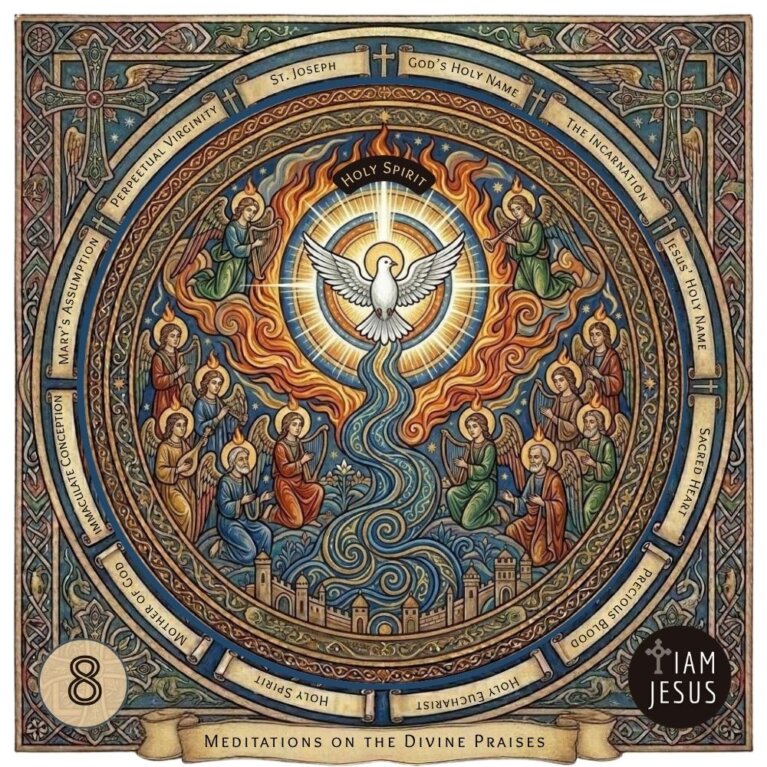
Welcome to our 8th Divine Praises meditation. If you are new to this series, scroll down to the bottom of this page for links to all our other meditations. Today we contemplate “Blessed be the Holy Spirit” who Guides and Consoles us in every moment of every day. If we listen we will hear Him speak in our conscience. He will convict our hearts, inspire us toward charity and mercy, and help us gain wisdom as we pray and learn our faith. The Holy Spirit is the third person of the Trinity, the Spirit of Promise, who is also known as our Paraclete and Advocate.
The word Paraclete comes from the Greek word paráklētos (παράκλητος), and it has a wide range of meanings. It describes an advocate who is called alongside someone to counsel them. He is a friend who offers help in times of trouble, an Advocate to those in need of advice, and a truth bearer that offers wisdom. The word “paraclete” was used in the first century to describe a defense attorney in court. When you think about who the Holy Spirit is to you, consider He is all of the above.
When we bless the Holy Spirit we are offering our gratitude for his loving presence. He is our Counselor who is called alongside us in this life. In this way, our blessing is a form of gratitude offered to the Holy Spirit for his constant presence as a personal Advocate and guide. When we offer prayers of blessing and gratitude, we aren’t asking the Holy Spirit for favors. Instead we are just worshiping him for who He is, and it is our duty to offer Him blessing and gratitude because of who He is and the wonderful way He consoles and guides us every day toward the fullness of Truth.
And the Catechism also teaches us that when we listen to the inspirations of the Holy Spirit we will grow in virtue and holiness.
“The moral life of Christians is sustained by the gifts of the Holy Spirit. These are permanent dispositions which make man docile in following the promptings of the Holy Spirit.
They belong in their fullness to Christ, Son of David. They complete and perfect the virtues of those who receive them. They make the faithful docile in readily obeying divine inspirations. Let your good spirit lead me on a level path.
“For all who are led by the Spirit of God are sons of God . . . If children, then heirs, heirs of God and fellow heirs with Christ.”
Romans 8:14,17.
The Descent of the Holy Spirit
Every year we celebrate Pentecost Sunday, which commemorates the birth of the Church fifty days after the Resurrection of Christ. At the first Pentecost, Jesus’ disciples were waiting together in a house in Jerusalem for the Holy Spirit that Jesus had promised would come. Symbolized by a dove, the Holy Spirit “comes down and remains in the purified hearts of the baptized” in the same way the dove returned to Noah after the flood holding an olive branch, symbolizing that the earth was once again habitable [CCC 701]. The Holy Spirit rests upon us and fills us with Himself. He descends on us like a dove, and moves through our hearts like fire.
In Acts 2, St. Luke explains to us how the Holy Spirit first came to dwell in His people. The disciples had been waiting and praying for nine days. Suddenly, they heard a sound like a roaring, rushing wind fill the room where they were. Then tiny flames of fire appeared and rested on top of everyone’s head, symbolizing the transforming energy of the Holy Spirit’s actions. The moment the Holy Spirit came He filled the disciples and this caused a tremendous miracle to happen. The disciples were given the ability to start speaking in all kinds of different languages they had never learned before.
Outside, visitors from all over the world heard this noise and rushed over. They were shocked because they could hear the disciples talking about God’s greatness in each of their own native languages! Some people were amazed, but others laughed and joked that the followers were just drunk.
Peter stood up in front of the huge crowd to explain the truth, and because he was filled with the Holy Spirit, he preached the truth boldly and with authority. Peter proclaimed that God was bringing His ancient promises to life, reminding the crowd that Jesus did amazing miracles, died on a cross, and rose from the dead. Peter declared that Jesus is the true Lord and King.
The people were so moved by Peter’s testimony that they asked Peter, “What should we do?”
Peter answered, “Turn away from your sins and be baptized in the name of Jesus.”
That very day, about 3,000 people were baptized. [To read the entire story, visit Acts 2].
The Gifts of the Holy Spirit
The seven gifts of the Holy Spirit come from Isaiah 11. They are wisdom, understanding, counsel, fortitude, knowledge, piety, and fear of the Lord. In Catholic tradition, the seven gifts of the Holy Spirit are given to us to help us be open to God’s divine power in our lives. These gifts are infused at Baptism and then strengthened in our Confirmation. We are freely given these gifts, but it is up to us to actively participate in grace, accept these gifts, and use them for the glory of God. If we cooperate with these gifts, the Holy Spirit will help us each day to live a holy life and respond intuitively to God’s will.
The Fruits of the Holy Spirit
There is a counterfeit spirit that can deceive us. Jesus clearly warns about this. So how can we discern a deceptive spirit from the Holy Spirit?
In Matthew 7:15-16 Jesus warns us to watch out for those who come disguised as harmless sheep but are inwardly dangerous. He says: “You will know them by their fruit.”
You will see good fruit wherever the Holy Spirit dwells, and the Bible tells us what these fruits are in Galatians 5:22-23:
- Love: Unconditional love for God and self-sacrificing love of neighbor.
- Joy: A deep, abiding happiness that is rooted in faith despite the situation.
- Peace: An untroubled heart that trusts in God in all circumstances.
- Patience: Ability to Endure difficult conditions with grace.
- Kindness: Actively doing good and being gentle toward others even when challenged.
- Goodness: Purity of heart that results in generous, righteous actions.
- Faithfulness: Ability to be loyal, trustworthy, and reliable in your relationship with God.
- Gentleness: A humble, mild, and forgiving attitude.
- Self-control: Ability to govern your own desires, passions, and fleshly impulses.
When these virtues are not present you will see the works of the flesh, as listed in Galatians 5:19-21:
- Hate (or Enmity) — The opposite of Love
- Misery (or Sorrows) — The opposite of Joy
- Strife (or Discord) — The opposite of Peace
- Impatience (or Wrath) — The opposite of Patience
- Cruelty (or Malice) — The opposite of Kindness
- Wickedness (or Evil) — The opposite of Goodness
- Infidelity (or Unfaithfulness) — The opposite of Faithfulness
- Harshness (or Arrogance) — The opposite of Gentleness
- Self-indulgence (or Dissipation) — The opposite of Self-control
In summary, when we are filled with the Holy Spirit we become more like God, who is perfect in all virtue. We will exhibit the qualities of holiness through the fruits we produce from the gifts the Holy Spirit gives us.
If, on the contrary, we exhibit any number of the bad fruits listed above, we need to repent and ask for grace to produce good fruit instead. As the Bible points out, those who exhibit the works of the flesh in Galatians 5 are lacking in the very virtues that come from the presence of an indwelling of the Holy Spirit. So we should know that the presence of these vices is a sign that there is a lack of obedience to the Holy Spirit.
If you are persuaded by a spiritual leader who lacks good fruit, but claims to be full of the Holy Spirit, then you can be certain it is a counterfeit spirit trying to persuade you through their leadership, as Jesus warns us about; you will know them by their fruit.
Now let’s take a moment to meditate on John 14:15-17
Take a few moments to prayerfully read the following verses. Pause over a word or phrase that catches your attention. When you are finished, take a moment to speak to the Holy Spirit, your Advocate and Guide who is with you each day helping you live a holy life and respond intuitively to God’s will for you.
Blessed be The Holy Spirit Our Paraclete
[Jesus said] “If you love me, you will keep my commandments. And I will ask the Father, and he will give you another Advocate to be with you always, the Spirit of truth, which the world cannot accept, because it neither sees nor knows it. But you know it, because it remains with you, and will be in you.”
Holy Spirit Brings Unity and Obedience
Jesus told his disciples that in order to prove their love for him they have to keep his commandments. When we disobey we get disconnected from the vine and we wither [John 15:6]. The Holy Spirit brings us toward the fullness of Truth because he is the Spirit of Truth. He also gives us the desire to be in perfect unity with other believers and bonded in the peace that only the Spirit can give [Ephesians 4:3]. The Holy Spirit binds all believers together under one unified faith.
If you have experienced disharmony and division in your faith journey and this has caused you to have confusion and doubt, you need to call upon the Holy Spirit. Ask for Him to give you grace and an increase in His gifts so that you can grow in holiness and virtue. As you grow closer to the Lord and increase in wisdom, knowledge, understanding, counsel, piety, fortitude, and fear of the Lord, the things that once confused you or caused division in your heart will no longer do so. You will replace all doubt, divisions, and confusion with faith, hope, and charity.
The poor in spirit inherit the Kingdom of God; it is through docility to the Holy Spirit that we become receptive to grace. Receptivity requires us to let go of our personal pride and worldly attachments, be docile to the will of God, listen to the movements of the Spirit, and obey Him when he speaks to our conscience.
“Holy Spirit” is the proper name of the one whom we adore and glorify with the Father and the Son. the Church has received this name from the Lord and professes it in the Baptism of her new children.
The term “Spirit” translates the Hebrew word ruah, which, in its primary sense, means breath, air, wind. Jesus indeed uses the sensory image of the wind to suggest to Nicodemus the transcendent newness of him who is personally God’s breath, the divine Spirit.
On the other hand, “Spirit” and “Holy” are divine attributes common to the three divine persons. By joining the two terms, Scripture, liturgy, and theological language designate the inexpressible person of the Holy Spirit, without any possible equivocation with other uses of the terms “spirit” and “holy.”Catechism, 691
Now let’s contemplate St. Paul’s many descriptions for the Holy Spirit.
Blessed Be The Holy Spirit
of Promise, Adoption, Christ, and God
Therefore, I tell you that nobody speaking by the spirit of God says, “Jesus be accursed.” And no one can say, “Jesus is Lord,” except by the holy Spirit. There are different kinds of spiritual gifts but the same Spirit; there are different forms of service but the same Lord; there are different workings but the same God who produces all of them in everyone.
Let us Pray:
Now that we understand the catechetical meaning of “Blessed be the Holy Spirit”; now that we understand who He is as the Third Person of the Holy Trinity, and that He is called to be an Advocate alongside us throughout our Christian journey on earth, and bearer of seven spiritual Gifts, let us bless the Holy Spirit in prayer.
The 8th Catechetical Meditation of the Divine Praises prayer
Let Us Bless the Holy Spirit
Holy Spirit who guides and consoles me and is called alongside me in Christ Jesus, I praise you and I bless you because you lead me toward holiness and a new heart in Christ. You lead me as an adopted child of yours, bearing witness with my spirit that I truly am a child of God, beloved and desired. In your eternal goodness you abundantly bless me as you breath on me, inspiring me to cooperate with grace and granting me seven gifts to aid me in producing spiritual fruits that glorify God.
In my suffering you comfort me; when I am confused you give me wisdom, and when I am under duress you advocate for me.
You convict my heart when I sin against God and you provide for all my spiritual needs when I call on your help. You truly are my Comforter and my Advocate in all things. You remain alongside me and counsel me all the days of my life. You give me wisdom when I ask for your help. When I need guidance you counsel me through the people sent to direct my path. I bless you with all my heart and offer you adoration and praise in thanksgiving for all you are and all you do. I bless you with my very life in service to the Kingdom of God.
Blessed be the Holy Spirit, my Paraclete. AMEN.
In Conclusion:
We pray “Blessed be the Holy Spirit” because He is our Divine Advocate who guides us toward holiness. He is our Spirit of Promise, of Adoption, Of Christ, and of God. Our blessings are a loving effort to compensate for those who blaspheme against the Holy Spirit, bear false witness against the Holy Spirit, and those who deny the existence of the Holy Spirit.
The birth of the Church came 9 days after the Ascension of Christ. It was on this day that the Holy Spirit descended on the disciples like a driving wind, and rested upon each of their heads with a tongue of fire, and they were filled with Him. Praise be to the Holy Spirit who sets our hearts on fire with the love of God and for our neighbor.
We remember the words that Jesus tenderly spoke from the Cross when he said, “Father, forgive them, they know not what they do” [Luke 23:34].
The Divine Praises in English
Blessed be God. Blessed be His Holy Name. Blessed be Jesus Christ, true God and true Man. Blessed be the Name of Jesus. Blessed be His Most Sacred Heart. Blessed be His Most Precious Blood. Blessed be Jesus in the Most Holy Sacrament of the Altar. Blessed be the Holy Spirit, the Paraclete. Blessed be the great Mother of God, Mary most Holy. Blessed be her Holy and Immaculate Conception. Blessed be her Glorious Assumption. Blessed be the Name of Mary, Virgin and Mother.
Blessed be St. Joseph, her most chaste spouse. Blessed be God in His Angels and in His Saints forever. AMEN.
The Divine Praises in Latin
Benedictus Deus. Benedictum Nomen Sanctum eius. Benedictus Iesus Christus, verus Deus et verus homo. Benedictum Nomen Iesu. Benedictum Cor eius sacratissimum. Benedictus Sanguis eius pretiosissimus. Benedictus Iesus in sanctissimo altaris Sacramento. Benedictus Sanctus Spiritus, Paraclitus. Benedicta excelsa Mater Dei, Maria sanctissima. Benedicta sancta eius et immaculata Conceptio. Benedicta eius gloriosa Assumptio. Benedictum nomen Mariae, Virginis et Matris. Benedictus sanctus Ioseph, eius castissimus Sponsus. Benedictus Deus in Angelis suis, et in Sanctis suis. AMEN.
The Divine Praises Prayer on YouTube
Pondering the Divine Praises: The Complete Series
The Divine Praises Series is a 14-part prayer journey made to help you deeply reflect on each line of this beautiful prayer. Through simple stories, scripture, and heartfelt reflections, this series explores the holiness of God, the Sacred Heart of Jesus, and the special place of the Blessed Virgin Mary. It is the perfect companion for a quiet hour in the adoration chapel or for your daily prayer time at home.