

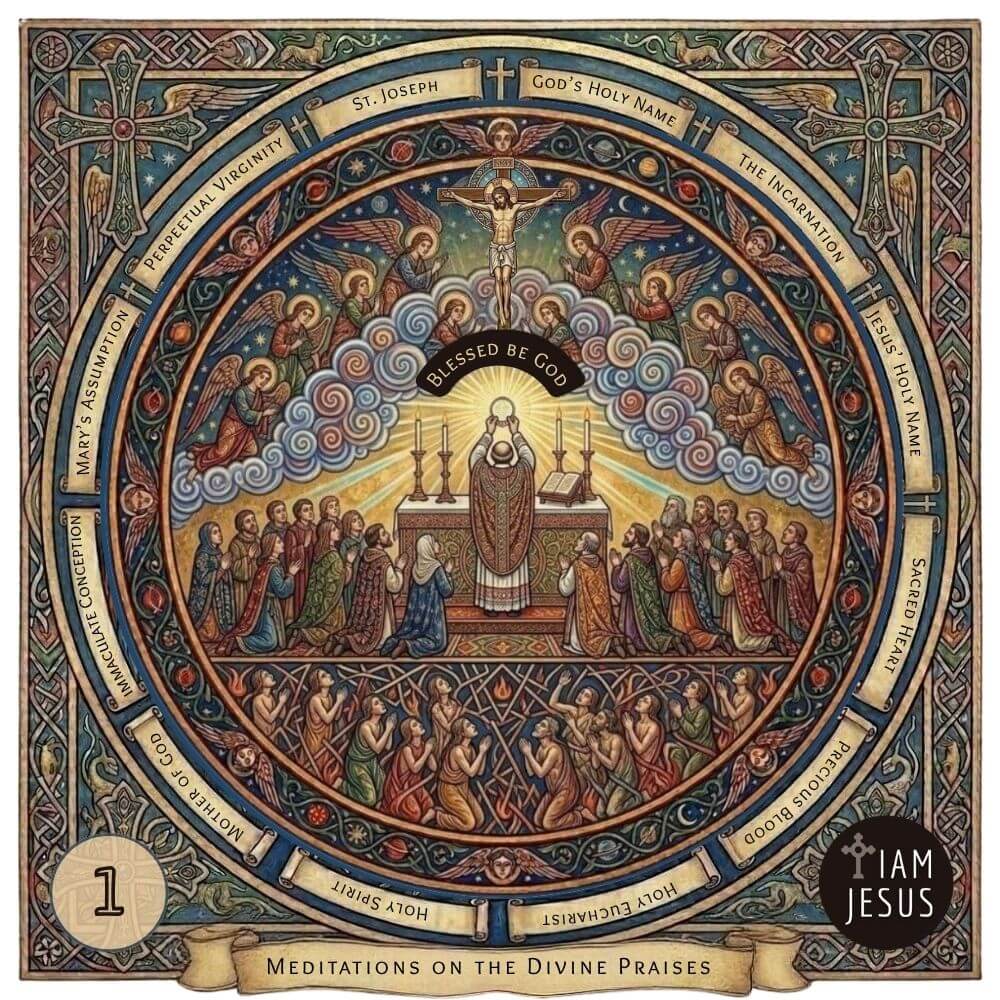
Thank you for journeying with us in our Divine Praises Meditations. In this 7th meditation we are contemplating the Holy Sacrament of the Altar. We will answer the question, “What is Blessing Jesus in the Holy Sacrament of the Altar?” In Catholic theology, Christ is priest, victim and the self-sacrificial offering on the altar. He is the priest because he is the one who offers, and he is the victim because he is simultaneously the one offered [see CCC 1383, below].
For this reason, we say that the altar is Christ. This is because, as Denis McNamara describes, “[Christ] fulfilled every previous priesthood and every previous sacrifice by becoming the True High Priest and True Victim. So, too, his body fulfilled and replaced every previous altar erected to the worship of God. Christ, then, took up and recapitulated every previous prefigurement of his own action in the world and returned them to the Father in heaven” [Adoremus, 2016].
And the Catechism also teaches us that Christ is present at the Mass as both victim offered and as food from heaven giving himself to us. This is why in John 6:49-51, Jesus tells the crowd he is the new manna from heaven, and unlike their ancestors who ate but still died, the bread that Jesus gives is his flesh for the life of the world and those that eat of it will never die.
Precursors of the Old Covenant, Fulfillment in the New Covenant
God requires a sacrifice for the atonement of sin. We see this as far back as Genesis 4, when after Adam and Eve sinned in the garden, their son Abel offered a blood sacrifice that was more pleasing to God than Cain’s sacrifice of the fruit of the ground. This is also mentioned in Hebrews 11:4, “By faith Abel offered to God a sacrifice greater than Cain’s. Through this he was attested to be righteous, God bearing witness to his gifts, and through this, though dead, he still speaks.”
We also see this prefigured in Abraham, who encounters the priest Melchizedek in Genesis 14. He is a priest who offered bread and wine. Then in Genesis 22, God asks Abraham to sacrifice his only son who was given to him by God as a promise, and Abraham shows his willingness to sacrifice Isaac. Both of these are seen as prefigurations of the Eucharist and the sacrifice of Christ in Catholic theology.
We also see in Exodus 25, the Lord telling Moses, “In the ark itself you are to put the covenant which I will give you.” In Hebrews 9:4 we are told what was put inside, “…and the ark of the covenant entirely covered with gold. In it were the gold jar containing the manna, the staff of Aaron that had sprouted, and the tablets of the covenant.” In Catholic theology we see the manna as a prefiguration of the Eucharist, the staff of Aaron representing the priesthood, and the tablets representing the word of God inscribed on stone. The word of God in the Ark of the Covenant foreshadows the Word of God in the flesh, who is Jesus Christ. And Jesus Christ is Incarnate of the Virgin Mary, who is the new Ark of the new Covenant.
When Jesus celebrated the Passover meal with his disciples and gave them his body and blood, he gave the Jewish Passover its definitive meaning. By his crucifixion, death, and resurrection, Jesus is passing over to his Father, and this new Passover is celebrated in the Eucharist which fulfills the Jewish Passover of the Old Covenant and anticipates the final Passover of the Church and the glory of the Kingdom of God.
The Holy Sacrament of the Altar: The Meaning of the Bread of Life Discourse
In John 6 we witness the multiplication of the loaves, followed by Jesus walking on water. Two miracles that point to Christ’s divinity. Then, the next day Jesus gives his famous Bread of Life discourse to the crowd of disciples, saying, “I am the bread of life. Your ancestors ate the manna in the desert, but they died; this is the bread that comes down from heaven so that one may eat it and not die. I am the living bread that came down from heaven; whoever eats this bread will live forever; and the bread that I will give is my flesh for the life of the world” [John 6:48-51].
There were many in the crowd who did not believe and people quarreled about it.
But Jesus said to them, “Amen, amen, I say to you, unless you eat the flesh of the Son of Man and drink his blood, you do not have life within you. Whoever eats my flesh and drinks my blood has eternal life, and I will raise him on the last day. For my flesh is true food, and my blood is true drink” [John 4:53-55].
Four Facts about Jesus in the Holy Sacrament of the Altar
- At the consecration, the substance of bread and wine no longer remain on the altar.
- At the consecration, the species or physical properties of bread and wine remain, but without their substance. The outward appearance of bread and wine — color, taste, texture — remain, but not the substance of bread and wine. Under the appearance of bread and wine is Christ’s Body and Blood in His humanity, united with His Divinity.
- At the consecration, Christ becomes essentially and really present. Essence is what makes a thing what it is; reality is what actually exists and is not a mere figment of the imagination.
- The sanctity of a priest or bishop does not affect his ability to validly offer Mass or change bread and wine into the Living Christ. If he offers Mass in mortal sin, he commits another sin of sacrilege, but his Mass is valid and Christ is really there.
Heresies Against the Holy Sacrament of the Altar
In the first millennium of Christianity the belief in the Real Presence of Christ in the Eucharist had no serious challenges. All of Christianity held to this belief for 1000 years until an 11th-century French theologian named Berengar of Tours publicly began deny transubstantiation and he preached this error for 40 years before renouncing his heresies and reconciling himself with the Church before he died.
About 100 years later, a cult arose in France. They were referred to as the Waldensians. This was a pre-Protestant cult who were very critical of the Church’s abuses. They believed in preaching a simplified biblical belief system. As part of their simplistic belief system, the Waldensians believed priestly powers could be conferred to any person who was holy enough. This heresy allows adherents to believe holy people have the power to confer the Sacraments without being ordained as priests by the Church.
Another heresy in the 14th century was promoted by an English priest, Oxford professor, and scholar named John Wycliffe. He was later condemned as a heretic. Wycliffe had 4 heretical claims against the Church’s teaching on the Eucharist that the Church condemned. The heretical beliefs of Wycliffe opened the door to the Protestant Reformation of the 16th Century, and all current heresies against the Real Presence of Christ in the Eucharist, Body, Blood, Soul, and Divinity that we see in the world today.
“The altar, around which the Church is gathered in the celebration of the Eucharist, represents the two aspects of the same mystery: the altar of the sacrifice and the table of the Lord.
This is all the more so since the Christian altar is the symbol of Christ himself, present in the midst of the assembly of his faithful, both as the victim offered for our reconciliation and as food from heaven who is giving himself to us. ‘For what is the altar of Christ if not
the image of the Body of Christ?’ asks St. Ambrose. He says
elsewhere, ‘The altar represents the body [of Christ] and the Body
of Christ is on the altar.” The liturgy expresses this unity of sacrifice and communion in many prayers. Thus the Roman Church prays in its anaphora:In humble prayer we ask you, almighty God: command that these gifts be borne by the hands of your holy Angel
to your altar on high in the sight of your divine majesty, so that all of us, who through this participation at the altar receive the most holy Body and Blood of your Son, may be filled with every grace and heavenly blessing.Take this and eat it, all of you: communion.”
Catechism, 1383 and
When we go to Mass we Bless Jesus in the Most Holy Sacrament of the Altar
As Christians we need to recognize the Real Presence of Christ in the Eucharist and proclaim the truth of this mystery to the world. Blessing Jesus in the Holy Sacrament of the Altar means participating in the Mass and receiving Christ in a worthy manner. It means bringing Christ with us out into the world and proclaiming the good news. By blessing Jesus in the Holy Sacrament of the Altar, we are actively expressing gratitude for his Real Presence in our lives and are orienting ourselves toward God in a substantial way.
Now let’s take a moment to bless Jesus by meditating on 1 Corinthians 10:14-22. The Apostle Paul warns us against idolatry in this passage, telling Christians we cannot participate in both the Lord’s Supper and pagan sacrifices. He emphasizes that the Lord’s Supper is communion with Christ and pagan sacrifices are to demons, and so are incompatible with the faith.
Take a few moments to prayerfully read the following verses. Pause over a word or phrase that catches your attention. When you are finished, take a moment to speak to Jesus your own blessings and praises for him from your heart.
The Cup of Blessing that We Bless
Therefore, my beloved, avoid idolatry. I am speaking as to sensible people; judge for yourselves what I am saying.
The cup of blessing that we bless, is it not a participation in the blood of Christ? The bread that we break, is it not a participation in the body of Christ?
Because the loaf of bread is one, we, though many, are one body, for we all partake of the one loaf.
Look at Israel according to the flesh; are not those who eat the sacrifices participants in the altar?
So what am I saying? That meat sacrificed to idols is anything? Or that an idol is anything?
No, I mean that what they sacrifice, [they sacrifice] to demons, not to God, and I do not want you to become participants with demons.
You cannot drink the cup of the Lord and also the cup of demons. You cannot partake of the table of the Lord and of the table of demons.
Or are we provoking the Lord to jealous anger? Are we stronger than he?
1 Corinthians 10:14-22
text
“The tabernacle is to be situated “in churches in a most worthy place with the greatest honor.” The dignity, placing, and security of the Eucharistic tabernacle should foster adoration before the Lord really present in the Blessed Sacrament of the altar.”
Now let’s contemplate St. Paul the Apostle’s instructions from 1 Corinthians 11. Slowly meditate on this passage, reflecting on what “Blessing Jesus in theh Holy Sacrament of the Altar” means. Take your time. Pause over a word or phrase that speaks to your heart. Reread the passage again, and then ask Jesus to give you the grace to understand that the Eucharist is both a sacrifice and a memorial. Jesus in the Holy Sacrament of the Altar is Christ himself, in union with the Church, perpetuating in an unbloody manner the sacrifice offered on the cross.
If you’d like to write your own blessing in your own words, take a moment to journal.
Blessed Be Jesus Christ in the Sacrament of the Altar
For I received from the Lord what I also handed on to you,k that the Lord Jesus, on the night he was handed over, took bread, and, after he had given thanks, broke it and said, “This is my body that is for you. Do this in remembrance of me.”
In the same way also the cup, after supper, saying, “This cup is the new covenant in my blood. Do this, as often as you drink it, in remembrance of me.”
For as often as you eat this bread and drink the cup, you proclaim the death of the Lord until he comes. Therefore whoever eats the bread or drinks the cup of the Lord unworthily will have to answer for the body and blood of the Lord. A person should examine himself, and so eat the bread and drink the cup.
For anyone who eats and drinks without discerning the body, eats and drinks judgment on himself.
Let us Pray:
Now that we understand the catechetical meaning of “Blessing Jesus in the Holy Sacrament of the Altar”, let’s bless Jesus in the Eucharist in prayer.
The 7th Catechetical Meditation of the Divine Praises prayer
Let Us Bless Jesus in the Holy Sacrament of the Altar
Eternal Father, I praise you and I bless you for the gift of your Son, who was sacrificed for the sake of my soul. In blessing Jesus in the Holy Sacrament of the Altar, I glorify you, Father. I bless you with all my heart and offer you adoration and praise in thanksgiving for Jesus Christ, my mediator, who is true God and true Man, and whose flesh is true food and true drink. I thank you Jesus for your eternal sacrifice and I bless you with my very life in service to your Kingdom. AMEN.
In Conclusion:
When we receive the Eucharist we are “Blessing Jesus in the Holy Sacrament of the Altar” and we are fed for our journey. In this way we are given the grace to take Jesus with us out into the world; we can then bring the Kingdom of God to those most in need. We can take Christ with us to minister to those in our own homes, in our families, in our communities, and in our world.
So let us go forth and announce the Gospel of the Lord to all those in our lives, and lets be a shining witness to those who are in darkness, oppressed, confused by heresies, and away from the Lord. You may be the only one to bring Christ to someone in need today. Let that be your prayer to find them.
We remember the words that Jesus tenderly spoke from the Cross when he said, “Father, forgive them, they know not what they do” [Luke 23:34].
The Divine Praises in English
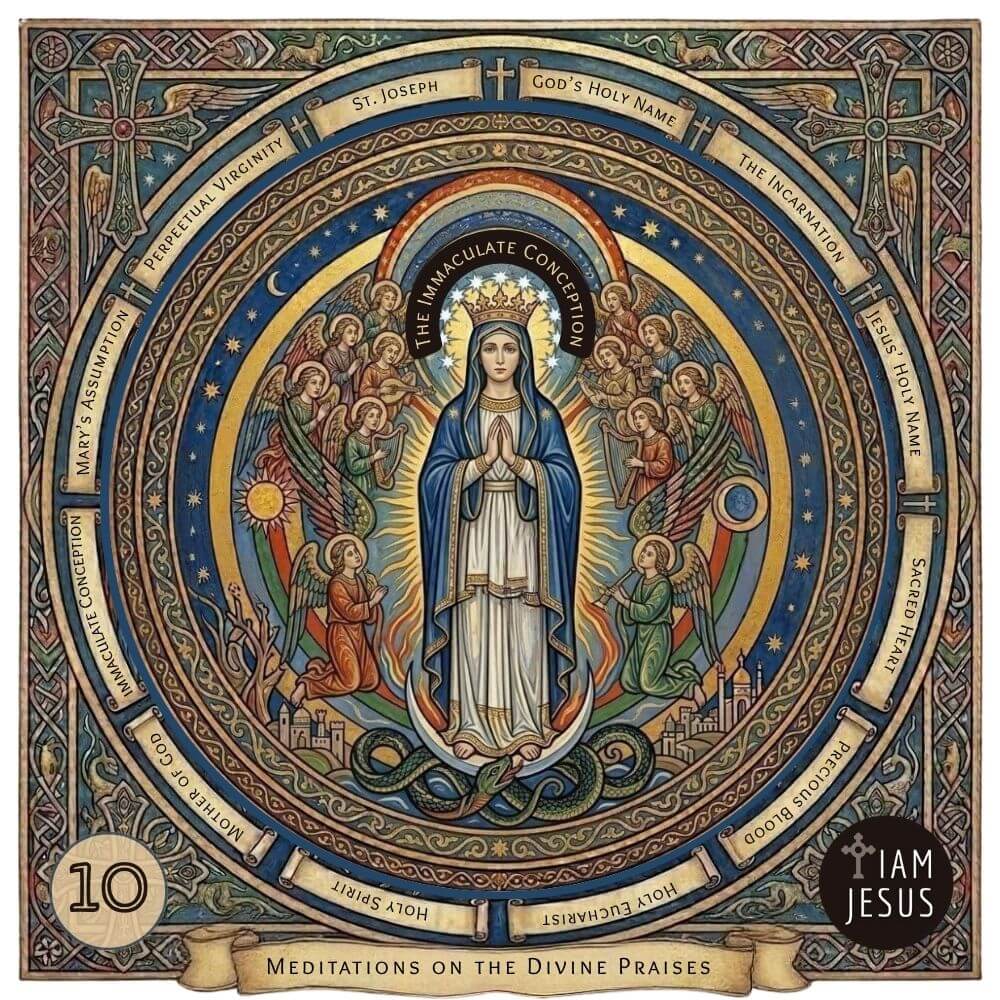
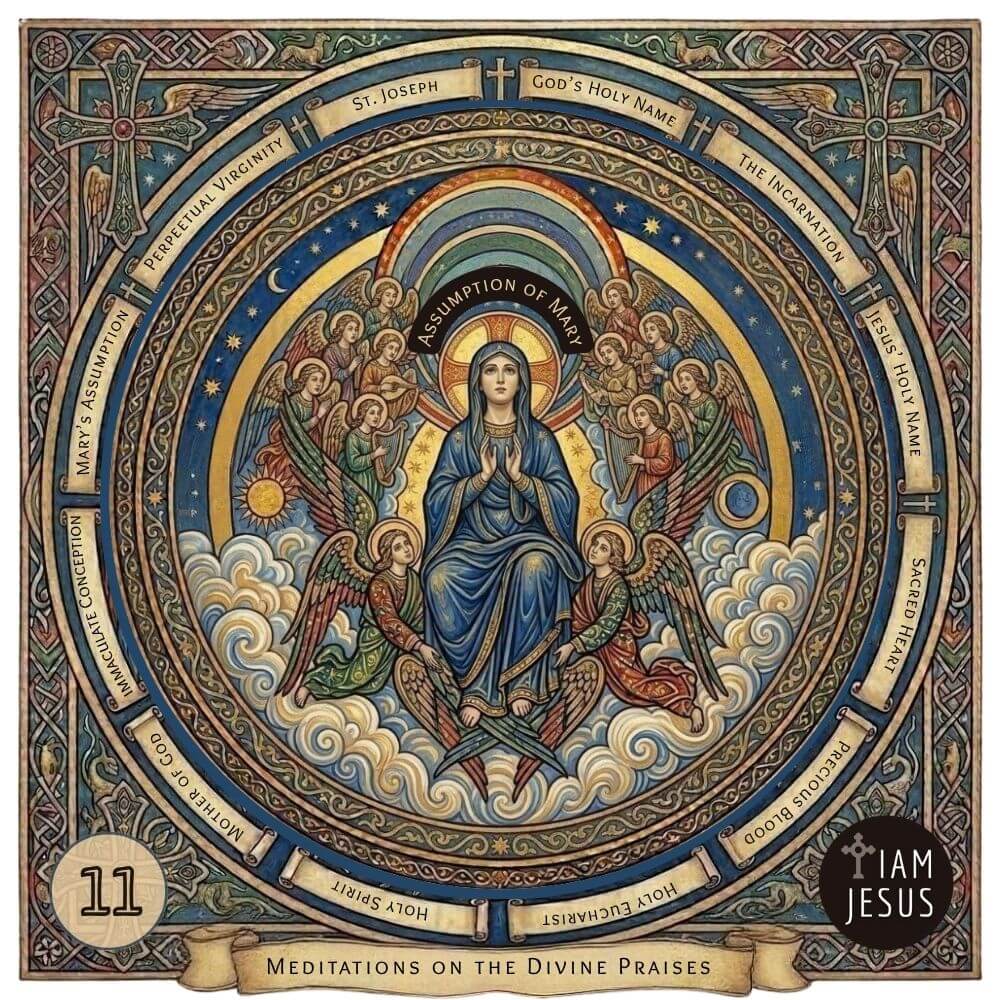
Blessed be God. Blessed be His Holy Name. Blessed be Jesus Christ, true God and true Man. Blessed be the Name of Jesus. Blessed be His Most Sacred Heart. Blessed be His Most Precious Blood. Blessed be Jesus in the Most Holy Sacrament of the Altar. Blessed be the Holy Spirit, the Paraclete. Blessed be the great Mother of God, Mary most Holy. Blessed be her Holy and Immaculate Conception. Blessed be her Glorious Assumption. Blessed be the Name of Mary, Virgin and Mother.
Blessed be St. Joseph, her most chaste spouse. Blessed be God in His Angels and in His Saints forever. AMEN.
The Divine Praises in Latin
Benedictus Deus. Benedictum Nomen Sanctum eius. Benedictus Iesus Christus, verus Deus et verus homo. Benedictum Nomen Iesu. Benedictum Cor eius sacratissimum. Benedictus Sanguis eius pretiosissimus. Benedictus Iesus in sanctissimo altaris Sacramento. Benedictus Sanctus Spiritus, Paraclitus. Benedicta excelsa Mater Dei, Maria sanctissima. Benedicta sancta eius et immaculata Conceptio. Benedicta eius gloriosa Assumptio. Benedictum nomen Mariae, Virginis et Matris. Benedictus sanctus Ioseph, eius castissimus Sponsus. Benedictus Deus in Angelis suis, et in Sanctis suis. AMEN.
The Divine Praises Prayer on YouTube
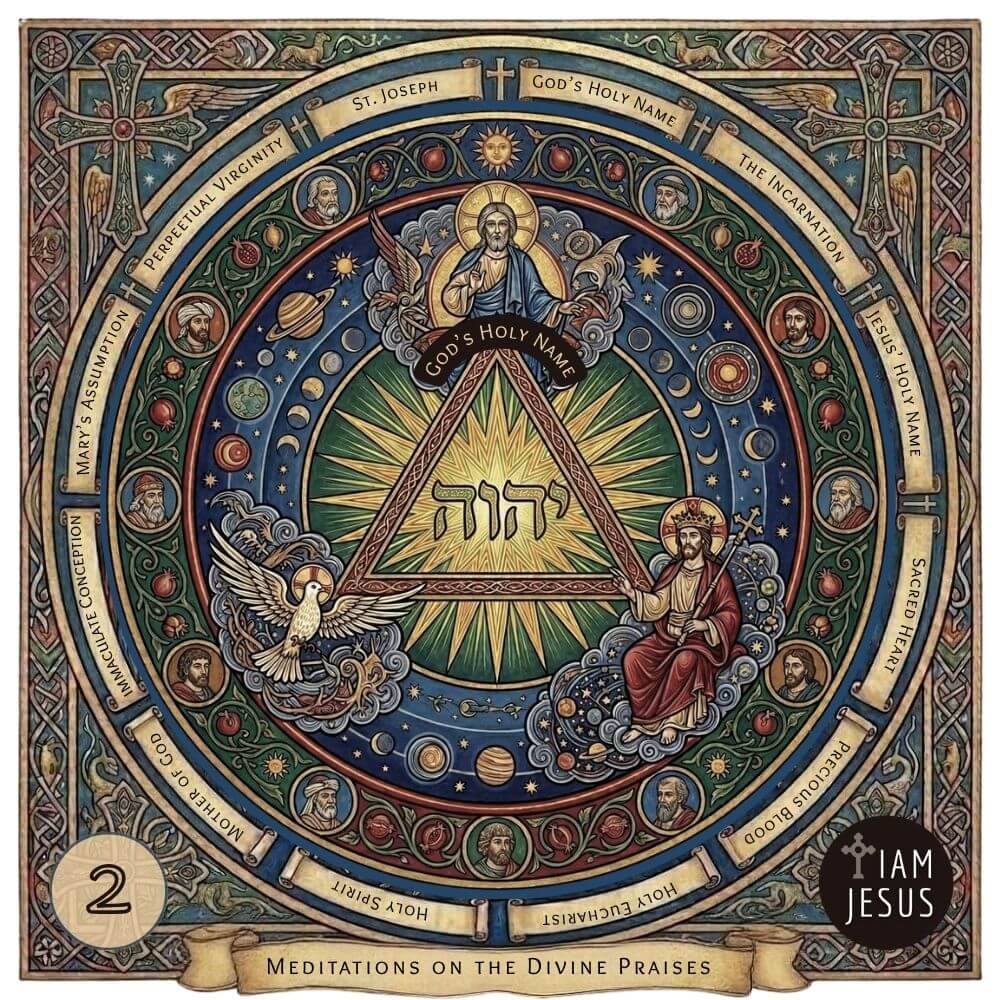
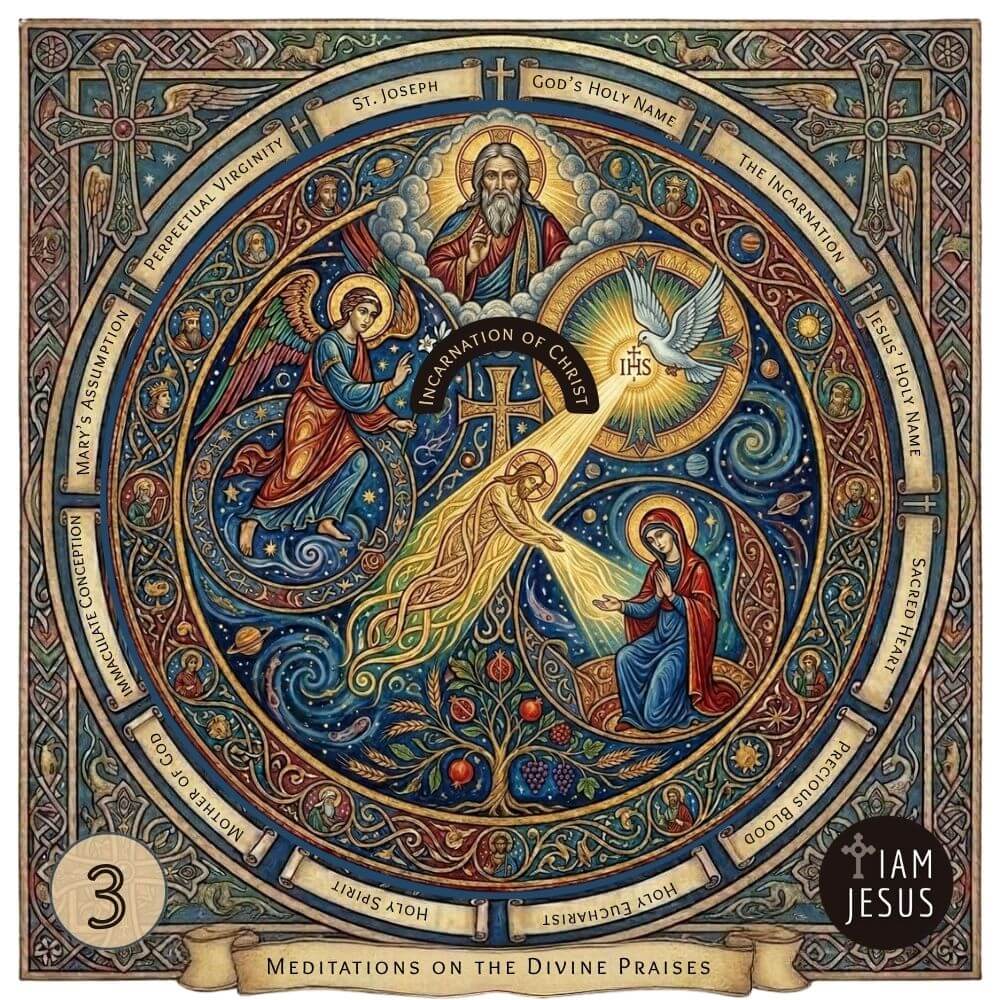
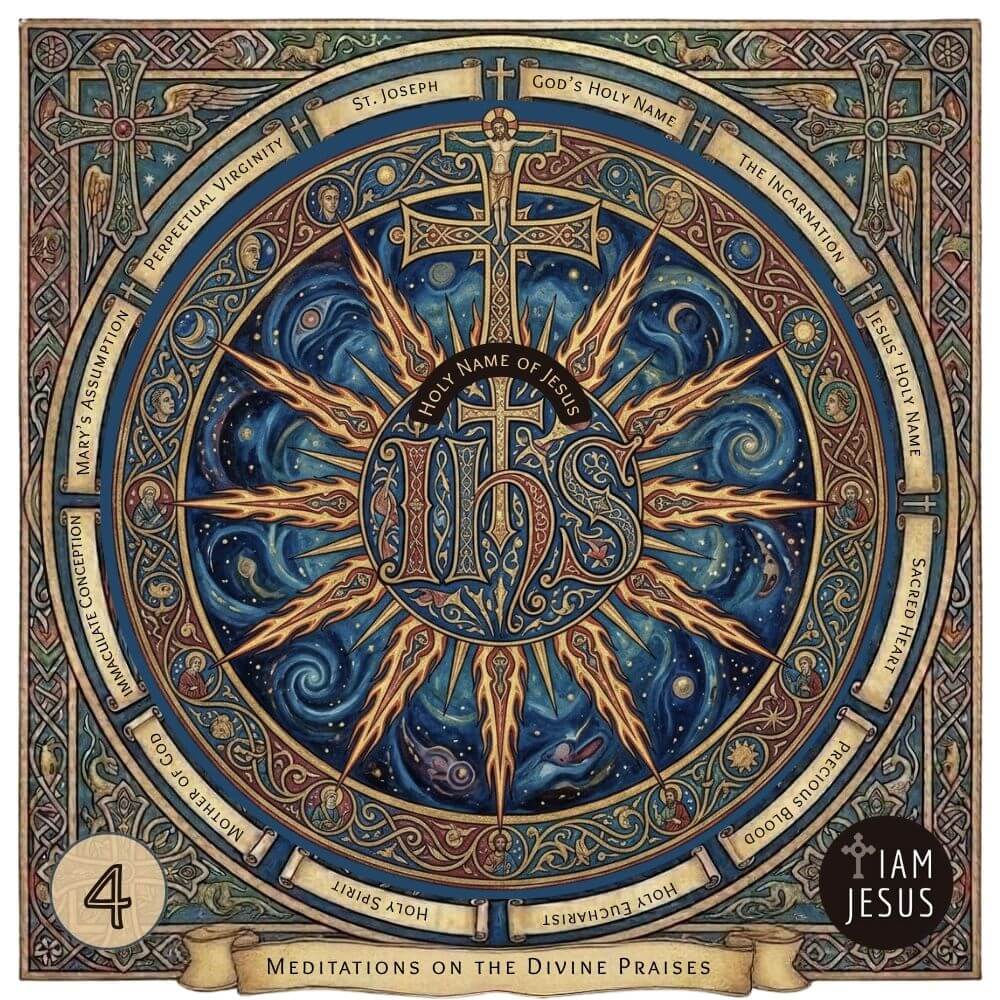
Pondering the Divine Praises: The Complete Series
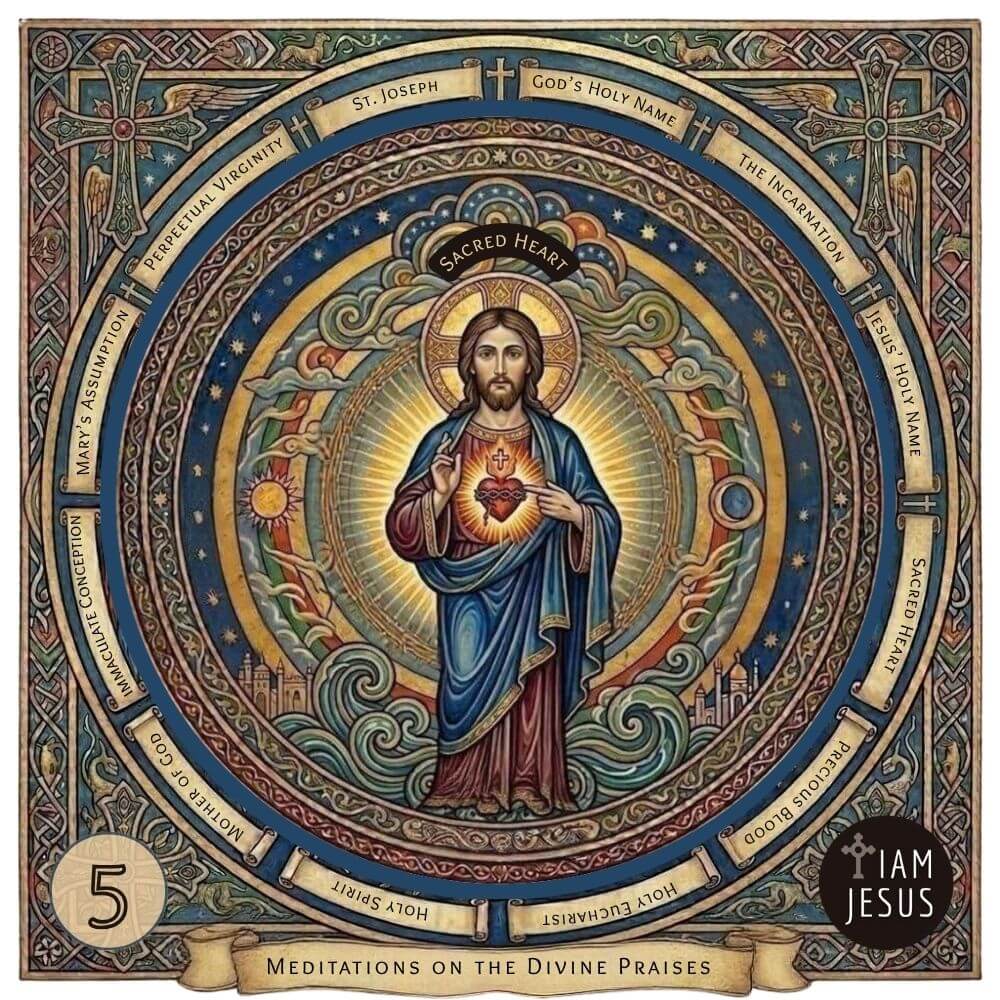
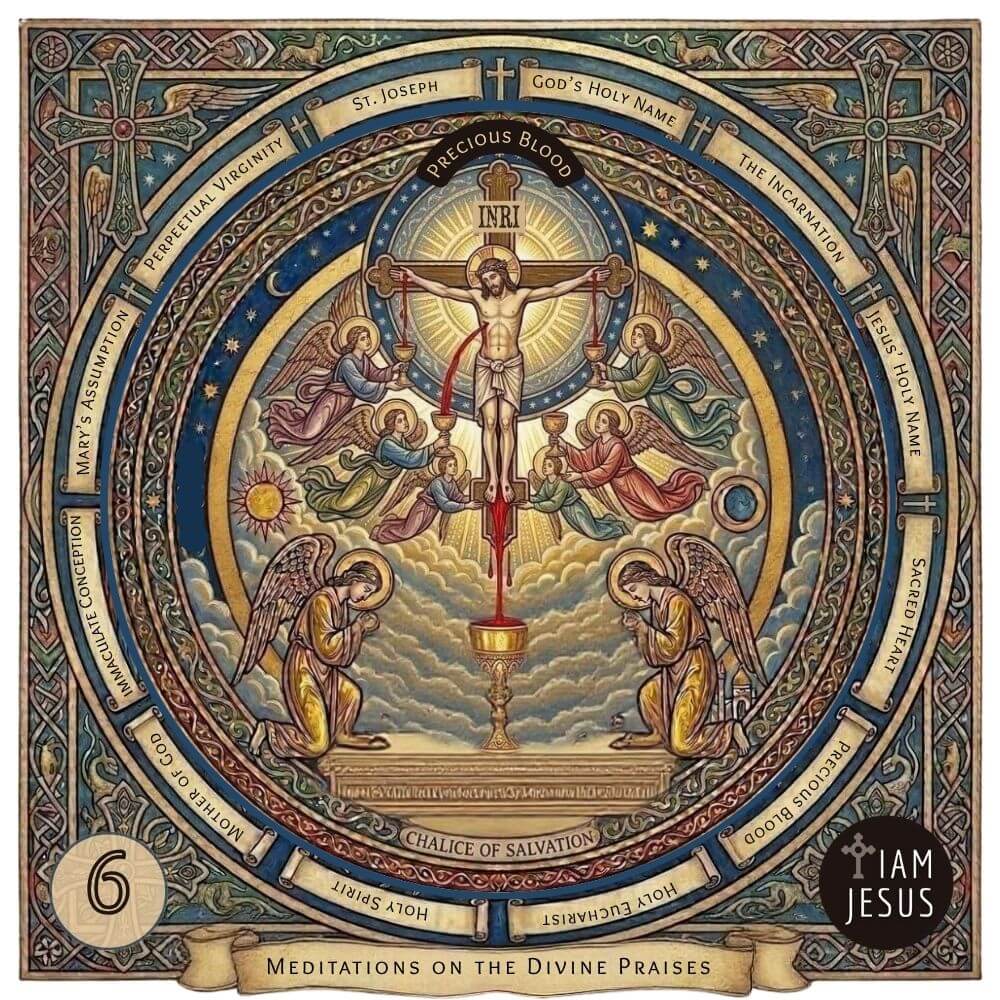
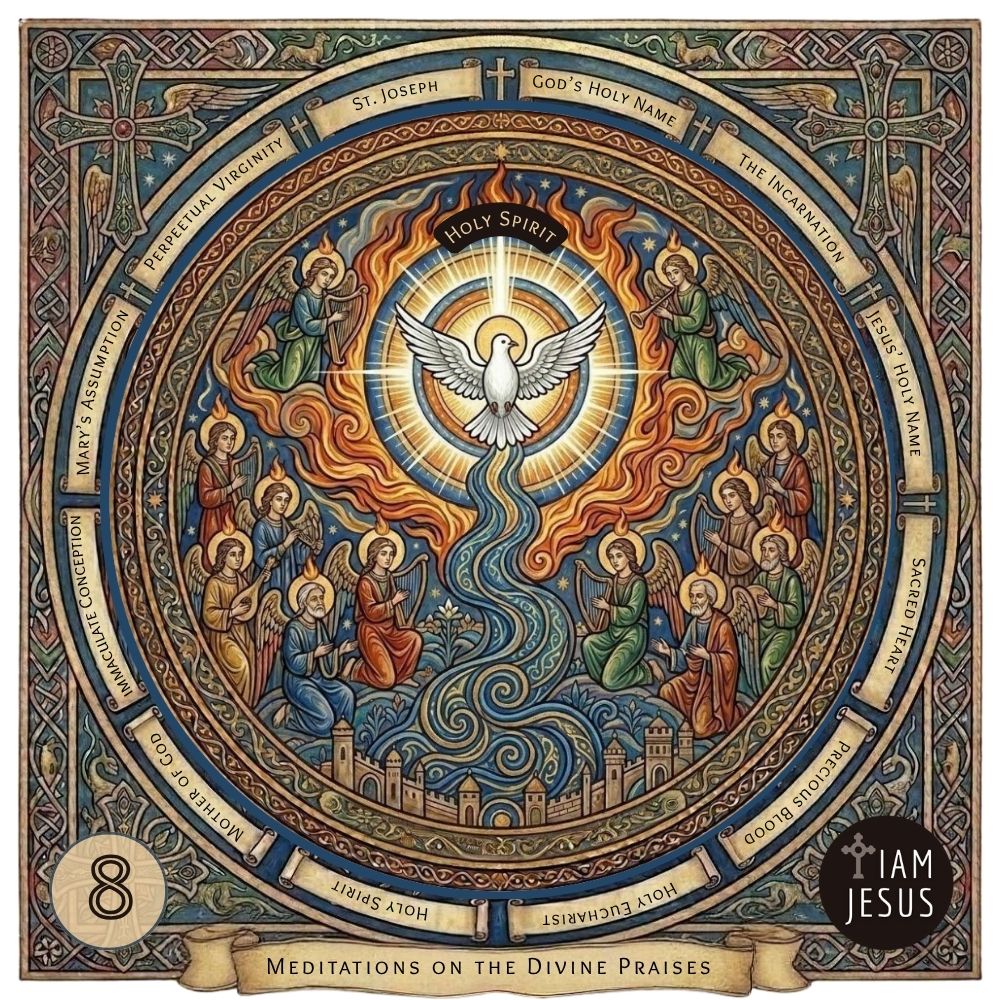
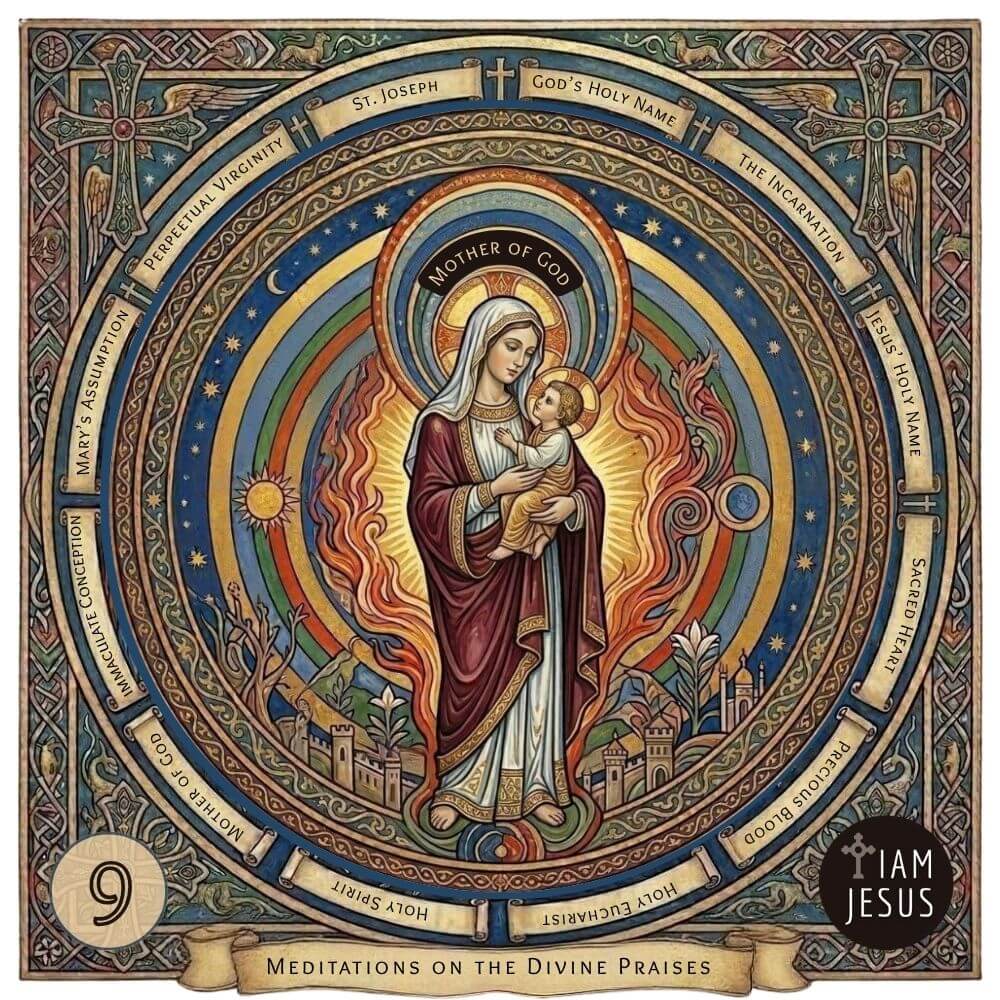
The Divine Praises Series is a 14-part prayer journey made to help you deeply reflect on each line of this beautiful prayer. Through simple stories, scripture, and heartfelt reflections, this series explores the holiness of God, the Sacred Heart of Jesus, and the special place of the Blessed Virgin Mary. It is the perfect companion for a quiet hour in the adoration chapel or for your daily prayer time at home.
One Response
-
This program is God Sent. Thank You for all your time and energy directed by Our Lord and Blessed Mother to Teach, instruct, and carry the message of Our Lords -Life,Death and Ressurection into the World. God Bless each and everone!
One Response
This program is God Sent. Thank You for all your time and energy directed by Our Lord and Blessed Mother to Teach, instruct, and carry the message of Our Lords -Life,Death and Ressurection into the World. God Bless each and everone!