
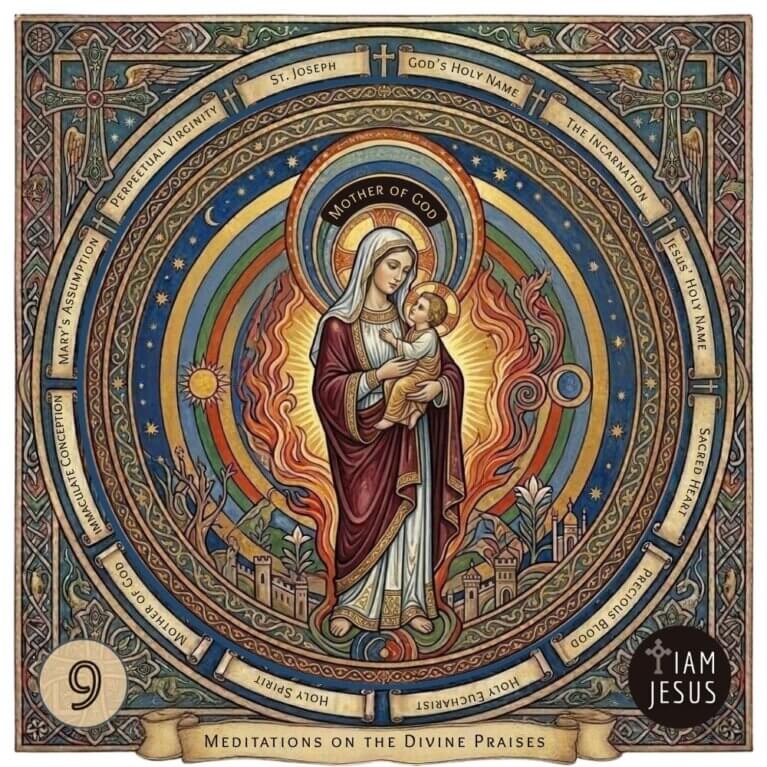
Blessing the great Mother of God, Mary, is not only condoned, but encouraged by the Catholic Church because she is not only the mother of Jesus, but she’s also the mother of the members of Christ. By her total cooperation in the redemptive action of the Incarnation, Life, Ministry, Passion, Death, and Resurrection of Christ, Mary became the New Eve—the new mother of all the living. In the order of grace, she acts as a spiritual mother to every individual, serving as our intercessor, always pointing her children away from herself and toward her divine Son, Jesus.
In fact, the Catholic Church’s teaching on Mary as the great Mother of God is one of its oldest and most foundational doctrines. It is the first of the four Marian Dogmas, or infallible truths, defined by the Church.
Let’s take a deeper look at the title, Great Mother of God. Why does Mary have a maternal relationship with the Church? It’s simple. This is because her role as our Mother is an inseparable extension of her profound, unbreakable union with Jesus Christ.
The Great Mother of God, Theotokos
The official Greek term for the title “Mother of God” is Theotokos; it literally translates to God-Bearer or The One Who Bore God. The Church teaches that Mary is truly the Mother of God because she gave birth to Jesus Christ, who is true God and true man.
The title “Mother of God” does not mean that Mary created God, or that she existed before God the Father. She is a created human being. However, in her motherhood she is bearing Christ who has two distinct natures that are in complete harmony with each other through what is referred to by theologians as a hypostatic union.
And since we know that Jesus is one single Divine Person who possesses two complete, distinct natures that are separate and in perfect harmony, Mary is not only the Mother of Jesus, but also the Mother of God. This is true because Jesus is not half-God and half-man. He is entirely God and entirely man at the same time. This is what the term hypostatic union means. In more simpler terms, we can say that Jesus is a single, fully human and divine Person whose two natures are in complete harmony with each other and inseparable.
Now that we know the two natures of Jesus cannot be separated, and we also know Mary gave birth to Jesus Christ, then this means she is not just the mother of Jesus but also the Mother of God. In the same way we cannot separate the human nature of Jesus from his divine nature we also cannot separate Mary as just the mother of Jesus and not also the mother of God.
I think it is also interesting to know that science has another proof that adds a layer of biological truth to this theological truth. Scientists have discovered a unique biological process called fetal microchimerism. This is a process where cells from the fetus cross the placenta and migrate into the mother’s tissues. Scientists have learned that these fetal cells can remain in the mother’s body for the rest of her life. Furthermore, these fetal cells act as healing cells within the mother’s body. Mary and Jesus had a unique biological bond as mother and Son, and by giving birth to Jesus, Mary received his fetal cells, and they most likely remained within her body throughout her life.
The Virgin Mary, who at the message of the angel received the Word of God in her heart and in her body and gave Life to the world, is acknowledged and honored as being truly the Mother of God and Mother of the Redeemer. Redeemed by reason of the merits of her Son and united to Him by a close and indissoluble tie, she is endowed with the high office and dignity of being the Mother of the Son of God, by which account she is also the beloved daughter of the Father and the temple of the Holy Spirit. Because of this gift of sublime grace she far surpasses all creatures, both in heaven and on earth. At the same time, however, because she belongs to the offspring of Adam she is one with all those who are to be saved.
She is “the mother of the members of Christ . . . having cooperated by charity that faithful might be born in the Church, who are members of that Head” [Saint Augustine De Sancta Virginitate (On Holy Virginity, section 6)]
Wherefore she is hailed as a pre-eminent and singular member of the Church, and as its type and excellent exemplar in faith and charity. The Catholic Church, taught by the Holy Spirit, honors her with filial affection and piety as a most beloved mother.
Lumen Gentium, 53
Mary, Mother of God
The Virgin Mary became the Mother of God at the moment Jesus became Incarnate in her womb. The Virgin Mary also had a special indwelling of the Holy Spirit throughout her life. This was evident when the Holy Spirit overshadowed her at the Incarnation in Luke 1:35. We see it as well in the Visitation story from Luke 1:39-56.
We can see confirmation of this theology in Luke 1:43, where Mary’s cousin Elizabeth, filled with the Holy Spirit, exclaims, “And why is this granted me, that the mother of my Lord should come to me?” In the Jewish context, Lord (Adonai) is the title used for God.
Mary was also instrumental at Jesus’ first public miracle, and throughout His ministry. Most notably, Mary united her immaculate heart to the Sacred Heart of Jesus as he suffered on the Cross; thus fulfilling the Simeon’s prophecy at the Presentation that a sword would pierce Mary’s own heart too [Luke 2:34-35].
Additionally, in Catholic exegesis, the typology of Mary as the Mother of God, or Theotokos, is further revealed through parallels of Old Testament figures, objects, and events that prefigure Mary’s role as the sinless bearer of the divine Word [John 1:1-3].
Mary as the New Ark of the Covenant
We see this coorelation in the Old Testament story of David and the Ark of the Covenant in 2 Samuel 6. King David asks, “How can the ark of the Lord come to me?” When we compare this Old Testament prefiguration to the New Testament fulfillment in Luke 1, we hear Elizabeth ask the same question, “And why is this granted me, that the mother of my Lord should come to me?”
We learn in Hebrews 9:4 that the Ark of the Covenant in the Old Testament contained three things. It held the manna that came down from heaven that fed the Israelites in the desert, the Ten Commandments, and Aaron’s rod, alive with buds on it. Symbolically, we say that the manna represents the Bread of Life, the Ten Commandments represent the Eternal Word, and the budding rod of Aaron represents the Eternal Priesthood.
The passage in Luke that describes the visitation of Mary to Elizabeth. Mary is the fulfillment of the Old Testament Ark and we see this when we look at the parallels. Mary carries within her womb the living Manna (Jesus), who is also the eternal Word incarnate, and the eternal High Priest.
Furthermore, the Holy Spirit “overshadowed” Mary (Luke 1:35). This same word is used to describe the cloud of glory that covered the Tabernacle in Exodus 40:34-35.
What was in the Old Testament Tabernacle? It contained the Ark of the Covenant and the Mercy Seat that contained the presence of God. Two solid-gold cherubim with outstretched wings covered the Mercy Seat.
But there is more. When the Ark of the Covenant came to David, it remained for 3 months, and this is exactly how long the New Ark, Mary, Mother of God, stayed with Elizabeth.
Furthermore, in the New Testament we learn that John the Baptist leapt in Elizabeth’s womb (Luke 1:41) when in the presence of Christ in Mary’s womb. This directly parallels the story of King David dancing and leaping before the Ark of the Covenant in 2 Samuel 6:14. In both accounts the Ark bears the physical presence of God from within.
The Lost Ark of the Covenant Fulfilled
When we ponder the science of fetal microchimerism within the theological concept of Mary as the new Ark, it also affirms this teaching through biological proof that the Presence of God remains in the Ark that bore it. Layer upon this the mystery of the Lost Ark of the Covenant and you begin to see the fulfillment of Jeremiah’s prophecy. In 2 Maccabees 2:4–8 we learn that the weeping Prophet Jeremiah (who is an archetype of Christ) hides the Ark of the Covenant in a cave during the Babylonian exile:
“The same document also tells how the prophet, in virtue of an oracle, ordered that the tent and the ark should accompany him, and how he went to the very mountain that Moses climbed to behold God’s inheritance.
When Jeremiah arrived there, he found a chamber in a cave in which he put the tent, the ark, and the altar of incense; then he sealed the entrance.
Some of those who followed him came up intending to mark the path, but they could not find it. When Jeremiah heard of this, he reproved them: “The place is to remain unknown until God gathers his people together again and shows them mercy.
Then the Lord will disclose these things, and the glory of the Lord and the cloud will be seen, just as they appeared in the time of Moses and of Solomon when he prayed that the place might be greatly sanctified.”
This is a profound prophetic mystery that points directly to the Incarnation of Christ, the Assumption of Mary, and the Gathering of the Church.
“We believe that the Holy Mother of God, the new Eve, Mother of the Church, continues in heaven to exercise her maternal role on behalf of the members of Christ” [Paul VI, CPG # 15].
Catechism, 975
Mary, Great Mother of God, Mother of the Church
Now that we understand Mary’s role as both Mother of Jesus and Mother of God due to the inseparable extention of her profound, unbreakable union with Jesus Christ, true God and true Man, we can also come to understand her role as Mother of the Church. As Jesus remains with us and will not leave us orphan, so he has also entrusted his Mother to intercede for us and draw us into His Sacred Heart.
When Mary gave her fiat and consented to offering herself according to the will of God and His divine plan for salvation, Mary received a universal maternal mission. We see this mission clearly when Christ explicitly gives Mary to his disciple and his disciple to Mary.
In John 19:26-27 we read, “When Jesus saw his mother and the disciple there whom he loved, he said to his mother, “Woman, behold, your son.” Then he said to the disciple, “Behold, your mother.” And from that hour the disciple took her into his home.”
The "Woman" - From Genesis to Revelation
God’s plan of salvation always included Mary’s cooperation with grace. Earlier we read John 19, and you may have noticed that Jesus addresses Mary not as Mother, but as Woman. Did you know that this is a deliberate echoing of the word Woman in Genesis 3:15, whose seed would crush the serpent? By telling the beloved disciple, “Behold, your mother,” Jesus establishes Mary as the mother of his mystically reborn believers, as the Mother of the Church.
This title culminates in the last book of the New Testament, the Book of Revelation. We see in Revelation 12:17, that a heavenly Woman is shown to have “other offspring”—specifically, “those who keep the commandments of God and bear testimony to Jesus.” This Woman is Mary, and the other offspring defines the Church.
The Catechism of the Catholic Church outlines Mary’s unique maternal role as a spiritual mother who intercedes for her children to God. This role as the great Mother of God is fundamentally inseparable from her union with Christ and his work of salvation. Mary is an exemplary saint who aids humanity through her intercession, and whose influence rests entirely upon the merits of Jesus Christ, who is our one Mediator and Savior.
Mary’s role in the Church is inseparable from her union with Christ and flows directly from it. “This union of the mother with the Son in the work of salvation is made manifest from the time of Christ’s virginal conception up to his death”; it is made manifest above all at the hour of his Passion:
“Thus the Blessed Virgin advanced in her pilgrimage of faith, and faithfully persevered in her union with her Son unto the cross. There she stood, in keeping with the divine plan, enduring with her only begotten Son the intensity of his suffering, joining herself with his sacrifice in her mother’s heart, and lovingly consenting to the immolation of this victim, born of her: to be given, by the same Christ Jesus dying on the cross, as a mother to his disciple, with these words: “Woman, behold your son.”
Catechism, 964
Mary Always Points to Jesus
Crucially, Mary’s role and spiritual influence does not diminish, obscure, or compete with the unique mediation of Jesus Christ. Her entire capacity to aid humanity flows directly from the superabundance of Christ’s merits, depends completely on him, and draws all its power from his redemptive work. Just as the single priesthood of Christ or the solitary goodness of God is shared and reflected among creatures in varying degrees, Mary’s cooperative role represents a subordinate participation in the one true source of salvation, Jesus Christ.
To deny Mary is the Mother of God is to deny that Jesus is God. Catholics honor her with this title not because we believe she is a goddess or a deity that is equal to the the Holy Trinity, but because she consented to the Incarnation and willingly carried and gave birth to the Eternal Word made flesh, Jesus Christ, true God and true Man.
Let us Pray:
Now that we understand what it means to say “Blessed be the Great Mother of God,” let’s offer the Mother of God a prayer of blessing from the heart:
The 9th Catechetical Meditation of the Divine Praises prayer
Let Us Bless the Great Mother of God
Holy Mary, Great Mother of God,
I thank you for the mantle of your loving guidance in my life. Mother Mary, you have helped me grow closer to Jesus. In the times that I stray from Him, through your intercession, I am given the grace to return. You are full of grace, and made perfect to be a dwelling place for the Lord. You are the model of virtue for all Christians through your charity toward all, even those who pierced your heart with a sword. You forgive and you love. You show us how to trust and obey the Lord in everything with great faith and humility. I bless you, great Mother of God, and I praise the Lord for creating you and giving you to us as our Mother.
Lord, we praise your holy Name and thank you for blessing mankind with a spiritual Mother who intercedes and guides us to know, love, and serve You.
AMEN
In Conclusion:
We pray “Blessed be the great Mother of God” because we recognize her role as the first Christian, the one who said yes to God’s will, and became the Christ-bearer knowing it would lead to the Cross as the prophets foretold. We praise her and we thank her for her role in salvation history, and we thank Jesus for giving us a Great Mother who can intercede for us and guide us to know and love Him intimately. When we pray blessings to the Mary as the Mother of God, we do reparation for all those who blaspheme her.
We remember the words that Jesus tenderly spoke from the Cross when he said, “Father, forgive them, they know not what they do” [Luke 23:34].
The Divine Praises in English
Blessed be God. Blessed be His Holy Name. Blessed be Jesus Christ, true God and true Man. Blessed be the Name of Jesus. Blessed be His Most Sacred Heart. Blessed be His Most Precious Blood. Blessed be Jesus in the Most Holy Sacrament of the Altar. Blessed be the Holy Spirit, the Paraclete. Blessed be the great Mother of God, Mary most Holy. Blessed be her Holy and Immaculate Conception. Blessed be her Glorious Assumption. Blessed be the Name of Mary, Virgin and Mother.
Blessed be St. Joseph, her most chaste spouse. Blessed be God in His Angels and in His Saints forever. AMEN.
The Divine Praises in Latin
Benedictus Deus. Benedictum Nomen Sanctum eius. Benedictus Iesus Christus, verus Deus et verus homo. Benedictum Nomen Iesu. Benedictum Cor eius sacratissimum. Benedictus Sanguis eius pretiosissimus. Benedictus Iesus in sanctissimo altaris Sacramento. Benedictus Sanctus Spiritus, Paraclitus. Benedicta excelsa Mater Dei, Maria sanctissima. Benedicta sancta eius et immaculata Conceptio. Benedicta eius gloriosa Assumptio. Benedictum nomen Mariae, Virginis et Matris. Benedictus sanctus Ioseph, eius castissimus Sponsus. Benedictus Deus in Angelis suis, et in Sanctis suis. AMEN.
The Divine Praises Prayer on YouTube
Pondering the Divine Praises: The Complete Series
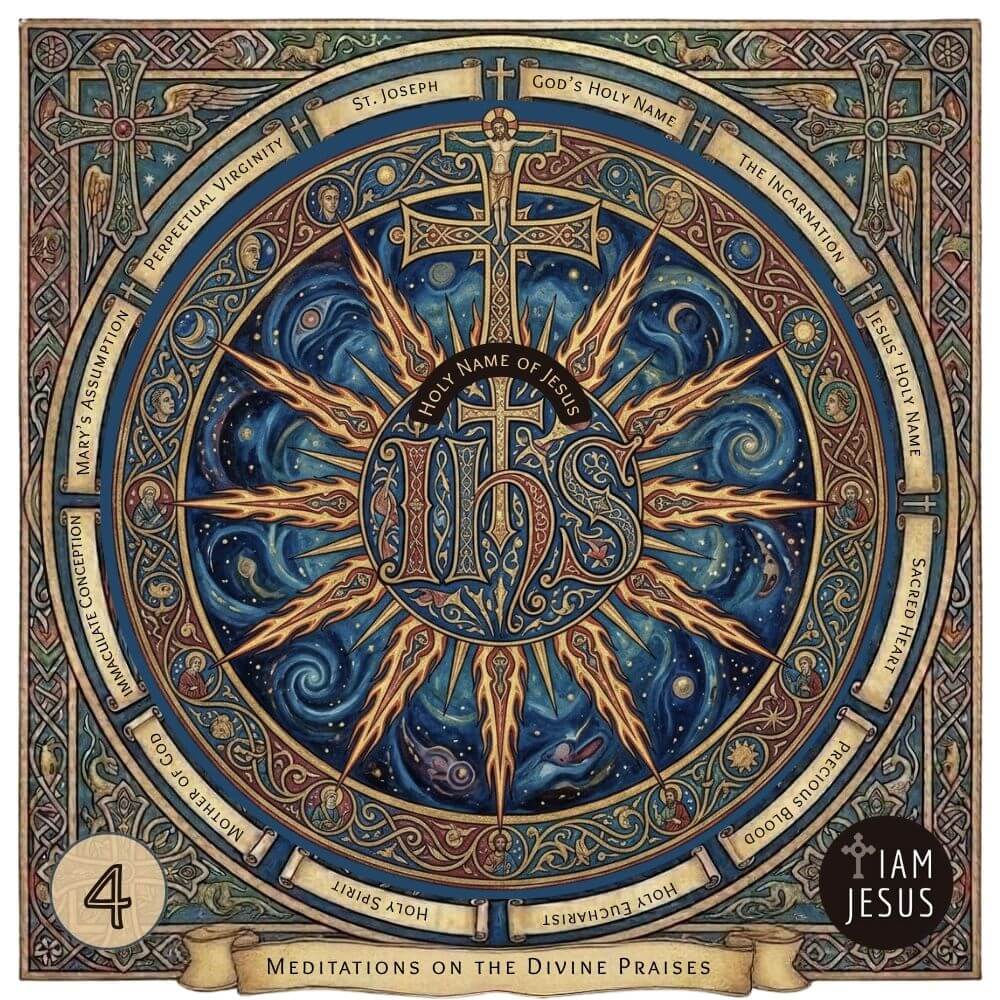
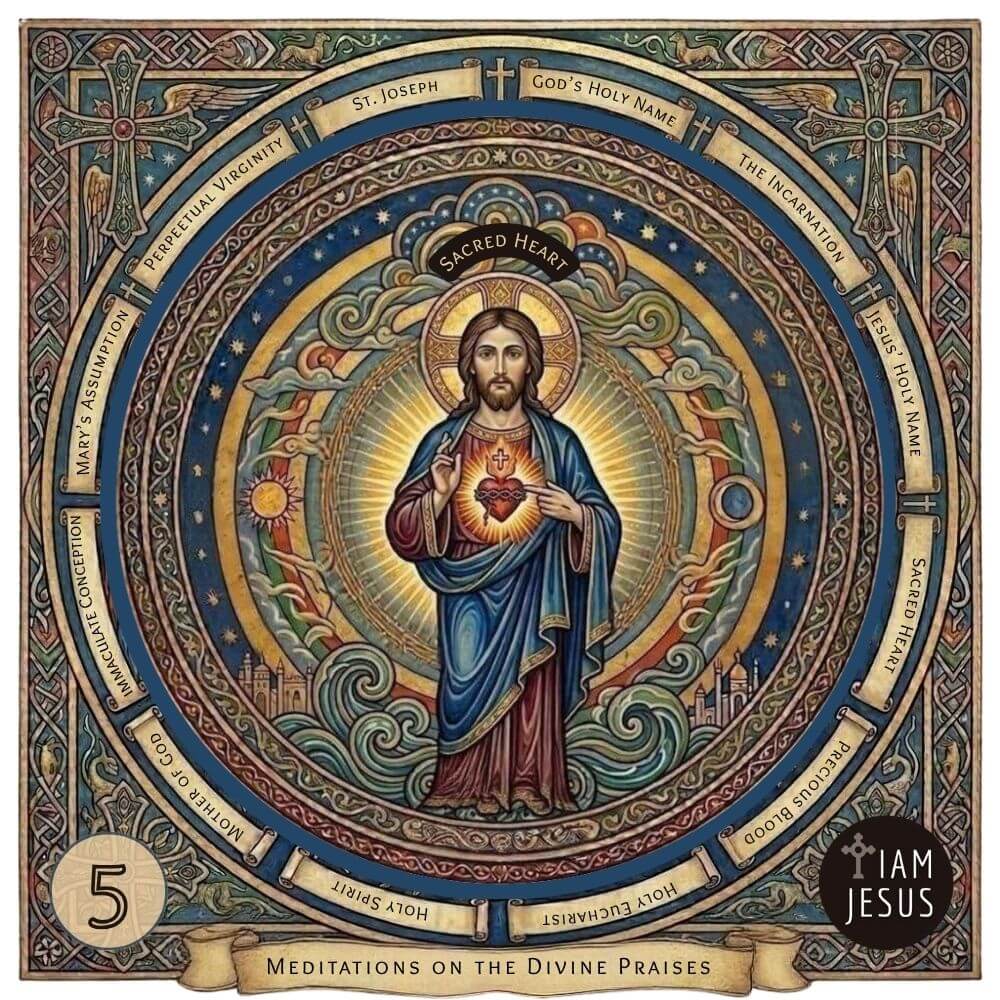
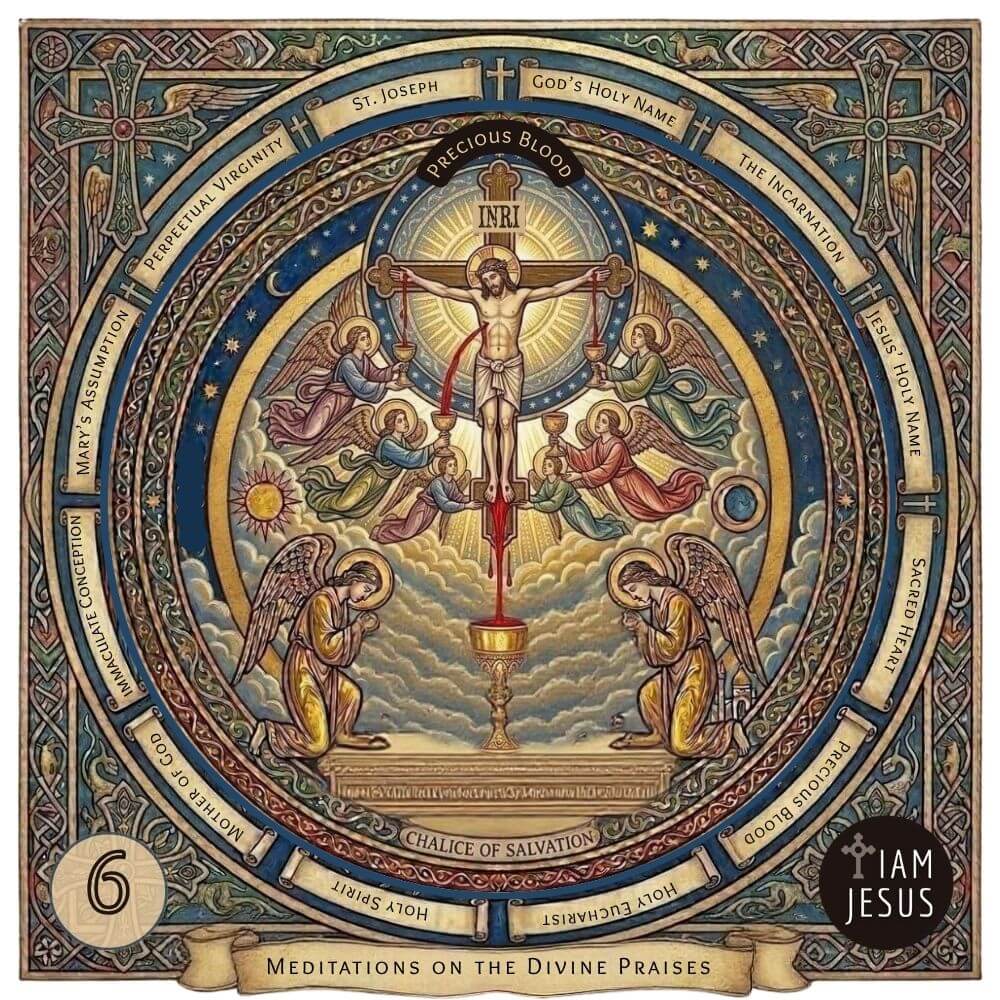
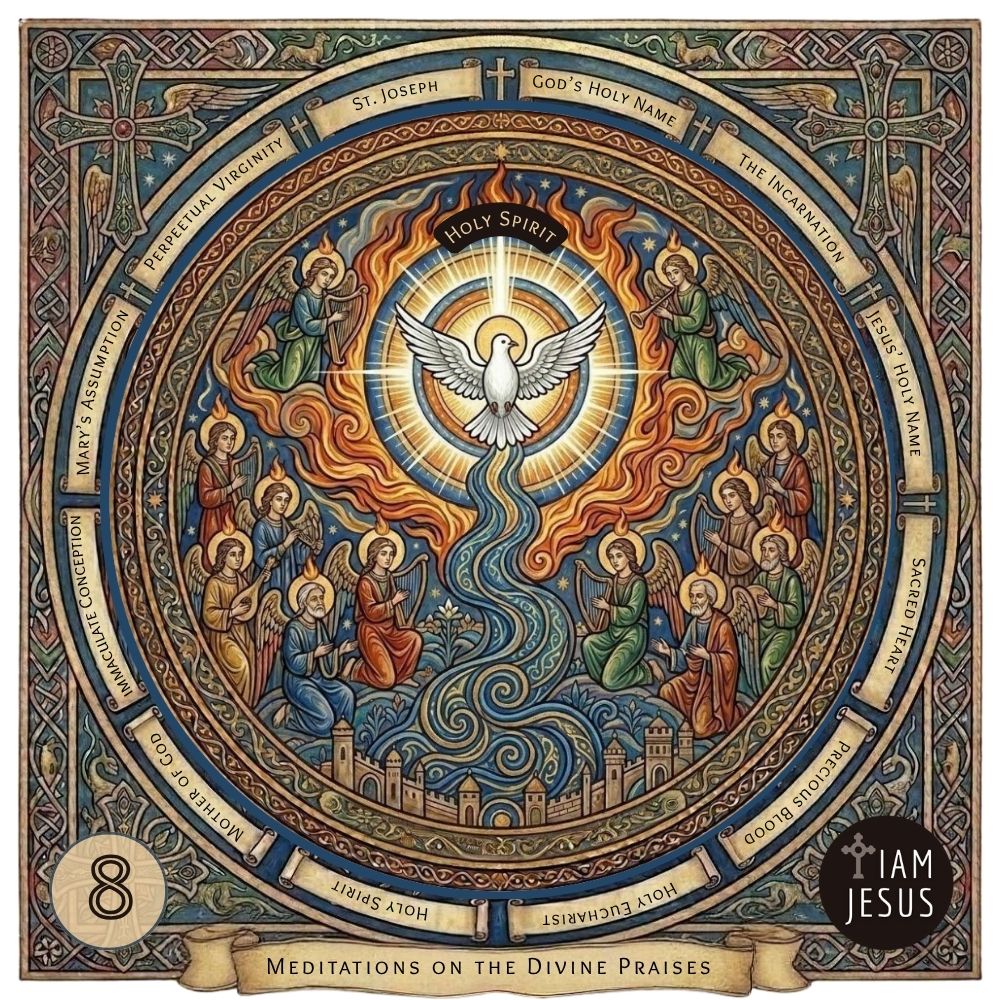
The Divine Praises Series is a 14-part prayer journey made to help you deeply reflect on each line of this beautiful prayer. Through simple stories, scripture, and heartfelt reflections, this series explores the holiness of God, the Sacred Heart of Jesus, and the special place of the Blessed Virgin Mary. It is the perfect companion for a quiet hour in the adoration chapel or for your daily prayer time at home.

One Response
Am gratefully for the lessons of catechism in learning about our mother Mary what she does in our lives.