The Five Visions
(Devil's seat)
(Christ)
(God)
pure light
Worldly Love → ... → Foolish Joy
Devil & Christ opposed
Pride → ... → Luxury
pure darkness
Gluttony → ... → Destruction of Souls
fruitfulness decaying into loss
Injustice → ... → Discord
| Part | Direction | Symbolic Reading | Vice-Category | Gateway Vice |
|---|---|---|---|---|
| I | East + South | Pure light — both sacred directions at once | Heart (Disordered Affection) | Amor Saeculi (Worldly Love) |
| II | West + North | Pure darkness — decline + the Devil's seat | Body (Appetite & Consumption) | Gula / Ingluvies (Gluttony) |
| III | North + East | Devil and Christ, directly opposed | Will (Self-Exaltation) | Superbia (Pride) |
| IV | South + West | Fruitfulness decaying into loss | Stewardship (Negligence & Misrule) | Injustitia (Injustice) |
| V | The whole earth | No fixed direction at all | Purpose (Aimlessness) | Scurrilitas (Scurrility) |
The Vice-Train: Five Chains, Five Gateway Vices
Part I — East and South: Pure Light
The Man's first orientation is the most luminous of all: East and South together, two directions of light rather than one, with no shadow to answer them. Fittingly, Part I is where the soul's most basic capacity — the heart's own affection — first goes astray. The chain begins with Worldly Love, the heart reaching for what feels good and natural rather than for God, and travels through Petulance, Jesting, Hard-Heartedness, Cowardice, and Anger before arriving at its gateway vice's full and settled form: Foolish Joy, a soul so at home in its own comfort that it no longer notices God's absence. That this entire disordered chain unfolds under a sky of pure light is itself the lesson — the corruption of the heart doesn't require darkness to take root. It can grow in full daylight, in a soul that never even registers that anything has gone wrong.
Part II — West and North: Pure Darkness
The Man turns fully away from the light here, facing West and North together — decline paired directly with the seat of the enemy. This is the darkest compass reading in the whole book, and it governs Part II's own descent into the body's appetite and consumption. Gluttony opens the chain, and it runs through Bitterness, Ruthlessness, Deceit, Strife, Despair, and Excess before ending at the only vice in the entire Liber Vitae Meritorum with no purgative remedy at all: Destruction of Souls. Every other vice in this book, however severe, is met with a path back. This one is described in reflexive, self-willed language — souls who "sent themselves" into ruin — matching, with unsettling precision, the Church's own teaching on final impenitence. It is no accident that the darkest direction on the compass governs the one vice from which there is no return.
Part III — North and East: Devil and Christ, Directly Opposed
Here the compass itself becomes a battlefield: North, the devil's own territory, set directly against East, one of Christ's own directions. Part III governs the will — the faculty that decides, ultimately, which of these two the soul will answer to. Pride opens this chain, named directly in Hildegard's own words as "the source of all faults and material and mother of all other evils" — and from Pride's refusal to submit follows Envy, Empty Glory, Disobedience, Unfaithfulness, and Despair, arriving finally at Luxury — the body's total surrender to appetite, once the will itself has already surrendered everything else. The compass reading makes the theology explicit: this is not a private struggle happening in a vacuum. It is Christ and the adversary contesting the same ground, in real time, for the same soul.
Part IV — South and West: Fruitfulness Decaying Into Loss
The Man turns again, this time to South and West together — one direction of divine radiance, one of decline, held in tension. Part IV governs stewardship: what a soul does with everything entrusted to it — time, position, relationships, resources — once its heart, self, and will have already been addressed in the Parts before. Injustice opens the gate, and the chain runs through Numbness, Forgetfulness, Changeableness, Care of Earthly Things, Obstinacy, and Desire, arriving at Discord — the vice who declares, in her own words, that she "turn[s] everything upside down — the noble to the ignoble, the rich to the poor — like a wheel." The compass reading fits precisely: fruitfulness is present here, unlike in Part II's total darkness, but it is fruitfulness actively decaying, squandered rather than stolen outright.
Part V — The Whole Earth: No Fixed Direction At All
For the first time, the Man stops facing any single direction. He looks out over the whole earth simultaneously — and this widened, cosmic gaze governs Part V's own theme: purpose, and what happens when a soul or an entire community loses its sense of why it exists at all. Scurrility opens this chain by mocking what deserves reverence, and the soul's own bearings unravel from there — through Aimlessness, Wrong Doing, and Avarice — until it arrives at the most purposeless portrait in the entire book: Sorrow of Time, a soul that has stopped reaching for anything because it no longer believes anything is worth reaching for. The compass itself tells us why this Part feels different from the four before it: a soul or a civilization untethered from purpose isn't just facing the wrong direction. It has no direction left to face.
Compiled from Pitra's Analecta Sacra Vol. VIII (1882) and cross-checked against Hozeski's English translation.
Why A Compass?
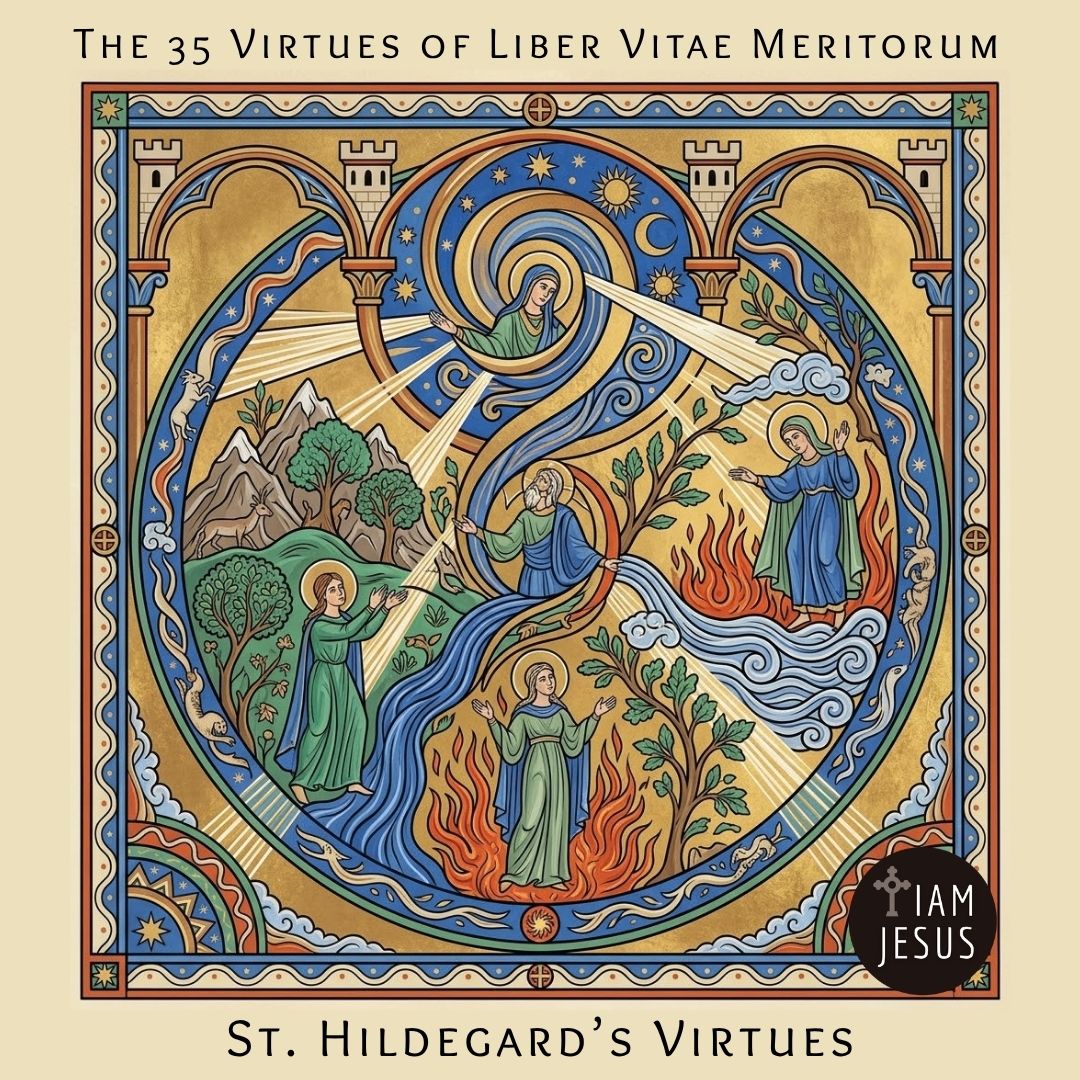
Throughout the Liber Vitae Meritorum, St. Hildegard sees a single figure standing at the center of every vision: a great Man, later revealed in Part 6 to be God himself in human form. He doesn’t stand still. Across the first four Parts of the book, he turns — facing East, then West, then North, then South, then combinations of these — and each direction he faces becomes the setting for a different chain of vice and virtue. By Part 5, he no longer faces any single direction at all. He looks out over “the whole earth” at once. And in Part 6, we finally see him move, as she puts it, “with the four zones of the earth” — the compass fully gathered up into a single, final vision.
This isn’t decoration. In Hildegard’s broader theological world, direction carries real weight: the North was long understood as the seat of the fallen angel’s pride, the direction from which Lucifer’s rebellion was said to originate, while the South held associations with divine radiance and the burning love of God. Reading each Part of this book against the direction the Man is facing gives us a second layer of meaning running underneath the vices and virtues themselves.
Part I — East and South: Pure Light
The Man’s first orientation is the most luminous of all: East and South together, two directions of light rather than one, with no shadow to answer them. Fittingly, Part I is where the soul’s most basic capacity — the heart’s own affection — first goes astray. The chain begins with Worldly Love, the heart reaching for what feels good and natural rather than for God, and travels through Petulance, Jesting, Hard-Heartedness, Cowardice, and Anger before arriving at its gateway vice’s full and settled form: Foolish Joy, a soul so at home in its own comfort that it no longer notices God’s absence. That this entire disordered chain unfolds under a sky of pure light is itself the lesson — the corruption of the heart doesn’t require darkness to take root. It can grow in full daylight, in a soul that never even registers that anything has gone wrong.
Part II — West and North: Pure Darkness
The Man turns fully away from the light here, facing West and North together — decline paired directly with the seat of the enemy. This is the darkest compass reading in the whole book, and it governs Part II’s own descent into the body’s appetite and consumption. Gluttony opens the chain, and it runs through Bitterness, Ruthlessness, Deceit, Strife, Despair, and Excess before ending at the only vice in the entire Liber Vitae Meritorum with no purgative remedy at all: Destruction of Souls. Every other vice in this book, however severe, is met with a path back. This one is described in reflexive, self-willed language — souls who “sent themselves” into ruin — matching, with unsettling precision, the Church’s own teaching on final impenitence. It is no accident that the darkest direction on the compass governs the one vice from which there is no return.
Part III — North and East: Devil and Christ, Directly Opposed
Here the compass itself becomes a battlefield: North, the devil’s own territory, set directly against East, one of Christ’s own directions. Part III governs the will — the faculty that decides, ultimately, which of these two the soul will answer to. Pride opens this chain, named directly in Hildegard’s own words as “the source of all faults and material and mother of all other evils” — and from Pride’s refusal to submit follows Envy, Empty Glory, Disobedience, Unfaithfulness, and Despair, arriving finally at Luxury — the body’s total surrender to appetite, once the will itself has already surrendered everything else. The compass reading makes the theology explicit: this is not a private struggle happening in a vacuum. It is Christ and the adversary contesting the same ground, in real time, for the same soul.
Part IV — South and West: Fruitfulness Decaying Into Loss
The Man turns again, this time to South and West together — one direction of divine radiance, one of decline, held in tension. Part IV governs stewardship: what a soul does with everything entrusted to it — time, position, relationships, resources — once its heart, self, and will have already been addressed in the Parts before. Injustice opens the gate, and the chain runs through Numbness, Forgetfulness, Changeableness, Care of Earthly Things, Obstinacy, and Desire, arriving at Discord — the vice who declares, in her own words, that she “turn[s] everything upside down — the noble to the ignoble, the rich to the poor — like a wheel.” The compass reading fits precisely: fruitfulness is present here, unlike in Part II’s total darkness, but it is fruitfulness actively decaying, squandered rather than stolen outright.
Part V — The Whole Earth: No Fixed Direction At All
For the first time, the Man stops facing any single direction. He looks out over the whole earth simultaneously — and this widened, cosmic gaze governs Part V’s own theme: purpose, and what happens when a soul or an entire community loses its sense of why it exists at all. Scurrility opens this chain by mocking what deserves reverence, and the soul’s own bearings unravel from there — through Aimlessness, Wrong Doing, and Avarice — until it arrives at the most purposeless portrait in the entire book: Sorrow of Time, a soul that has stopped reaching for anything because it no longer believes anything is worth reaching for. The compass itself tells us why this Part feels different from the four before it: a soul or a civilization untethered from purpose isn’t just facing the wrong direction. It has no direction left to face.
Part VI — Where the Compass Comes to Rest
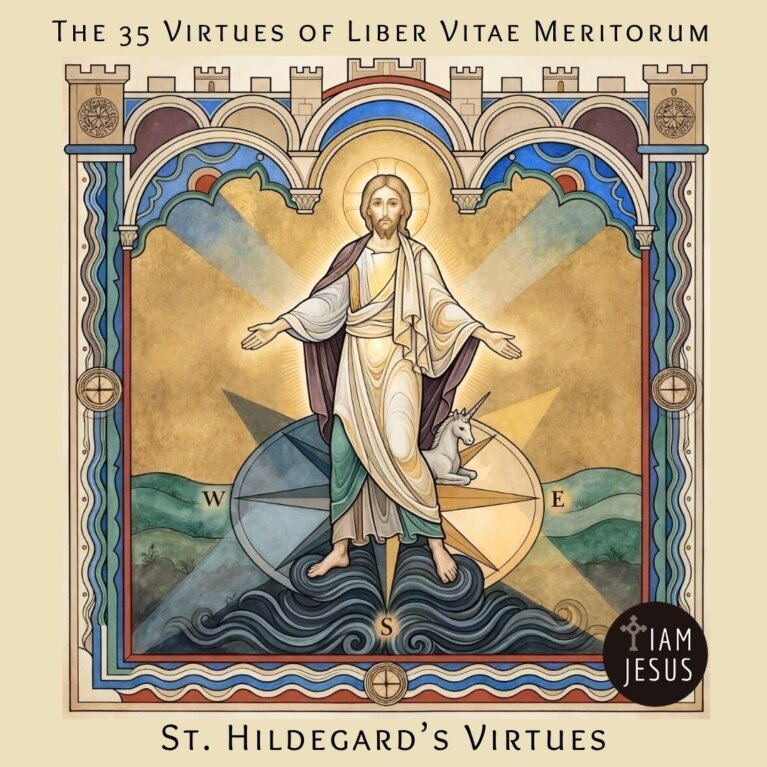
All four directions, and the whole earth besides, are finally gathered into a single vision. The Man moves “with the four zones of the earth” at once, and at his side rests a unicorn — Christ himself, revealed at last in the gentlest possible form, the same one who has been present as a lion, a fiery presence, a voice, and a weapon of judgment across every Part that came before. This is the compass’s true resting point: not one more direction to travel toward, but the end of travel altogether — the Celestial City, where every direction the soul was ever asked to face turns out to have been leading here all along.
Explore More from the St. Hildegard Virtue Series
This article is one piece of a larger body of work exploring St. Hildegard of Bingen’s Liber Vitae Meritorum and the theology behind her vision of the virtues. If St. Hildegard’s five visions of the compass orientation resonated with you, the pieces below go further into the sources, structure, and terminology that shape the entire series.