A Medieval Book for A Modern World
Although St. Hildegard of Bingen lived nearly a millennia ago, her work on the virtues is absolutely vital for the anxious, isolated, and aimless souls in our modern world who are seeking meaning in life and a sense of belonging. It’s as if she is speaking to us directly, and perhaps her long awaited canonization was for such a time as ours, so that our generation would be the one to embrace the wisdom of her work on the virtues so that we might all do our parts to save the secular culture we live in that has all but forgotten God and has lost all sense of virtue.
If you are interested in the theology behind the Book of the Rewards of Life, or Liber Vitae Meritorum, you’ve landed on the right page.
A Note on the Bridal Mysticism of the Book
Catholic readers formed in the tradition of mystical prayer—those who have encountered St. Gertrude the Great, St. John of the Cross, or St. Thérèse of Lisieux—will recognize something familiar in the Book of the Rewards of Life, even though its register is different from those more intimate mystical writers. St. Hildegard writes as a bride of Christ who has been married for many years: her love for God is no less ardent than the love of a newly-wed soul encountering Christ for the first time, but it has expanded outward to encompass the whole of creation. She doesn’t linger in the sweetness of personal encounter; she maps the territory of the Kingdom her Beloved governs. Both registers—the intimate and the cosmic—are authentic expressions of the same love, at different stages of the soul’s journey with God.
Readers who want to go deeper into this dimension of St. Hildegard’s spirituality will find her Ordo Virtutum—a musical morality play in which the Soul (Anima), depicted as a bride who has abandoned her Bridegroom, is reclaimed by the Virtues—a beautiful companion piece to the Book of the Rewards of Life.
St. Hildegard—As an Augustinian Mystic
If you have ever attended a Benedictine monastery or spent time with Benedictine spirituality, you have encountered a tradition formed by St. Augustine of Hippo — often without knowing it. From the very founding of the Benedictine order in the sixth century, St. Benedict of Nursia pointed his monks directly to St. Augustine’s writings. His Rule—the founding document of the entire tradition—explicitly recommends St. Augustine’s Confessions and sermons as essential reading. That single recommendation shaped a thousand years of Western Christian formation.
St. Augustine’s most famous line captures the heart of that tradition: “You have made us for yourself, O Lord, and our heart is restless until it rests in you” (Confessions, Book I). This is the sentence St. Hildegard had been breathing in for thirty years before she began writing her famous works. The Book of the Rewards of Life is built around this premise. Every vice in the book is a heart resting in the wrong thing—the world, the self, self-will, material possessions, and worldly pleasures. Every virtue is a heart that has found its rest in God and, from that rest, has become capable of genuine greenness, genuine warmth, genuine fruitfulness and most importantly, eternal purpose in life.
St. Hildegard takes Augustine’s philosophical vision of two cities—one built on love of self, one built on love of God—and does something no philosopher could do: she sees it. She shows it to us in color, in shape, in physical form, in the voices of personified vices and virtues speaking directly to our hearts. That is the gift of mystical vision, and it is the gift she is offering to every reader of this book. So when we look at her book, the Book of the Rewards of life or Liber Vitae Meritorum (the Latin Title of the Book), we can see how it complements St. Augustine’s City of God in a unique and unexpected way.
The Symphony of Salvation (Ordo Virtutum)
Woven into the pages of Scivias itself, St. Hildegard brought this interior combat to life through sacred song in the Ordo Virtutum (Order of the Virtues)—one of the earliest surviving moral plays in Western history. As a gifted composer, her musical heart shapes her entire vision of eternity. If you have never listened to her music, we highly recommend you find it on YouTube, iTunes, Qobuz, Spotify, or Bandcamp.
St. Hildegard teaches that holiness is a celestial symphonia. When we choose the heavy blindness of vice, we create screeching discord in our lives and relationships. But when we choose virtue, we allow the Holy Spirit to tune the broken strings of our hearts—and then we are sent to bring that same harmony to everyone God has placed in our path.
St. Hildegard’s Celestial City
St. Hildegard spent her life mapping out a single, grand reality: how regular Christians can break free from the heavy clay of sin, claim their divine inheritance, and become living stones built into the Celestial City. For St. Hildegard, salvation is not a concept to analyze—it is a visual journey and a breathtaking symphony of Divine love between God and his people.
To help you understand the broad strokes of her cosmic theology, her three masterworks reveal how the purification of your individual soul directly connects to the final victory of the Church:
- Know the Ways (Scivias) — Her Earliest Work. This book is the monumental foundation of her work that took over ten years to write. Scivias is a visual roadmap of the entire divine economy. Through unforgettable images of cosmic towers and radiant allegorical figures, she shows how the Church navigates the dark storms of human history. It teaches us that every daily battle for holiness plays a vital role in building God’s eternal kingdom.
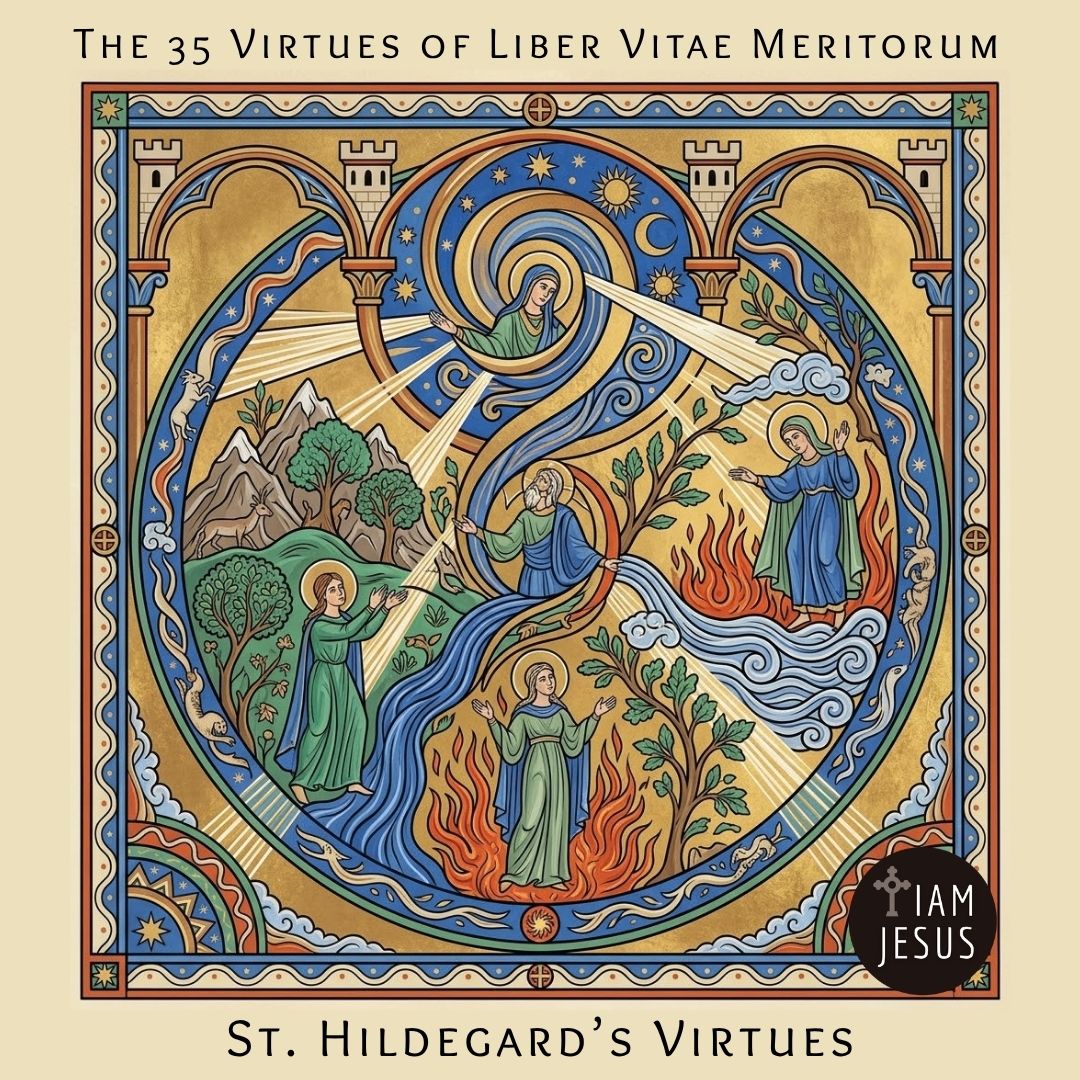
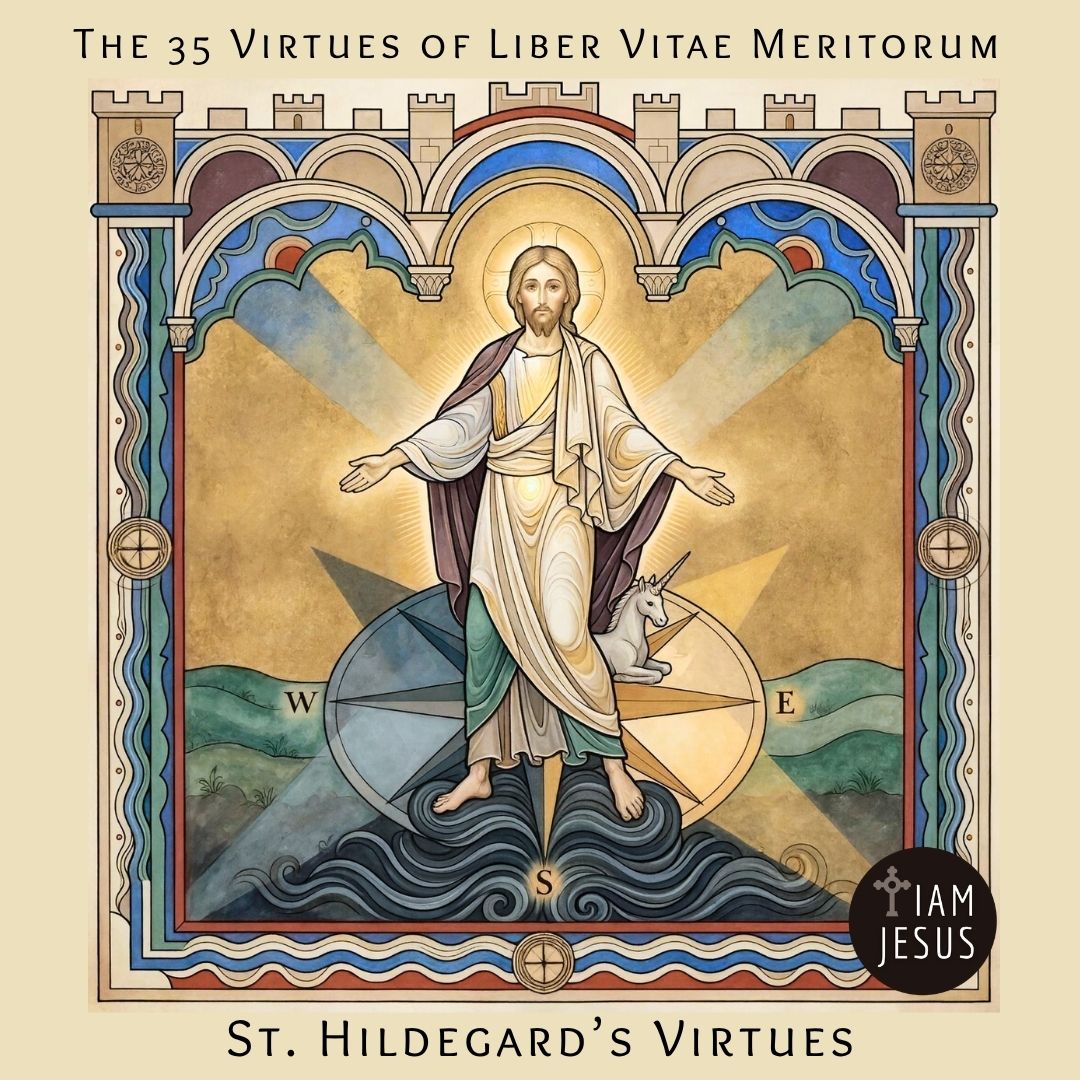
- The Book of the Rewards of Life (Liber Vitae Meritorum) — Her Middle Work. This is the specific blueprint for our 35-week prayer challenge. Here, St. Hildegard zooms directly into the human soul (the Microcosm) as an integral part of the Celestial City of God (the Macrocosm). She presents your interior life as a dynamic cosmic battlefield where 35 specific vices—and the virtues that defeat them—debate for your heart. It strips away our self-reliance and shows that true freedom is found only in total surrender to God, step-by-step.
- The Book of Divine Works (Liber Divinorum Operum) — Her Final Masterpiece. This work pulls back the veil on the entire universe (the Macrocosm). St. Hildegard reveals that you are not an accident; humanity is held directly in the heart of God. She shows how the structure of the cosmos, the history of salvation, and the architecture of the Church are completely interwoven. It reminds us that our personal choices ripple across creation, preparing the Bride of Christ for His Second Coming.
Explore More from the St. Hildegard Virtue Series
This article is one piece of a larger body of work exploring St. Hildegard of Bingen’s Liber Vitae Meritorum and the theology behind her vision of the virtues. If the theology behind the St. Hildegard Virtue Series resonated with you, the pieces below go further into the sources, structure, and imagery that shape the entire series.