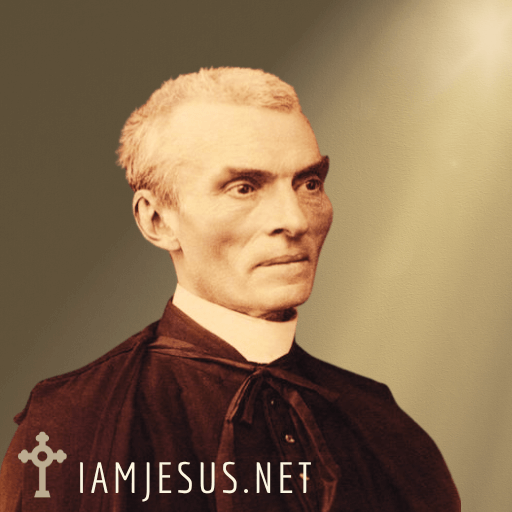
St. John of the Cross (1542-1591)
St. John of the Cross was the man chosen by God to assist and complement St.Teresa in the work of founding the Discalced Carmelite Order. So different in character and temperament, yet they were one in their passionate search for union with God – both were impelled with apostolic love and zeal. As St.Teresa desired to help the Church and obtain the sanctification of priests, John longed to help souls who were seeking union with God to climb the steep slopes of Mount Carmel by teaching them to walk the path of pure faith and complete detachment.
John was born probably in a small town in Old Castile called Fontiveros, in the year 1542, the youngest of three sons. His father was Gonzalo de Ypes and came from a wealthy family of silk merchants; his mother Catarina Alvarez, on the contrary, came from a poor humble weaving family. It was a love match and Gonzalo paid the price of being cut off from the family fortunes forever. John’s father died when he was about three years old. So John grew up experiencing great poverty in his home but also piety, love and gentleness. Catarina travelled to Toledo to seek assistance from her husband’s family, but was met with rejection and contempt. Finally she moved with her two sons – one of them had died, probably due to malnutrition – to Medina Del Campo.

John’s first education was at a school for the poor. This was like an orphanage where the children received food, clothes and lodging and were taught Christian doctrine. Later, he had the opportunity to become an apprentice and learn a trade. While here John was chosen by the priest in charge to be the acolyte in the sacristy of the nearby monastery of Augustinian nuns. He did not seem to have an aptitude for any trade but Don Alonso, the director of the hospital, noticed his great gentleness and patience for the poor who had infectious diseases. John was employed there, nursing with great compassion the poor people whom others did not wish to come near. Don Alonso continued to take an interest in John and had him enrolled in the Jesuit school where he would be given an excellent education, obtaining a knowledge of grammar, rhetoric, Latin, Greek and the Spanish Classics – tools which would facilitate his later work as a Spanish poet.
At this time it looked as though John might, with Don Alonso’s patronage, be ordained and become the chaplain to the hospital, which would lift his mother and brother out of their poverty. However instead, in 1563, at the age of twenty one he entered the newly founded monastery of the Carmelites at Medina del Campo. Perhaps he was drawn to the contemplative life. His devotion to Mary already had a significant place in his spiritual life. After his novitiate year he was sent to Salamanca University to study philosophy and theology. The professors at Salamanca at this time were among some of the most brilliant and renowned scholars in Europe. During his time at university John was noted for ‘his outstanding talent’ and reliability and so was made prefect of studies while still a student.
John became dissatisfied with the academic world of intellectual brilliance with its temptations to ambition and self-excellence. It was this that had moved him to ask to be admitted to the Carmelite Order. He began to think of the Carthusian life but God’s providence however, continued to bless John. St.Teresa was at this time in the city making arrangements for her second foundation of the Reformed Carmelites at Medina del Campo. She had permission from the General to found a monastery of Reformed Carmelite Friars who would minister to the spiritual needs of her nuns and she was looking for vocations for this new venture. She had one, Fr. Anthony of Jesus, the Prior of the monastery of the Carmelites of the Ancient Observance in Medina, but then she met John and was struck with his exceptional qualities and his desire for a more recollected life. Teresa persuaded him to join her friars, pointing out the advantages of living a more contemplative life while remaining within the Carmelite family. St.Teresa was not disappointed with her diminutive little friar for John was very short in stature; his virtues and his gifts for guiding souls to perfection were immensely valuable, not only for Teresa’s nuns but for all those who came to him for help.
Some people have misunderstood St. John of the Cross’s personality. He has come across to some as inhuman in his insistence on negation and complete detachment. Possibly this has come about by their reading some of his writings such as the Ascent of Mount Carmel and the Dark Night, which deal with the radical purification and prolonged spiritual darkness that chosen souls have to undergo before the soul can reach perfect union with God. These works are often read without a proper understanding or without balancing them with John’s sublime spiritual poetry about the soul’s passion for God and the commentaries he wrote for these poems. John was in fact a very gentle and humane person and he condemned any type of excessive penance that did not result in helping a person to become more gentle, humble and Christlike. Incidentally, St. John of the Cross ranks as one of Spain’s most distinguished poets.
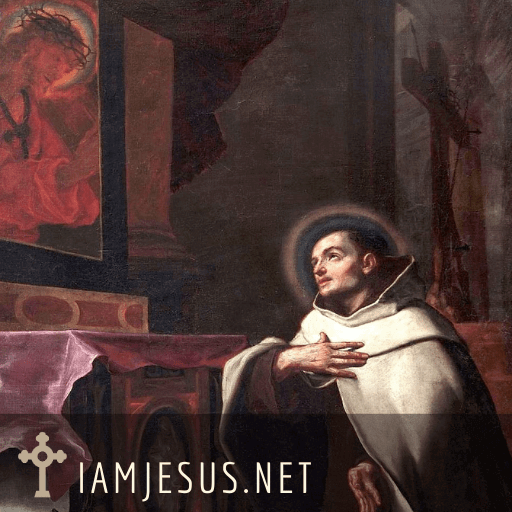
Once when John was praying before an image of Christ carrying the cross, he heard the voice of Christ saying. “What reward would you like to have from me for all you have done and all you have suffered?” John replied, “Lord, to suffer and be despised for you.” Indeed, his prayer was to be answered in due time. John continued to work in conjunction with St. Teresa for the spread of the Reform. He was an able Superior of the new monasteries for friars that he helped to found, but he preferred to apply himself to the more contemplative occupations of writing and manual labor. When he was made Superior of the new foundation in Segovia, he took the initiative of building a new monastery, including a new aqueduct system. He not only supervised its construction, but helped to lay the heavy stones with the masons.
St. John of the Cross continued to be a steadfast supporter of St.Teresa in her task of establishing the Discalced Carmelites. However, his persevering efforts for this cause earned him only the increasing dislike of the enemies of the Reform.
A crisis was reached when John and another friar were abducted and taken to a monastery in Toledo. For months he was imprisoned in a tiny cell, given practically nothing but bread and water, and frequently brought before the other friars to be scourged with a discipline. Amazingly, it was during his imprisonment that he composed some of his most beautiful poems. He became desperately ill and knew he would die if he did not manage to escape. One night, he managed to let himself down from his tiny window after knotting his sheets together and he escaped to the nearby monastery of the Discalced Nuns who hid him in the enclosure until he could safely leave the city.
After the Reformed Order became a separate Province, John again experienced suffering. Fearlessly speaking out against whatever he perceived as unjust, he incurred the displeasure of the new Reformed Vicar General by defending the nuns whom he considered were being dominated and by also defending Gratian. As a result he was he was not re-elected as one of the Advisors and was removed from his office as Prior of Segovia. There was no doubt that John was deeply hurt by this but he accepted it peacefully and offered himself for a mission to Mexico; his offer was accepted but later the decision was reversed. Not long afterwards John discovered that scandalous calumnies were being circulated against Gratian and himself with a view to bringing about their expulsion from the Order. By September 1991, John had developed erysipelas. He chose to retire to a monastery that was poor and had few medical facilities and where the Prior disliked him. During the three months of John’s dying illness, this Prior’s treatment of him was inhuman. Apart from continual humiliations, John was denied food and the medication he should have had to alleviate the excruciating pain his ulcerated and suppurating flesh was causing him. As word spread around that ‘little Fray John’ was dying, many people came to visit him or send special gifts, which annoyed the Prior even more, causing him to forbid friars from visiting John.
On December 13th, the saint received the Sacrament of the Sick; his pain was intense. He asked pardon of the Prior and friars for the trouble he had given them. Just before midnight, when they began the prayers for the dying, John begged them to read instead from passages from the Canticle of Canticles. At midnight, the bell for Matins rang. John said, “Glory to God, I shall say Matins in heaven.” After looking at each one tenderly, he kissed his crucifix, closed his eyes and said,” In manus tuas Domine commendo spiritum meum” and died. His journey through the night was over. He died as he lived – gently, humbly and tenderly (source).
“Take God for your spouse and friend and walk with him continually, and you will not sin and will learn to love, and the things you must do will work out prosperously for you.”
St. John of the Cross
St John of the Cross’s Feast Day is the 14th of December. He is the Patron Saint of Contemplative life, contemplatives, mystics, Spanish poets.
Learn about his life and works here.
More Saint Biographies to Explore
Draw closer to the Eucharist by walking alongside the holy men and women who paved the way. Explore our collection of saint biographies to discover their miraculous lives, mystical graces, and the timeless wisdom they left behind for our own spiritual journeys.