
Five Virtue/Vice Pairings That Give You Eternal Purpose
We finish the pairings with Part 5. In this Part we begin to enclose the sanctuary in our souls with a protective roof, as envisioned in the Celestial City of God. On this page, we will unpack the surface-level, theological, symbolic, and mystagogical meaning in the fifth part of St. Hildegard of Bingen’s Liber Vitae Meritorum.
Surface Level
The Five Pairs and the Chain of Purpose
Part 5 is the widest and most universal Part of the Book of the Rewards of Life—and St. Hildegard signals this immediately in her vision, showing us the great man no longer looking in one direction, but looking at the whole earth. This Part is not only about the individual soul. It is about communities, civilizations, and the entire human project. Its question is the deepest one: Why do you exist?
Five pairs trace the chain of lost purpose: Scurrility (the mockery of what is sacred), Aimlessness (the soul and community adrift without direction), Wrong Doing (acting against one’s own principles and the common good), Avarice (hoarding what should flow in justice), and finally Sorrow of Time — the most purposeless portrait in the entire book, a soul that has grieved itself empty over what it cannot hold.
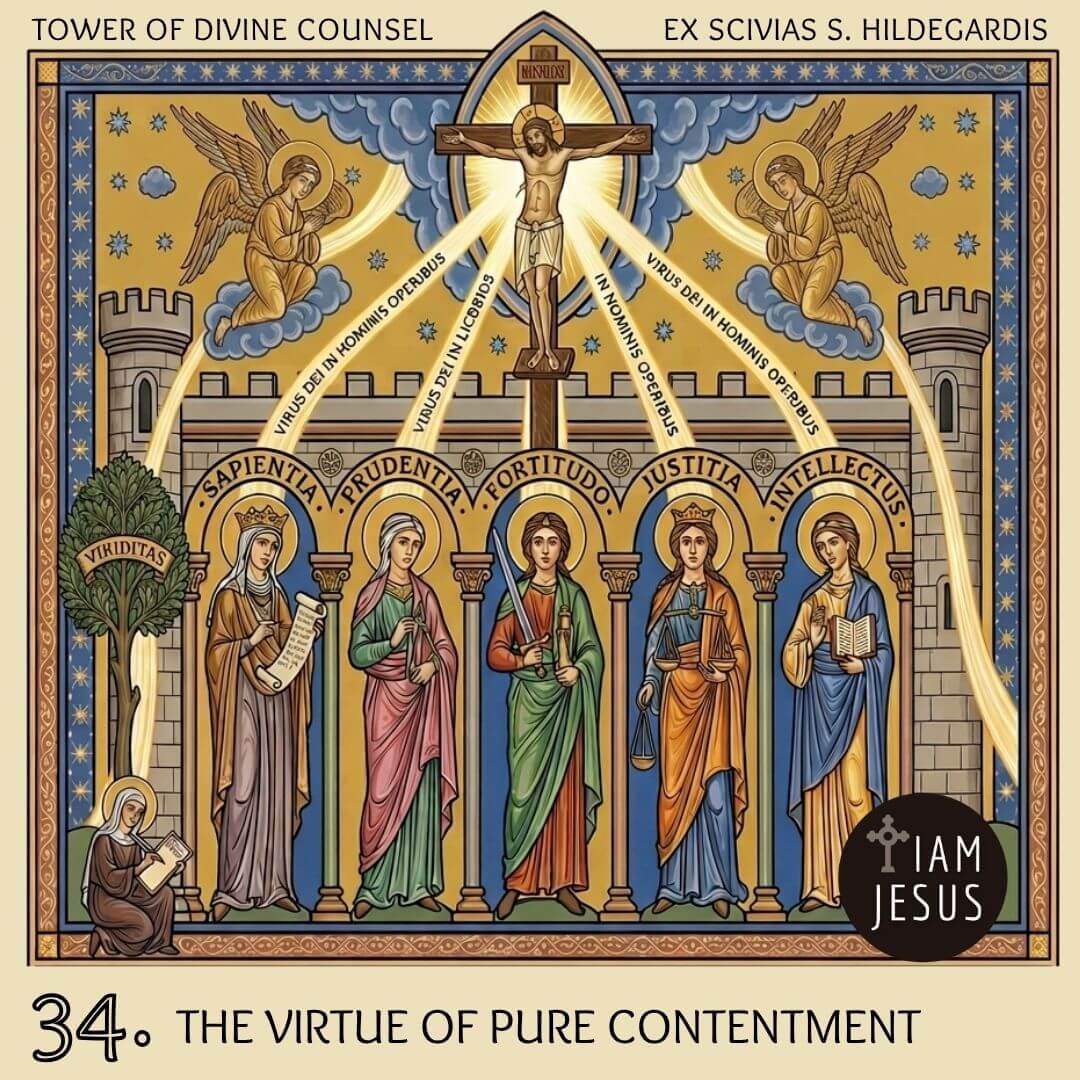
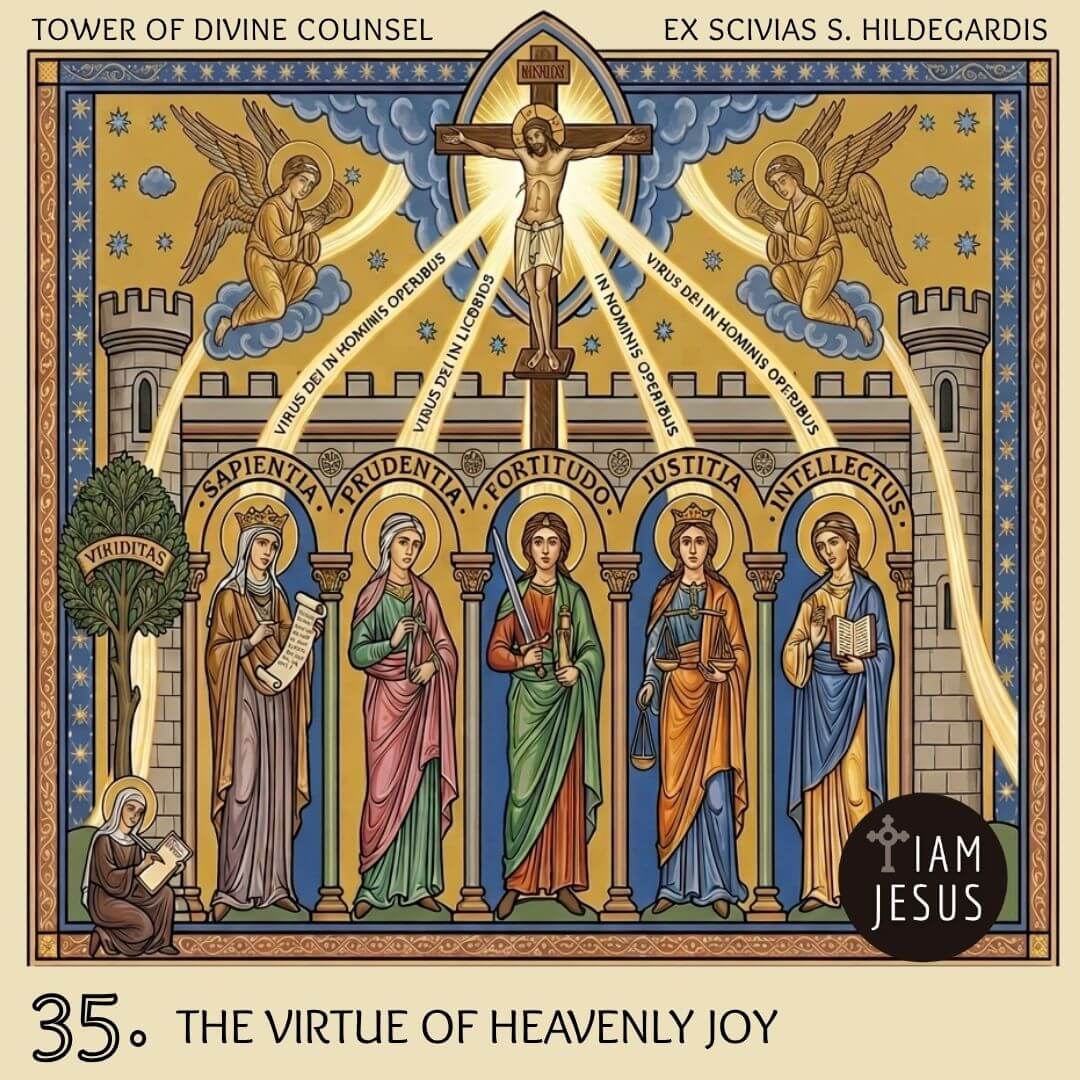
Five virtues answer them: Reverence, Quiet Stability, True Care of God, Pure Contentment, and Joy of Heaven. Together they are the portrait of a soul—and a community—that has found its true north: not in achievement or accumulation or recognition, but in God, whose purposes are the only ones that outlast time. These five meditations are an invitation to discover that the deepest human ache—the sense of purposelessness so common in the modern world—is not a malfunction. It is a compass pointing home.
Theological Level
Purpose, the Common Good, and the City of God
Augustine wrote The City of God in response to the fall of Rome—a civilization that had organized itself around earthly glory, appetite, and power, and discovered, in the end, that none of these were sufficient reason for a civilization to exist. Part 5 is St. Hildegard’s vision of exactly that collapse, traced through five pairs that move from mockery of the sacred to purposeless grief. The chain of Part 5 is, in essence, St. Augustine’s diagnosis of the earthly city in miniature.
Catholic social teaching has always insisted that human beings are not merely individuals—we are social creatures, made for community, and the health of that community depends on its orientation toward God. The Catechism teaches that “the common good presupposes respect for the person as such” and that society is ordered toward the flourishing of human beings made in God’s image (CCC 1906-1912). Part 5’s chain shows what happens when a community loses that orientation: reverence collapses (Scurrility), direction disappears (Aimlessness), principle is abandoned (Wrong Doing), resources are hoarded against justice (Avarice), and the whole project ends in purposeless grief (Sorrow of Time).
Note St. Hildegard’s placement of Avarice in Part 5 rather than Part 2—she treats it as a vice of governance and communal stewardship, not merely of personal appetite. This is a theologically precise distinction: the misdirected accumulation of what should serve the common good is a social sin before it is a personal one. Part 5 is where the interior journey of Parts 1 through 4 meets the world—and asks what mark a rightly ordered soul will leave on the civilization it inhabits.
Symbolic Level
Every Part before this one gave you a chain to walk: vice after vice and the corresponding virtues that answer each one.
The Scattering Wind and the Joy That Remains
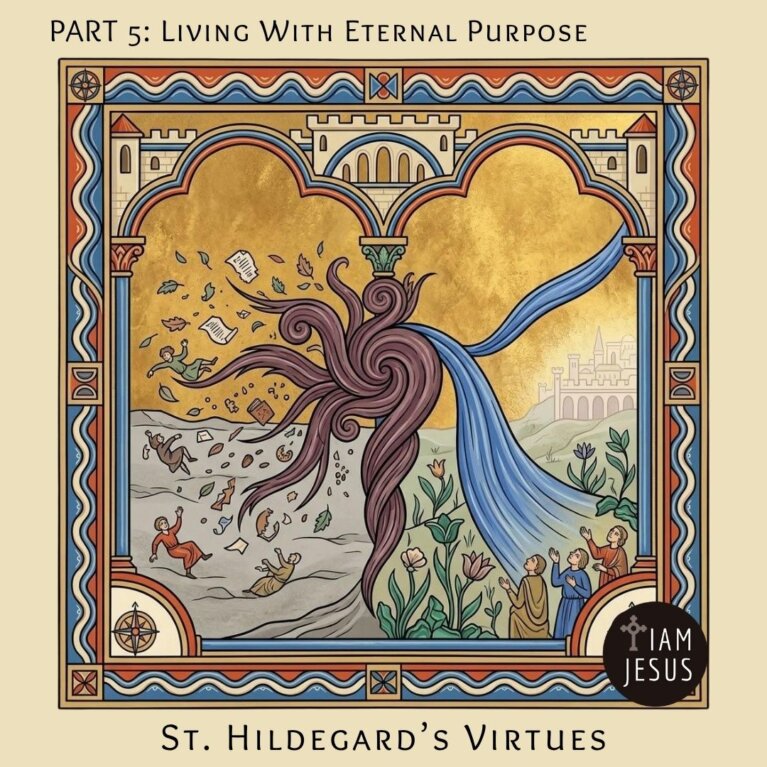
Part 5’s most precise symbolic image belongs to Sorrow of Time, the terminus vice: “It is like a wind that does not have the usefulness of greenness or dryness, but that simply scatters everything it touches…sorrow of time dries up all living things” (Liber Vitae Meritorum, Part 5, Section 64, Para. 83, trans. Hozeski). This is St. Hildegard’s elemental portrait of purposelessness: the air element, which in its true form should carry the Spirit’s breath and draw the soul toward heavenly things, has become a wind with no direction, touching everything and accomplishing nothing.
The contrast with Joy of Heaven could not be more complete. Where Sorrow of Time scatters, Joy of Heaven gathers. Where Sorrow dries up living things, Joy of Heaven is surrounded by the fragrance of living blossoms, the sound of music, the warmth of light. In St. Hildegard’s vision of Part 6—which immediately follows Part 5—the souls who have lived in virtue are clothed in the beautiful dawn and the splendor of the sun, their voices filled with every kind of music, rooted in the fullness of what God always intended.
Watch for the imagery of wind and breath throughout Part 5’s meditations—the scattering wind of purposelessness answered by the breath of the Spirit that draws all things toward God. This is the air element in its two forms: scattered and purposeless on one side, directed and life-giving on the other. Part 5 asks you to notice which kind of wind is moving through your own life right now—and to open yourself to the One who breathes where he wills.
A Note to Watch For
He appears once more here, and this time not as a lion, not as a fiery face, but as something colder and stranger: a brazen club, “like the club of a murderer,” fixed in the abyss, moving as if ready to strike. And it speaks: “O destructive mockers who are opposed to God, you want to ascend to the summit, but you will descend into hell. I will drag you away from honor… I will throw you down like a rotting body that is dead” (Liber Vitae Meritorum, Part 5, Section 12, Para. 19). This is his fiercest form yet—appropriate, perhaps, to a vision that has widened from one soul’s own interior struggle to love and obey God, to the whole earth, and everything in it that resists God’s justice.
Mystagogical Level
The Soul That Has Found Its Song
At the deepest level, Part 5 is about what St. Hildegard calls symphonia—the cosmic harmony of creation oriented toward God—and its opposite, the scattering discord of a soul or a civilization that has lost its song. Throughout the Book of the Rewards of Life, virtue is associated with music: Chastity’s life is a symphony, the souls in heaven fill their voices with every kind of music, the virtues themselves sing in the Ordo Virtutum while the devil can only howl. Vice, by contrast, is noise, scattering, wind without direction.
Part 5’s mystagogical invitation is the most sweeping in the entire book: it asks not just about your individual soul but about your role in the larger song. You were created with a specific part to sing in the great harmony of creation—a gift, a calling, a purpose that only you can fulfill in the particular community and moment in history God has placed you in. When that purpose is lost—when Scurrility has mocked reverence, Aimlessness has scattered direction, and Sorrow of Time has dried up the last green shoot of hope—the song has a gap in it.
The five virtues of Part 5 are the invitation to fill that gap: to stand in reverence before what deserves reverence, to find your stability in God rather than in circumstances, to act with integrity in your community, to hold your goods with open hands, and finally to discover the Joy of Heaven that no grief of time can touch. This is your part in the symphony. Part 5’s meditations are your invitation to find it, claim it, and begin to sing.
Why This Vice Chain Matters More Mystagogically
As you move through these five weeks, hold onto this: the closer a soul draws to Christ and to real holiness, the more fiercely the enemy works to pull it back. This is not a sign that something has gone wrong in your spiritual life—it is often a sign that something has finally gone right. But take heart, because the same chain that shows a vice deepening also shows Christ’s own zeal deepening to meet it. He does not leave you to fight alone. Every virtue you have prayed for across this whole journey—every small grace already given you—is the very Fortitude you gained in Week 24 that He now fights beside you with. Ask for these virtues. Desire them. The Holy Spirit’s viriditas is not withheld from any soul who asks; it is offered “without discrimination,” and it is entirely up to us to cooperate with the grace already extended.
Part 5 — Purpose: Why Do You Exist?
Are you ready to break through the noise of the modern world and discover why you truly exist? Welcome to Part 5: Living with Eternal Purpose, the final, most expansive phase of our journey through St. Hildegard’s Liber Vitae Meritorum. In this section, we move beyond the individual soul to look at our place within our communities, our civilizations, and God’s cosmic harmony. Don’t let your soul drift in the scattering winds of the world—claim your place in the divine symphony today.
Visit St. Hildegard Virtues the Complete Library Page
This meditation is part of a 35-week prayerful journey through Saint Hildegard of Bingen’s masterpiece, The Book of the Rewards of Life. If you are seeking to step away from the noise and anxiety of the modern world, we invite you to return to our complete St. Hildegard Virtues library, where you can explore the full roadmap for your weekly Holy Hour reflections. There, you will discover all six parts of this sacred series, designed to help you break free from the fog of vice, cultivate the renewing life-force of the Holy Spirit, and build your interior life as a living stone in God’s Celestial City.