
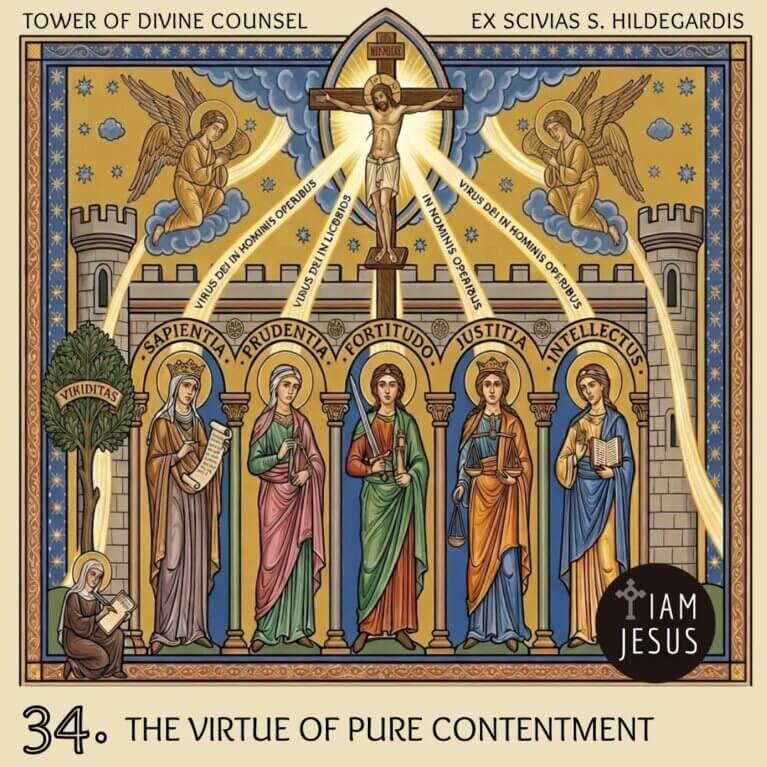
Overcoming A Greedy Heart
Today we look at how to heal a greedy heart through the virtue of pure contentment, and how it thwarts the love of money and desire to accumulate material goods. Last time we looked at the tragedy of a divided heart. Today, we uncover how those quiet compromises snowball into an anxious, greedy mind—and find St. Hildegard’s path to pure contentment in this Part 5 meditation.
Opening Prayer
Lord, not only do I lack pure contentment in the material world, but my greedy heart has hurt my spiritual life in many ways. What I have done to advance myself in profit, honor, prestige, and power, has caused damage to my relationship with you and those I am called to love.
My efforts to gain mastery of myself through riches have not shown good fruit. It has not made me more holy, righteous, or virtuous. On the contrary, my works have caused a wake of destruction in my personal life. This is because I failed to put you first, about all else; I have also failed to love the people you have given me. I lack pure contentment because I lack an intimate relationship with you that is humble, obedient, and loving. This has gravely affected my ability to have a substantial and meaningful relationship with my family.
Lord, I want to change my heart’s desires. Please help me be humble and have fear of offending you, so that I might live my life longing for God, and not for the things of this world. Jesus, you love me unconditionally, but it is my duty to love you back and to obey all that you have taught me. I do not want to betray you for money as Judas Iscariot did. My greedy heart is causing me deep regret, and I’m remorseful for having chosen love of money over God in my life.
Lord, you are my pearl of great price, and I am willing to turn away from worldly distractions and stop being materialistic just to follow you. Please give me a heart of pure contentment so that I may serve you and follow you all the remaining days of my life.
AMEN
The tenth commandment forbids greed and the desire to amass earthly goods without limit. It forbids avarice arising from a passion for riches and their attendant power. It also forbids the
desire to commit injustice by harming our neighbor in his temporal goods:When the Law says, “You shall not covet,” these words
mean that we should banish our desires for whatever does
not belong to us. Our thirst for another’s goods is immense,
infinite, never quenched. Thus it is written: “He who loves
money never has money enough.”Catechism, 1236
What is the Virtue of Pure Contentment?
In Catholic moral theology, the virtue of pure contentment is the ultimate spiritual shield against a greedy heart, freeing the soul by anchoring its desires entirely in God’s perfect grace. It stands in direct opposition to the spirit of avarice, which is an inordinate, insatiable hunger for earthly possessions, wealth, power, or prestige. St. Hildegard of Bingen teaches that this worldly attachment leaves the soul anxious, envious, and perpetually restless, as it relies on material things rather than the Creator for security. When we actively practice pure contentment, we confidently recognize that God’s gifts are entirely sufficient for us, breaking the cycle of constant dissatisfaction and quieting the anxious mind.
This transformation requires us to shift our focus away from the empty pursuit of wealth and find our true value through the eyes of Christ. The enemy loves to exploit a greedy heart, using the pressures of a consumer-driven world to convince us that we must accumulate material goods to prove our worth or escape the criticisms of others. Pure contentment pulls us out of this trap by fostering a spirit of deep humility and joyful surrender. By intentionally letting go of selfish ambitions and cultivating an intimate, obedient relationship with Jesus, we replace internal disquietude with lasting peace, transforming our hearts into tranquil spaces where we can rest fully in divine providence.
The Face Of Avarice
Avarice has human form but no hair—dishonesty in the will, nothing cultivated there but bare desire. A goat’s beard, because it loves foulness over its own beauty. Small pupils, wide whites—the mark of envy. Hands of iron for pillaging without mercy. Bloody shins, because it has killed for what it wanted. And the lion’s feet, carried forward from Wrong Doing, now walking and plundering “ferociously, sparing nothing” (Liber Vitae Meritorum, Part 5, Section 33, Para. 43, trans. Hozeski). Before her stands a tree, rooted in Gehenna, bearing fruit that is “pitchy and sulfurous” (Liber Vitae Meritorum, Part 5, Section 33, Para. 45, trans. Hozeski)—and she gazes at it carefully, then seizes its fruit and “devours it avidly in its mouth,” without any moderation at all. Watch this tree closely. It reappears, one vice later, at Sorrow of Time’s own back—except by then, every leaf on it “has dried up completely” (Liber Vitae Meritorum, Part 5, Section 35, Para. 47, trans. Hozeski). Avarice’s own unlimited consumption is what leaves nothing behind for the soul to find later but a dead and fruitless tree.
How this builds the foundation for what comes next:
A soul that hoards and consumes without limit isn’t merely storing up wealth. It is stripping bare the very source it depends on — until there is nothing left to draw from, and grief is all that remains.
Pray for Pure Contentment now.
Ask for the grace to hold what you’ve been given with open hands rather than a grasping fist. A contented soul doesn’t need to strip the tree bare, because it already trusts there will be enough.
St. Hildegard’s Remedy: How To Tame a Greedy Heart
by St. Hildegard of Bingen
The Words of Avarice
“I am not foolish, but I am wiser than those who look at the winds and then demand that the air give them everything they need. I snatch all things to myself; I gather all things to my bosom; the more I have collected, the more I have. For it is better for me to have whatever I need than to beg from others. I am not wrong when I carry things away from a person who has more than he needs, for when I have whatever I need, I do not worry about needing something from someone else. When I have all the things I want in my bosom, I fortunately am filled and delighted. At such times I do not fear anybody, but I live in blessedness and do not need anybody’s mercy. I am cleverly wise and no one deceives me when I demand all things. How can this hurt me? I am not a thief or a robber, but I take all the things I want and acquire all of them with my own craftiness.”
The Response of Pure Contentment
“I again heard a voice from the storm cloud respond to this image: ‘O diabolical fraud, you are quick to plunder, like a wolf, and you devour another person’s things, like a vulture. But gross pus also boils up in you since you are burdened with illicit desires, like a camel with its burdens. You are like the mouth of a wolf that is open and ready to devour things. You lie in hardness and forget God because you do not trust him… I, however, sit above the stars where all of God’s good things are sufficient for me, and I rejoice in the sweet sound of a tambourine when I trust in him. I kiss the sun when I hold him with joy; I embrace the moon when I hold him in love and when all the things that have come into existence from the sun and moon are sufficient for me. Why should I desire more than I need? Because as a result of my having mercy for all things, my garment is made from white silk…’ ”
St. Hildegard of Bingen, Liber Vitae Meritorum (The Book of the Rewards of Life),
Part 5, Sections 8-9, Paras. 12-13 (Trans. Hozeski)
Reflection:
We all struggle with having material wants in this life. I think it is part of the human condition to want things we don’t have. But when do the things I want become a sin that separates me from God?
This transition happens quietly when we lose sight of our spiritual worth. When we lack understanding of who we are in Christ, it causes us to seek our identity through the opinions of those around us. Our sense of self becomes attached to the praise and criticisms of others, and this drives us to prove our worth on the world’s stage. So we strive to make something of ourselves at all costs to counter the criticisms and to increase the praises of those in our orbit.
This way of living causes us to value things over people and self over God. Ultimately it becomes a living lie—the exact same trap that ensnared Judas—because we seek to hide things from others so that we remain in their approval and are not criticized. We can’t handle being critiqued. All our energy goes into being above our critics and proving they were wrong about us. This mentality fuels our pride and avarice, and is the reason we lie to ourselves and deny the truth.
“Where are the rulers of the nations, and those who lorded it over the beasts of the earth; those who made sport of the birds of the sky, and who hoarded up silver and gold in which men trust, and of whose getting there is no end; those who schemed for silver and are anxious, whose labors are beyond tracking? They have vanished and gone down to Hades, and others have risen up in their place.”
Baruch 3:16–19
Reflect on How Much You Really Love God
The Prophet Baruch’s warning is a sobering reminder of what happens when we refuse to let go of our attachments; those who spend their lives scheming for silver vanish in their anxiety, perfectly illustrating Avarice’s delusion that ‘the more I have collected, the more I have.’ We must reflect honestly about whether or not we have loved God more than any material thing.
God is more worthy of our love than any other thing because of his greater goodness. He has given you your life. He has provided you with countless grace over the course of your life so that you might know and love and follow him.
What should matter to you most is whether God approves of your doings. If God is with you, then who can possibly be against you? The humble man can receive criticism well, whether it be just and honest or an attack on his character. This is because the humble man loves God above all else and he lives to serve God and not man. If God uses a man to correct him justly, he will accept with gratitude. If a man attacks him unjustly with false criticisms then he is able to receive them in silence knowing he is justified in God’s eyes.
How have you responded to God’s love for you? Are you able to accept just criticism humbly? Can you ignore false accusations in silence knowing that God sees the truth? This is the beginning of having pure contentment in God.
Take a moment to reflect on all the ways he has given you grace so that you could come to know him, love him, and worship him as he desires. Ask him to reveal to you his love through the memories of your life. Acknowledge these memories. Do they move your heart toward love of God? Do your memories reveal his infinite goodness? If you have not responded to his grace with love in the past and you have not confessed this sin to him already, take some time to repent. Tell the Lord you are sorry for the times you received grace but did not return his love with love. Tell him you want to change your greedy heart to one of pure contentment. This might be prayed in writing. You may want to take some time this week to write a letter to God professing your gratitude for all the graces you have been given throughout your life and then offer a promise to him for the remaining days of your life.
Changing My Greedy Heart to One of Pure Contentment
Now ask the Lord to give you the grace to overcome your greedy heart.
Ponder this verse:
“But blessed are your eyes, because they see, and your ears, because they hear. Amen, I say to you, many prophets and righteous people longed to see what you see but did not see it, and to hear what you hear but did not hear it” [Matthew 13:16-17].
Offer God a moment of gratitude from your heart right now. God has blessed you with the ability to see what you see and hear what you hear. He has given you grace to convert your heart. If you desire to change and desire to love God then the Holy Spirit is already at work in you. Can you see what God sees in you? Can you hear what God is saying to you? Put your hand on your heart. Feel love for God and let that love radiate from your heart to his heart. Say thank you to Jesus for this moment.
How Our Path Toward God Gets Disrupted by Greed and Avarice
If we are honest with ourselves and wise in the way we see the secular world around us, it is easy to see that when Christ is made absent in a place darkness and destruction follows. Jesus Christ is the light of the world, and when the light of Christ is not shining brightly, people make themselves their own gods and are consumed by their own greedy hearts. We know that our efforts are necessary to establish and keep ourselves in communication with Christ. [Matthew 13:18-23].
St. Hildegard tells us that God’s gifts are sufficient for us. We need no material thing in this life to have pure contentment. We see this in the lives of the desert monks, like St. Paul of Thebes. When his brother-in-law threatened to turn him into authorities for having converted to Christianity, Paul the First Hermit, fled to the desert at age 22 and lived out the rest of his life in solitude until he died at age 113. St. Paul the First Hermit gave up everything for an inner life of the spiritual and it led him to asceticism. He was visited by St. Anthony and St. Athanasius.
Going Further:
If you would like to go deeper, you may want to read Matthew 13:44-50. Building on our reflection of Judas last week, Jesus explicitly shows us how to heal a greedy, anxious heart in that passage.
Anchoring the Restless Soul:
Take a moment to pause, drop your defensive walls, and settle into the absolute stillness of this adoration chapel. A greedy heart is an anxious, exhausting trap—an insatiable hunger for material possessions, wealth, and worldly status driven by our fear of criticism and a desire to prove our worth to others. When we value things over people and self over God, we entangle our souls in a living lie that destroys our interior peace. Before we open the Word of God, let us offer up a sincere prayer of petition—asking for the profound humility to stop being materialistic, quiet our anxious desires, and rest fully in divine providence.
Prayer of Petition
Eternal Father, I am the work of your creation, made in your image and likeness but too weak to conquer the devil by my own power. I ask you for the grace to grow in virtue, surrendering all my thoughts, words, and deeds to you. Please help me resist the devil and all his tricks. Jesus says that whoever believes in him will do the works that he does and that whatever we ask in Jesus’ name he will do so that You may be glorified. Heavenly Father, you sent us your Son to show us what it means to have perfect virtue in life. Jesus is fully human and fully divine and has perfect virtue. Father, have mercy on me and please give me the grace I need to grow in the virtue of pure contentment so that I might grow in holiness and imitate Christ in my thoughts, words, and deeds. AMEN.
The Progression of the Fall: From Divided to Greedy
Last week, we looked at the tragedy of Judas at the Last Supper as a warning of how internal corruption results in hollow, transactional worship. But corruption doesn’t happen overnight. This week, St. Hildegard’s text pulls back the curtain on how Judas’s heart became so decayed. In her vision, Pure Contentment exposes Avarice as a ‘diabolical fraud’ that is ‘quick to plunder like a wolf’ and ‘devour like a vulture.’ When we look at the Gospel of John, we see this exact animalistic greed play out in Judas.
When we look at the Gospel of John, we see the quiet, daily compromises that led to his ultimate downfall. When Mary beautifully pours out her costly nard to adore Christ, it is Judas who scoffs, masking his greed behind a fake concern for the poor. Holy Scripture exposes the raw truth: he didn’t care about the poor; he was a thief who held the money bag and stole from it.
Now let’s contemplate the Lord by listening to him speak to us in the Gospels. Slowly meditate on the following passage, reflecting on the virtue of pure contentment. Take your time. Pause over a word or phrase that speaks to your heart. Reread the passage again, and then ask Jesus to show you how you can imitate him in his inner love of the spiritual and better overcome your greedy heart and the worldly attachments you struggle with. Choose a word or phrase from this passage to write in your journal, and add your thoughts. Go back and prayerfully re-read it throughout the week.
How the Greed Of Judas Iscariot Led to Betrayal
from the Gospel of John Chapter 12:1-9, Luke 22:1-6
Six days before Passover Jesus came to Bethany, where Lazarus was, whom Jesus had raised from the dead. They gave a dinner for him there, and Martha served, while Lazarus was one of those reclining at table with him. Mary took a liter of costly perfumed oil made from genuine aromatic nard and anointed the feet of Jesus and dried them with her hair; the house was filled with the fragrance of the oil.
Then Judas the Iscariot, one [of] his disciples, and the one who would betray him, said, “Why was this oil not sold for three hundred days’ wages and given to the poor?” He said this not because he cared about the poor but because he was a thief and held the money bag and used to steal the contributions.
So Jesus said, “Leave her alone. Let her keep this for the day of my burial. You always have the poor with you, but you do not always have me.”
The Conspiracy Against Jesus
Now the feast of Unleavened Bread, called the Passover, was drawing near, and the chief priests and the scribes were seeking a way to put [Jesus] to death, for they were afraid of the people. Then Satan entered into Judas, the one surnamed Iscariot, who was counted among the Twelve, and he went to the chief priests and temple guards to discuss a plan for handing him over to them.
They were pleased and agreed to pay him money.
He accepted their offer and sought a favorable opportunity to hand him over to them in the absence of a crowd.
Let us Pray:
Jesus, I thank you for the countless ways you have come to me to give me grace and show me how much you love me. I thank you for the people you have given me in this life and entrusted to me to love and serve and honor for your sake. Let me be a seed that takes root and grows in good soil.
Jesus, let me choose you over money all the remaining days of my life. Show me a path that is pleasing to you. Help me mend what has been broken due to my greedy heart and sins of avarice. Let me have perfect contrition and an obedient heart of love for you.
I do not want my greed to take me down a path that is irrevocable, as Judas Iscariot did. I want to walk with you, Lord, and communicate with you Lord, and live in pure contentment as the desert fathers did.
AMEN.
A Prayer for an Increase in Virtue for Others
Lord Jesus Christ, you say that when two or more are gathered in your name, you are with us. Jesus, in your name I lift up every person who has joined this prayer challenge or will join it in the future. I ask you to give us all the grace we need to grow in virtue and holiness so that we may love and serve you in our lives and through the people we love and care for. Help us in our thoughts, our words, and our actions. Guide us all by your Holy Spirit and give us the strength to overcome every temptation from the evil one. We ask all this in the name of the Father, and of the Son, and of the Holy Spirit, AMEN.
Together as a group we will pray for each other and strive to make good resolutions and keep them. Remember, it’s your heart that God wants to capture. Your efforts are out of love for him and a desire to imitate him as best you can in holiness.
If you fail, do not quit trying. Be merciful to yourself and learn to love the process of striving to be more like Jesus every day. Just take it one day at a time, and stay in the present moment with Jesus.
Being virtuous is a process. No one is perfect, so just start anew every time you fail.
The Shared Talents: Your Week 34 Send-Off
Thank you for your dedication to Week 34. Overcoming a greedy heart and choosing pure contentment requires deep interior maturity. When you feel financial anxiety creep back in, or catch yourself trying to accumulate things this week, do not let discouragement take root. Reclaiming your focus is a daily process of surrender, not an overnight shift. Take immediate accountability when your focus wavers, and let the Sacrament of Reconciliation restore your peace.
True contentment anchors your security firmly in God’s love rather than material possessions. You are called to actively drop your personal idols, accept just corrections with gratitude, and rest fully in divine providence. Let’s look at what the Catechism says:
On coming into the world, man is not equipped with
everything he needs for developing his bodily and spiritual life.
He needs others. Differences appear tied to age, physical abilities,
intellectual or moral aptitudes, the benefits derived from social
commerce, and the distribution of wealth. The “talents” are not
distributed equally.These differences belong to God’s plan, who wills that
each receive what he needs from others, and that those endowed
with particular “talents” share the benefits with those who need
them. These differences encourage and often oblige persons to
practice generosity, kindness, and sharing of goods; they foster the
mutual enrichment of cultures:“I distribute the virtues quite diversely; I do not give all of them to each person, but some to one, some to others. . . . I shall give principally charity to one; justice to another; humility to this one, a living faith to that one. . . . And so I have given many gifts and graces, both spiritual and temporal, with such diversity that I have not given everything to one single person, so that you may be constrained to practice charity towards one
another. . . . I have willed that one should need another and that all should be my ministers in distributing the graces and gifts they have received from me” [Jesus to St. Catherine of Siena, Dial. I, 7].Catechism, 1936-1937
Make a Resolution
Take a moment to reflect on the virtue of pure contentment. What are the ways you can freely practice this virtue this week? Ask the Lord to give you opportunities, and when you feel the Holy Spirit prompting you, take action. Write down your resolutions for this coming week in your prayer journal. Remind yourself to complete these resolutions daily for this entire week, and as the Spirit prompts you, feel free to write about your experiences with this virtue throughout the week.

In My Thoughts:
Jesus, this week I promise to take time daily to conform my thoughts by… (make your intention).
In My Words:
Jesus, this week I promise to take time daily to conform my words by… (make your intention).
In My Actions:
Jesus, this week I promise to take time daily to conform my actions by… (make your intention).
Pray the Litany of Virtues prayer.
Join our Virtue Meditation Prayer Challenge
Don't let spiritual overwhelm hold you back!
Let us guide you step-by-step through Saint Hildegard’s transformative path to holiness.
Receive one long-form meditation in your inbox each week—perfect for a powerful 35-minute holy hour.
