
Our faith in Jesus relies on the grace He gives us. Where does this grace come from? Grace is a free gift given to us by God, and God give us tremendous grace when we receive the Body, Blood, Soul and Divinity of Jesus Christ in the Eucharist. Scripture shows us the importance of the Bread of Life and the Blood of Christ. This is found in both the Old Testament through the need for the shedding of blood to atone for sin as well as in the Manna from Heaven to sustain the exiles until they reached the promised land. We know that the Manna was kept in the Ark of the Covenant, the Holy of Holies. It was a precursor for the Body of Christ given to us through the Holy Sacrifice of the Mass.
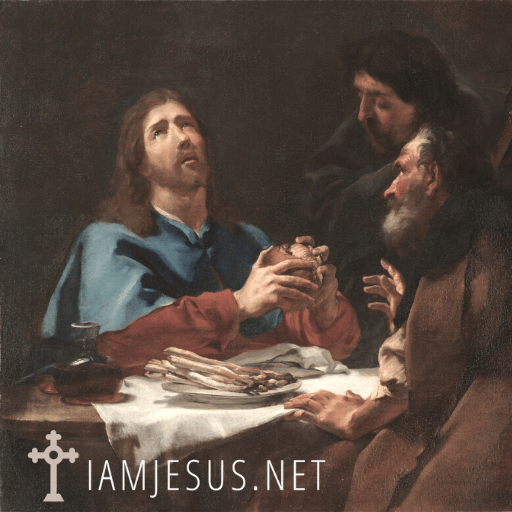
Are you needing faith in Jesus? Have you found yourself lacking? Let’s look at the two disciples that met our Lord on the Road to Emmaus after His crucifixion and resurrection. They walked with Him and they spoke with Him, yet they did not recognize Him until the breaking of the BREAD.
Road to Emmaus: Faith in Jesus is in the Breaking of the Bread
Gospel of Luke 24:13-35
Now that very day two of them were going to a village seven miles from Jerusalem called Emmaus, and they were conversing about all the things that had occurred.
And it happened that while they were conversing and debating, Jesus himself drew near and walked with them, but their eyes were prevented from recognizing him.
He asked them, “What are you discussing as you walk along?”
They stopped, looking downcast. One of them, named Cleopas, said to him in reply, “Are you the only visitor to Jerusalem who does not know of the things that have taken place there in these days?”
And he replied to them, “What sort of things?”
They said to him, “The things that happened to Jesus the Nazarene, who was a prophet mighty in deed and word before God and all the people, how our chief priests and rulers both handed him over to a sentence of death and crucified him. But we were hoping that he would be the one to redeem Israel; and besides all this, it is now the third day since this took place. Some women from our group, however, have astounded us: they were at the tomb early in the morning and did not find his body; they came back and reported that they had indeed seen a vision of angels who announced that he was alive. Then some of those with us went to the tomb and found things just as the women had described, but him they did not see.”
And he said to them, “Oh, how foolish you are! How slow of heart to believe all that the prophets spoke! Was it not necessary that the Messiah should suffer these things and enter into his glory?” Then beginning with Moses and all the prophets, he interpreted to them what referred to him in all the scriptures.
As they approached the village to which they were going, he gave the impression that he was going on farther. But they urged him, “Stay with us, for it is nearly evening and the day is almost over.”
So he went in to stay with them. And it happened that, while he was with them at table, he took bread, said the blessing, broke it, and gave it to them. With that their eyes were opened and they recognized him, but he vanished from their sight.
Then they said to each other, “Were not our hearts burning [within us] while he spoke to us on the way and opened the scriptures to us?”
So they set out at once and returned to Jerusalem where they found gathered together the eleven and those with them who were saying, “The Lord has truly been raised and has appeared to Simon!”
Then the two recounted what had taken place on the way and how he was made known to them in the breaking of the bread.
Jesus Presence in the Breaking of the Bread
What is in this event, this breaking of the bread, that causes the two disciples to finally recognize Jesus who was with them all along, sharing the Gospel and reminding them of the purpose of the messiah? Why was it that even though He was present to them, still they did not RECOGNIZE Jesus’ presence?
Why did Jesus give us the Last Supper? Why do we really lack faith in Jesus?
What is the Eucharist all about? Why does it have such an important place in the life of the Church? Why is it called the Source and Summit of our FAITH? Why is it harder to have faith in Jesus when we do not frequent holy Communion? Is there something more to it than we realize?
There is that word again, faith. And this faith is tied so closely to the Bread of Life, not just the symbolic terminology that comes from Jesus Himself saying that He is the Bread of Life.
No.
Look at the bigger picture. Look at all the instances where Jesus and bread are intertwined in scripture.
There is always real bread. There is always real food being eaten. There is always an increase in the faith of the people.
Except in one occasion where Jesus warned about Judas Iscariot, whose heart was hard and who was a betrayer. In this case, in the last supper, we see Judas receive and do so with bad intent and unworthily, and then the devil entered him.
Wow. What does this mean?
Let’s look at St. Peter Julian Eymard’s reflection on faith in Jesus’ presence in the Eucharist for a better understanding of how the Eucharist is the source and summit of our faith.
Get Ready to Meditate on Scripture with Prayer
Let’s pray and ask the Holy Spirit to come and fill our hearts and our minds, imparting the wisdom of God and the understanding of scripture.
Before we delve into this meditation, I want you to reflect a moment on the following verse, and then pray for the indwelling of the Holy Spirit as you read St. Peter Julian Eymard’s reflection below. Bring yourself into Jesus’ presence right now. Try to imagine Jesus looking at you in your mind. Imagine His face right now, think about Him sitting across from you at the table, and He is about to break bread with you.
Jesus presence in Our Lives
John 6:44-59
Faith in Jesus Presence in the Eucharist
How happy we would be if we had a lively faith in the Most Blessed Sacrament!
For the Eucharist is the royal truth of faith; it is the virtue and sovereign act of love, the whole of religion in action. O! but if we knew the gift of God!
But belief in the Eucharist is a treasure we must seek by submissiveness, preserve by piety, and defend at any cost.
Not to believe in the Blessed Sacrament is the greatest of misfortunes.
Part I
First of all, is it possible for one who formerly believed and received Communion to lose all faith in the Blessed Sacrament? No, I do not think so. A child may despise his father and insult his mother, but it is impossible for him not to recognize them. In the same way, a Christian cannot deny that he has communicated; he cannot forget that he was happy at least once.
Unbelief in the Eucharist is never a result of the evidence of the reasons advanced against this mystery.
Suppose that a man, immersed in temporal affairs, has allowed his faith to grow torpid, to lie dormant. He has forgotten; but let the grace of God arouse him, the ordinary grace of conversion, and he will instinctively come back to the Eucharist first of all.
Passions that dominate the heart are another source of unbelief. A passion that wants to have its own way knows no mercy. When fully gratified, it scorns the object of its pleasure; when attacked, it denies. “How long is it,” we may ask, “since you have ceased believing in the Eucharist?” And by tracing this loss of faith to its source, we find a weakness, an evil impulse which he did not have the courage to resist.
A faith that has gone on weakening and doubting over a long period of time is another source of unbelief. The sight of so many who are indifferent and live like unbelievers scandalizes us. The crafty arguments and sophisms drummed into our ears by a false science are also an object of scandal. Why does our Lord let these things go unpunished? Why does He allow Himself to be insulted if He is there? So many unbelievers are honest people!
That is the kind of wavering faith that leads one to a loss of belief in the Eucharist.
An untold misfortune indeed, for then, like the Capernaumites, we separate ourselves from Him Who has the words of truth and life.
Part II
What are the consequences of unbelief in the Eucharist? It is a denial of the power of God. What?! God is present under this mean appearance? It is impossible, and who can believe it?
The unbeliever accuses Jesus Christ of falsehood, for our Savior said: “This is My Body. This is My Blood.”
He despises our Lord’s goodness, like the disciples who, on hearing the Eucharistic promise, “went back and walked no more with” their Divine Master.
Moreover, his faith in the other mysteries will soon be shaken and destroyed. If he does not believe in this living Mystery, the truth of which is confirmed by an actual fact, in what mystery will he believe?
His virtue will soon become sterile; it is deprived of its natural food; it no longer associates with Jesus Christ from Whom it drew all its vigor; it loses sight of Jesus, its living Model, and forgets Him.
His piety dries up almost immediately; it has lost its center of life and affection.
Consequently, he is without consolation in the trials of life, and if his tribulations become too great, he falls into despair. A sorrow that cannot find an outlet into the heart of a friend soon becomes overwhelming.
Part III
Let us then believe in the Eucharist. “I believe, Lord,” we should often say, “help my tottering faith!” There is nothing that gives greater glory to our Lord than this act of faith in His Eucharistic presence.
It honors His Divine truthfulness in a supereminent fashion; the greatest honor that can be offered any man is to believe him on his word, just as the greatest insult would be to suspect him of lying, to doubt his word, and to demand proof of a guarantee. Now, if a child believes his father on his word, a servant his master, a subject his king, why not believe Jesus Christ on His word when He declares with an oath that He is present in the Most Blessed Sacrament?
This simple and absolute act of faith in the word of Jesus Christ gives Him glory because it pays Him the homage of recognition and adoration in His hidden state. The honor paid to a friend in disguise, or to a king without his royal insignia, is greater than any other, because it is really the person who is then honored and not his trappings.
So it goes with Jesus in the Most Blessed Sacrament; to honor Him, to believe in His Divinity in spite of the veil of weakness thrown over Him is to honor His Divine Person and to respect the mystery which envelops Him.
Such an act of faith adds to our merit. Like Peter confessing the Divinity of the Son of man, like the Good Thief declaring the innocence of the Crucified, we proclaim Jesus Christ to be what He really is in spite of what He seems to be. Still more, we believe the opposite of what our senses tell us relying solely on the truth of His infallible word.
Let us believe, and believe firmly in the Real Presence of Jesus in the Eucharist! Jesus Christ is there! When we enter a church, a feeling of respect should come upon us, a respect of faith and love on meeting Jesus Christ in person; for it is indeed He Whom we are meeting.
Let that be our apostolate, our preaching; it is the most eloquent for the unbelievers and the impious.
Prayer of Faith in Jesus Presence in the Holy Eucharist
My good Jesus,
I believe with a firm faith that the Blessed Sacrament is truly Your Body and Blood, Soul and Divinity. I believe that in this consecrated Host I will receive the same Body which was born of the most pure Virgin Mary, which suffered pains and torments for love of me on the Way to Calvary, and which rose gloriously the third day from the dead.
I believe that the consecrated Host I will receive is God Himself.
I adore You, O my God, as my Creator, my Preserver, my Redeemer, and my Judge, truly present in the Holy Eucharist.
Divine Host, I adore You with the angels who fill the sanctuary and hover over the tabernacle as they hovered over the cave of Bethlehem at Your birth; I adore Thee, my God, with the Blessed Virgin, and in union with all the saints.
Lord and Master of the universe, Who has made Your dwelling among men, I adore You with profound gratitude. O my Jesus, bless my body wherein You shall Reside, and make me a worthy temple of Your Holy Ghost. I offer You my heart as a living abode and place of rest.
Deign ever to inhabit it by Your grace and Your love, and may my sins never banish You from it! Lord, I have a firm faith, but do strengthen my faith, and animate it so that it may produce in my soul deeper sentiments of adoration and love.
Good Lord, increase my faith that I may love You more, and be more generous in my sacrifices for love of You and for the love of my neighbors.
AMEN.
Faith in Jesus presence in the Eucharist requires the outpouring of the Holy Spirit. You see, faith is a theological virtue, and we cannot possess it without the action of God in our lives. If you pray for an increase in faith in Jesus presence, God will give this to you through His Holy Spirit because His desire is for you to know Him and love Him.
Let us read the scriptures again, this time the words of St. Paul the Apostle. Again, call upon the Holy Spirit for enlightenment. Ask for the grace to understand the scriptures and to have faith in Jesus presence.