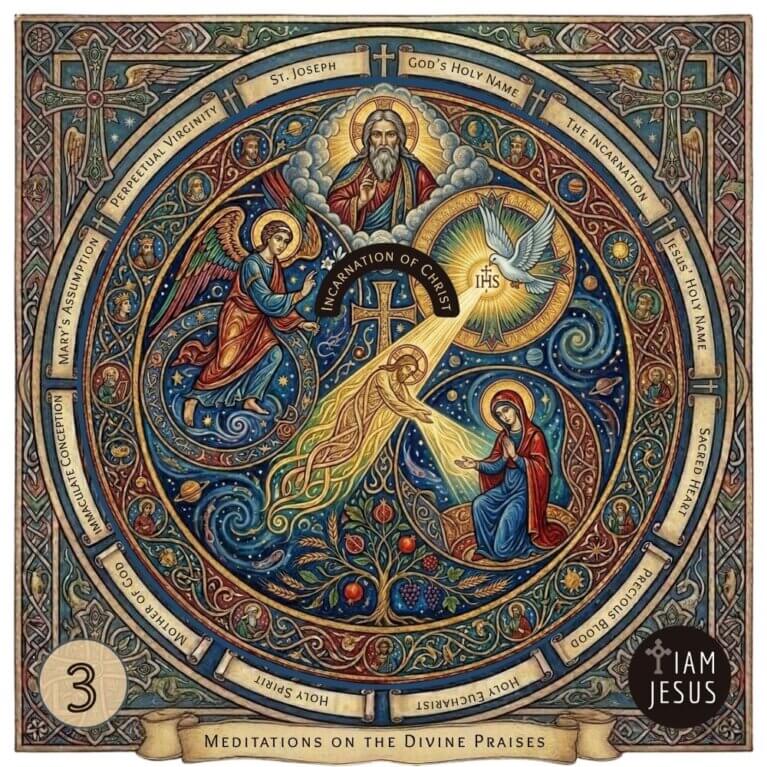
What does “True God and True Man” mean? When we profess Jesus Christ is true God and true man, we believe that Jesus is both fully human and fully divine, united in one person. The technical term for this is hypostatic union. This means his human nature and divine nature are distinct, separate, and in perfect harmony. When we accept this as true we profess to believe in the Incarnation of Christ. Jesus, who is eternally begotten of the Father as the second person of the holy Trinity, came to earth and became Incarnate in the womb of the Virgin Mary. So in this way we can say that Christ who always was and always will be [John 8:58], assumed a human form. The word incarnation literally means to take on flesh.
The History of Belief in the Incarnation
Where does the Church come to believe that Jesus is true God and true man?
As Christians, we believe in the Incarnation of Christ because the Church has proclaimed this is true since the 1st century and it is central to the Christian faith. The Catechism of the Catholic Church says that God became man to redeem us. He did it to reveal how much he loves us, and to show us how to live in this life. The Nicene Creed in the 4th century and the Chalcedonian Creed in the 5th century both profess to believe Jesus is fully God and fully human.
Over the centuries there have been many heresies to deny this truth. Without belief in the Incarnation, however, we don’t properly understand the reason for Christ’s crucifixion and death or how we can receive the Holy Spirit and have eternal life. Our understanding of salvation depends on believing Christ had to become fully human first before he could share his full divinity with us.
The Bible also affirms that Jesus is God Incarnate
Let’s first look at Jesus in his humanity. In Jesus’ humanity he has a body, mind, soul, and will just like us. He was born an infant who needed the care of a tender mother and loving father. The Bible tells us that Jesus grew up experiencing a completely human life. He grew and developed [Luke 2:52], had emotions [John 11:35], and felt stress [Luke 22:44] just like we do. He lived the challenges of ordinary life like we do, but he did this while remaining sinless. In this way he is a perfect model for us on how to live the Christian faith in our humanity. He is like us in his humanity in everything except sin.
In Jesus’ divinity he is the Eternal Word of God [John 1:1]. This means that Jesus existed eternally before becoming Incarnate, sharing the same divine nature as the Father. In his divinity, Christ possesses the power to perform miracles [Matthew 19:26], forgive sins [Matthew 9:1-8], and offer salvation [John 14:6]. This belief explains the reason Jesus became human; he offered himself as a sacrifice for our sins to show us the depth of God’s love for us and his desire to be united with us and to give us a share in the divine life [2 Peter 1:4].
Jesus, the Word Made Flesh
In summary, Jesus Christ is true God and true man. His humanity and his divinity are in harmony. For this reason, he is the one and only mediator between God and men who can atone for our sins by his sacrifice and feed us with his Body and Blood [1 Timothy 2:5-6]. He can do this because he humbled himself and became a man who was obedient in all things, even to suffering a cruel death on the Cross [Philippians 2:6-8].
Belief in the true Incarnation of the Son of God is the distinctive sign of Christian faith:
“By this you know the Spirit of God: every spirit which confesses that Jesus Christ has come in the flesh is of God.” [1 John 4:2]
Such is the joyous conviction of the Church from her beginning whenever she sings “the mystery of our religion”: “He was manifested in the flesh.”
Catechism, 463
Why Must we Believe in the Incarnation?
From the beginning there were many false gospels that arose and challenged the belief of the Incarnation. The Apostles taught their disciples to hold fast to their teachings and traditions [2 Thessalonians 2:15] and to reject false teachers who deny that Jesus Christ came in the flesh [2 John 1:7].
Heresies Deny the Incarnation of Jesus Christ
In the second century, Irenaeus, a disciple of Polycarp (who was discipled by John the Apostle), wrote extensively about the Incarnation of Christ. He argued against all heresies that denied this truth in his book, Against Heresies. And there were many. And there are still many.
Two such heresies that deny the Incarnation of Christ are Arianism and Nestorianism. While these heretical sects have faded since ancient times, their heretical beliefs resurface in modern spiritual movements. We still see them today.
Now, the Arians believed that Jesus was a created human being and he was not born with a divine nature. They held that he was distinct from God and that he was not an eternal being consubstantial with the Father. They also falsely claimed that Jesus was adopted by God as his son after his birth. The Nestorians, on the other hand, believed that Jesus existed in two distinct persons and that they were separate and not in harmony with each other. So in this heresy, the Nestorians falsely claimed that Jesus was crucified as a human and not as the Incarnate Son of God.
Modern Heresies also Deny Christ is True God and True Man
As mentioned above, today there are many Christians who hold gnostic beliefs that deny the Incarnation of Christ as true God and true man in a hypostatic union, and this is in direct contradiction to the Catholic faith. Gnosticism is present in every generation. In Gnosticism, the goal is to acquire secret knowledge about the spiritual realm. There is always a newness in the ideologies that counters and opposes Apostolic truth. When religious ‘experts’ disagree about core Biblical beliefs and ancient Apostolic teaching they are professing a false ideology that is rooted in Gnosticism. There is a lack of unity in Gnostic ideologies, and this is why St. Irenaeus wrote such a lengthy book about heresies!
Book of Enoch and the Incarnation of Christ
If you are exposed to claims that there are “lost gospels” or ancient books somehow “removed” by the Church that are worthy of belief, understand that this is just nonsense. Ancient Gnostic texts were never considered canonical, or “removed” from the Bible by the Church as some claim.
One currently popular noncanonical text full of heresies, is the ancient book of Enoch. This text has been revealed as a forgery, or a pseudepigraph, by both theologians and historians. Despite this, many Protestant sects are currently adopting ideas from this book as true and embracing its alleged secret knowledge of heavenly journeys and spiritual realms. They believe this book was hidden from Christianity and not accessible to everyone until now, and this is a Gnostic idea. Enoch falsely teaches that fallen angels spiritually impregnated human women to produce a race of giant people who were inherently evil and therefore not redeemable. In short, the Book of Enoch presents its own unique cosmology and views of heavenly beings, which do not align with the Christian concept of the Incarnation of Christ as unique and salvific for all mankind.
Pseudepigraphic books were all rejected by the Church when the canon of Scripture was approved in the 4th century. Pseudepigraphs are not admissible because the contents of those books cannot be historically attributed to their supposed authors. They are unreliable.
Now let’s prayerfully meditate on a passage from Philippians. In this passage pay close attention to verse 6. This verse can be interpreted as a reference to Christ in his divinity being willing to give up his preexistence in the divinity to serve us in human form through the Incarnation. It can also be a reference to Jesus in his humanity refusing to grasp at or attain divinity by human means alone. Many scholars see this verse pointing to the Genesis story with the first man, Adam. Jesus, the new Adam, even though he is in the form of God through the Incarnation [Genesis 1:26–27], did not reach out for equality with God, as the first Adam did when he took the fruit of secret knowledge to try to become like God [Genesis 3:5–6].
Now let’s prayerfully focus our Divine Praises meditation on a passage from Philippians. In this passage, pay close attention to verse 6:
Jesus Christ, True God and True Man
If there is any encouragement in Christ, any solace in love, any participation in the Spirit, any compassion and mercy, complete my joy by being of the same mind, with the same love, united in heart, thinking one thing.
Do nothing out of selfishness or out of vainglory; rather, humbly regard others as more important than yourselves, each looking out not for his own interests, but [also] everyone for those of others.
Have among yourselves the same attitude that is also yours in Christ Jesus, Who, though he was in the form of God, did not regard equality with God something to be grasped. Rather, he emptied himself, taking the form of a slave, coming in human likeness; and found human in appearance, he humbled himself, becoming obedient to death, even death on a cross.
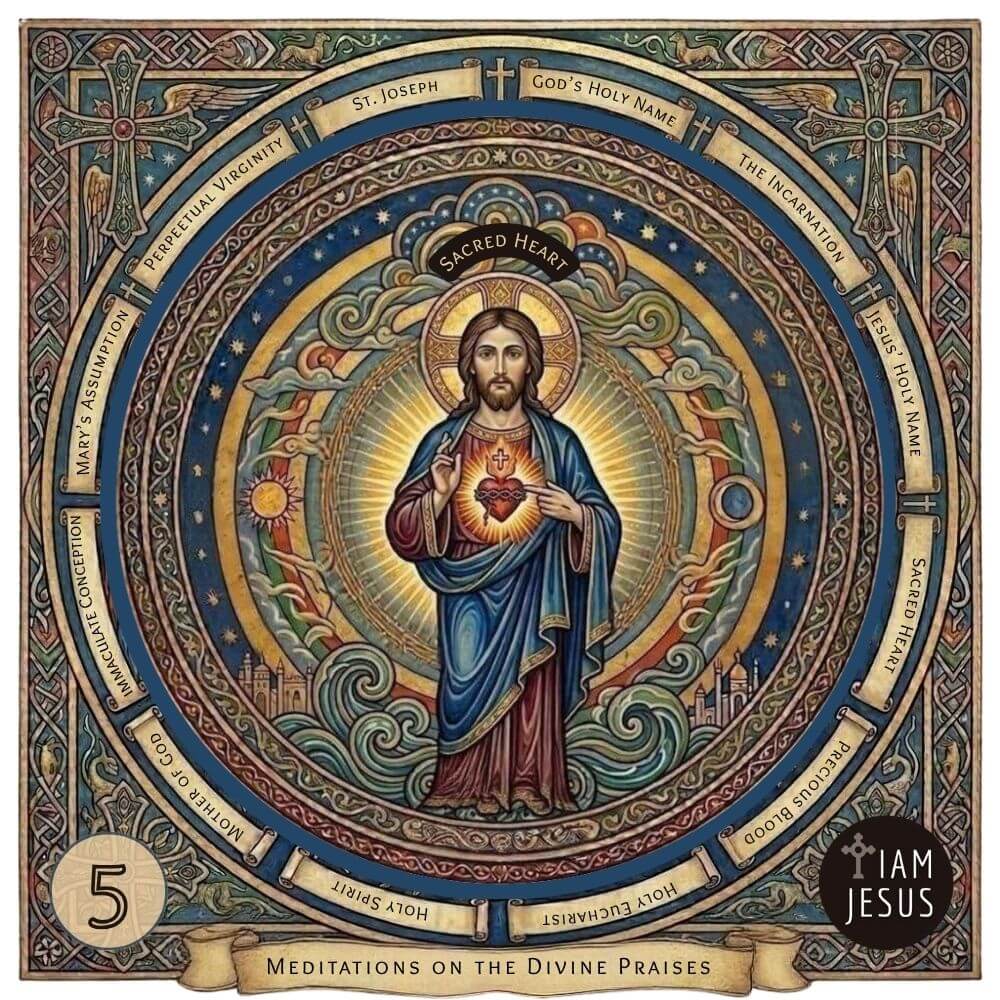
Let us pause to contemplate the infinite love of the Savior, who carries each of us in His Sacred Heart:
Jesus knew and loved us each and all during his life, his
agony, and his Passion and gave himself up for each one of us: “The Son of God . . . loved me and gave himself for me.” He has loved us all with a human heart. For this reason, the Sacred Heart of Jesus,
pierced by our sins and for our salvation, “is quite rightly
considered the chief sign and symbol of that . . . love with which the divine Redeemer continually loves the eternal Father and all human beings” without exception.Catechism, 478
Now let’s contemplate a passage from the second chapter of Hebrews. Slowly meditate on this passage, reflecting on the meaning of being true God and true man. Take your time. Pause over a word or phrase that speaks to your heart. Reread the passage again, and then ask God to help you understand the fullness of Jesus’ humanity and the fullness of his divinity in this passage. If you’d like to, take a moment to journal.
Jesus was Exalted after He Humbled Himself
For it was not to angels that he subjected the world to come, of which we are speaking. Instead, someone has testified somewhere:
“What is man that you are mindful of him, or the son of man that you care for him? You made him for a little while lower than the angels; you crowned him with glory and honor, subjecting all things under his feet.”
In “subjecting” all things [to him], he left nothing not “subject to him.” Yet at present we do not see “all things subject to him,” but we do see Jesus “crowned with glory and honor” because he suffered death, he who “for a little while” was made “lower than the angels,” that by the grace of God he might taste death for everyone.
For it was fitting that he, for whom and through whom all things exist, in bringing many children to glory, should make the leader to their salvation perfect through suffering.
He who consecrates and those who are being consecrated all have one origin. Therefore, he is not ashamed to call them “brothers,” saying:
“I will proclaim your name to my brothers, in the midst of the assembly I will praise you”; and again: “I will put my trust in him”; and again: “Behold, I and the children God has given me.”
Now since the children share in blood and flesh, he likewise shared in them, that through death he might destroy the one who has the power of death, that is, the devil, and free those who through fear of death had been subject to slavery all their life.
Surely he did not help angels but rather the descendants of Abraham; therefore, he had to become like his brothers in every way, that he might be a merciful and faithful high priest before God to expiate the sins of the people.
Because he himself was tested through what he suffered, he is able to help those who are being tested.
Let us Pray:
Now that we understand the catechetical meaning of “Blessed be Jesus Christ, true God and true man”, let’s bless Jesus Christ the Incarnate Word of God [John 1:14] in prayer.
The 3rd Divine Praises Meditation: True God and True Man
Let Us Bless Jesus Christ, True God and True Man
Jesus Christ, True God and True Man, the Incarnate Word of God, I praise you and I bless you because it is right and just. You existed throughout eternity as the Second Person of the Trinity. For by you all things are created, in heaven and on earth, everything visible and invisible. You alone are my sole mediator and high priest who reconciles me to God the Father. In your humanity you took on a human nature, making yourself lower than the angels so that I might merit eternal life through you. In your eternal goodness you bless me and provide for all my spiritual and temporal needs. You feed me your mystical Body so that I may have life within me. I bless you with all my heart and offer you adoration and praise in thanksgiving for all you are and all you do. I bless you with my very life in service to your Kingdom. AMEN.
In Conclusion: The Incarnation Shows How Deeply Loved we Are
We bless Jesus Christ “true God and true man” because it is right and just, and also because by doing so we acknowledge that our humanity is beautiful to God. Jesus Christ redeemed us by becoming Incarnate of the Virgin Mary and assuming human flesh so that we would be reconciled to God. As our sole mediator to the Eternal Father, Jesus has opened up the fountain of grace for all mankind. The Incarnation of Christ has given us a share in the divine nature of God. We are now able to partake in the life of God, to receive his favor, his love, his gifts, and merit eternal life. We exist because of the love of God and the sacrifice of Jesus Christ, and so we must say, blessed be Jesus Christ, true God and true man, as it is right and just.
By blessing the Incarnate Word of God, we make a loving effort to compensate for gnostic heresies that deny the Incarnation of Christ, and also the Real Presence of Jesus Christ, Body, Blood, Soul and Divinity in the holy Eucharist. Our prayers of blessing are made in reparation for the many heretical ideas about Christ as true God and true man that continue in our modern world today.
The Angelus prayer is a wonderful daily devotion that offers spiritual protection and is a short prayer that can be memorized and recited three times a day. It is a prayer that remembers the Incarnation of Christ.
We remember the words that Jesus tenderly spoke from the Cross when he said, “Father, forgive them, they know not what they do” [Luke 23:34]
The Divine Praises in English
Blessed be God. Blessed be His Holy Name. Blessed be Jesus Christ, true God and true Man. Blessed be the Name of Jesus. Blessed be His Most Sacred Heart. Blessed be His Most Precious Blood. Blessed be Jesus in the Most Holy Sacrament of the Altar. Blessed be the Holy Spirit, the Paraclete. Blessed be the great Mother of God, Mary most Holy. Blessed be her Holy and Immaculate Conception. Blessed be her Glorious Assumption. Blessed be the Name of Mary, Virgin and Mother.
Blessed be St. Joseph, her most chaste spouse. Blessed be God in His Angels and in His Saints forever. AMEN.
The Divine Praises in Latin
Benedictus Deus. Benedictum Nomen Sanctum eius. Benedictus Iesus Christus, verus Deus et verus homo. Benedictum Nomen Iesu. Benedictum Cor eius sacratissimum. Benedictus Sanguis eius pretiosissimus. Benedictus Iesus in sanctissimo altaris Sacramento. Benedictus Sanctus Spiritus, Paraclitus. Benedicta excelsa Mater Dei, Maria sanctissima. Benedicta sancta eius et immaculata Conceptio. Benedicta eius gloriosa Assumptio. Benedictum nomen Mariae, Virginis et Matris. Benedictus sanctus Ioseph, eius castissimus Sponsus. Benedictus Deus in Angelis suis, et in Sanctis suis. AMEN.
The Divine Praises Prayer on YouTube
Pondering the Divine Praises: The Complete Series
The Divine Praises Series is a 14-part prayer journey made to help you deeply reflect on each line of this beautiful prayer. Through simple stories, scripture, and heartfelt reflections, this series explores the holiness of God, the Sacred Heart of Jesus, and the special place of the Blessed Virgin Mary. It is the perfect companion for a quiet hour in the adoration chapel or for your daily prayer time at home.