
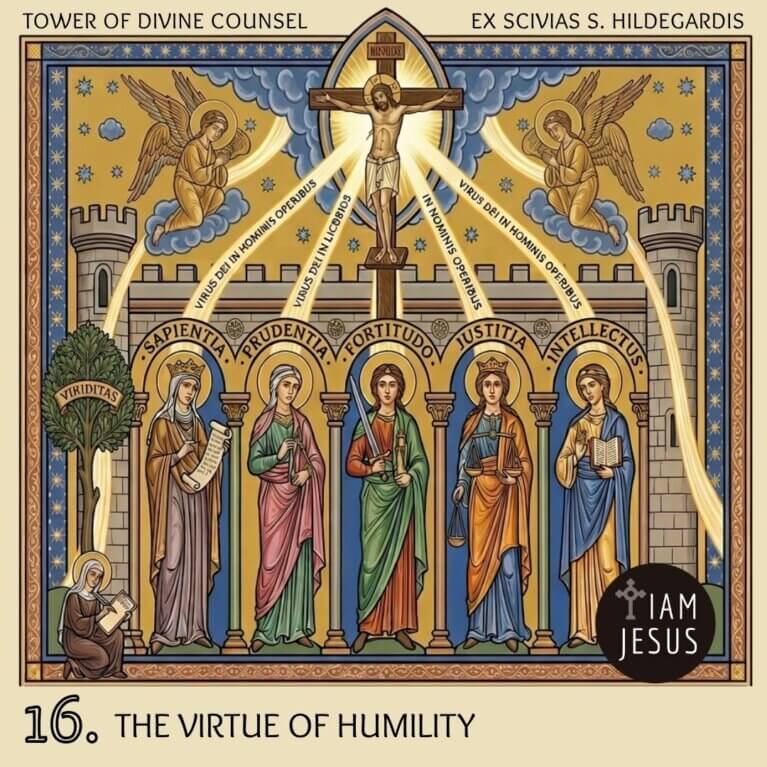
Overcoming Self-Reliance and ego
Today we contemplate the foundational grace of a modest spirit, learning how to shatter the deceptive illusion of self-reliance and ego. Join our prayer community for this sixteenth weekly meditation inspired by St. Hildegard of Bingen to cultivate a profound humility of heart, conquer the destructive grip of human pride, and ground your soul in the truth by learning to embrace the supernatural virtue of humility.
Opening Prayer
Lord Jesus Christ, please give me humility of heart so that I might overcome my human pride. I recognize the sin of pride is the greatest evil and that the virtue of humility is the only thing that can destroy it once and for all. Lord, please give me the grace to recognize all the areas of my life where the sin of pride has taken root, and where I need to grow in the virtue of humility.
Help me recognize your omnipotence, and the need for me to let go of all control so that I might humbly submit to your authority in my life. Let me see that your just judgments are for my spiritual good, and all my suffering in this life is by your divine authority and for my eternal salvation. I submit to your will in all things, humbly receiving everything that you prune from me, and working toward everything you choose to cultivate in me.
Help me reject the need to be praised by my superiors and subordinates. Let me desire to serve them with humility of heart and for the love of God. Let me be fearful of disobeying or offending you. In this way I will live in the truth and by the light of the Holy Spirit, seeking only what pleases you and not what feeds my ego: honor, prestige, riches, and authority over others. Help me bless those in need with every good thing you give me; I want to go forth and spread the Gospel with every gift you have graciously given me.
Let me always keep my eyes toward heaven, and not live in fear of those who can kill my body. I shamefully admit that I have chosen to act with cowardice and through deception many times. I repent of this now and admit my actions were due to my foolish pride. I wanted to preserve myself from humiliation and suffering, and in doing so I committed evil in your sight. I am deeply ashamed of what I have done and my failure to act due to human pride.
Lord, please forgive me for having human pride and give me a pure heart full of humility. Lord, I humbly ask for the grace to live by faith and in obedience to your will so that I have the strength to humbly reject all self-aggrandizement. Take away all fear of being humiliated and all fear of having to suffer for your sake.
Jesus, I beg you to give me the virtue of humility so that I can reject every self-seeking desire rooted in the sin of pride, the greatest evil. You know every thought in my head, every action I have ever made, every sinful desire I have kept secret. Please purify my heart and renew my soul. I humbly submit to your authority. Restore in me a clean heart and take away from me the deadly sin of human pride.
AMEN
“Prayer is the raising of one’s mind and heart to God or the requesting of good things from God.” But when we pray, do we speak from the height of our pride and will, or “out of the depths” of a humble and contrite heart? He who humbles himself will be exalted; humility is the foundation of prayer, Only when we humbly acknowledge that “we do not know how to pray as we ought,” are we ready to receive freely the gift of prayer. “Man is a beggar before God.”
Catechism, 2559
An Introduction to Part Three
In Part One, we learned to release our grip on the world. In Part Two, we learned to release our grip on ourselves. This week begins Part Three of St. Hildegard’s Liber Vitae Meritorum, and it takes us somewhere deeper still: the will itself, the very faculty that made both of those earlier struggles possible in the first place. There are seven virtue/vice pairings in this Part, and today you’ll meet the first: Pride, whom St. Hildegard calls “the mother of faults”—the root from which every vice in this Part grows, one producing the next in an unbroken chain all the way to its final vice, Luxury.
In her vision, the man representing God turns to face North and East. This is still the soul’s own interior battlefield, the same as Parts One and Two — but where Part One asked whether you’d choose God over the world, and Part Two asked whether you’d choose God over yourself, Part Three asks something sharper still: will you actually hand your will over to His?
Watch for two things as these seven weeks unfold. First, notice how vividly each vice catches fire from the one before it — often literally, in St. Hildegard’s own imagery — as the chain moves forward. Second, notice that every punishment described here is explicitly a path back, never a final sentence. St. Hildegard isn’t showing us seven ways to be lost. She’s pruning a disciple into someone ready to be sent out — which is exactly where Part Four will carry us next.
What Is Humility of Heart?
In Catholic moral theology, human pride is recognized as the mother of all evils because it twists the soul into believing it is the author of its own goodness. When we crave the applause of men or demand total control over our lives, we echo the original rebellion of Lucifer. To break this cycle of vanity, we must actively beg the Holy Spirit for a true humility of heart.
Having humility of heart does not mean denying the gifts God has given us; rather, it means acknowledging that we are completely dependent on His mercy for every breath we take. By intentionally practicing the supernatural virtue of humility, we train ourselves to reject self-aggrandizement, serve our neighbors without expecting praise, and submit fully to the divine authority of God. It is through this quiet strength that we protect our interior peace, align our actions with the Gospel, and destroy the subtle trap of pride once and for all.
Concerning Pride [Abridged]
by St. Hildegard of Bingen
The first image stands for pride, which is the source of all faults and material and mother of all other evils since pride caused the first angel to be cast out of heaven and drove man from paradise.
Regarding souls who want to return to life by doing good, pride places snares in the purpose of their work and prevents them from receiving the highest reward. For when man is praised often for his good actions, he becomes proud and this cancels out his blessed reward…
With foolishness it also caused the first woman to be cast from paradise; even now it leads men beyond themselves with twisted softness. Her eyes are fire since her intention burns with foolishness. Her nose is sprinkled with dirt since lacking discretion; it is filthy with foolishness. And her mouth is closed since she has no fondness for righteous words but denies God and everything else that is good…
She is opposed to God in heavenly things and she truly rushes to the devil in earthly things…
[Pride’s] heart is always swelled up with empty greatness… In its swelled up heart it tolerates its own ways with vainglory and gives out empty and unstable examples… It does not offer any pasture land that can be used, nor does it give anyone any strong support with which that person could persevere in doing good…
A proud mind doing proud work walks foolishly and naked without the hair of prudence and without the garment of salvation. Unless it was hidden in the darkness I mentioned earlier, this means that no matter what it does, it lies in the perversity of unhappiness… It neither gives honor nor shows care but only shows contempt to anyone who knows God who knows all things.
It has done this and has been outwardly foolish from the beginning right up to the present, just as a spring bubbles to the top, when with gnashing teeth and biting it tries to overcome God who is stronger than it is. But just as it fell down prostrate in an ugly manner in the past, so also even now the higher it rises in the thoughts and actions of foolish men, the lower it drags them down. Nevertheless it knew no one was like it, as it said earlier. Humility, however, resists pride and encourages men to shrink back from it.
St. Hildegard of Bingen, Liber Vitae Meritorum (The Book of the Rewards of Life),
Part 3, Section 34, Chapter 42 (Trans. Hozeski, Abridged)
A Note on Humility: The Cloud of Water and Air
Notice what Humility calls herself: “Ego columna nubis sum”—”I am the pillar of cloud” (Liber Vitae Meritorum, Part 3, Section 4, Para. 6, trans. Hozeski). This isn’t just a poetic turn of phrase. A cloud is, quite literally, water suspended in air—two of God’s elements held together in a single, gentle form. Humility doesn’t need to choose one element to claim as her own; she carries both at once, the way Christ himself did when he said, “I am meek and humble of heart” (Matthew 11:29). His heart was gentle enough to absorb every wound without striking back, yet strong enough to carry the weight of the whole world’s sin to the Cross—this is what real humility looks like: soft enough to yield, and sturdy enough to bear everything asked of it.
And St. Hildegard isn’t inventing this image out of nothing. It’s the very same pillar of cloud that led the Israelites out of Egypt—”the LORD preceded them… in a column of cloud, to lead them on their way” (Exodus 13:21)—and the same cloud that filled the tabernacle with God’s own glory (Exodus 40:34). Humility says of herself, “I dwelt with the Creator in the heights, and I descended with him to earth”—she is that same guiding, sheltering presence of God among his people, now dwelling quietly in a single humble soul. Where Pride reaches upward on her own borrowed wings, straining toward a height she has no right to, Humility doesn’t need to reach at all. She simply moves with God as he wills her to move—in the heights or on the earth—because her whole nature is to follow him.
Reflection:
To fully understand the virtue of humility we must first look at the greatest evil of mankind, our own human pride. This sin truly is the mother of all evils because it is the root cause of all disobedience and contempt toward God.
St. Hildegard of Bingen describes pride as foolishness. At its core, human pride forms a greedy heart that believes we should possess whatever we desire and we can disregard God and disobey his commandments without consequence. The image she depicts helps us to see that the further away we go from God the more darkened our intellect becomes and the more pervasively unhappy we are. Our lives become unstable to the point of having contempt for God.
Why is Human Pride the Greatest Evil?
Pride is the very first sin ever committed. Through an act of free will, Lucifer became a fallen angel when he refused to humbly recognize God’s authority and submit to God’s will for him. His pride became the greatest evil and he was cast out of heaven. Then, under a false pretense, he convinced Eve that God was hiding secret knowledge that he could give her if she listened to him and took the forbidden fruit. In her foolishness she embraced the lie, and by his cowardice, Adam also indulged in the sin of human pride by his own free will.
Human pride caused all of humanity to suffer from this original sin. Man rejected life and entered into death. This created a chasm between mankind and God that only Jesus could remedy. Jesus came to earth not as a prince, or wealthy elite, but as a poor lowly infant. Jesus was the son of a carpenter who lived with perfect humility and in total obedience to the will of the Father. In his public ministry he served the poor and marginalized, ministering to the sick and the sinners alike. He knew his purpose in life and the manner in which he was to die. Jesus humbly submitted himself to be crucified for our sake as the Passover Lamb. He became the sacrifice for sin. He covered us with his Precious Blood.
When we reject this gift of God, we lose our souls. The devil knows this, so he continually tempts us toward pride so that we are unable to love and obey God with humble, contrite hearts.
Pride: The Root of Everything to Come
St. Hildegard doesn’t leave Pride standing alone. She tells us directly: “Just as man guides his whole body with his five senses, so also pride with hate, disobedience and empty glory draws all the other faults to itself and then sends each one of them back into error” (Liber Vitae Meritorum, Part 3, Section 49, Para. 61, trans. Hozeski). Pride doesn’t just sit quietly as the root cause of these other vices—she actively directs these other vices that follow her, the same way the five senses direct the whole body. In the weeks ahead, watch this happen one vice at a time: Envy, Empty Glory, Disobedience, Unfaithfulness, Despair, and finally Luxury. All these vices are rooted in Pride. The will’s first refusal to submit to God doesn’t stay contained; it spreads, one vice quietly enhancing the next vice.
Characteristics of a Humble Person
The man with a humble heart knows that all gifts he has received are from God who lovingly gives and takes away like a gentle Father who loves his son.
A man’s health comes from God, as does his physical appearance. A man’s wisdom and ability to learn and apply himself is also a gift from God. His body is a gift and should be cared for and honored so that he is a true temple of the Holy Spirit where God can happily dwell. Likewise, a man’s wealth is a gift from God and so he should use his wealth for good and give back to the Lord with gratitude for all that he has been blessed with. In this way he pleases God by caring for the widowed and orphaned.
The man with humility of heart will gladly serve the Lord and listen for the inspiration of the Holy Spirit, even if this conviction is unpopular with men. He will courageously go where his conscience leads him because he is led by God to serve. He is focused not on earning the praise and admiration of men, but on the work God has given him to complete; the virtue of humility gives him an increased faith in God and confidence in the work he has been given.
Humility of heart requires having no need for the praise of men. The humble soul will not seek out the esteem of others and will not measure his self-worth based on the opinions of others. His gaze is always on Christ. The man with humility of heart wants to humbly serve and obey the Holy Spirit in his every action. When his conscience tells him he has failed, immediately he feels remorse and wants to apologize to God for his failure and then continue the work the Lord has given him.
Going Further:
Take some time this week to sit in prayerful reflection with the Lord by reading James 4. This is a beautiful chapter about human pride and humility of heart. When you have finished reading this chapter, take some time to be with the Lord in prayer, asking him questions about how you can overcome the sin of human pride and grow to have humility of heart. As the Lord begins to speak to your conscience, write down your thoughts. You may want to copy a few verses that speak loudly to you from this chapter, like James 4:6-10:
“But he bestows a greater grace; therefore, it says: ‘God resists the proud, but gives grace to the humble.’ So submit yourselves to God. Resist the devil, and he will flee from you. Draw near to God, and he will draw near to you. Cleanse your hands, you sinners, and purify your hearts, you of two minds. Begin to lament, to mourn, to weep. Let your laughter be turned into mourning and your joy into dejection. Humble yourselves before the Lord and he will exalt you.“
Laying down the Illusion of Self-Reliance:
Take a moment to pause, drop your defenses, and settle into the absolute stillness of this chapel. Human pride is a deceptive, blinding optical illusion—a quiet rebellion of a greedy heart that arrogantly believes it can disregard God’s law, demand total control over its circumstances, and live without consequence. When we obsess over our own prestige, manipulate outcomes to protect our egos, or treat God’s gifts as our own achievements, we darken our intellects and walk straight into spiritual unhappiness. Before we open the Word of God, let us offer up a sincere prayer of petition—asking for the spiritual courage to smash this vanity, strip away our pride, and ground our souls in absolute dependence on the Father.
Prayer for True Humility of Heart
Eternal Father, You know the proud and restless corners of my heart. I confess that I have routinely fallen into the trap of self-reliance—frantic to preserve my own comfort, demand my own terms, and treat Your blessings as if they were earned by my own power. Forgive me for the times I have allowed a greedy heart to push You to the margins, chasing the passing praise and admiration of others while leaving my soul cold and empty. By my own human strength, I cannot break the grip of this pride. I desperately need the cleansing fire of Your grace.
Lord Jesus, grant me the supernatural virtue of humility of heart. Teach me to accept Your divine authority with the absolute trust of a child, recognizing that every breath I take is a gift of Your mercy. When I am tempted to seek out prestige, harbor self-aggrandizement, or hide my mistakes out of fear of being humiliated, catch my thoughts and fix my gaze upon Your Cross. Deliver me from the toxic cowardice that makes me compromise my conscience just to fit in with popular opinion. Give me a humble, contrite spirit that immediately repents when I fail. Reorder my desires so that I may seek only what pleases You, finding my true worth, my ultimate security, and my highest joy in serving Your eternal Kingdom.
AMEN.
Now let’s contemplate the Lord by listening to him speak to us in the Gospels. Slowly meditate on the following passage, reflecting on his virtue of humility of heart and the deadly sin of human pride. Take your time. Pause over a word or phrase that speaks to your heart. Reread the passage again, and then ask Jesus to show you how you can imitate him in his humility of heart and better overcome human pride and worldly attachments. Do you see yourself in the actions of Pilate or the soldiers who mocked Christ? Maybe you see yourself in the actions of the crowd, who listened to popular opinion and did not listen to their consciences? Choose a word or phrase from this passage to write in your journal, and add your thoughts. Go back and prayerfully re-read it throughout the week.
The Public Humiliation of Christ
from the Gospel of John Chapter 19:1-16
Then Pilate took Jesus and had him scourged.
And the soldiers wove a crown out of thorns and placed it on his head, and clothed him in a purple cloak, and they came to him and said, “Hail, King of the Jews!” And they struck him repeatedly.
Once more Pilate went out and said to them, “Look, I am bringing him out to you, so that you may know that I find no guilt in him.”
So Jesus came out, wearing the crown of thorns and the purple cloak. And he said to them, “Behold, the man!”
When the chief priests and the guards saw him they cried out, “Crucify him, crucify him!”
Pilate said to them, “Take him yourselves and crucify him. I find no guilt in him.”
The Jews answered, “We have a law, and according to that law he ought to die, because he made himself the Son of God.”
Now when Pilate heard this statement, he became even more afraid, and went back into the praetorium and said to Jesus, “Where are you from?” Jesus did not answer him. So Pilate said to him, “Do you not speak to me? Do you not know that I have power to release you and I have power to crucify you?”
Jesus answered [him], “You would have no power over me if it had not been given to you from above. For this reason the one who handed me over to you has the greater sin.”
Consequently, Pilate tried to release him; but the Jews cried out, “If you release him, you are not a Friend of Caesar. Everyone who makes himself a king opposes Caesar.”
When Pilate heard these words he brought Jesus out and seated him on the judge’s bench in the place called Stone Pavement, in Hebrew, Gabbatha. It was preparation day for Passover, and it was about noon. And he said to the Jews, “Behold, your king!”
They cried out, “Take him away, take him away! Crucify him!” Pilate said to them, “Shall I crucify your king?” The chief priests answered, “We have no king but Caesar.”
Then he handed him over to them to be crucified.
Let us Pray:
Jesus, you showed us by your life and through your death what it means to have perfect humility of heart. Please guide me to imitate you in humility. When you were beaten and mocked by evil men you remained silent. The ugliness of human pride was evident in all who surrounded you.
Pilate told you he had power over you and could save you. By his human pride he believed you were under his authority. He had no regard for God. But you told him all power comes from God. The soldiers were also filled with human pride and together they mocked you, believing with darkened confidence that they could act unjustly. Then the crowd acted with human pride by collectively condemning you and denying the truth of their consciences because they were afraid of the power of Caesar. These same people proclaimed you blessed when you rode into Jerusalem on the donkey. All of these actions were foolish and rooted in human pride.
Jesus, I too, have done things I am ashamed of due to my own human pride. I have believed I had power over others and over my destiny. I have had a darkened confidence that led me to mock others and act unjustly. I have also followed others against my conscience because I feared man more than I feared God’s justice. Jesus, you humbly obeyed the will of the Father, suffering unthinkable torture for the heinous sins of mankind. You suffered for me, for the sins I have committed against God and my brothers and sisters. You ransomed me from the fate I deserved by becoming the sacrifice.
I have crucified you with my sin of human pride. I am so sorry for every proud thing I have ever done, every disobedience I have ever knowingly committed out of lack of love and gratitude to God. I am ashamed I was ever proud and felt I knew better than God. Please forgive every sin of human pride I have ever committed and have not yet repented of. Lord, I humbly ask for a clean heart and the grace to grow in the virtue of humility so that I no longer desire what the world offers and instead desire to do only the will of the Father, just like you. Let me be courageous and obedient, serving you with humility of heart. I ask all this in the name of the Father, and of the Son, and of the Holy Spirit.
AMEN.
A Prayer for an Increase in Virtue for Others
Lord Jesus Christ, you say that when two or more are gathered in your name, you are with us. Jesus, in your name I lift up every person who has joined this prayer challenge or will join it in the future. I ask you to give us all the grace we need to grow in virtue and holiness so that we may love and serve you in our lives and through the people we love and care for. Help us in our thoughts, our words, and our actions. Guide us all by your Holy Spirit and give us the strength to overcome every temptation from the evil one. We ask all this in the name of the Father, and of the Son, and of the Holy Spirit, AMEN.
Stripping away the Vanity: Your Week 16 Send-Off
Thank you for committing to Week 16 and for your incredible dedication throughout this entire virtue meditation series. Confronting human pride—breaking the pull of self-reliance and choosing a humble, contrite heart—takes profound interior warfare, and Jesus sees every single hidden effort you make to master your ego. When you inevitably feel the impulse to chase human praise, find yourself trying to control every circumstance, or catch yourself hiding your faults out of fear of humiliation this week, do not let discouragement take over. Overcoming pride is a slow, lifelong process of daily conversion, not an overnight shift. Be gentle with yourself, take immediate accountability when you slip, and run to the Sacrament of Reconciliation to let His mercy wash away the weight of your vanity.
As you walk out of this chapel and step back into a loud, self-absorbed world that constantly rewards self-aggrandizement, prideful behavior, and superficial prestige, guard your interior peace. True humility of heart isn’t a life of weakness or self-hatred; it is an act of ultimate spiritual freedom that aligns your soul with reality and anchors you in God’s grace. You are called to actively govern your reactions, serve others without expecting applause, and find your primary security in Jesus Christ. To see exactly how the Church classifies the deep-seated vices that oppose our spiritual growth—identifying the capital sins which Christian experience has distinguished because they engender other sins and other vices—look at the sacred standard in the Catechism:
“Vices can be classified according to the virtues they oppose, or also be linked to the capital sins which Christian experience has distinguished. They are called “capital” because they engender other sins, other vices. They are pride, avarice, envy, wrath, lust, gluttony, and sloth or acedia.”
Catechism, 1866
Make a Resolution
Take a moment to reflect on the virtue of humility of heart. What are the ways you can freely practice this virtue this week? Ask the Lord to give you opportunities, and when you feel the Holy Spirit prompting you, take action. Write down your resolutions for this coming week in your prayer journal. Remind yourself to complete these resolutions daily for this entire week, and as the Spirit prompts you, feel free to write about your experiences with this virtue throughout the week.
In My Thoughts:
Jesus, this week I promise to take time daily to conform my thoughts by… (make your intention).
In My Words:
Jesus, this week I promise to take time daily to conform my words by… (make your intention).
In My Actions:
Jesus, this week I promise to take time daily to conform my actions by… (make your intention).
Pray the Litany of Virtues prayer.
Join our Virtue Meditation Prayer Challenge
Don't let spiritual overwhelm hold you back!
Let us guide you step-by-step through Saint Hildegard’s transformative path to holiness.
Receive one long-form meditation in your inbox each week—perfect for a powerful 35-minute holy hour.
