
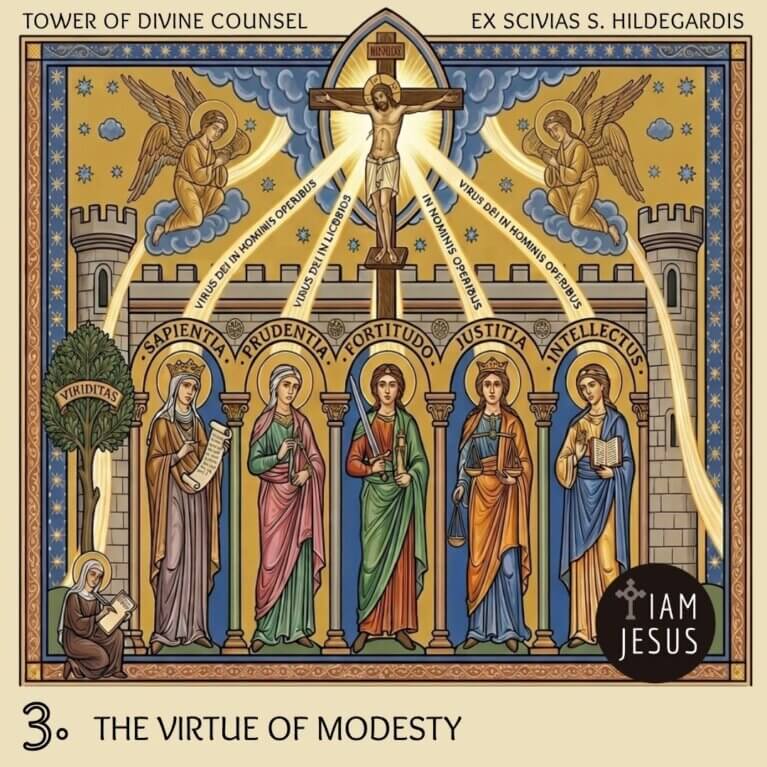
Overcoming Idle Jest, Vanity, and Jocularity
Today we contemplate the grace of choosing inner purity over worldly praise. St. Hildegard doesn’t begin this struggle with vanity itself—she begins it with something smaller and easier to excuse: restless jesting, the inability to be still in anything serious. Learn how to shield your soul from the vice of vanity and attention-seeking behaviors. Join our prayer community for this third meditation inspired by St. Hildegard of Bingen to anchor your soul in the virtue of modesty, allowing your thoughts, words, and dress to reflect your true identity as a beloved child of God in this third meditation from Part 1 of the Book of the Rewards of Life.
Opening Prayer
Lord, today I ask for the virtue of modesty, which will repair the secret feelings of shame and inadequacy hidden in my soul.
Lord, you know that in my life there have been times when I sought the attention of others, and in doing so I have hurt people with the noise I have created from it. I’ve degraded others with my speech, dressed, and behaved in undignified ways that now fill me with deep shame. Please give me the virtue of modesty.
I recognize my ego as the true force behind any attention-seeking behaviors: my provocative language, clothing, and actions. All were pure vanity, and they have never reflected my true identity as your beloved creation. Please forgive my sins and help me see myself as you do so that I may grow in the virtue of modesty and have a holy respect for the dignity of myself and others.
Help me to regain the simple and pure heart of innocence that I was born with, and to treat bodies as a temple of the Holy Spirit in every situation. Give me the grace to imitate you, Jesus, in my speech, dress, and actions. Help me be in harmony with the virtue of modesty every day.
Please help me respect the dignity of other people in my life.
AMEN.
“The struggle against carnal covetousness entails purifying the heart and practicing temperance: Remain simple and innocent, and you will be like little children who do not know the evil that destroys man’s life.”
The sixth beatitude proclaims, “Blessed are the pure in heart, for they shall see God.”
“Pure in heart” refers to those who have attuned their intellects and wills to the demands of God’s holiness, chiefly in three areas: charity; chastity or sexual rectitude; love of truth and orthodoxy of faith.
Catechism, 2517-2518
What is the Virtue of Modesty?
Modesty is way more than just a dress code—it’s a guard for your inner life. Think of it as a healthy boundary that keeps the noisy, attention-seeking culture from cheapening who you are. The Catechism teaches that modesty is simply decency. It guides how you talk, how you dress, and how you behave in public so you don’t treat yourself or others like objects to be consumed. Instead of constantly chasing worldly validation or feeding your ego, modesty anchors your self-worth in the fact that you are a child of God. It gives you a quiet, authentic dignity that doesn’t need to show off to feel important.
It’s worth pausing here on the word itself, because Hildegard actually gives us two related vices that Modesty stands against, not one. In her Liber Vitae Meritorum, she names a vice called Joculatrix—a jesting, performing figure who insists that life is for play, not seriousness (Part 1, trans. Hozeski). In her earlier work Scivias, she returns to this same territory but follows it further, naming a related vice, Scurrilitas, translated as “Jocularity”—coarse, suggestive humor that shades directly into vanity and bodily display (Book 3, Vision 3, Chapter 7, trans. Hart/Bishop). These aren’t two translations of one word; they’re two related vices from two different visions. For this meditation, we’ve chosen to read them together, as a seed and what it grows into: the trouble starts with the restless jesting of Joculatrix. Left unchecked, the seed of Joculatrix grows into the vanity and self-display of Scurrilitas. Modesty—Verecundia in Hildegard’s Latin, the same word in both books—is the one virtue Hildegard sends to guard against both.
St. Hildegard also takes Modesty a step further in Scivias, painting her as a fierce spiritual warrior. In this vision, Modesty actually covers her face with her sleeve to protect her conscience, which Hildegard calls the “face of the soul.” She wraps herself in a clean garment of innocence to block out vanity and cheap distractions (Book 3, Vision 3, Chapter 7, trans. Hart/Bishop). By combining Hildegard’s warrior imagery with the Church’s teaching on a pure heart, modesty becomes a real superpower. It helps you cut through the exhausting trap of luxury and vanity so you can live with a clean, peaceful mind.
Modesty destroys unlawful fornication with great strength
by St. Hildegard of Bingen
Modesty appears after discipline to blush and drive away sin. Therefore she covers her face with the white sleeve that clothes her right arm; for she protects her inner conscience, which is, as it were, the face of her soul, by flying from fornication and the Devil’s pollution. She defends herself with the white garment of innocence and chastity, on the right hand of which is the salvation coming from her deeds. For contempt and utter rejection of the filth of Satan is entwined strongly around her conscience.
St. Hildegard of Bingen, Scivias, Book 3, Vision 3, Chapter 7 (Trans. Hart/Bishop)
A Note on Modesty: Dead Sound Against Living Voice
Notice what Jocularity claims for herself: the air God created “carries pleasant sounds” to her and brings forth flowers she feeds her eyes on (Liber Vitae Meritorum, Part 1, Section 5, Para. 14, trans. Hozeski). Those aren’t just any flowers — they’re flowers of greenness, viriditas again, the same claim we’ve traced since Week One, now reaching for the eye’s delight rather than the hand’s grasping.
Jocularity makes a dead sound, made by the hand of man. The contrast St. Hildegard draws isn’t loud against quiet, or noise against song — it’s death against life (Liber Vitae Meritorum, Part 1, Section 6, Paragraph 15, Latin ed. Pitra). Modesty confirms this herself moments later, when she says: “I am alive with the heavenly virtues” (Liber Vitae Meritorum, Part 1, Section 6, Para. 15, trans. Hozeski). Jocularity’s dead sound against Modesty’s living voice reinforces our understanding of viriditas vs ariditas, true greeness of the Holy Spirit living in us versus the barrenness of Jocularity’s sound, which is arid and lacks life-giving greenness.
Reflection:
Saint Hildegard of Bingen frames this week’s spiritual battle as a war between the vice of Jesting (Joculatrix)/Jocularity (Scurrilitas) and the virtue of Modesty (Verecundia). Many people today in the modern world completely misunderstand modesty—reducing it to an uptight fashion dress code—true modesty is a deep matter of the heart. It isn’t just about what you wear; it is about protecting your inner dignity and checking your ego before it takes over your life. St. Hildegard envisions this vice with a hooked nose and a hunched, animal posture—hands like a bear’s, feet like a griffin’s—dressed in pale cloth that hides black hair underneath. It’s a costume of innocence over something else entirely (Liber Vitae Meritorum, Part 1 Section 5, Para. 14, trans. Hozeski).
The Real Battle: Ego vs. Authentic Dignity
We easily slip into jocularity when we let our guard down for the sake of “fun.” As St. Paul warns in Ephesians 5:4, we should have “no obscenity or silly or suggestive talk, which is out of place, but instead, thanksgiving.” When we resort to offensive humor or double meanings just to get a laugh, we are appealing to our lowest instincts. This constant craving to be the center of attention usually comes from a place of insecurity—and it feeds our ego while stripping away our dignity.
True modesty (Verecundia) is the ultimate antidote because it checks that pride. It’s not just about a dress code; it is a quiet, God-first mentality where you recognize Christ living inside your heart. When your self-worth is anchored in God, you stop needing to show off, pass inappropriate comments, or dress to impress a broken culture. A truly modest person has too much respect for themselves—and for the souls around them—to treat anyone like a cheap object for consumption.
When we choose to speak, act, and dress inappropriately to impress others it’s a sin against charity. The lack of modesty is rooted in vanity, a form of self-pride. St. Hildegard doesn’t just call Jesting foolish—she calls him noisy. Unlike the faithful who sound like a loud trumpet in every kind of music, Jesting can’t sing at all. In Liber Vitae Meritorum, Shyness tells Jesting he makes a dead sound (Liber Vitae Meritorum, Part 1, Section 6, Para. 15, Latin ed. Pitra).
Modesty is rooted in humility, the queen of all virtues (Ordo Virtutum, Humilitas, p. 2, trans. Dronke), Modesty is how you comport yourself around people in public situations; it has to do with having dignity for yourself and everyone you meet at all times. The virtue of modesty is a God-first mentality where you recognize Christ within your heart and this love makes you abstain from speech, dress, and behaviors that would not dignify yourself, those in your company, or Christ.
A truly modest person is humble. He dresses in a way that honors his body and is not attention-seeking. A modest person does not engage in low-brow conversations or speech that objectifies others. He also does not desire praise or attention from others or special treatment due to his status and wealth. Such a soul has a heart for God and humbly acknowledges his body, talents, and status as gifts that should be used for God’s glory, and not for self promotion.
Why is Our Speech and Behavior Important?
St. Hildegard doesn’t treat the Vice of Jocularity as something that starts big. In her Liber Vitae Meritorum, the vice paired with Modesty isn’t named fornication at all—it’s Jesting, pictured as a restless figure who insists that life is for play, not seriousness, and who can’t bear to be thought sad or boring (Liber Vitae Meritorum, Part 1, Section 5, Para. 14, trans. Hozeski). That’s the seed; it looks harmless. It’s just a joke, just a little inappropriate attention, it’s just provoking you to let your guard down for fun.
But St. Hildegard never lets the seed stay separate from the fruit. In Scivias, she shows us where that restlessness ends up if it’s never disciplined: Modesty has to guard “the face of the soul” specifically against fornication and the pull of vanity. The seed of playfulness sprouts into the temptation of fornication (Book 3, Vision 3, Chapter 7, trans. Hart/Bishop). And in her play Ordo Virtutum, Modesty describes her own work in the broadest terms possible—her purpose is to cover over, drive away, and tread down “all the filths of the Devil” (Ordo Virtutum, Verecundia, p. 4, trans. Dronke). So St. Hildegard draws a more complete picture of the vice opposing Modesty through three different books, using three different angles. In all her writings on the vice opposing Modesty there is one thing in common: Modesty stands guard at every point along the same road, from the first inappropriate joke that crosses a boundary, to the deeper vanity and immodesty it can grow into, to the act of fornication, the filths of the devil, that grows out of such seeds.
If we look at the vice of jocularity we might only see it as a relaxed, anything-goes, light-hearted attitude about situations. We let our guard down. We pass inappropriate jokes, comments, and suggestions. We seek attention and we tempt others in ways that might harm our dignity and theirs. Because we are doing it for “fun” it all seems harmless. But if we look at what these little seeds can eventually grow into, we clearly see that our harmless jokes are not so harmless, and our need for attention may eventually put us in a more serious situation that we may not have initially seen coming. We are growing vanity and immodesty when we constantly jest, and this will grow into more serious sins because it normalizes the dehumanization of people we joke about, or are trying to manipulate.
Jocularity forms division and it leads us to other more serious sins because it normalizes the dehumanization of the people we joke about, or are trying to manipulate. Jocularity is used to convince others to let their guard down and give in to something when they otherwise would not.
Sometimes our words will lead to crossing boundaries, and when we are in the bad habit of regularly crossing boundaries, we begin to lose the trust of our family, friends, and co-workers. People get tired of the jokes and innuendos, the self-seeking behaviors that are not dignified, and how jocular people make them feel about themselves.
You’ll meet this restless, jesting spirit again in Week 31, transformed. There, it’s no longer one person’s undisciplined joke—it’s Scurrility, the same flippant refusal to take sacred things seriously, now working at the level of a whole community rather that in just the individual soul. What starts here in Week 3 as a private struggle to guard your own dignity becomes, in Part 5, a warning about what happens when an entire culture stops taking anything seriously at all—and St. Hildegard shows us exactly where that road leads: not to modesty’s collapse, but to aimlessness itself.
Being Renewed in Christ through Virtue of Modesty
The virtue of modesty heals this vice and transforms us into a true imitator of Christ. In Scripture, Jesus showed dignity and true selfless charity toward people from all walks of life. Jesus modeled modesty through his perfect humility.
Reflect on your own life and the ways you have lacked the virtue of modesty. Ask God to give you discernment. As you pray in silence listen to your conscience and allow the Lord to speak to your heart about how you should behave and dress, now.
Modesty is not just about how you dress. While it is prudent to dress in a way that doesn’t cause others to objectify your body, you could fully cover your body and still not be modest. If you have a hard heart full of conceit toward others, this is not a true picture of the virtue of modesty. If you lack charity then you lack true modesty. If you lack humility as well, then you lack modesty.
When we lack modesty it puts us in tempting situations where we could more easily fall into sin. If you want to please God and be virtuous, pray from your heart and be confident that God will guide your conscience on how you should practice modesty in your life. Remember it’s about your heart and your intentions.
“Your adornment should not be an external one: braiding the hair, wearing gold jewelry, or dressing in fine clothes, but rather the hidden character of the heart, expressed in the imperishable beauty of a gentle and calm disposition, which is precious in the sight of God” (1 Peter 3:3-4).
Shielding the Face of the Soul:
Take a moment to pause, drop your defensive walls, and settle into the absolute, healing stillness of this adoration chapel. The spirit of vanity and luxury is a deceptive, exhausting trap—a restless hunger for worldly validation, provocative self-display, and constant attention to soothe hidden feelings of shame or inadequacy. When we manipulate how others view us to feed our ego, we compromise our interior innocence and cheapen our true identity. Before we open the Word of God, let us offer up a sincere prayer of petition—asking for the profound humility to stop seeking human applause, guard our conscience, and wrap our souls in authentic modesty.
Prayer for Holy Modesty
Lord Jesus Christ, You are the King of Glory who hid Your majestic divinity in the quiet simplicity of human flesh, yet You know the insecure, vain, and attention-seeking corners of my heart. I confess that I have often succumbed to the vices of luxury and vanity—using my speech, my dress, and my behaviors to draw eyes to myself, elevate my ego at the expense of others, and chase passing worldly praise. Forgive me for the noise I have made at the expense of my own dignity and forgotten that I am Your beloved creation. I cannot tame my desire for attention by my own fragile willpower. I desperately need the cleansing fire of Your grace.
Holy Spirit, come and restore the simple and pure heart of innocence within me. Grant me the supernatural virtue of modesty. Teach me to guard my conscience—the very face of my soul—with absolute vigilance, flying from the enemy’s pollutions and the trap of self-idolatry. When the urge to show off, use provocative language, or seek cheap validation flares up this week, catch my thoughts and anchor my security firmly in Your love. Transform my body into a worthy temple of Your presence, and let my entire life reflect a quiet, radiant respect for my dignity and the dignity of everyone I meet.
AMEN.
Take a slow, deep breath. Leave your distractions behind and prepare to listen to Jesus speak. As you read this Gospel passage, picture Him sitting across from you at a table, looking at you with total love.
Don’t rush through the words. Read them slowly. If a single phrase or instruction strikes your heart, pause right there and let it sink in. Ask Jesus to show you where your ego is demanding the “seat of honor” in your life, and how true modesty can bring you into harmony with the Holy Spirit. When you are ready, pick up your pen and write His answer in your journal.
Conduct of Invited Guests and Hosts
from the Gospel of Luke Chapter 14:7-14
He told a parable to those who had been invited, noticing how they were choosing the places of honor at the table. “When you are invited by someone to a wedding banquet, do not recline at table in the place of honor. A more distinguished guest than you may have been invited by him, and the host who invited both of you may approach you and say, ‘Give your place to this man,’ and then you would proceed with embarrassment to take the lowest place.
Rather, when you are invited, go and take the lowest place so that when the host comes to you he may say, ‘My friend, move up to a higher position.’
Then you will enjoy the esteem of your companions at the table. For everyone who exalts himself will be humbled, but the one who humbles himself will be exalted.”
Then he said to the host who invited him, “When you hold a lunch or a dinner, do not invite your friends or your brothers or your relatives or your wealthy neighbors, in case they may invite you back and you have repayment.
Rather, when you hold a banquet, invite the poor, the crippled, the lame, the blind; blessed indeed will you be because of their inability to repay you. For you will be repaid at the resurrection of the righteous.”
Let us Pray:
Jesus, you said do not desire the place of honor nor choose it for myself. Jesus, you said to take the lowest place, be humble, and act with modesty—do not seek attention or praise from others.
Jesus, keep me in your name. Protect me and guard me from the vice of jocularity. Do not let me be lost. Do not let me be like the people St. Paul warns about in Ephesians. Please protect me from having an ego. Give me a pure heart, mind, and eyes that look to imitate your modesty. Help me be humble and modest when I am socializing with others. I want to be one with God in my heart, mind, and through my actions.
I do not want to belong to this world. Consecrate me in the truth. Send me, Lord, into the world and help me be one with the Holy Trinity and one with my brothers and sisters in Christ.
Jesus, you are a gift to me. Thank you for being present to me. Give me the grace to be present to you and to grow in the virtue of modesty. AMEN
A Prayer for an Increase in Virtue for Others
Lord Jesus Christ, you say that when two or more are gathered in your name, you are with us. Jesus, in your name I lift up every person who has joined this prayer challenge or will join it in the future. I ask you to give us all the grace we need to grow in virtue and holiness so that we may love and serve you in our lives and through the people we love and care for. Help us in our thoughts, our words, and our actions. Guide us all by your Holy Spirit and give us the strength to overcome every temptation from the evil one. We ask all this in the name of the Father, and of the Son, and of the Holy Spirit, AMEN.
Guarding the Sacred: Your Week 3 Send-Off
Thank you for pushing forward into Week 3 of this virtue challenge. Striving to change your daily habits takes real effort, and God sees that desire. When you fail or slip back into old habits, don’t throw in the towel. Growing in modesty is a slow process. It’s hard to stop the noise of jesting and begin new kinds of relationships with others. Be patient with yourself, keep Jesus close when temptation hits, and get to Confession quickly if you fall.
As you leave this chapel and step back into a loud culture that constantly screams for attention, validation, and vanity, remember your dignity. True modesty isn’t about hiding in shame; it is about protecting the beautiful mystery of who you are as a child of God. You have to actively manage your speech, your clothes, and your ego out there in the real world. To see exactly how the Church expects us to protect this inner purity and practice healthy, discreet boundaries in our daily relationships, look at the standard laid out right here in the Catechism:
“Modesty protects the mystery of persons and their love. It encourages patience and moderation in loving relationships; it requires that the conditions for the definitive giving and commitment of man and woman to one another be fulfilled.
Modesty is decency. It inspires one’s choice of clothing. It keeps silence or reserve where there is evident risk of unhealthy curiosity. It is discreet.
Catechism, 2522-2523
Make a Resolution
Take a moment to reflect on the virtue of modesty. What are the ways you can freely practice this virtue this week? Ask the Lord to give you opportunities, and when you feel the Holy Spirit prompting you, take action. Write down your resolutions for this coming week in your prayer journal. Remind yourself to complete these resolutions daily for this entire week, and as the Spirit prompts you, feel free to write about your experiences with this virtue throughout the week.

In My Thoughts:
Jesus, this week I promise to take time daily to conform my thoughts by… (make your intention).
In My Words:
Jesus, this week I promise to take time daily to conform my words by… (make your intention).
In My Actions:
Jesus, this week I promise to take time daily to conform my actions by… (make your intention).
Pray the Litany of Virtues prayer.
Join our Virtue Meditation Prayer Challenge
Don't let spiritual overwhelm hold you back!
Let us guide you step-by-step through Saint Hildegard’s transformative path to holiness.
Receive one long-form meditation in your inbox each week—perfect for a powerful 35-minute holy hour.

3 Responses
Am heavenly blessed to learn how to be more disciplined. Be more modest in my heart. In my soul that is god the father of son and of holy spirit. May I be more modest in every happenings of my life. More disciplined have inner love of my spiritual over material world. Praying for intercession of heavenly presence to help me and my countless brother’s and sisters in living Christ Jesus.
This is mind-blowing for me. I am the opposite of modesty. Truly, I lack modesty. Lord, please help me to get this virtue.
I am so glad I found this website. I love all the prayers and readings on each of the virtues. Modesty is a virtue that I want to continue to grow in. Thank you so much. It’s incredible ♥️