

Overcoming the Tower of Contempt
Today we contemplate the courageous fire of an apostolic heart, learning how to tear down the fortified tower of contempt a soul can build against its own Maker. Join our prayer community for this fifteenth weekly meditation inspired by St. Hildegard of Bingen’s Liber Vitae Meritorum, to cultivate the supernatural virtue of desiring the salvation of souls, embrace your true Christian vocation, and stand victorious by actively fighting against evil for the glory of God. This is the final virtue/vice pairing of Part 2.
Opening Prayer
Eternal Father, as your child I should commit to fighting against evil for the salvation of souls. Open my heart to love sinners and desire their conversions. I want to be an intercessor. Please let me become a vessel of the Holy Spirit so that I willingly pray for others when inspired and do charitable things for souls in need. Give me holiness so that I want what you want and I am obedient when the Spirit comes to ask me to pray and do acts of charity. Please give me the grace for desiring the salvation of souls. If I desire the salvation of souls I will glorify you in the way I live my life, and I will be open to the inspirations of the Holy Spirit as they come.
Jesus, I draw my strength from the mighty power of your Precious Blood. Your grace empowers me in fighting against the temptation to build a small tower of pride in my heart as if You were not present to me. Instead, please make me a tower built for peace, fortified not by my own pride, but by Your love alone.
I am all yours. Everything I have is yours.
Help me long for heaven. Let me avoid relationships that are against your holy will. Let me avoid things that will destroy my soul. I surrender to your holy will for my life. Let me thirst for You the way a stag thirsts for running water, and flood my soul with the gifts of Your Holy Spirit. Let my senses, my reason, and my knowledge never become closed windows that block out your light, but instead let them be open so that I may see your face and feel the glory of your Divine presence.
AMEN
“Those who with God’s help have welcomed Christ’s call and freely responded to it are urged on by love of Christ to proclaim the Good News everywhere in the world. This treasure, received from the apostles, has been faithfully guarded by their successors. All Christ’s faithful are called to hand it on from generation to generation, by professing the faith, by living it in fraternal sharing, and by celebrating it in liturgy and prayer.”
Catechism, 3
What Is the Virtue of Desiring the Salvation of Souls?
In Catholic moral theology, the gravest danger to a soul is not weakness but when we settle our minds and our wills on contempt—the quiet decision to live as though God were not there at all. St. Hildegard calls this Destruction of Souls, and she pictures it as a tower: fortified, unshaken, built with its own three windows containing: a soul’s senses, intellect, and knowledge—the very faculties God gave us to find Him. Rather than turned inward on the self, or turned toward God, Destruction of Souls looks outward to find souls she can drag away from God. St. Hildegard traces this tower back to its first builder, the fallen angel, who in his pride, fell from heaven and built a ruin for himself and then chose to deceive souls into following him.
To resist this vice, we must actively cultivate the supernatural virtue of desiring the Salvation of Souls. This holy zeal is born from a deep union with the Holy Trinity and a profound, sacrificial love for sinners. Living out this virtue means surrendering daily contempt and self-will so that we can become true instruments of the Holy Spirit. By offering up our daily sufferings, remaining fiercely obedient to our conscience, and fearlessly fighting against evil, we open ourselves to the gifts of the Holy Spirit and help lead broken hearts back to the mountain of salvation.
How To Reflect On Today’s Meditation
Hildegard frames the vice of Destruction of Souls differently than all the others. Throughout her visions, every other fault she describes comes with a clear path back — a punishment to undergo, a practice of repentance, a way to “blot out” the sin and be restored. Destruction of Souls is the one exception. St. Hildegard doesn’t describe her as someone being punished into correction; she describes her as someone who has simply stopped wanting God at all, and who must, if she is ever to return, tear herself away from where she has placed herself.
This distinction matters, and it lines up closely with what the Church has always taught: God does not condemn anyone. A soul closes itself off from grace only by refusing it persistently — whether through despair, believing forgiveness is impossible, or through quiet self-justification, believing it was never needed. Both are failures not of action but of an open, honest heart before God.
If this unsettles you, take heart in what it actually means: this isn’t a trap anyone falls into by accident, through a bad day, a single sin, or even a long pattern of struggle honestly fought. It describes only a will that has been closed, deliberately and persistently, against the very offer of mercy. If you are reading this and worried about your own soul, that worry is itself evidence the door is still open — a heart that fears losing God is not a heart that has stopped wanting Him. St. Hildegard’s vision isn’t meant to frighten the faithful who struggle; it’s meant to show, by contrast, just how wide and patient God’s mercy remains for anyone willing to ask for it, however weakly, however late.
Concerning the Destruction of Souls
by St. Hildegard of Bingen
The eighth image stands for the destruction of souls. It follows immoderation because when a person fights against God without any moderation, he brings about the destruction of his soul. He refuses to be with God and gnashes his teeth against him although he realizes that He is the mountain of salvation. He is full of ruins since the first angel (who) built a ruin for himself and for all those who follow after him… They do not have any hope for salvation. For destruction seeks nothing; it desires nothing other than to lead other souls to where it is… But the salvation of souls refutes destruction and warns people not to imitate destruction which places no value on salvation.
St. Hildegard of Bingen, Liber Vitae Meritorum (The Book of the Rewards of Life),
Part 2, Section 50, Paragraph 59 (Trans. Hozeski, Abridged)
Note: Hozeski’s translation uses masculine pronouns here as a generic stylistic convention; Pitra’s Latin confirms Destruction of Souls is grammatically feminine. She is addressed directly as “ipsam” [her] in the surrounding text where Salvation of Souls refutes her.
Reflection:
St. Hildegard says it is not enough to know God “is the mountain of salvation.” We have to be with God by surrendering our hearts. We must take the knowledge God has given us, and commit ourselves to acts of love—not just hold correct ideas about him from a safe distance.
What is the virtue of desiring the salvation of souls? We must start with the opposite vice, so that we understand how God wants us to desire the salvation of souls. We do this by cooperating with the daily working of the Holy Spirit in our lives. This is our surrender of self-will and ascent to the will of God. By doing this, we look upward and not outward. We offer what we see and think about a person or situation to God, who sees and knows all things. Our surrender is an act of faith, and it gives us peace in spite of the circumstance.
St. Hildegard’s Destruction of Souls is a tower built with three windows—senses, reason, and knowledge—through which the soul looks outward instead of toward heaven. From her window, Destruction of Souls is looking for others she can lead into the same ruin she has made for herself. Destruction of Souls doesn’t have a diminished capacity to know God; instead she has done an about-face and turned her God-given capacity to know Him into a fortress that acts against Him.
Ask yourself, “do I use my senses, my reason, or my knowledge to draw closer to God, or have I quietly built small rooms in the tower of my heart where I look out and not up, treating Him as if he isn’t there at all? Are you able to hear the voice of the Spirit through your daily life activities and are you able to respond to the Lord immediately when called? We will return to this again in a bit, but first let’s look at ways we can get in the way of God and thwart grace through the vice of destruction of souls.
In Part 2, Section 15, Para. 24, St. Hildegard says the soul with contempt for God knows she merits fire, and even though she does not want this consequence, she still refuses to follow the will of God and the teachings of the Church. She remains proud, unshaken, lacking compunction of heart. The vice of pride leads to destruction of souls if we are not careful. Vainglory is the first stone laid in this tower; contempt is the tower completed.
Am I Opposing Christ and Living For Myself?
According to St. Hildegard, this vice is rooted in contempt—choosing, again and again, to act as though God does not exist, even while never formally denying Him. It rarely begins as outright rejection. Destruction of Souls begins small; you develop the habit of acting on your own terms, and this eventually leads to a hardened unwillingness to let God’s will take precedence in your life. Left unchecked, this hardens into the very tower Hildegard describes—fortified, unshakable, reaching upward not toward heaven but only into emptiness, since, as St. Hildegard says, its arms stretch “above the slate roof” into darkness, with “no hope in God but only in empty vanity.”
How is this so? It is because the soul with contempt has denied Christ his place as the ruler of her own soul, and by doing so, the Destruction of Souls has convinced herself to act as if God does not exist. She manipulates circumstances for her own wants and needs, even when they are contrary to the will of God.
Destruction of Souls commits sins against others rather than working toward the salvation of their souls. She does this because she has turned away from God in her contempt and in doing so, has decided to look outward toward other souls she can deceive with her contempt for God. She cannot hear the Holy Spirit nor does she want to obey her conscience when it convicts her. She knows what she needs to do but she can’t bring herself to do it.
In short, Destruction of Souls views God by her own terms; she never surrenders herself to God’s will. This is why St. Hildegard ties this image directly to the fall of the first angel. It is not a sin of weak flesh, like gluttony or luxury (lust), that can be corrected through discipline alone. Destruction of Souls is a sin of the will, and St. Hildegard’s remedy is not fasting or other penances, but the restoration of trust:
“Let them trust in God. Let them follow God’s laws justly and holily with as good a will as they are able.”
Liber Vitae Meritorum, Part 2, Section 83, Para. 100
Apostacy of the heart is healed only by grace renewing what contempt severed—not by willpower alone. In Part 2, Section 50, Para. 59 we are told the three ways Destruction of Souls denies the Trinity: senses, intellect, and knowledge. The soul with this vice uses all three of these avenues to turn away from God. St. Hildegard tells us the exact remedy for this in Part 5, Section 76, Paragraph 95. The penitent soul looks upward and reconciles with the holy Trinity it once denied. The soul reconciles through the Father in repentance, the Incarnate Son in confession, and the Holy Spirit in the moisture of greenness (Viriditas), which is the life-force of grace. When the moisture of greenness returns to a soul through reconciliation with God, His grace flows back into that soul and it results in growth of both virtue and holiness.
St. Hildegard describes the virtue of salvation of souls as opposing the vice of contempt for God’s life-force of grace in your life. Destruction of Souls lacks initiative to do good works for the Kingdom of God and be in union with the holy Trinity because she refuses the fire of the Holy Spirit (Liber Vitae Meritorum, Part 6, Sections 19-23).
The Two Towers: Babel and the Beloved
Let’s take a deep dive into St. Hildegard’s vision of the two towers. If you recall from Part 1, Patience responds to Anger by saying: “When you build your tower I will destroy it with one word and scatter everything in it. You will be destroyed; I, however, will remain for eternity” (Section 12, Para. 23). It is worth noting that years before she depicts Destruction of Souls as a tower, she gives us the exact same image in Part 1. What is even more incredible, Patience answers Anger by using the word scatter. This is the same word used in Genesis in the telling of the story of Babel. Our takeaway, before we begin, is in understanding that the tower St. Hildegard mentions in Destruction of Souls is not a new tower, this is the same tower Patience knew how to destroy, the same tower God destroyed in Genesis with one word as well. Let’s unpack this.
The first, Destruction of Souls, is described as fortified, reaching upward, but rooted in nothing but pride. Scripture gives us this same image twice, and the contrast between them is the whole of our meditation in miniature.
The first tower is Babel. After the flood, the descendants of Noah said to one another:
“Let us build ourselves a city and a tower with its top in the sky, and so make a name for ourselves… the LORD confused the speech of all the world. From there the LORD scattered them over all the earth.”
Genesis 11:4,9
They built upward by their own strength, seeking their own glory rather than God’s. The Lord came down, scattered them, and confused their language so that they could no longer understand one another (Genesis 11:7). Babel is a tower of self-sufficiency: built without God, it ends not in heaven but in scattering and noise — the same ruin St. Hildegard describes when she says the soul “denies true faith in the Holy Trinity” and stretches its arms “into darkness,” reaching for a height it has no power to hold. Notice she does not say no belief in the Holy Trinity. This contempt is rooted in a lack of faith. In short, we see two towers, two builders convinced their fortifications would stand forever, and in both cases, God needs only a single WORD to undo what pride has spent excessive energy to build. Patience doesn’t need an army; she just needs a single WORD and the tower comes down.
The second tower belongs to the Bride. In the Song of Songs, the Bridegroom praises her: “Your neck is like the tower of David” (Song of Songs 4:4), and “Your neck is like a tower of ivory” (Song of Songs 7:4). The Bride herself says, “I am a wall, and my breasts are like towers” (Song of Songs 8:10) — adding that because of this, she has become in his eyes one who brings peace. This tower is also fortified and lifted up — but it is built with the Bridegroom’s love, not against Him. Where Babel’s tower scatters and confuses, the Bride’s tower brings peace.
In the Catholic mystical tradition, saints like Bernard of Clairvaux describe the tower in the Song of Songs as both the Church and the individual soul who is wed to Christ. This Bridal tower becomes a figure for every soul fortified by grace. This is in contradiction the tower built by Destruction of Souls that is fortifide by pride. When we read the words of the Salvation of Souls tower, we need to envision it is the same Bridal Tower in the Song of Songs. Hildegard gives us in her answer to Destruction of Souls from this Bridal Tower:
“I am like a building built out of good materials. I am the tower of Jerusalem in the works of holy ones”
Liber Vitae Meritorum, Part 2, Section 16, Para. 25
Both of these towers stand before your soul. One is built by contempt, reaching outward intent on scattering souls to ruin. The other is built by love and surrender to God, held firm by the Bridegroom’s kiss, and becomes — in both God’s eyes and ours — a dwelling place of peace.
Ask yourself this week: which tower am I building?
How do I live for the Salvation of Souls?
You must embrace the holy Trinity, Father, Son and Holy Spirit. You must reconcile with the Father, confess to the Son, and open your heart to the life-force of the Holy Spirit. Jesus is the Bridegroom of your soul, and you must be continually looking up and bringing him into your daily activities and life decisions. Contempt for God creeps in slowly. Destruction of Souls has less to do about curbing a behavior and everything to do with surrendering your will to God in obedience to His divine plan for your life.
When you are willing to live for Christ, all the windows to grace begin to open and the Holy Spirit’s greenness of grace begins to flow freely. In so much as you are willing to deny yourself for Christ’s sake, you will be given more gifts and opportunities because the Lord knows you will use them to multiply his Kingdom. If you are not seeing good fruit, then you need to contemplate all the ways you deny the presence of God in your life. You cannot obtain the virtue of salvation of souls unless you are willing to humbly give yourself to the holy Trinity in service of the Kingdom. Pray for these things and patiently work with the talent you have been given.
Am I Desiring the Salvation of Souls?
St. Hildegard’s Destruction of Souls says:
“I do not even want to be embellished with bright things since I am the one who plunders souls. This is my joy since the one I came from wants me to do these things. And I speak evil things.”
Liber Vitae Meritorum Part 2, Section 15, Para. 24
This should hit you hard if you are struggling to hear the Holy Spirit. If you are not living in the light of truth and obedience to the will of God, you will find it difficult to recognize the Holy Spirit. You may even be deceived. You may not be living for the salvation of souls and able to respond to the inspirations of the Holy Spirit.
St. Hildegard describes it perfectly. She says,
“You are like an arrow from the devil, flying through the dark as a snare and wounding the blessed with martyrdom since they do not agree with you. Since they do what you reject, you want to destroy them, but you are not able to. For the blessed rise up with the flag of faith among the multitude of the angels. They rush against you and, like a great thirst, want to overcome you, just like a stag wants to drink water from a fountain. For they baptize you and bring you the seven gifts of the Holy Spirit who appeared in the humanity of the Savior as if in a flood of water. These things will destroy you since you are against God.“
Liber Vitae Meritorum, Part 2, Section 16, Para. 25
The virtue of salvation of souls will raise us up. When we repent and follow Christ, surrendering all for the sake of his Kingdom, St. Hildegard says this virtue will “hold simple ones firmly through the faith of baptism and the innocent ones through the anointing of the Holy Spirit.” We are restored to salvation and become a companion of God. We are flooded with the seven gifts of the Holy Spirit.
Fulfilling God’s Plan for Your Life
The virtue of desiring the salvation of souls will help you fulfill your Christian vocation, given to you by God; he alone can help you know it and fulfill it. The Christian experience is found in community. We are a Kingdom. This community needs workers willing to join God in opposing all the forces that work toward the destruction of souls. This includes our own selfish wants and needs that lead us to hurt others and disobey the will of God in our lives. Ask the Lord to direct your path toward service in his Kingdom [Matthew 6:33].
Going Further:
Take a moment to read the following passage, then spend time this week in prayer. Use your journal to write your own prayer for overcoming contempt for God and for living in the good works that God has prepared for you in advance. How will you assent to be his handiwork? Tell the Lord all the ways you have worked toward the destruction of souls in your life and ask him for the virtue of desiring the salvation of souls.
“You were dead in your transgressions and sins in which you once lived following the age of this world, following the ruler of the power of the air, the spirit that is now at work in the disobedient. All of us once lived among them in the desires of our flesh, following the wishes of the flesh and the impulses, and we were by nature children of wrath, like the rest.
But God, who is rich in mercy, because of the great love he had for us, even when we were dead in our transgressions, brought us to life with Christ (by grace you have been saved), raised us up with him, and seated us with him in the heavens in Christ Jesus, that in the ages to come he might show the immeasurable riches of his grace in his kindness to us in Christ Jesus. For by grace you have been saved through faith, and this is not from you; it is the gift of God; it is not from works, so no one may boast. For we are his handiwork, created in Christ Jesus for the good works that God has prepared in advance, that we should live in them.”
Ephesians 2:1-10
Quieting Down the Tower Within
Take a moment to pause, settle your thoughts, and strip away the heavy gravity of your personal worries. Denying the presence of God in your life is a quiet, dangerous rebellion—an exhausting habit of self-preservation where we become so consumed by our own intellect and will that we grow completely blind to the tower of contempt we are building in our souls. When we live in a state of unrepentance toward God, rejecting the greenness of the Holy Spirit, we lead other souls to become trapped in moral darkness. Before we open the Word of God, let us offer up a sincere prayer of petition—asking for the spiritual courage to shatter any instance of Destruction of Souls in our senses, reason, or will. Let’s die to ourselves and look up to Christ and confess these sins so that the Holy Spirit’s grace will once again flow in our lives, and we receive the burning fire of an apostolic heart.
Prayer for Holy Zeal and the Salvation of Souls
Eternal Father, You are the magnificent mountain of salvation, yet I confess how often my restless heart has chosen the path of least resistance. I look into my soul and acknowledge the times I have denied the holy Trinity in my life, through lack of repentance, refusal to make a confession, and closing myself off from the flow of the Holy Spirit’s grace. By living for my own will in contempt of You, I chose to live without holy purpose, obsessing over my own well-being, and even looking outward for ways to thrust the fortress of my bitterness and pride toward other souls, to their destruction. Forgive me for the moments I have played the role of being my own “god,” bending the truth to suit my desires and treating the people around me as useful tools for my selfish gains rather than souls belonging to You. I am too weak to conquer this spirit by my own power and I recognize my lack of faith can only be restored through the power of the holy Trinity at work in my life through the Sacraments. I desperately need the cleansing greenness of the Holy Spirit.
Lord Jesus, grant me the supernatural virtue of desiring the salvation of souls. Infuse my soul with a fierce, sacrificial love for sinners, and deliver me completely from the lack of faith in the holy Trinity to guide my life. Strip away my toxic need to control outcomes. Grant me a servant’s heart and a willing spirit to carry my cross daily, so that I may respond to the promptings of the Holy Spirit without a moment’s hesitation. Flood my life with Your light, make me a faithful intercessor for those in danger of destruction, and let me live entirely for the glory of Your eternal Kingdom.
AMEN.
Take a slow, deep breath. Settle your mind, and open your heart to the presence of God. As you prepare to listen to Jesus speak in this monumental passage from the Gospel of Matthew, remember that Christ draws an absolute line in the sand—He reveals that there is no middle ground, no limbo, and no gray area when it comes to loving His people.
Do not rush through these verses. Read the words slowly and step directly before the glorious throne of the King. Look at the dramatic separation taking place between the sheep and the goats. Notice that the metric of judgment isn’t based on empty talk or flashy spiritual titles, but on hidden, immediate acts of charity to the vulnerable—feeding the hungry, welcoming the stranger, and visiting the imprisoned. Watch how Jesus completely identifies Himself with the suffering of the least of these. Ask the Lord to show you where your own lack of faith in the holy Trinity you have become blind to the needs of others, and where He is calling you to lay down your life to rescue souls from the fire. When you are ready, pick up your pen and write His promptings directly into your prayer journal.
The Judgment of the Nations
from the Gospel of Matthew Chapter 25:31-46
[Jesus said] “When the Son of Man comes in his glory, and all the angels with him, he will sit upon his glorious throne, and all the nations will be assembled before him. And he will separate them one from another, as a shepherd separates the sheep from the goats. He will place the sheep on his right and the goats on his left.
Then the king will say to those on his right, ‘Come, you who are blessed by my Father. Inherit the kingdom prepared for you from the foundation of the world. For I was hungry and you gave me food, I was thirsty and you gave me drink, a stranger and you welcomed me, naked and you clothed me, ill and you cared for me, in prison and you visited me.’
Then the righteous will answer him and say, ‘Lord, when did we see you hungry and feed you, or thirsty and give you drink? When did we see you a stranger and welcome you, or naked and clothe you? When did we see you ill or in prison, and visit you?’
And the king will say to them in reply, ‘Amen, I say to you, whatever you did for one of these least brothers of mine, you did for me.’
Then he will say to those on his left, ‘Depart from me, you accursed, into the eternal fire prepared for the devil and his angels. For I was hungry and you gave me no food, I was thirsty and you gave me no drink, a stranger and you gave me no welcome, naked and you gave me no clothing, ill and in prison, and you did not care for me.’
Then they will answer and say, ‘Lord, when did we see you hungry or thirsty or a stranger or naked or ill or in prison, and not minister to your needs?’ He will answer them, ‘Amen, I say to you, what you did not do for one of these least ones, you did not do for me.’
And these will go off to eternal punishment, but the righteous to eternal life.
Let us Pray:
Jesus, I must let go of all control. I help me have faith in the Holy Trinity and surrender my senses, reason, and will every day. Help me keep my eyes on you and not looking out the window, stirring up contempt and causing others toward ruin.
Do not let me seek what the pagans seek. Convict my heart of all selfishness and every sinful desire that works toward the destruction of souls. Lord, give me my purpose by revealing to me my vocation. I renounce a lack of faith in the holy Trinity and I proclaim my faith in Father, Son, and Holy Spirit, giving my senses, intellect, and will over to you. Lead me by still waters and restore my soul. Fill me with the greenness of your grace, Holy Spirit. From today forward I want to live in union with You and share in your desire to save souls from destruction. Let me be righteous and have eternal life like the sheep. AMEN.
A Prayer for an Increase in Virtue for Others
Lord Jesus Christ, you say that when two or more are gathered in your name, you are with us. Jesus, in your name I lift up every person who has joined this prayer challenge or will join it in the future. I ask you to give us all the grace we need to grow in virtue and holiness so that we may love and serve you in our lives and through the people we love and care for. Help us in our thoughts, our words, and our actions. Guide us all by your Holy Spirit and give us the strength to overcome every temptation from the evil one. We ask all this in the name of the Father, and of the Son, and of the Holy Spirit, AMEN.
The Flaming Flag of Faith: Your Week 15 Send-Off
As you conclude this fifteenth week of your virtue journey, carry with you the striking image of the two towers standing before your soul. Remember that the tower of contempt is rarely built through outright rebellion; instead, it is stacked stone by stone through the quiet, daily habits of self-will and acting as though God is not there. Your critical takeaway this week is to fiercely guard the windows of your soul—your senses, your reason, and your intellect. Instead of turning these God-given faculties outward to build a fortress of pride that drags others down, look upward in absolute surrender to the Holy Trinity, allowing His love to fortify you into a bridal tower of true, unshakable peace.
Stepping out of this chapel and back into a loud, self-absorbed world means choosing the burning fire of an apostolic heart over the heavy gravity of spiritual apathy. Desiring the salvation of souls is never a passive feeling—it is an active, supernatural force fueled by the Holy Spirit. As you return to your daily routines, resolve to live like the sheep at the final judgment, refusing to let self-preservation blind you to the vulnerable. Let the fresh, cleansing greenness of God’s grace flow through you, prompting you to immediately govern your reactions, intercede for those trapped in moral darkness, and lay down your life in hidden acts of charity.
Let’s reflect on the importance of the Holy Spirit’s grace in our lives:
“It is from God’s love for all men that the Church in every age receives both the obligation and the vigor of her missionary dynamism, “for the love of Christ urges us on.”
Indeed, God “desires all men to be saved and to come to the knowledge of the truth”; that is, God wills the salvation of everyone through the knowledge of the truth.
Salvation is found in the truth. Those who obey the prompting of the Spirit of truth are already on the way of salvation. But the Church, to whom this truth has been entrusted, must go out to meet their desire, so as to bring them the truth. Because she believes in God’s universal plan of salvation, the Church must be missionary.”
Catechism, 851
Make a Resolution
Take a moment to reflect on the virtue of desiring the salvation of souls. What are the ways you can freely practice this virtue this week? Ask the Lord to give you opportunities, and when you feel the Holy Spirit prompting you, take action. Write down your resolutions for this coming week in your prayer journal. Remind yourself to complete these resolutions daily for this entire week, and as the Spirit prompts you, feel free to write about your experiences with this virtue throughout the week.
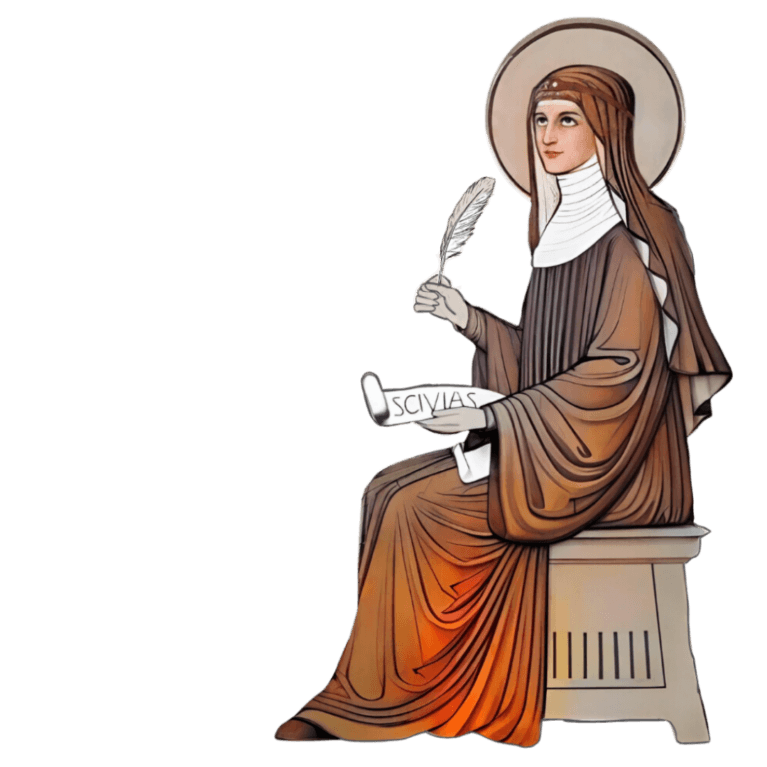
In My Thoughts:
Jesus, this week I promise to take time daily to conform my thoughts by… (make your intention).
In My Words:
Jesus, this week I promise to take time daily to conform my words by… (make your intention).
In My Actions:
Jesus, this week I promise to take time daily to conform my actions by… (make your intention).
Pray the Litany of Virtues prayer.
Join our Virtue Meditation Prayer Challenge
Don't let spiritual overwhelm hold you back!
Let us guide you step-by-step through Saint Hildegard’s transformative path to holiness.
Receive one long-form meditation in your inbox each week—perfect for a powerful 35-minute holy hour.
