
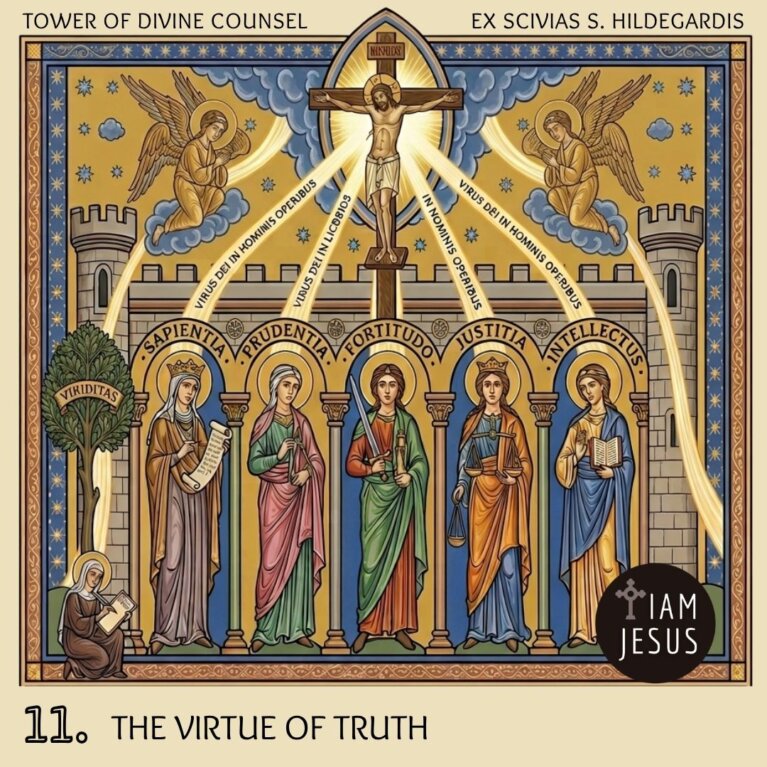
Overcoming Urge to Lie to Myself
Today we contemplate the liberating power of reality, learning how to dismantle the heavy traps of self-denial, self-deception, and the temptation to validate our feelings over the truth. Join our prayer community for this eleventh weekly meditation inspired by St. Hildegard of Bingen’s Book of the Rewards of Life—Part 2—to anchor your conscience in reality, receiving the spiritual courage to fully overcome self-interest and embrace the truth.
Opening Prayer
Jesus, please help me overcome the urge to lie to myself. I want to embrace the truth and be at peace. I am sorry for every lie I have ever told and every lie I have ever promoted through my own cowardice and self-interest. Please forgive me. I need the virtue of of truthfulness. I desperately want to change. I am ready to stop covering up my sins and mistakes to protect me from feeling ashamed of myself. Help me see the lies the devil has told me about myself and all the lies of the world. I want to live in the truth and inherit eternal life.
Please, Jesus, form my conscience. I don’t want to hide the truth or believe the lies of the world just to protect my ego, my finances, or my honor. I repent to you now for the times I let others take the blame for things I did because I wouldn’t admit the truth. I also repent for the times I chose to believe the world’s lies and was not in right relationship with you. I repent of the damage my lies have done to innocent people. I repent of the lies I hid for selfish gain and all the people who were injured by this action. I humbly embrace this truth about myself and ask you for the courage to live in this truth. Let me come into the light of truth and follow you completely with my whole heart from this day forward, courageously speaking the truth and committed to your will in my life.
From today, I humbly ask you to give me the courage to be completely honest. Jesus have mercy on me and help me overcome the urge to lie. Let me recognize the lie for what it is. Please give me the spiritual gifts I need to have the virtue of truthfulness.
I know the sins of falseness are wrong, but on my own I lack the courage and fortitude to change myself. Please help me be honest and brave. Let me overcome the lies of the devil and the lies I tell myself to justify my sins. I reject every form of falseness.
Jesus, I know you love me and if I ask you to help me live in the truth you will give me the virtue of honesty. I have so many sins I hide from others because I lack courage and honesty. The people in my life need to be able to trust me, and I need to trust myself to do the right thing for the right reasons. You know my heart and love me unconditionally, desiring me to grow in holiness and be in communion with you. I am so unworthy of your love, but you give it to me abundantly every time I seek your face. From the bottom of my heart I thank you. I offer you my sincere gratitude because you have never betrayed me or forsaken me. Jesus, thank you for helping me to strive for the virtue of truthfulness. With your help I will overcome the urge to lie to myself and embrace the truth.
AMEN.
“The eighth commandment forbids misrepresenting the truth in our relations with others. This moral prescription flows from the vocation of the holy people to bear witness to their God who is the truth and wills the truth. Offenses against the truth express by word or deed a refusal to commit oneself to moral uprightness: they are fundamental infidelities to God and, in this sense, they undermine the foundations of the covenant.”
Catechism, 2464
What Is the Virtue of Truthfulness?
In Catholic moral theology, the urge to lie to ourselves is an escape mechanism rooted in fear and pride. We alter reality to protect our egos, validate our changing feelings over facts, or avoid the sting of shame. Saint Hildegard describes falseness as a state where the soul actively invents scenarios it does not see or hear just to secure a temporary, comfortable advantage. She brilliantly warns that while falsehoods have to be constantly multiplied and managed so they don’t collapse, the truth remains completely immovable—like a giant, deeply rooted tree in our conscience. You can run from it or pretend it isn’t there, but you cannot destroy its roots.
To break free from the exhausting cycle of self-denial, we must actively practice the supernatural virtue of truthfulness (Veritas). Rooted directly in the cardinal virtue of justice, the virtue of truthfulness means aligning our minds, words, and actions with reality as God sees it. When we choose to embrace the truth, we step out of the dark prison of self-deception and into the light of Christ. It gives us the spiritual courage to confess our sins honestly, stop twisting facts to make ourselves look good, and find authentic interior peace.
The Words of Falseness
by St. Hildegard of Bingen
“Who speaks everything truthfully?
If I were to speak truthfully to others about their prosperity, I would offend myself. For lifting up another makes me fall down. I prefer to speak puffed up words that will give me honor. What I cannot have in one hand, I will demand with the other. For if I were to be truthful, I would not be able to require all the things I want when I attend to my business, I discover things that are unsuitable to me, and so I say whatever I want to.
For many truths are so immovable that they are not able to move even themselves; they have been tied, as it were, to a tree. They bring about only what they see and hear. Therefore, many are poor and needy and deprived from these truths. What I, however, demand falsely, I acquire. When I want to be nobler and richer than others, I speak more nobly and richly than they do. This is better than being tied to a tree. But I often speak the things that I do not see and hear. Thus I turn away from many evil things, but I also pass through many evil things.
If my speech were to be only one way, I might be condemned. Therefore, I multiply my stories so that I cannot be overcome by any one of them. This is more useful to me than being pierced by javelins and swords. I never come across the noble and rich without some business to do.”
St. Hildegard of Bingen, Liber Vitae Meritorum (The Book of the Rewards of Life,
Part 2, Section 7, Para. 12 (Trans. Hozeski)
From Impiety to Falseness: The Drying Continues
St. Hildegard places Falseness directly after Impiety in her vision:
It follows after impiety because when a man is impious, he approaches falsehood.
Liber Vitae Meritorum, Part 2, Section 45, Para. 54, Trans. Hozeski
This is the next stage of the same drying we traced last week. Impiety dug in her heels against the Holy Spirit’s conviction; Falseness is what a soul builds once it has stopped listening altogether—a whole architecture of self-protective stories, because the truth is too costly to face. St. Hildegard describes her standing on “a dry, hard, black foam” (Liber Vitae Meritorum, Part 2, Section 7, Para. 11), and Truth’s own rebuke names exactly what’s missing: “absque omni viriditate gratiae Dei es” —”you are without any of the viriditas, the very greenness of the grace of God” (Liber Vitae Meritorum, Part 2, Section 8, Para. 13). Where Truth is a living pillar—rooted, immovable, watered by God—Falseness is dry ground that can only produce more dryness. Every lie we tell ourselves is one more inch further from the greenness we were made to carry.
Reflection:
Truth is immovable. It brings about only what it sees and hears, so let’s contemplate what St. Hildegard is saying here: “for many truths are so immovable that they are not able to move even themselves.”
I think this is why the guilt of sin forces us to either deny the truth, oppose it, or repent and make a confession. Let’s begin with a little self-reflection on the urge to lie.
Do I Live in Falseness or Embrace the Truth?
St. Hildegard defines falseness as “speaking about the things that I do not see or hear.” Ask yourself, do I imagine scenarios in my mind and then believe the falseness of what I have imagined? Perhaps this is what Judas Iscariot did when after betraying Christ he told himself that the only viable option for him was suicide. The tragic lie Judas told himself was that Jesus would never forgive him. He presumed he would be condemned for his sin so he went ahead and condemned himself. Judas was guilty of self-hatred.
But maybe your sinful inclinations are not directed toward self-hatred. Instead you instigate hatred toward your brothers and sisters because you may believe as St. Hildegard says, “lifting up another makes me fall down.” Ask yourself, are my stories a form of gossip about others? Are they lies about myself to cover my sins toward my neighbor so that I look good and my neighbor looks bad? Do I tell things about others that can’t be proven because they are false, yet I do this anyway to destroy their reputation so that I am seen as a better person?
The Consequence of Deception
We are reminded by Scripture that “the lying tongue is its owner’s enemy” (Proverbs 26:28). Let’s contemplate the consequences of deception in the home, among friends, in the community, in the church, in our nation and in the world.
Lord have mercy on us and heal us of all falseness.
St. Hildegard uses a tree to visualize this phenomena:
We can imagine this giant tree of truth before us with its enormous trunk and deep roots. We can’t move it. We can try to cut it down at great effort but we will not remove the roots. Even if the truth is hidden from others and only the stump remains, in our conscience we know that the roots are there beneath the surface and they point to the truth of the matter. They cannot be destroyed.
If we embrace falsehood rather than choose truth, we will avoid repenting of that hidden sin.
The urge to lie will drive us to do one of three things:
- We may first close our eyes and pretend it isn’t there –walking around it like we don’t know it exists even though we do.
- Once the lie grows large enough we may try to hide it from view by distracting ourselves and others from seeing it.
- And finally, when the lie begins to overpower us, we may desperately try to destroy the truth at all costs. We may oppose it through aggressive means, we may destroy everything that we believe represents it, and sadly, we may choose to destroy ourselves from the weight of it on our consciences.
Only when we humbly admit the truth about the tree’s existence will we have the courage to look directly at it and recognize it is there before us, the towering unmovable truth. We may even decide to take advantage of its height, and its shade, and live beneath it’s great towering wisdom; we are all sinful and in need of a Savior and we have a Savior desperately in love with us and wanting to reconcile with us. To embrace the truth we must recognize our sinfulness and our desperate need for Jesus to deliver us from our evil inclinations and our sinful past. When we embrace the truth we will recognize, like Peter did after he denied Jesus three times, that the love of Christ is a greater power than our past sins and our urge to lie.
What Happens when I Repent from the Urge to Lie?
When I repent I am finally freed from the urge to lie about myself. I finally embrace the truth. God enters into my brokenness and heals me with his loving merciful grace. With my humble repentance he comes and gives me a right mind willing to embrace the virtue of honesty through courage and humility. I am no longer the center of my life, and instead God is my center. I am freed to move and act and exist in the truth according to his plan for my life. And in time, I am made whole again, fundamentally changed and renewed by Christ. I am able to begin a new life in Christ.
What if I Oppose the Truth?
Of course, if I oppose this tree of truth I will despise it. I will relocate to a place where I can no longer see it. Perhaps I believe that if I block it from my view it somehow no longer exists. But the immovable truth will remain regardless. Instead of avoiding guilt, my guilt will fester and grow. And if I am stubborn my opposition to truth will grow. And if I allow this to grow, I will continue to spiral toward self-destruction, like a snowball effect, until I finally succeed in destroying my soul. St. Hildegard continues her lesson on Lying in Liber Vitae Meritorum, when she writes:
“[Falseness] does not place any value on the truth, but speaks strange things with lies that people are unaware of. It is anxious to do these things against God and his holy ones in whom God has done marvelous things. This sin is inhuman; when man sins as a result of his desires of the flesh, he is human, but when he lies, he is inhuman. For lies cover themselves with lies, just as the serpent hides in his hole… they reject the teachings of the Holy Spirit when they follow the works of the devil.”
Liber Vitae Meritorum, Part 2, Section 70, Para. 83
The Immovable Truth Always Overwhelms Falseness
This is how we treat the truth. We either try to destroy it, try to pretend it doesn’t exist, or we embrace it and acknowledge it for what it is and we live in it, reconciled to God through Jesus Christ, with peace of heart. The truth is and always will be immovable. It remains in your conscience because you are made in the image and likeness of God. You were made to be in right relationship with God and to live in the truth. You cannot escape the roots of truth. You can deny it, try to hide it, run as far away from it as possible, but deep in your heart it remains, always. You are hard-wired to know the truth and live in it. Until you do you will never be set free. He is with you and until you accept him and allow him to be in you and work through you, this angst will remain.
Jesus says, ““I am the way and the truth and the life. No one comes to the Father except through me” (John 14:6). Let’s come to the Father through Christ and embrace the truth of the Gospel and be reconciled, repenting of the urge to lie and embracing the truth about ourselves and the world. We all fall short of the glory of God, but through Christ we are all called to rebirth and renewal. We are called to remain in his Word, to know the truth, and to be set free by it.
Going Further:
If you’d like to spend more time this week contemplating the eternal consequence of the urge to lie, read Acts 5:1-11. This is where we read the tragic story about Ananias and Sapphira.
Let us Pray Before the Immovable Tree of Truth:
Take a moment to pause, drop your defenses, and settle into the absolute stillness of this chapel. The urge to lie to ourselves is a sneaky mechanism rooted in fear and pride—an exhausting attempt to protect our egos, avoid the sting of shame, or alter reality to match our changing feelings. We often imagine false scenarios in our minds and then foolishly choose to believe them, multiplying our stories just so we don’t get caught. Before we open the Word of God, let us offer up a sincere prayer of petition—asking for the spiritual grit to stop running, to look directly at the towering, immovable tree of truth in our conscience, and to step out of the dark prison of self-deception.
Prayer for Perfect Honesty and Spiritual Courage
Eternal Father, You see into the deepest hidden corners of my conscience, and You know the exact layout of the lies I tell myself. I confess that when I am faced with my own mistakes, failures, or sins, I often succumb to the urge to lie—inventing false narratives to protect my ego, my finances, or my honor. Forgive me for the times I have allowed self-deception to breed self-hatred, or when I have maliciously twisted facts and gossiped about my neighbors just to make them look bad and make myself look better. I am too weak to conquer this cowardice by my own power. I desperately need the cleansing fire of Your grace.
Lord Jesus, grant me the supernatural virtue of truthfulness. Align my mind, my words, and my daily actions with reality as You see it. Give me a right mind rooted in courage and humility so that I may stop covering up my faults to escape feeling ashamed. When I am tempted to close my eyes, pretend a sin isn’t there, or distort the facts this week, catch my tongue and anchor my soul in Your reality. Deliver me from the exhausting cycle of duplicity and hypocrisy. Give me the grace to live beneath the great, towering wisdom of Your unmovable truth, recognizing my desperate need for a Savior. Let Your perfect love cast out all my fears, so that I may walk completely in the light, reconciled to You and set free by Your Holy Word.
AMEN.
Take a slow, deep breath. Settle your mind, drop your daily checklist, and open your heart. As you prepare to listen to Jesus speak in this passage from the Gospel of John, remember that Christ doesn’t just speak the truth—He is the Truth, and He desires to break the chains of every habit that keeps your soul enslaved.
Do not rush through these verses. Read the words slowly and let the weight of Christ’s conversation with the crowd sink in. Notice the sharp contrast between their stubborn denial—pridefully claiming they have never been enslaved to anyone—and Jesus’ clear, loving revelation that everyone who commits a sin becomes a slave to sin. Watch how He beautifully promises that true freedom doesn’t come from our own shifting arguments, but from remaining anchored in His Word. Ask Jesus to reveal the specific lies you are still using to justify your sins, and where His light needs to shine to set you truly free. When you are ready, pick up your pen and write His promptings directly into your prayer journal.
The Truth will set You Free
from the Gospel of John Chapter 8:28-36
So Jesus said (to them), “When you lift up the Son of Man, then you will realize that I AM, and that I do nothing on my own, but I say only what the Father taught me. The one who sent me is with me. He has not left me alone, because I always do what is pleasing to him.”
Because he spoke this way, many came to believe in him.
Jesus then said to those Jews who believed in him, “If you remain in my word, you will truly be my disciples, and you will know the truth, and the truth will set you free.”
They answered him, “We are descendants of Abraham and have never been enslaved to anyone. How can you say, ‘You will become free’?”
Jesus answered them, “Amen, amen, I say to you, everyone who commits sin is a slave of sin. A slave does not remain in a household forever, but a son always remains. So if a son frees you, then you will truly be free.”
Let us Pray:
Jesus, you teach us to remain in your word and I will be free. Please help me meditate on your words and believe the truth.
Jesus, let me know the truth about myself and please set me free. I no longer want to be a slave to sin or enslaved by anyone due to lies. Protect me and guard me from the vice of falseness. Do not let me be lost. Do not let me succumb to the urge to lie. Please protect me from this world. Give me humility and courage. Help me come to believe in you like the disciples in the passage.
I do not want to belong to this world. Set me free with the truth.
Jesus, you are a gift to me. Thank you for being present to me. Give me the grace to be present to you and to grow in the virtue of honesty. AMEN
A Prayer for an Increase in Virtue for Others
Lord Jesus Christ, you say that when two or more are gathered in your name, you are with us. Jesus, in your name I lift up every person who has joined this prayer challenge or will join it in the future. I ask you to give us all the grace we need to grow in virtue and holiness so that we may love and serve you in our lives and through the people we love and care for. Help us in our thoughts, our words, and our actions. Guide us all by your Holy Spirit and give us the strength to overcome every temptation from the evil one. We ask all this in the name of the Father, and of the Son, and of the Holy Spirit, AMEN.
The Immovable Tree: Your Week 11 Send-Off
Thank you for committing to Week 11 and for your incredible persistence throughout this entire virtue journey. Confronting the urge to lie to yourself—dismantling those protective stories we tell our own egos—takes profound spiritual bravery, and Jesus sees every single moment you choose reality over deception. When you inevitably feel the impulse to cover up a mistake, exaggerate a story, or invent a scenario to avoid shame this week, do not let discouragement take over. Overcoming the habit of dishonesty is a slow process of reclaiming your conscience, not an overnight fix. Be gentle with yourself, take immediate accountability when you slip, and run to the Sacrament of Reconciliation to let His truth set you completely free once again.
As you walk out of this chapel and step back into a loud, superficial world that often rewards “curating” the truth and building false images of ourselves, guard your interior peace. True honesty isn’t just about the words you say; it is an act of spiritual freedom that aligns your soul with God’s light. You are called to actively govern your thoughts, stop the gossip that destroys reputations, and live beneath the towering tree of truth out there in the real world. To see exactly how our very nature is divinely ordered toward this light—reminding us that every person is bound by a moral obligation to seek the truth and adhere to it once it is known—look at the sacred standard laid out right here in the Catechism:
“Man tends by nature toward the truth. He is obliged to honor and bear witness to it: ‘It is in accordance with their dignity that all men, because they are persons . . . are both impelled by their nature and bound by a moral obligation to seek the truth, especially religious truth. They are also bound to adhere to the truth once they come to know it and direct their whole lives in accordance with the demands of truth.’
Truth as uprightness in human action and speech is called truthfulness, sincerity, or candor. Truth or truthfulness is the virtue which consists in showing oneself true in deeds and truthful in words, and in guarding against duplicity, dissimulation, and hypocrisy.”
Catechism, 2467-2468
Make a Resolution
Take a moment to reflect on the virtue of truthfulness. What are the ways you can freely practice this virtue this week? Ask the Lord to give you opportunities, and when you feel the Holy Spirit prompting you, take action. Write down your resolutions for this coming week in your prayer journal. Remind yourself to complete these resolutions daily for this entire week, and as the Spirit prompts you, feel free to write about your experiences with this virtue throughout the week.
In My Thoughts:
Jesus, this week I promise to take time daily to conform my thoughts by… (make your intention).
In My Words:
Jesus, this week I promise to take time daily to conform my words by… (make your intention).
In My Actions:
Jesus, this week I promise to take time daily to conform my actions by… (make your intention).
Pray the Litany of Virtues prayer.
Join our Virtue Meditation Prayer Challenge
Don't let spiritual overwhelm hold you back!
Let us guide you step-by-step through Saint Hildegard’s transformative path to holiness.
Receive one long-form meditation in your inbox each week—perfect for a powerful 35-minute holy hour.

One Response
Thank you for the course of 35 Virtues. I am very grateful because I can learn about my weaknesses and can correct them with practice. I especially like the Litany of Virtues. Thank you.