
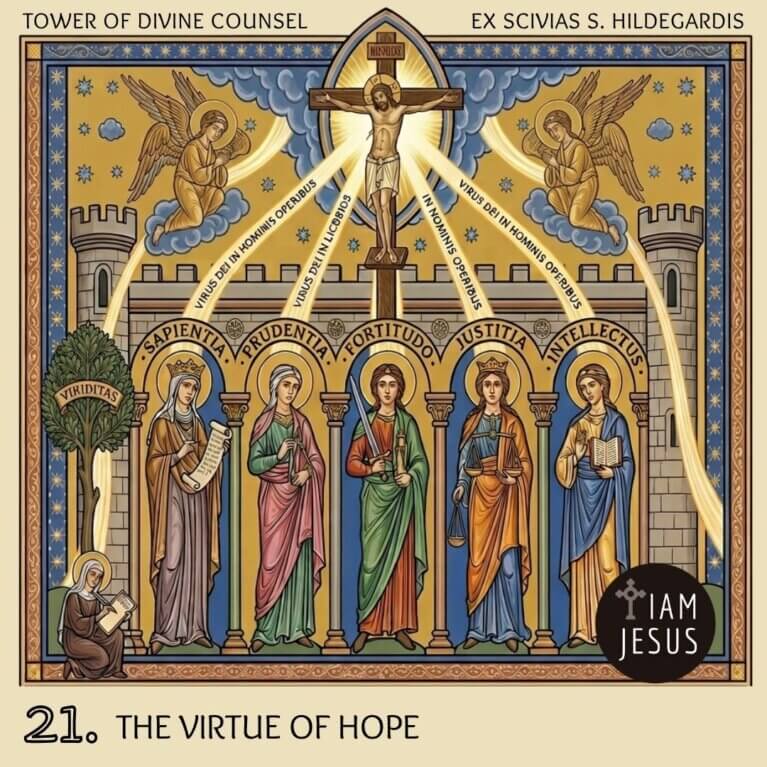
Overcoming Doubt and Despair
Today we contemplate the grace of shaking off spiritual desolation and choosing unshakeable confidence in Christ’s promises. Join us for this Part 3, Week 21 mental prayer challenge as we discover how cultivating the virtue of hope St. Hildegard of Bingen championed can break through your darkest seasons, shatter the heavy weight of despair, and securely anchor your soul in divine victory.
Opening Prayer
Heavenly Father, by rejecting despair I trust you will help me grow in the virtue of hope. I need you to overcome obstacles that will cause me to despair. I have a weak mind that sees the bad and often overlooks the good. With your help I can finish my daily responsibilities, trusting in your providence for all my needs. By rejecting despair I believe you will help me learn to fully trust in you. Help me learn to lean on you for all my needs. Help me have hope in the future and believe that you love me no matter what.
Lord, you know that I struggle with doubt and sometimes this leads me toward despairing thoughts. I humbly ask for an increase in the virtue of hope. I want to be strong in faith and trust in you. By rejecting despair in difficult situations I will show that I really trust in your love and your providence. Help me remain hopeful even when my situation seems impossible. Help me pray and proclaim it even when my heart and my emotions tell me not to believe and to despair instead.
I believe you will not forsake me.
Father, please help me to also be hopeful with others in my life. Help me be more charitable toward people in need, especially those in despair. If you help me be more loving toward them, I believe my actions may be a sign for them to also have hope in Christ. By rejecting despair and praying with fervor through my thoughts, words, and actions, I know you will help me grow in the virtue of hope and help me to be a blessing toward others in my life.
Lord, I promise to trust in you when I am overcome with doubt, rejecting despair for the virtue of hope, and I will also put my hope into action for the good of others in my life.
AMEN.
“The first commandment is also concerned with sins against hope, namely, despair and presumption:
By despair, man ceases to hope for his personal salvation from God, for help in attaining it or for the forgiveness of his sins. Despair is contrary to God’s goodness, to his justice – for the Lord is faithful to his promises – and to his mercy.There are two kinds of presumption. Either man presumes upon his own capacities, (hoping to be able to save himself without help from on high), or he presumes upon God’s almighty power or his mercy (hoping to obtain his forgiveness without conversion and glory without merit).”
Catechism, 2091-2092
What Is the Virtue of Hope Hildegard Shows Us?
In Catholic moral theology, sliding into despair is a quiet rebellion where we choose emotional defeat over God’s promises. When consumed by current struggles, we grow blind to the Resurrection. St. Hildegard warns in Scivias that letting despair take root acts like a spiritual blackout—cutting us off from grace and closing the door to divine love.
To shatter that heavy spirit, we must cultivate the supernatural virtue of hope in Christ as the ultimate antidote. According to St. Hildegard’s visions, anyone facing the tempests of despair who refuses to consent in their heart is viewed by God as a strong warrior who will be helped speedily. In this spiritual battle, Christian hope unfolds from the Proclamation of the Beatitudes, tracing a path through the trials awaiting Christ’s disciples. Through the merits of His Passion, God keeps us in a hope that does not disappoint. This theological virtue serves as a protective weapon and a steadfast anchor of the soul, affording us joy even under trial. Living it out means showing up, keeping our promises when numb, and trusting that His grace brings resurrection out of our worst dead ends.
On Rejecting Despair for Virtue of Hope
by St. Hildegard of Bingen
Words of David
“The fool has said in his heart, ‘There is no God’ ” [Psalm 13:1].
What does this mean? In his foolish utterance he who lacks wisdom and understanding has denied God in his heart, unable to know Him. How? Because he did not want to know or understand the true God, saying to himself, “What is God? God does not exist. And what then am I? I do not know what I am!” He who says these things is a fool, for he has not the true wisdom by which God is known. But anyone who has really known God, reigning in power, is wise even if a sinner. Hence anyone who has despair of God’s mercy fixed in his heart, saying, “God is nothing; I know Him not because He has not known me, and I deny Him because He has denied me;” such a one will not rise again to life or inherit joy, for since he regards the Creator as nothing, all creatures will desert him.
And one who despairs because of his sins and believes that their great weight makes it impossible for him to be saved is faithless; he shall not attain to life, for he contradicts the One Who gives life to all. But if any of these is led by penitence and truly seeks Me, he shall find Me, for I reject no one who comes to me with a sincere heart.
Anyone who resists blasphemous despair is quickly helped by God
And if the blackest tempests of blasphemy and despair fall on anyone, and he does not consent to them in his heart or his will or any perverted taste but struggles against them in great torment; then if he perseveres in the fight and strongly resists, I will quickly help him. And let him not doubt because he must struggle, for I say he is a strong warrior against the greatest of storms, and I will help him most speedily and hold him as a friend; for, patiently enduring, he has nobly conquered great misfortunes for love of Me.
St. Hildegard of Bingen, Scivias, Book 2, Vision 5, Chapters 57-58 (Trans. Hart/Bishop)
The Face of Despair
St. Hildegard sees Despair “in the form of a woman,” her head covered with a dark veil “in a woman’s manner,” her whole body clothed in darkness. Before her face rises a mountain of burning sulfur; the same mountain stands on either side of her. Thunder sounds behind her back. Terrified by all of it, she presses her arms and hands to her chest, groaning and trembling, and sinks herself entirely into the darkness before she can even speak.
Despair Speaks and Hope Responds:
St. Hildegard gives Despair her own voice, and it is nothing but collapse:
“I am greatly terrified! Who could console me?… The fire of Gehenna is around me, and the zeal of the Lord has cast me into hell. What remains for me but death?”
Liber Vitae Meritorum, Part 3, Section 13, Para. 19, trans. Hozeski
Hope answers her not with comfort but with a diagnosis:
“O tinder of the devil, you are tinder of sin… I sit on the throne of God in good desire, and by doing good works, I draw all the earth to myself.”
Liber Vitae Meritorum, Part 3, Section 14, Para. 20, trans. Hozeski
Despair calls herself already-burning wood; Hope calls herself rooted in the whole earth. One is kindling. The other is ground that holds.
A Note on Viriditas: Dry Wood, Living Wood
St. Hildegard tells us plainly why Hope calls Despair nothing but “tinder”: “if wood did not have greenness in itself, it would not be wood… man is nothing without the greenness of faith” (Liber Vitae Meritorum, Part 3, Section 66, Para. 83, trans. Hozeski). Despair isn’t simply sadness or discouragement — she has let dry out of her every trace of God’s living greenness, until what remains isn’t really wood at all anymore, only kindling, waiting for a fire that will finish what despair already started. This is what despair truly is: not a feeling, but a slow drying-out of the soul’s capacity to hope, until nothing is left that can hold a flame of grace without being consumed by it instead.
Hope answers simply by being everything Despair no longer is. She doesn’t argue despair out of its fear—she just says what is true: “I sit on the throne of God in good desire… and by doing good works, I draw all the earth to myself” (Liber Vitae Meritorum, Part 3, Section 14, Para. 20, trans. Hozeski). Hope is rooted, growing, alive—drawing the whole earth toward herself the way a living tree draws water up through its own roots. Where despair has become dry kindling, hope remains green wood, still bearing fruit no matter how deep the darkness pressing in around her.
Ask the Lord this week to show you where the greenness of your own faith has quietly dried into kindling—brittle, waiting only to be burned—and ask Him to send His grace like rain, so that you remain living wood, never dead branches, no matter what trial surrounds you.
Reflection:
St. Hildegard tells us plainly how we arrive here. Despair “follows in the footsteps of unfaithfulness,” she writes, “because it is the kindling wood of unfaithfulness and of all the other faults” (Liber Vitae Meritorum, Part 3, Section 41, Para. 50, trans. Hozeski). Despair does nothing for the soul. It is a poison that kills the heart. We have to have hope. As we reflect on the virtue of hope, St. Hildegard reminds us that despair is blasphemous against God. This is why it is considered a sin against the Holy Spirit. Despair denies God access to your love. It’s a closed door to grace. Lord, when our trust in you has already worn thin, don’t let us add despair on top of it. Keep us green and living, never dry kindling waiting for one more doubt to strike the spark.
Despair begins in Desolation
When your heart feels the love of God you naturally have hope and you know you are in his embrace. When we are weak baby Christians this form of consolation gives us so much energy and hope. But for many of us this initial stage of intimacy with God gives way to periods of desolation. In many cases the desolation begins when we commit a sin and are too proud to confess it. Desolation always pulls us into material things. We are naturally drawn from intimate prayer life toward the distractions of this world, our lower faculties.
Hope begins with Rejecting Despair
Hope comes from God and it is a gift we can only receive through prayer. When you are in desolation and full of despair your only recourse is to pray anyway, regardless of how you feel. Pray as you know you should even when you don’t feel like it. Say the words even if your heart is cold and unfeeling. Repeat the prayers. Be honest with God and ask him for the gift of hope and to cultivate in you the virtue of hope. Never give into the temptation. Rejecting despair requires prayer and complete surrender to the will of God.
Ask the Lord to help you establish new thought patterns. Ask him to give you a grateful heart and the wisdom to understand Sacred Scripture when you prayerfully meditate on the virtue of hope in Christ. St. Hildegard talks about having clear eyes and strong feet. She says when we “pursue celestial things” we fix our vision entirely on Christ’s victory and direct our footsteps away from the paralyzing darkness of despair. If we can keep a firm habit of remembering God in all things and keeping a good prayer habit, we will not succumb to the temptation of despair.
Going Further:
If you have time this week to go further, I encourage you to read the 6th chapter of Hebrews and meditate on the passage and what it means to have the “fulfillment of hope” until the end of your life.
In Hebrews 6: 9-12 we read, “But we are sure in your regard, beloved, of better things related to salvation, even though we speak in this way. For God is not unjust so as to overlook your work and the love you have demonstrated for his name by having served and continuing to serve the holy ones. We earnestly desire each of you to demonstrate the same eagerness for the fulfillment of hope until the end, so that you may not become sluggish, but imitators of those who, through faith and patience, are inheriting the promises.”
Take some time to prayerfully reflect on the passage, asking Jesus to help you understand what this means for you and how you can exhibit the virtue of hope in your own life. You may want to journal about it.
Shattering Desolation:
Take a moment to pause, drop your defenses, and settle into absolute stillness before the Eucharist. Despair is a quiet, devastating rebellion—a toxic poison that darkens the soul, denies God access to our love, and slams the door shut against His grace. When we slide into desolation, it is so easy to turn away from intimate prayer, get swept up in the distractions of material things, and mistakenly believe that the crushing weight of our sins makes salvation impossible. Before we open the Word of God, let us offer up a sincere prayer of petition—asking for the spiritual grit to pray anyway when our emotions are cold, reject the blasphemy of hopelessness, and receive the gift of a sure and steadfast hope.
Prayer for Supernatural Hope
Eternal Father, You are the faithful keeper of promises, yet You know the weak, fearful, and doubting corners of my heart. I confess that I have often allowed the heavy spirit of despair to take root during seasons of desolation—obsessing over my failures, turning to worldly distractions for comfort, and letting my pride tell me that You have hidden Your face from me forever. Forgive me for the times I have doubted Your mercy and ceased to hope for my salvation. I am too weak to conquer this paralyzing darkness by my own willpower. I desperately need the cleansing fire of Your grace.
Lord Jesus, grant me the supernatural virtue of hope. Infuse my mind with the absolute, unshakeable confidence that You will never forsake me, no matter how impossible my circumstances appear. When the dark tempests of doubt fall upon my soul this week, catch my thoughts and give me the strength to resist consenting to defeat. Even when my heart feels cold, unfeeling, and numb, grant me the grace to show up, repeat my prayers, and fight like a strong warrior. Fix my vision entirely on Your resurrection victory, establish new and grateful thought patterns within me, and anchor my soul securely in Your promises so that I may inherit Your eternal joy.
AMEN.
Take a slow, deep breath. Settle your mind, clear away your daily checklist, and lay down any feelings of unworthiness you brought in with you today. As you prepare to encounter Jesus in this beautiful passage from the Gospel of Luke, look past the familiar story and peer directly into the infinite, restorative power of divine hope.
Do not rush through these verses. Read the words slowly and step directly into the dusty road with the prodigal son. Notice how despair initially tells him he is no longer worthy to be called a son, tempting him to settle for the life of a hired servant. Watch the breathtaking response of the father: catching sight of him from a long way off, running out to meet him in the dirt, and completely restoring him with a fine robe, a ring, and a celebration feast. Ask Jesus to reveal where your own desolation has made you feel spiritually dead or lost, and where He is calling you to reject that despair and run straight back into the arms of the Father. When you are ready, pick up your pen and write His promptings directly into your prayer journal.
The Parable of the Lost Son
from the Gospel of Luke Chapter 15:11-32
Then [Jesus] said, “A man had two sons, and the younger son said to his father, ‘Father, give me the share of your estate that should come to me.’ So the father divided the property between them.
After a few days, the younger son collected all his belongings and set off to a distant country where he squandered his inheritance on a life of dissipation. When he had freely spent everything, a severe famine struck that country, and he found himself in dire need. So he hired himself out to one of the local citizens who sent him to his farm to tend the swine. And he longed to eat his fill of the pods on which the swine fed, but nobody gave him any. Coming to his senses he thought, ‘How many of my father’s hired workers have more than enough food to eat, but here am I, dying from hunger. I shall get up and go to my father and I shall say to him, “Father, I have sinned against heaven and against you. I no longer deserve to be called your son; treat me as you would treat one of your hired workers.”’
So he got up and went back to his father. While he was still a long way off, his father caught sight of him, and was filled with compassion. He ran to his son, embraced him and kissed him.
His son said to him, ‘Father, I have sinned against heaven and against you; I no longer deserve to be called your son.’
But his father ordered his servants, ‘Quickly bring the finest robe and put it on him; put a ring on his finger and sandals on his feet. Take the fattened calf and slaughter it. Then let us celebrate with a feast, because this son of mine was dead, and has come to life again; he was lost, and has been found.’ Then the celebration began.
Now the older son had been out in the field and, on his way back, as he neared the house, he heard the sound of music and dancing. He called one of the servants and asked what this might mean. The servant said to him, ‘Your brother has returned and your father has slaughtered the fattened calf because he has him back safe and sound.’
He became angry, and when he refused to enter the house, his father came out and pleaded with him.
He said to his father in reply, ‘Look, all these years I served you and not once did I disobey your orders; yet you never gave me even a young goat to feast on with my friends. But when your son returns who swallowed up your property with prostitutes, for him you slaughter the fattened calf.’
He said to him, ‘My son, you are here with me always; everything I have is yours. But now we must celebrate and rejoice, because your brother was dead and has come to life again; he was lost and has been found.’”
Let us Pray:
Jesus, You love me so much that you clothe me in a new garment when I repent and return to you. I am your beloved child, and by hoping for forgiveness and humbly repenting you come and restore me as an adopted child in sanctifying grace. Thank you for helping me in rejecting despair and having the virtue of hope in salvation.
Help me to be grateful for your sacrifice and always remember the price that you paid out of love for me. Let me rejoice with you over all my brothers and sisters who come back to life again after a lifetime of being lost to sin. Let me love them with the same generosity that you have shown the prodigal son. Lord, let me imitate you in my thoughts, words, and actions. AMEN.
A Prayer for an Increase in Virtue for Others
Lord Jesus Christ, you say that when two or more are gathered in your name, you are with us. Jesus, in your name I lift up every person who has joined this prayer challenge or will join it in the future. I ask you to give us all the grace we need to grow in virtue and holiness so that we may love and serve you in our lives and through the people we love and care for. Help us in our thoughts, our words, and our actions. Guide us all by your Holy Spirit and give us the strength to overcome every temptation from the evil one. We ask all this in the name of the Father, and of the Son, and of the Holy Spirit, AMEN.
The Anchor of Hope: Your Week 21 Send-Off
Thank you for committing to Week 21 and for your incredible dedication throughout this entire virtue meditation journey. Confronting the paralyzing darkness of despair—shattering the temptation to give up during heavy seasons of desolation and choosing a steadfast, supernatural hope—takes profound interior grit, and Jesus sees every single moment you choose to show up and pray when your heart feels cold and unfeeling. When you inevitably feel doubt creep back in, catch yourself slipping into worldly distractions for comfort, or feel tempted to believe that your mistakes make salvation impossible this week, do not let discouragement take root.
To see exactly how Christian hope unfolds from the very beginning of Jesus’ preaching, just look at this passage in the Catechism:
Christian hope unfolds from the beginning of Jesus’ preaching in the proclamation of the beatitudes. The beatitudes raise our hope toward heaven as the new Promised Land; they trace the path that leads through the trials that await the disciples of Jesus. But through the merits of Jesus Christ and of his Passion, God keeps us in the “hope that does not disappoint”[Romans 5:5]. Hope is the “sure and steadfast anchor of the soul … that enters … where Jesus has gone as a forerunner on our behalf” [Hebrews 6:19-20].
Hope is also a weapon that protects us in the struggle of salvation: “Let us … put on the breastplate of faith and charity, and for a helmet the hope of salvation” [1 Thessalonians 5:8]. It affords us joy even under trial: “Rejoice in your hope, be patient in tribulation” [Romans 12:12]. Hope is expressed and nourished in prayer, especially in the Our Father, the summary of everything that hope leads us to desire.
Catechism, 1820
Make a Resolution
Take a moment to reflect on the virtue of hope. What are the ways you can freely practice this virtue this week? Ask the Lord to give you opportunities, and when you feel the Holy Spirit prompting you, take action. Write down your resolutions for this coming week in your prayer journal. Remind yourself to complete these resolutions daily for this entire week, and as the Spirit prompts you, feel free to write about your experiences with this virtue throughout the week.
In My Thoughts:
Jesus, this week I promise to take time daily to conform my thoughts by… (make your intention).
In My Words:
Jesus, this week I promise to take time daily to conform my words by… (make your intention).
In My Actions:
Jesus, this week I promise to take time daily to conform my actions by… (make your intention).
Pray the Litany of Virtues prayer.
Join our Virtue Meditation Prayer Challenge
Don't let spiritual overwhelm hold you back!
Let us guide you step-by-step through Saint Hildegard’s transformative path to holiness.
Receive one long-form meditation in your inbox each week—perfect for a powerful 35-minute holy hour.
