

Overcoming Anxiety about the Future
Today we contemplate the grace of fixing our eyes on Jesus Christ and His Kingdom rather than a world that is passing away, learning how practicing the virtue of heavenly desire cures our anxiety by shattering our disordered attachments. Join us for this Part 4, Week 27 meditation inspired by St. Hildegard of Bingen’s Liber Vitae Meritorum to shake off the suffocating weight of earthly worry, take flight on the wings of a good will, and anchor your daily life on the living vine of Christ.
Opening Prayer
Lord, I struggle with letting go of all worry and cares of this world. Help me to have the virtue of heavenly desire. I know that with your grace I can learn how to let go of all my worries about the future and rest in your loving providence. Lord, I know that worrying about my life will not add a single moment to my life-span (Matthew 6:27). Throughout the Gospels you teach us that we must have the virtue of heavenly desire. Please help me obtain this.
If I can let go of all cares of this world I will truly be free to follow the Holy Spirit, which will lead me to the truth. If I can follow the truth then I know I can live in it and do what you have created me to do in this life. Let me find my greater purpose in my life by letting go of all worry and cares of this world to rest in the vision and beatitude of your kingdom through a heavenly desire.
Remind me always that what I think does not matter if it is not the truth. Let me have faith to believe that you know all things, including the right path for my life, and you love me with a deep eternal love that I will never fully understand in this life.
Jesus, I beg you, give me the grace to reject all anxiety about my life and replace it with trust in you and faith in your providence. Help me to recognize that everything will work together for my good as long as I live to please you and follow your will for my life. I know that my trials and sufferings are a gift from you. They make me want to lean on you and trust in you when I would otherwise have pride or indifference.
Eternal Father, I praise you for your great wisdom in providing me with everything I need for my eternal salvation and purification. I trust that any suffering you bring me to experience you will also give me the grace to overcome. Thank you for loving me like a Father and giving me all that I need. I am made to have a relationship with you. I was given a heart and a soul and the ability to choose you or reject you for the things of this world. I am made for eternal life. Please help me remember this every day of my earthly life.
AMEN.
Desire for true happiness frees man from his immoderate attachment to the goods of this world so that he can find his
fulfillment in the vision and beatitude of God.“The promise [of seeing God] surpasses all beatitude. . . .
In Scripture, to see is to
possess. . . . Whoever sees God has obtained all the goods of which
he can conceive.”Catechism, 2548
What is the Virtue of Heavenly Desire?
In simple terms, the virtue of heavenly desire is not an abstract theological escape hatch, nor does it let us slide into the lazy heresy of quietism. Catholic spirituality is entirely about a Person—Jesus Christ. In her Liber Vitae Meritorum, St. Hildegard exposes the vice of earthly worry as a “predator of souls” that traps us in total darkness. When we give in to anxiety, we become exactly like the naked, barrel-shaped man in her fifth vision—pounding our chests in panic, obsessively calculating, and falsely believing that if we do not acquire everything through our own human thinking, words, and deeds, we will perish. The virtue of heavenly desire does not tell us to abandon our earthly responsibilities; instead we surrender them to God. This virtue helps us overcome the fearful need for control of our lives.
According to St. Hildegard, trying to solve all our worries through purely human expertise reduces our spiritual life to the status of “dead bones who lie rotting in the tombs.” Real anxiety is actually a form of spiritual carelessness that chooses to live entirely apart from the grace of God. But when we steadfastly pursue the virtue of heavenly desire, we unleash what she calls viriditas—the fresh, divine “vital force” of the Holy Spirit. This virtue builds an “unalterable mind” that flies high above worldly panic on the wings of a good will. In plain English, she is saying that when we want what God wants for our lives and we are surrendered to His will with complete trust in Him, we will no longer suffer from ‘worldly panic’ about our future. Our “good will” simply means choosing to align our desires with Jesus. Instead of letting our thoughts get trapped in survival mode—worrying about money, control, or what tomorrow looks like—our trust acts like wings that lift us up, freeing us to rest safely in the loving providence of God.
In her fifth vision, St. Hildegard sees a dramatic showdown between a vice and a virtue that perfectly explains why we struggle so deeply with anxiety:
In Her Fifth Vision: A Showdown between Anxiety and Surrender to Christ
by St. Hildegard of Bingen
The Words of Care of Earthly things:
This image spoke: “Which care of all the cares of this world is better? Where do the grasses and fruit-bearing things, the grapes and the other things necessary for this life and for sustaining and refreshing men, grow? If I were to shed tears from my eyes and sigh and beat my breast, or if I were to bend my knees, I might then have neither food nor garments, but might rather fall down instead. If I were to cry aloud to heaven and want the things necessary for me to come from the sun, moon and stars, nothing would come to me. Therefore, as long as I live on this earth, I will acquire the things I want by thinking, speaking and working.”
The Response of Heavenly Desire:
From the storm cloud I again heard a voice respond to this image: “O spoiler of souls, what are you saying? Your mind is full of deceit since you do not trust in God who is responsible for all the things you need, for just as the body cannot live without the soul, so also no fruit springs forth from the earth without God’s grace.
Look, therefore, at the bones of the dead that lay in tombs and think about what they can do. They do not do anything but lay in rottenness. Similarly, you do not do anything but live in carelessness since you are willing to live without God’s grace. Neither do you desire nor seek God with all your cares.
I, however, dwell in the highest of places, and I come to each and every creature with grace because I am the life and greenness in all good works. I am the jewel of all the virtues, I am the delight and understanding of the love of God, and I am the foundation of all desire because I do each and every thing God wishes. With wings of good will, I fly above the constellations of heaven so that I accomplish God’s will in all his justice. I also ascend above the mountains of Bethel where I look face to face at God’s words. As a result, I neither demand, nor desire, nor want anything except what is holy; therefore, I am the Psalter and harp of God’s joy. But I am also a representative from heaven in all causes.”
St. Hildegard of Bingen, Liber Vitae Meritorum (The Book of the Rewards of Life),
Part 4, Sections 9-10, Para. 14-15 (Trans. Hozeski, Abridged)
The Face Of Care Of Earthly Things
St. Hildegard’s own vision shows this figure with the form of a human, pale hair, standing naked in darkness as if enclosed inside a dark cask. She isn’t shaped like a barrel — she’s standing inside one, sealed away in her own dim, narrow container of worry, unable to see past its walls. Heavenly Desire, true to the pattern of every virtue in this series, receives no physical image at all — she is voice only, unconfined by any body, flying “above the constellations of heaven” the instant she begins to speak.
From Changeableness To Care Of Earthly Things: When Restlessness Finds Something To Grip
St. Hildegard tells us plainly how we arrived here. Care of Earthly Things “follows changeableness,” she writes:
“Because men who are changeable in their actions and customs as a result of their unstable minds are often concerned with the care of earthly things and resist heavenly things.”
Liber Vitae Meritorum, Part 4, Section 31, Para. 42, trans. Hozeski
A restless mind can’t stay unsettled forever — eventually it needs somewhere to land, and the ground is always right there, always solid, always something to grip. Changeableness never found anything to hold onto; Care of Earthly Things finally does. It just happens to be the wrong thing.
Reflection:
What is heavenly desire? How can I have a true understanding of God and my relationship with him? How can I stop worrying about myself and my physical needs and struggles in life and still achieve great things?
Throughout the Gospels, Jesus always talks about emptying yourself so that you can be filled by God’s Spirit and go out into the world to proclaim the good news. Jesus showed us how this is done, through a life of humility and obedience to the will of God. Jesus told Pilot that his kingdom is not of this world. Worry hinders the working of the Holy Spirit. It reveals distrust for God and at some level, belief that God doesn’t truly love you.
Your worrying will not just go away on its own. You need to look at the root cause. Ask yourself, “Why do I need to control things in my life?”
The virtue of heavenly desire means to let go of all worries and cares of this world. It means to let go of all control and let God lead you instead. Heavenly desire recognizes that you don’t know what you don’t know, and only God knows so it is best to lift your heart to him and trust in his love and guiding presence in your life. It is a peaceful submission to the Father who loves you and a trust that he will carry you through every trial you may encounter in life and that each suffering will work toward your ultimate spiritual good.
A Mind Running In Circles
St. Hildegard’s own interpretive commentary on this vice adds a detail worth sitting with. She explains that this figure’s pale hair signifies foolishness, and that “in great noise”—in constant inner clamor—her mind runs everywhere at once, never settling. And then this: those caught in this vice suffer great unrest in both body and soul, “but in this, as if in great quiet, they delight” (Liber Vitae Meritorum, Part 4, Section 31, Para. 42, trans. Hozeski). That line is worth reading twice. Anxiety doesn’t always feel like unrest to the person living inside it—it can also feel like control, like finally doing something. St. Hildegard is naming the trap precisely: what we call “staying on top of things” can be nothing more than restlessness mistaking itself for peace.
Human Pride is the Hidden Source of All Worry
Jesus also repeatedly warns that human pride hinders the spiritual life and causes us to fall away from grace (Mark 7).
Pride destroys us; it’s an enemy from within the heart. How do you recognize pride in your life so that you can root it out? Maybe you see yourself as an authority on a subject, someone who uses his knowledge and understanding about hidden things to teach others who do not fully understand. God can use us to lead others and guide us to the truth. He can bring people into our lives to minister to. But sometimes we let our pride get in the way of God’s will and we make decisions that negatively affect others. Many false prophets have risen due to pride and vainglory.
Sometimes we use our human “expertise” to problem-solve or assess situations as we counsel and lead others. These are important leadership roles, but when they become about us and not about trusting in God, we tend to go off the rails. Pride overlooks the fact that we have limited human understanding and cannot know the future. Pride can lead us to elevate our own thoughts above what the Bible says or what the Church teaches. We rationalize because we believe our lived experiences and opinions are somehow superior to the Word of God, even if just in this instance, this one relationship, or particular job, or a certain affiliation.
Pride is present when you act without considering the will of God because you want what you want and deep down you know that if you prayed about it, the answer would be the opposite of what you seek. Your desires are usually attachments to things or people that lead you away from God. Humility is a light that shines into the darkness of our sinful thoughts and desires. It leads us to the truth about things and helps us reconcile the parts of our lives we want to have control over to God.
The Virtue of Heavenly Desire Helps us Imitate Christ
St. Hildegard explains that by letting go of all worry and cares of this world, the Christian can grow in the virtue of heavenly desire through an unalterable mind.
In her Liber Vitae Meritorum, she shows us that this virtue gives us the strength to trust in God through the severest of struggles. It serves as an interior warning system for people living in the messy, secular world, urging us to imitate the example of Jesus Christ. By rejecting a desperate, anxious attachment to worldly things, we build an unalterable mind that is fiercely locked onto Him. When we actively want what God wants for our lives and surrender to His will with complete trust, the “worldly panic” that turns our spiritual life into rotting bones is completely broken.
Faith in God strengthens the will, and obedience to God grows our virtue, but humility of heart is the key to gaining heavenly desire through an unalterable mind. When we trust in God and the desire to obey him, we are ready to desire heaven over the secular world. The virtue of humility lets us trust in God’s loving hand through every trial, temptation, and even the severest of struggles.
Our pride desires to separate from grace when we struggle; it causes us to desire control over our situation. We may even seek our own form of justice, causing us to commit sins. Unholy attachments to the things of this world will cause us to accept the darkness of our sinful thoughts and desires and rationalize them. This leads us away from the truth. Pride elevates our opinions and lived experiences as somehow acceptable even if they are condemned in the Bible and the Catechism of the Church.
Jesus teaches us to imitate him, and he tells us in the Gospels that he is meek and humble of heart. He shows us his assent to the Father in all things, that they are One, and he obeys even unto death on the Cross, so that we could be heirs to the Kingdom of God. We ought to desire the things of heaven and look to God for direction, obeying our consciences when the Holy Spirit convicts us. If we live in the Truth, we will have a peace that passes all understanding and we will no longer worry because we can trust that God will deliver us from all evil.
Going Further:
If you want to do ‘extra’ you may spend some time reading Mark 7 and writing some prayerful thoughts to the Lord about what touched your heart. If you do this, be sure to give the Lord time to respond to you by offering time to listen in silence.
Shattering the Weight of Earthly Worries:
Take a moment to pause, completely drop your guard, and settle into the absolute, healing stillness of this adoration chapel. Earthly worry is a deceptive predator of souls—an exhausting habit of control where we obsessively calculate our future, pound our chests in panic, and live as if our survival depends entirely on our own human thinking, words, and deeds. When we give in to anxiety, our pride tricks us into elevating our own opinions above God’s providence, reducing our spiritual life to the status of rotting bones in a tomb. Before we open the Word of God, let us offer up a sincere prayer of petition—asking for the humility to surrender our need for control, break our attachments to worldly things, and open our hearts to the fresh vital force of the Holy Spirit.
Prayer for Heavenly Desire and Unchanging Mind
Eternal Father, You are the loving Provider who clothes the grass of the field and feeds the birds of the sky, yet You know the anxious, fearful, and controlling corners of my heart. I confess that I have often succumbed to the vice of worldly panic—worrying about my tomorrow, trying to micromanage my life through purely human expertise, and pridefully doubting Your deep, eternal love for me. Forgive me for the times I let stress paralyze my faith, and for the moments I rationalized my sinful attachments instead of trusting in Your guiding presence. I am too weak to conquer this suffocating anxiety by my own willpower. I desperately need the cleansing fire of Your grace.
Lord Jesus, grant me the supernatural virtue of heavenly desire. Infuse my soul with Your viriditas—the fresh, divine vital force of the Holy Spirit—so that I may successfully grow in holiness. When anxious thoughts or the desperate need for control flare up this week, catch my impulses immediately and give me the strength to rest in Your loving providence. Deliver me from the trap of spiritual carelessness. Grant me an unalterable mind fiercely locked onto You, and give me a good will that flies high above worldly chaos. Teach me to desire the things of heaven over the secular world, trusting that every trial and suffering will work toward my ultimate spiritual good.
AMEN.
Take a slow, deep breath. Settle your mind, clear away your daily checklist, and lay down the frantic burden of trying to solve tomorrow’s problems right now. As you prepare to listen to Jesus speak in this monumental passage from the Sermon on the Mount, remember that Christ is offering you a total escape from the prison of anxiety.
Do not rush through these verses. Read the words slowly and let the breathtaking clarity of Christ’s promises pierce through your worries. Look at the vivid imagery He paints: the birds who do not sow or reap yet are fed by the Father, and the wild lilies who do not work or spin yet are clothed in greater splendor than King Solomon. Watch how gently He exposes our lack of faith, and listen to His radical alternative—to seek first the Kingdom of God and His righteousness, trusting that everything else will be given to us besides. Ask Jesus to reveal exactly which earthly treasures or worries are trapping your heart in darkness, and where He is calling you to surrender control this week. When you are ready, pick up your pen and write His promptings directly into your prayer journal.
Treasure in Heaven
from the Gospel of Matthew Chapter 6:19-34
[Jesus said] “Do not store up for yourselves treasures on earth, where moth and decay destroy, and thieves break in and steal. But store up treasures in heaven, where neither moth nor decay destroys, nor thieves break in and steal. For where your treasure is, there also will your heart be.
The lamp of the body is the eye. If your eye is sound, your whole body will be filled with light; but if your eye is bad, your whole body will be in darkness. And if the light in you is darkness, how great will the darkness be.
No one can serve two masters. He will either hate one and love the other, or be devoted to one and despise the other. You cannot serve God and mammon [money].
Therefore I tell you, do not worry about your life, what you will eat [or drink], or about your body, what you will wear. Is not life more than food and the body more than clothing?
Look at the birds in the sky; they do not sow or reap, they gather nothing into barns, yet your heavenly Father feeds them. Are not you more important than they?
Can any of you by worrying add a single moment to your life-span?
Why are you anxious about clothes? Learn from the way the wild flowers grow. They do not work or spin. But I tell you that not even Solomon in all his splendor was clothed like one of them. If God so clothes the grass of the field, which grows today and is thrown into the oven tomorrow, will he not much more provide for you, O you of little faith?
So do not worry and say, ‘What are we to eat?’ or ‘What are we to drink?’ or ‘What are we to wear?’ All these things the pagans seek. Your heavenly Father knows that you need them all. But seek first the kingdom [of God] and his righteousness, and all these things will be given you besides. Do not worry about tomorrow; tomorrow will take care of itself. Sufficient for a day is its own evil.”
Let us Pray:
Jesus, You know the true condition of my heart and the amount of pride I have. You see all the ways I seek to do my own will and how it impedes the work I am supposed to accomplish for the Kingdom of God. Please increase in me the virtue of heavenly desire so that I may overcome all my earthly cares and worries. I want to want what you want for me. I want to be meek and humble of heart, seeking the beatitudes and trusting in divine providence for all my earthly needs. I assent to you, Lord, so that you will help me overcome my pride and all the things I am attached to that lead me to worry about my life and my future. I love you and I thank you for the gift of the Holy Spirit and the ability to change. I want to desire the kingdom to come and to obey your will for my life in all things. I ask you to remove unholy attachments in my life that lead me away from you and inhibit the virtue of heavenly desire.
AMEN.
A Prayer for an Increase in Virtue for Others
Lord Jesus Christ, you say that when two or more are gathered in your name, you are with us. Jesus, in your name I lift up every person who has joined this prayer challenge or will join it in the future. I ask you to give us all the grace we need to grow in virtue and holiness so that we may love and serve you in our lives and through the people we love and care for. Help us in our thoughts, our words, and our actions. Guide us all by your Holy Spirit and give us the strength to overcome every temptation from the evil one. We ask all this in the name of the Father, and of the Son, and of the Holy Spirit, AMEN.
Wings of Good Will: Your Week 27 Send-Off
Thank you for committing to Week 27 and for your incredible dedication throughout this entire virtue meditation journey. Confronting the suffocating weight of earthly worry—shattering the urge to control tomorrow and choosing a pure heart of heavenly desire—takes profound interior maturity, and Jesus sees every single hidden effort you make to rest in His loving providence. Overcoming anxiety is a slow, daily process of surrendering your limited human thinking, not an overnight shift. Be gentle with yourself.
As you walk out of this chapel and step back into a loud, frantic world that constantly screams at you to micromanage your survival, obsess over temporal goods, and live in a state of perpetual fear, guard your interior peace. True heavenly desire isn’t a passive escape from reality; it is an act of ultimate spiritual power that unleashes the fresh, divine vital force of the Holy Spirit within your soul. To see exactly how our petitions must remain beautifully ordered let’s look at the Catechism:
Christian petition is centered on the desire and search for the Kingdom to come, in keeping with the teaching of Christ. There is a hierarchy in these petitions: we pray first for the Kingdom, then for what is necessary to welcome it and cooperate with its coming.
This collaboration with the mission of Christ and the Holy Spirit, which is now that of the Church, is the object of the prayer of the
apostolic community. It is the prayer of Paul, the apostle par
excellence, which reveals to us how the divine solicitude for all the churches ought to inspire Christian prayer. By prayer every baptized person works for the coming of the Kingdom.Catechism, 2632
Make a Resolution
Take a moment to reflect on the virtue of heavenly desire. What are the ways you can freely practice this virtue this week? Ask the Lord to give you opportunities, and when you feel the Holy Spirit prompting you, take action. Write down your resolutions for this coming week in your prayer journal. Remind yourself to complete these resolutions daily for this entire week, and as the Spirit prompts you, feel free to write about your experiences with this virtue throughout the week.
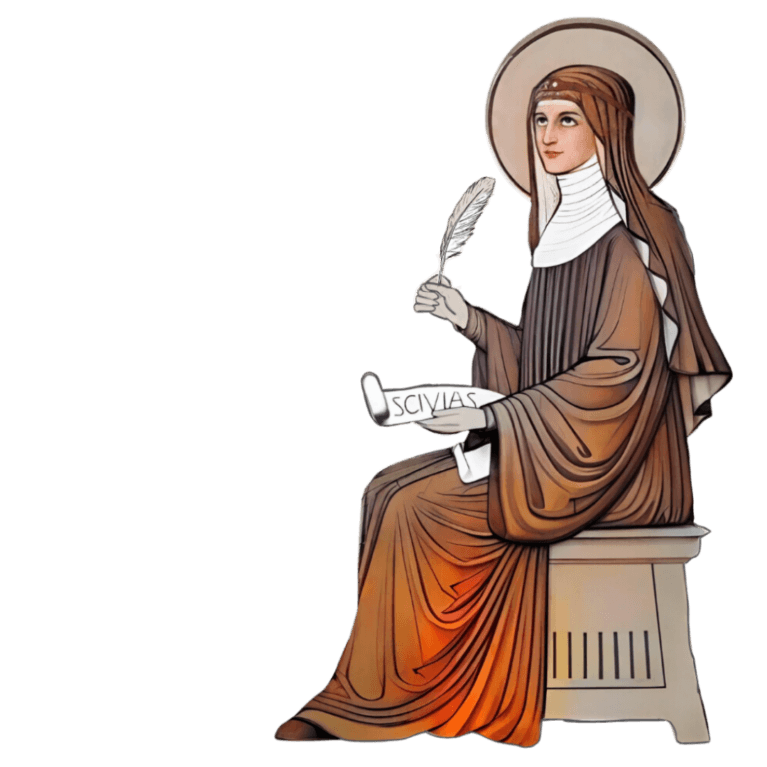
In My Thoughts:
Jesus, this week I promise to take time daily to conform my thoughts by… (make your intention).
In My Words:
Jesus, this week I promise to take time daily to conform my words by… (make your intention).
In My Actions:
Jesus, this week I promise to take time daily to conform my actions by… (make your intention).
Pray the Litany of Virtues prayer.
Join our Virtue Meditation Prayer Challenge
Don't let spiritual overwhelm hold you back!
Let us guide you step-by-step through Saint Hildegard’s transformative path to holiness.
Receive one long-form meditation in your inbox each week—perfect for a powerful 35-minute holy hour.
