
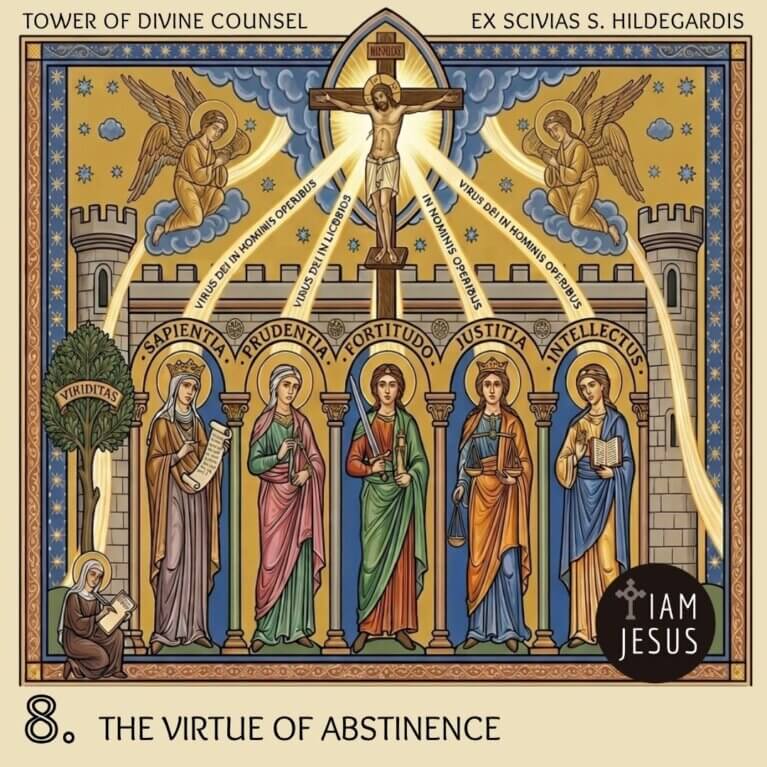
Overcoming the Seduction of Gluttony
Today we contemplate the grace of disciplined moderation, learning how to master our physical appetites and desires. Join our prayer community for this eighth weekly meditation inspired by St. Hildegard of Bingen to anchor your soul in the virtue of abstinence, receiving the divine strength to resist the seduction of gluttony. This is the first virtue/vice pairing from Part 2 of the Book of the Rewards of Life.
Opening Prayer
Lord, please help me resist the seduction of gluttony. Please help me have the virtue of abstinence so that I might be disciplined in my body and keep my desires under control. I struggle with gluttony, and you know how this vice burdens me. Sometimes I desire things that I believe will give me pleasure and I will overindulge myself to the point that I am no longer consuming to live but living to consume.
Jesus, you are the Bread of Life and Living Water. Nothing on earth can be consumed that will fulfill me as much as you can. I do not need to eat, drink, or indulge in anything for pleasure in excess of moderation. Lord, I give you this vice and humbly ask you to give grace to overcome it.
Jesus, you know my tendency to eat and drink for pleasure beyond what is necessary. You know I use these things as a comfort when I really should abstain. I need strength to resist the seduction of gluttony so that I can obtain the virtue of abstinence. Please give me the grace to no longer desire self-indulgence. I do not want to self-soothe with carnal indulgences when I am feeling emotional or vulnerable. I’d rather be disciplined and desire the peace and comfort that comes from prayer.
Lord, if you give me the virtue of abstinence and help me overcome my love of self-soothing indulgences, I will desire holiness. I will want to fast for the sake of your kingdom. Help me resist my appetites. Please teach me the virtue of abstinence so that I might grow spiritually strong and produce good fruit.
Jesus, you fasted for 40 days in the desert before you began your earthly ministry. The devil tempted you three times, but you abstained from his seductions. You understand how hard it is to abstain from food and drink. You know my heart. You know everything I lack. Without your help, I can’t overcome my habit of overindulging myself. Please teach me how to control my desire for self-indulgence. Give me the strength to overcome my addictive habits of overindulgence and resist the seduction of gluttony.
AMEN.
“Jesus’ call to conversion and penance, like that of the prophets before him, does not aim first at outward works, “sackcloth and ashes,” fasting and mortification, but at the conversion of the heart, interior conversion.
Without this, such penances remain sterile and false; however, interior conversion urges expression in visible signs, gestures and works of penance.”
Catechism, 1430
An Introduction to Part Two
In Part One, we meditated on the heart’s affections. This week begins a brand-new “Part” in St. Hildegard’s book, Liber Vitae Meritorum. There are eight virtue/vice pairings in Part Two and today you will be introduced to the first one. Part Two is all about appetite: what we consume, how much, and why. In her vision, the man representing God turns to face West and North—the two darkest directions in her symbolism. West is the direction of decline, where the sun goes down; North is the Devil’s own territory. There is no light mixed in here at all—and fittingly, this is one of the two longest chains in her entire work: eight vices, each one quietly producing the next, beginning right here in this meditation, with the body’s own hunger. This is what we might call the ‘micro’ battlefield of the soul—not nations or institutions, just you, your body, and what you choose to feed it. It’s about how and what you feed your appetites. St. Hildegard insists this is where the destruction of the soul begins.
What is the Virtue of Abstinence?
In Catholic moral theology, gluttony is actually a deeper, sneakier habit of self-soothing. It is the vice of running to physical things—whether that’s food, drink, shopping, or endless screen time—to comfort ourselves when we feel stressed, lonely, or vulnerable. We cross the line into gluttony the moment we stop consuming things to live, and start living just to consume. Saint Hildegard warns us that because the devil used food to pull humanity into the very first sin in the Garden, he still uses gluttony today as his favorite entryway to dull our spirits and snare us in other vices.
To break this cycle, we have to intentionally lean into the virtue of abstinence. True abstinence isn’t about punishing ourselves or thinking that physical pleasures are evil; it’s a beautiful act of spiritual freedom. By practicing healthy moderation and willfully saying “no” to our passing cravings, we clear away the noise and reorder our hearts. Abstinence breaks our dependency on worldly comforts, melts away the regret and guilt that gluttony leaves behind, and opens up the interior space we need to find our ultimate comfort in prayer and the presence of God.
The Voice of Abstinence
by St. Hildegard of Bingen
“No one should play a lyre in such a way that its strings are damaged. If its strings have been damaged, what sound will it make? None. You, gluttony, fill your belly so much that all your veins are bloated and are turned into a frenzy. Where then is the sweet sound of wisdom that God gave man? You are mute and blind and do not know what you are saying. Just as heavy rains destroy the earth, so also excess meat and wine lead man into blasphemies of mockery. I, however, saw a beautiful form in the mud as God put man together. I am, therefore, like a soft rain so that man does not have to sprout weeds. I draw moderation out of men so that their flesh does not revolt and burst, having been flooded with more life-giving food than it needs.”
St. Hildegard of Bingen, Liber Vitae Meritorum (The Book of the Rewards of Life),
Part 2, Section 2, Paragraph 5 (Trans. Hozeski)
Reflection:
The virtue of abstinence gives us power over concupiscence. We resist the seduction of gluttony and more closely imitate Jesus through penitential fasting. We should not fast to gain something we desire from God. On the contrary, we fast to remind ourselves that we are sinners, that we use things for the pleasure of our bodies and our self-indulgence causes us to forget about God.
Gluttony is not just about food or drink. Yes, food and drink are often associated with gluttony, but gluttony can be any overindulgence we struggle with. Gluttony can be something like too much time watching television, surfing the internet, or scrolling on social media. It can be too much time shopping and too many purchases for things you want but do not need. It is a vice of excess.
Gluttony causes me to focus on myself. It is concerned with what I can do to please myself, pamper myself, feed myself, and entertain myself. It’s all about me. When I feed my gluttony I may believe I will have satisfaction afterward, but this is not the case. Gluttony causes guilt. It doesn’t matter what I overindulge in, the result afterward is always regret.
Without the discipline to have boundaries on myself and my desire to overindulge, I will always end up with a feeling of regret. If it’s food, then I will suffer the effects on my body and my health.
If it is drinking, then there will be consequences for my drunkenness. If it is wasteful spending, then I will become vain and materialistic. If it is too much time wasted on digital technology, then I will succumb to other vices as well like impurity, sloth, envy, and greed.
Hildegard herself makes this connection directly. In the vision immediately following Gluttony’s confrontation with Abstinence, she sees a second figure—Bitterness—and says plainly that bitterness “follows after gluttony of the belly…just as winter follows summer.” She doesn’t treat this as a separate sin we might or might not also commit; she treats it as the next season. Overindulgence doesn’t just risk a separate vice afterward—it grows one, the way a seed grows into what it already contains.
Gluttony was the Vehicle for Original Sin
St Hildegard teaches us that the sin of gluttony was the vehicle for the original sin of pride that Adam and Eve committed. Both were tempted by the serpent to eat a fruit that God had forbidden, and they did. Through the sin of our first parents, we have fallen natures so humans naturally struggle with l, or the ‘desires of the flesh.’ St. Hildegard explains what this means; humanity is “estranged from the protection of holiness” by our sin of “forgetting about God” (Liber Vitae Meritorum, Part 2, Section 46, Para. 55, trans. Hozeski).
When we fast from the things that we enjoy, this brings our hearts and minds back to remembrance. This happens because abstinence overcomes the sin of gluttony. Through fasting we willfully deny ourselves the ‘forbidden fruit’ that seduces us to forget about God; instead we proclaim we will not forget Him. Fasting shows we are willing to suffer and abstain from pleasure out of solidarity and love for the one who loves us and redeemed us at so high a price.
This is why the Church teaches us to fast on Fridays during Lent. Historically, Catholics also fasted on Fridays during Advent until the early 20th century. Some Catholics choose fasting on Wednesdays and Fridays throughout the year, but this is not obligatory. Fasting on Wednesday is a way to remember the day the council gathered to betray Jesus, and fasting on Friday is a way to remember his passion and death.
How to Resist the Seduction of Gluttony
Look at the areas of your life where you most forget about God. What indulgences do you always find yourself doing to satisfy your carnal desires? Willfully choose to abstain for a while from one of them. It is okay to continue this activity as long as it is not considered sinful but just do it in moderation. Replace your habit of overindulgence with an activity that shows love for God and your neighbor. Mindfully take that selfish desire within you and resist your urge for self-indulgence; instead please God.
What might this look like? Perhaps you love to eat a favorite dish. Think about this food right now. Let your mind smell it, chew it, taste it. Now make this food and instead of eating it, give it to someone who needs a meal. Do you have an elderly neighbor? Is there someone you know who is sick right now? Do you know someone who cannot afford to buy food and is hungry? By practicing abstinence and fasting with generosity and love, we show conversion of heart, which is what the Catechism teaches.
In this way, you will fast with love in your heart for God and your neighbor. You will find great joy in doing this. Another wonderful practice in moderation and humility is to put yourself last when you are offered food. Choose to take the least desirable portion; wait until all others are fed, and make sure to take a modest amount so that someone else will have plenty. This is a wonderful practice of charity and moderation in the spirit of abstinence that loves your neighbor, and it will help you overcome habits of gluttony.
Going Further:
Spend time prayerfully meditating on Isaiah 58. This chapter talks about authentic fasting that leads to a blessing from God. Remember what the Catechism teaches about fasting. It says that fasting must come from an interior conversion of your heart. This is made clear in Isaiah 58 in a beautiful way. Dialogue with the Lord after reading this passage. Can you resolve this week in light of what you learned in Isaiah 58? What might you do to abstain from the temptation of gluttony and charitably use your fasting? Journal about it.
Let’s Enter into Prayer for Holy Moderation:
Take a moment to pause, settle your thoughts, and quiet the restlessness of your day. We often think of gluttony as merely a physical appetite, but it is truly a hidden sanctuary where we attempt to self-soothe our underlying stress, loneliness, and vulnerability. Before we turn to the Word of God, let us offer up a sincere prayer of petition—asking for the spiritual freedom to step out of the cycle of overindulgence and anchor our ultimate comfort in Him alone.
Prayer for Perfect Moderation and Spiritual Freedom
Eternal Father, You know how easily my restless heart seeks comfort in the wrong places. I confess that when I am feeling stressed, lonely, or vulnerable, I often run to physical things—whether it is carnal appetites: food, drink, shopping, or endless screen time—to soothe my soul. Forgive me for the moments I have crossed the line into excess, living just to consume rather than consuming to live, and forgetting that You are my true protector. By my own willpower, I cannot silence these clamoring carnal cravings. I desperately need the cleansing fire of Your grace.
Jesus, grant me the supernatural virtue of abstinence. Strip away my dependency on passing worldly comforts and reorder my physical appetites. When I am tempted to numbing distractions or physical overindulgence this week, catch my impulses before I give in. Grant me the grace to pause, breathe, and find my rest in Your quiet presence. Deliver me from the heavy weight of guilt and regret that gluttony leaves behind. Infuse my soul with a holy desire for prayer and fasting so that I may freely choose healthy boundaries, put myself last with genuine humility, and find my ultimate satisfaction in You, the Bread of Life.
AMEN.
Take another slow, deep breath and rest in the silence of this chapel. Let go of your daily cravings, your checklist, and the urge to distract your mind. As you prepare to listen to Jesus speak in this Gospel passage, look closely at the ultimate battlefield between carnal seduction and perfect abstinence. Picture Christ standing in the harsh, blistering heat of the desert—exhausted, isolated, and profoundly hungry after forty days of fasting.
Do not rush through these verses. Read the words slowly and watch how the devil targets Jesus at His absolute weakest physical moment, using food as the entryway just as he did with Adam and Eve in the Garden. Notice how Jesus does not negotiate or compromise; He completely shatters the temptation of self-soothing by anchoring Himself in the Word of the Father. Ask the Lord to reveal the specific areas where you are most tempted to overindulge, and where He is calling you to practice disciplined moderation. When you are ready, pick up your pen and write His promptings directly into your prayer journal.
Jesus is Tempted in the Desert
Then Jesus was led by the Spirit into the desert to be tempted by the devil. He fasted for forty days and forty nights, and afterwards he was hungry.
The tempter approached and said to him, “If you are the Son of God, command that these stones become loaves of bread.”
He said in reply, “It is written: ‘One does not live by bread alone, but by every word that comes forth from the mouth of God.’”
Then the devil took him to the holy city, and made him stand on the parapet of the temple, and said to him, “If you are the Son of God, throw yourself down. For it is written: ‘He will command his angels concerning you’ and ‘with their hands they will support you, lest you dash your foot against a stone.’”
Jesus answered him, “Again it is written, ‘You shall not put the Lord, your God, to the test.’”
Then the devil took him up to a very high mountain, and showed him all the kingdoms of the world in their magnificence, and he said to him, “All these I shall give to you, if you will prostrate yourself and worship me.”
At this, Jesus said to him, “Get away, Satan! It is written: ‘The Lord, your God, shall you worship and him alone shall you serve.’”
Then the devil left him and, behold, angels came and ministered to him.
Let us Pray:
Jesus, you were hungry, tired, and tempted. Rather than give in to the temptation of the devil you said, “Get away Satan!”
Please help me resist every temptation to give into my carnal desires for food and drink and the things that give me self-indulgent pleasures. Let me learn to enjoy these things in moderation. I want to resist overindulging out of love for you and my neighbor.
Please let me grow in the virtue of abstinence so that I can become closer to you and have more holiness. Lord, the Bible says that the sins of the flesh are deadly (Romans 8:13). Please do not let me fall into this sin and forget you as Adam and Eve did in the garden.
Please protect me from the temptations of the devil. Give me a pure heart, mind, and eyes that look to heaven daily. Help me imitate the way you resisted the devil in this scripture passage. Let me be one with God in my heart and through my actions, with fasting, and praying as you taught us.
I do not want to give into self-indulgence. Help me persevere in abstinence. Help me love my brothers and sisters in Christ who have less than I do and freely give from my abundance.
Jesus, you are a gift to me. Thank you for being present to me. Give me the grace to be present to you and to grow in the virtue of abstinence. AMEN.
A Prayer for an Increase in Virtue for Others
Lord Jesus Christ, you say that when two or more are gathered in your name, you are with us. Jesus, in your name I lift up every person who has joined this prayer challenge or will join it in the future. I ask you to give us all the grace we need to grow in virtue and holiness so that we may love and serve you in our lives and through the people we love and care for. Help us in our thoughts, our words, and our actions. Guide us all by your Holy Spirit and give us the strength to overcome every temptation from the evil one. We ask all this in the name of the Father, and of the Son, and of the Holy Spirit, AMEN.
A Short Footnote on Long Term effects of Gluttony
Science is starting to catch up to what St. Hildegard already knew. Doctors now know that the gut makes most of the body’s “feel good” chemicals—not the brain. Months of overeating don’t just change the body; they slowly dull the brain’s ability to feel pleasure from anything else, food included. The treat that once felt like a reward stops working, so we reach for more, and more, and joy keeps shrinking instead of growing.
St. Hildegard was inspired by the Holy Spirit with a vision, and she was right. Gluttony’s collapse into Bitterness won’t happen overnight. Not all the strings are broken at once, but when they are all eventually broken, what sound will your heart and mind make?
Abstinence says, “I encourage moderation in food so that a person is neither hungry nor too full…O all you faithful, restrain yourselves from gluttony. The belly of the ancient serpent gulped many things down from Eve, and it vomited forth many filthy things through Eve.”
Liber Vitae Meritorum, Part 2, Section 2, Para. 5, trans. Hozeski
Reclaiming the Table: Your Week 8 Send-Off
Thank you for committing to Week 8 and pushing through to the completion of this virtue challenge. Standing up to the sneaky habits of self-soothing and mastering your physical appetites takes profound spiritual grit, and Jesus sees every single hidden effort you make. When you inevitably feel vulnerable, reach for comfort in excess, or watch your old carnal cravings flare back up this week, do not let discouragement lock you in a cage of shame. Overcoming gluttony is a slow process of building healthy boundaries, not an overnight shift. Be gentle with yourself, take immediate accountability when you stumble, and run to Confession to let His grace wash away the weight of regret.
As you walk out of this chapel and step back into a hyper-consumerist world that constantly screams at you to indulge every whim, pamper your ego, and live just to consume, guard your interior peace. True abstinence isn’t a life of miserable deprivation; it is the ultimate act of spiritual freedom that reorders your heart. You are called to actively govern your impulses and find your primary satisfaction in prayer and service to others. To see exactly how the Church expects us to use our human effort to freely practice the good, acquire moral virtues, and dispose all our sensory and spiritual powers for communion with divine love, look at the standard laid out right here in the Catechism:
“A virtue is a habitual and firm disposition to do the good. It allows the person not only to perform good acts, but to give the best of himself. The virtuous person tends toward the good with all his sensory and spiritual powers; he pursues the good and chooses it in concrete actions. The goal of a virtuous life is to become like God. The virtuous man is he who freely practices the good. The moral virtues are acquired by human effort. They are the fruit and seed of morally good acts; they dispose all the powers of the human being for communion with divine love.”
Catechism, 1803-1804
Make a Resolution
Take a moment to reflect on the virtue of abstinence. What are the ways you can freely practice this virtue this week? Ask the Lord to give you opportunities, and when you feel the Holy Spirit prompting you, take action. Write down your resolutions for this coming week in your prayer journal. Remind yourself to complete these resolutions daily for this entire week, and as the Spirit prompts you, feel free to write about your experiences with this virtue throughout the week.
In My Thoughts:
Jesus, this week I promise to take time daily to conform my thoughts by… (make your intention).
In My Words:
Jesus, this week I promise to take time daily to conform my words by… (make your intention).
In My Actions:
Jesus, this week I promise to take time daily to conform my actions by… (make your intention).
Pray the Litany of Virtues prayer.
Join our Virtue Meditation Prayer Challenge
Don't let spiritual overwhelm hold you back!
Let us guide you step-by-step through Saint Hildegard’s transformative path to holiness.
Receive one long-form meditation in your inbox each week—perfect for a powerful 35-minute holy hour.
