
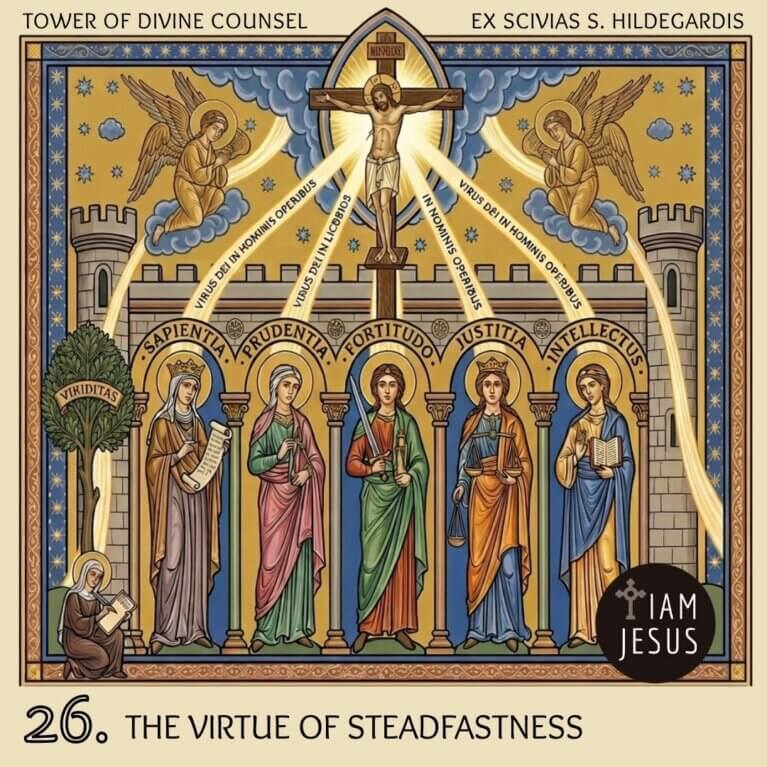
Overcoming Spiritual Instability
Today we contemplate the grace of choosing eternal truths over temporal desires, learning how practicing the virtue of steadfastness (Constantia) grants us a quiet stability in all our ways. Join us for this Part 4, Week 26 meditation inspired by St. Hildegard of Bingen to anchor your soul against the restless winds of changeableness or instability (Inconstantia) and remain firmly on the vine.
Opening Prayer
Jesus, I admire you for your steadfast love. Let me be steadfast and stable in all my ways, drawing on the example of your compassionate love in spite of all my ignorance and obstinacy. You are with me always, even in my darkest hour, taking pity on me and walking with me even when I am blind and cannot feel your presence. You call to me in my moments of weakness, convict my heart when I sin against you and against my brothers and sisters. Your tenderhearted reproach is kind and patient. You give me enough grace to pick myself up and try again. Nothing in life can compare to your love.
You suffered for me, knowing that throughout my life I would choose to do wrong and fail to do right so many times. But each time I have fallen and turned back to you with remorse and a resolution to change you have forgiven me and given me the grace I needed. You’ve accompanied me in my loneliness, in times of sickness, when I am tempted, when I am put to the test.
There is no way for me to repay you for what you have given me. There is nothing I have and nothing I can give that would equal in measure to what you have given me. I am eternally grateful for your loving presence in my life. Please, Lord, give me the virtue of steadfastness so that I might have quiet stability in all my ways for the remaining years of my life. I want to merit seeing you at the end of my life so that I might fall to the ground and worship you with all the angels and saints, giving you all the praise and glory that you deserve and to thank you for your loving sacrifice for my sake.
AMEN.
“We know that in everything God works for good for those
who love him.” [Romans 8:28]The constant witness of the saints confirms this
truth:St. Catherine of Siena said to those who are scandalized and
rebel against what happens to them: “Everything comes
from love, all is ordained for the salvation of man, God does nothing without this goal in mind.”St. Thomas More, shortly before his martyrdom, consoled his daughter: “Nothing can come but that that God wills. And I make me very sure that whatsoever that be, seem it never so bad in sight, it shall indeed be the best.”
Dame Julian of Norwich: “Here I was taught by the grace of
God that I should steadfastly keep me in the faith . . . and
that at the same time I should take my stand on and earnestly believe in what our Lord shewed in this time—that ‘all manner [of] thing shall be well.’”Catechism, 313
What Is The Virtue Of Steadfastness?
In simple terms, the virtue of steadfastness isn’t a virtue for people who have it all together. It is the grit that keeps a struggling sinner running back to the Sacraments instead of changing course and drifting away. It’s the grace that allows our worst spiritual wounds to be healed and turned into virtues. In Catholic moral theology, this virtue acts as your spiritual anchor, providing a quiet stability—a true Constantia (steadfastness)—that keeps you firmly on the vine attached to Christ when life gets chaotic. True steadfastness means waking up every single day, remembering God’s immense mercy, and choosing to stay the course—even when you feel completely weak, distracted, or broken by your past mistakes.
St. Hildegard teaches us that the real danger in our spiritual life isn’t falling down; it’s the vice of “instability” that makes us give up entirely. Without an active virtue of habit of Constantia guarding our hearts, we easily twist in the wind of modern culture allowing Inconstantia—changeableness— to reduce our relationship with the Father into a secondary chore. But when we remain steadfast through constant prayer and penitence, Christ takes our deepest spiritual wounds and transforms them into beautiful ornaments of grace. Cultivating this virtue makes daily devotion part of your second nature and it gives you the resilience to reject deceptions and stand unshakeable in the truth.
The Face Of Changeableness
St. Hildegard’s vision shows Changeableness standing inside a wagon wheel, spinning in darkness as if driven by the wind, turning like a millstone. Four spokes rise around her, wide enough for a person to stand inside — and a human figure does stand there, holding one spoke in each hand while two more press against the back, turning endlessly with the wheel itself. Her hair is curly and black; her hands are like a monkey’s forefeet; her feet, a hawk’s. Her garment is striped black and white. She has cast out a net to catch something, but it holds nothing at all.
Concerning Changeableness
by St. Hildegard of Bingen
The fact that, however, you see a wheel, like the wheel of a wagon, turning in the darkness. This wheel, agitated as if by the winds, turns around like a mill-stone. This means that changeableness, having no stability… has been weighed down with so many excesses and loaded down with so many vanities that it has become sluggish with unfaithfulness. Having been struck down with earthly temptations, it is no longer honest, but runs here and there and overturns all the old institutions with new worries… And this fault protests against honesty because when the unfaithful consider God as worth very little and forget him, they become very changeable. They seize changeableness at the devil’s suggestion because the devil is not righteous and does not love moderation. The devil seduces men and drives them to various changes since he chooses instability and is so unstable and, therefore, stirs up those who are stable.
St. Hildegard of Bingen, Liber Vitae Meritorum (The Book of the Rewards of Life),
Part 4, Section 30, Para. 40 (Trans. Hozeski, Abridged)
A Quieter Kind Of Descent
St. Hildegard doesn’t state this link the way she stated the others. Instead, she plants it early — inside last week’s vice, Forgetfulness (the soul that has simply stopped remembering God is owed anything at all), one section before Changeableness ever speaks.
Forgetfulness’s own cloud, we’re told, holds three qualities at once: “the impiety of blackness, the disbelief of storminess, and the changeableness of mistiness”
Liber Vitae Meritorum, Part 4, Section 29, Para. 39, trans. Hozeski
Changeableness — Inconstantia — is named before she even arrives, already present as one quality of the very haze Forgetfulness leaves behind her. A soul that has forgotten God doesn’t hold still in that forgetting. The haze itself is already shifting, unstable, restless — and that restlessness simply steps forward this week and takes its own shape. What we know with full certainty is where this leads next: Changeableness produces next week’s vice, Care of Earthly Things, “because men who are changeable in their actions and customs as a result of their unstable minds are often concerned with the care of earthly things and resist heavenly things” (Liber Vitae Meritorum, Part 4, Section 31, Para. 42, trans. Hozeski).
Reflection:
St. Hildegard teaches us that we can’t truly know ourselves without knowing Christ. She says the vice of changeableness leads to the loss of our intimate relationship with the Lord because:
“a worker who does not do the work he is capable of doing and who forsakes his craft and does not practice it will become a rustic.”
Liber Vitae Meritorum, Part 4, Section 7, Para. 11, trans. Hozeski
What is the “craft” of a Christian seeking holiness? It is the firm resolve to know and love God through daily effort. The constancy of devotion through thick and thin comes through the virtue of steadfastness.
Lord, Let me Be Steadfast
St. Hildegard explains that we are all dependent on God’s gifts so that we can be steadfast and stable. We can’t just do what we want in life and think we will succeed or be blessed by God in all our ways and prosper. Why?
St. Hildegard says, “the devil did what he wanted to do and fell into hell. What Adam did, he sensed with his taste and he and all his offspring are now mortal. Goliath had confidence in what he did, but a young boy overcame him… God gave man the ability to work; he also divided up his knowledge so that he could discern what is honest and what is dishonest.”
Liber Vitae Meritorum, Part 4, Section 8, Para. 12, trans. Hozeski
It is not enough to receive gifts from God and to be given special talents. What do you do with the gifts you have been given by God? Are you steadfast and stable, giving praise and glory to God every day for all that he has given you? Are you working hard to do all that he has asked of you in this life? Are you firm in your commitment to the Lord or do you run away in times of trouble? Are you unstable and changeable? Where is your resilience?
Relying on My Own Knowledge is Foolish
The kind of knowledge that comes from God far surpasses human ingenuity. He is all knowing, all seeing, all powerful. While this alone is enough reason to want to obey the Almighty, he also is pure love, and seeks to do no harm to your soul. Every temptation, isolation, rebuke, loss of health, loss of financial power, loss of freedom, and loss of friendship is by the will of God. It is either by his permissive will because he loves you and desires for you to turn toward grace, or it is by his divine will and is needed for a greater purpose. Remember, “We know that all things work for good for those who love God, who are called according to his purpose” (Romans 8:28).
Every suffering you endure is by the grace of God. It is not indicative of a lack of love. It is because he loves you deeply that he allows it.
Jesus says, “He takes away every branch that does not bear fruit, and every one that does he prunes so that it bears more fruit. You are already pruned because of the word that I spoke to you” (John 15:2-3). Bingen reminds us, “God put evil knowledge in hell and the ladder of good knowledge in heaven since virtue is from God.”
Going Further:
Are you going through a trial right now? Take some extra time this week to meditate on James 1:2-4. Prayerfully reflect on what the Lord may be softly speaking to your heart. Take a few moments in the prayer of silence to listen. You may want to journal about your experience.
Anchoring the Soul Against the Changeable Winds
Take a moment to pause, quiet your mind, and settle into the absolute, reverent stillness of this adoration chapel. Spiritual changeableness is a quiet, dangerous erosion of the soul—an exhausting habit of changeableness where we lose our footing, allow our devotion to become a secondary chore, and let the chaos of modern culture pull us away from the Father. When we live like a wagon wheel driven by the wind, turning aimlessly like a millstone, we reject all spiritual decorum and find ourselves completely broken by our past mistakes. Before we open the Word of God, let us offer up a sincere prayer of petition—asking for the grit to run back to the Sacraments, the resilience to reject passing vanities, and the gift of a quiet stability.
Prayer for Quiet Stability
Eternal Father, You are the unshakeable rock who remains faithful even when we drift away, yet You know the weak, easily distracted, and unstable corners of my heart. I confess that I have often succumbed to the vice of inconstancy—allowing the restless trends of this world to dictate my mood, neglecting my prayer commitments, and letting the enemy convince me to give up entirely when I fall down. Forgive me for the times I have forgotten Your immense mercy, and for the moments I pridefully relied on my own human ingenuity instead of Your revealed truth. I am too weak to conquer this spiritual wanderlust by my own power. I desperately need the cleansing fire of Your grace.
Lord Jesus, grant me the supernatural virtue of steadfastness. Infuse my soul with a true spirit of constancy so that I may remain firmly attached to You, the true vine, when life gets chaotic. When a heavy trial, temptation, or dry season threatens to push me into despair this week, catch my thoughts and give me the grace to stay the course. Deliver me from the toxic trap of spiritual laziness. Take my deepest spiritual wounds, heal them in Your Precious Blood, and transform them into beautiful ornaments of grace. Make daily devotion an unbreakable part of my second nature, so that I may walk in Your justice, bear fully ripened fruit, and confidently serve You all the remaining years of my life.
AMEN.
Take a slow, deep breath. Settle your mind, clear away your daily anxieties, and completely open your heart to the presence of God. As you prepare to listen to Jesus speak in this monumental passage from the Gospel of John, remember that true steadfastness isn’t for people who have it all together—it is the holy grit of a struggling sinner who refuses to let go of the Master.
Do not rush through these verses. Read the words slowly and let the absolute clarity of Christ’s imagery settle into your conscience. Look at the vivid relationship He establishes between the vine and the branches, warning that without Him, we can do absolutely nothing. Notice the dramatic pruning process of the Father, who cuts away what is dead and prunes what is fruitful so that it may bear even more abundantly. Ask Jesus to reveal where your own instability has caused you to wither or drift, and where He is calling you to remain rooted in His love and keep His commandments this week. When you are ready, pick up your pen and write His promptings directly into your prayer journal.
The Vine and the Branches
from the Gospel of John Chapter 15
[Jesus said] “I am the true vine, and my Father is the vine grower. He takes away every branch in me that does not bear fruit, and every one that does he prunes so that it bears more fruit. You are already pruned because of the word that I spoke to you. Remain in me, as I remain in you. Just as a branch cannot bear fruit on its own unless it remains on the vine, so neither can you unless you remain in me.
I am the vine, you are the branches. Whoever remains in me and I in him will bear much fruit, because without me you can do nothing. Anyone who does not remain in me will be thrown out like a branch and wither; people will gather them and throw them into a fire and they will be burned.
If you remain in me and my words remain in you, ask for whatever you want and it will be done for you. By this is my Father glorified, that you bear much fruit and become my disciples. As the Father loves me, so I also love you. Remain in my love. If you keep my commandments, you will remain in my love, just as I have kept my Father’s commandments and remain in his love.
I have told you this so that my joy may be in you and your joy may be complete.
This is my commandment: love one another as I love you. No one has greater love than this, to lay down one’s life for one’s friends. You are my friends if you do what I command you. I no longer call you slaves, because a slave does not know what his master is doing. I have called you friends, because I have told you everything I have heard from my Father. It was not you who chose me, but I who chose you and appointed you to go and bear fruit that will remain, so that whatever you ask the Father in my name he may give you.
This I command you: love one another.”
Let us Pray:
Jesus, prune me. Let me be perfected by your tenderhearted reproach. Help me grow in the virtue of steadfastness so that I am stable in all my ways, unwavering in times of distress, and obediently following you throughout my difficult trials.
Let me believe in your love for me and in your loving design for my life. I assent to every pruning you deem necessary, fully trusting that it is done out of love and with the desire that I would rise to the greatest height of holiness that you have willed for me in this life. Help me walk in your justice with the virtue of steadfastness. Lord, let me be steadfast and stable in all my ways. I want to love you and follow you all the remaining days of my life and worship you for eternity in heaven.
AMEN.
A Prayer for an Increase in Virtue for Others
Lord Jesus Christ, you say that when two or more are gathered in your name, you are with us. Jesus, in your name I lift up every person who has joined this prayer challenge or will join it in the future. I ask you to give us all the grace we need to grow in virtue and holiness so that we may love and serve you in our lives and through the people we love and care for. Help us in our thoughts, our words, and our actions. Guide us all by your Holy Spirit and give us the strength to overcome every temptation from the evil one. We ask all this in the name of the Father, and of the Son, and of the Holy Spirit, AMEN.
Together as a group we will pray for each other and strive to make good resolutions and keep them. Remember, it’s your heart that God wants to capture. Your efforts are out of love for him and a desire to imitate him as best you can so that you may be steadfast and stable in all your ways.
If you fail, do not quit trying. Be merciful to yourself and learn to love the process of striving to be more like Jesus every day. Just take it one day at a time, and stay in the present moment with Jesus. Being virtuous is a process. No one is perfect, so just start anew every time you fail.
True Vine: Your Week 26 Send-Off
Thank you for committing to Week 26 and for your incredible dedication throughout this entire virtue meditation journey. Confronting the vice of spiritual instability—shattering the temptation to twist in the wind like a restless wagon wheel and choosing a quiet stability—takes profound interior grit, and Jesus sees every single moment you choose to stay anchored to Him when life gets chaotic. When you inevitably feel instability creep back in, catch your daily devotions slipping into a secondary chore, or feel broken by your past mistakes this week, do not let discouragement take root. Overcoming inconstancy is a slow process of letting grace prune your heart, not an overnight shift. Be gentle with yourself, take immediate accountability when your footing wavers.
As you walk out of this chapel and step back into a loud, frantic world that constantly drives you toward passing vanities, excesses, and spiritual wanderlust, guard your interior peace. True steadfastness isn’t a rigid burden; it is an act of ultimate spiritual resilience that anchors you to the true vine so Christ can transform your deepest wounds into beautiful ornaments of grace. To see exactly how a steadfast life of faith bears fruit through a watchful heart full of gratitude, let’s take a look in the Catechism:
IV. Prayer of Thanksgiving
Thanksgiving characterizes the prayer of the Church which, in celebrating the Eucharist, reveals and becomes more fully what she is. Indeed, in the work of salvation, Christ sets creation
free from sin and death to consecrate it anew and make it return to the Father, for his glory. The thanksgiving of the members of the Body participates in that of their Head.As in the prayer of petition, every event and need can become an offering of thanksgiving. The letters of St. Paul often begin and end with thanksgiving, and the Lord Jesus is always present in it: “Give thanks in all circumstances; for this is the will of God in Christ Jesus for you”; “Continue steadfastly in prayer, being watchful in it with thanksgiving.” [1 Thess 5:18; Col 4:2]
Catechism, 2637-2638
Make a Resolution
Take a moment to reflect on the virtue of steadfastness. What are the ways you can freely practice this virtue this week? Ask the Lord to give you opportunities, and when you feel the Holy Spirit prompting you, take action. Write down your resolutions for this coming week in your prayer journal. Remind yourself to complete these resolutions daily for this entire week, and as the Spirit prompts you, feel free to write about your experiences with this virtue throughout the week.
In My Thoughts:
Jesus, this week I promise to take time daily to conform my thoughts by… (make your intention).
In My Words:
Jesus, this week I promise to take time daily to conform my words by… (make your intention).
In My Actions:
Jesus, this week I promise to take time daily to conform my actions by… (make your intention).
Pray the Litany of Virtues prayer.
Join our Virtue Meditation Prayer Challenge
Don't let spiritual overwhelm hold you back!
Let us guide you step-by-step through Saint Hildegard’s transformative path to holiness.
Receive one long-form meditation in your inbox each week—perfect for a powerful 35-minute holy hour.
