
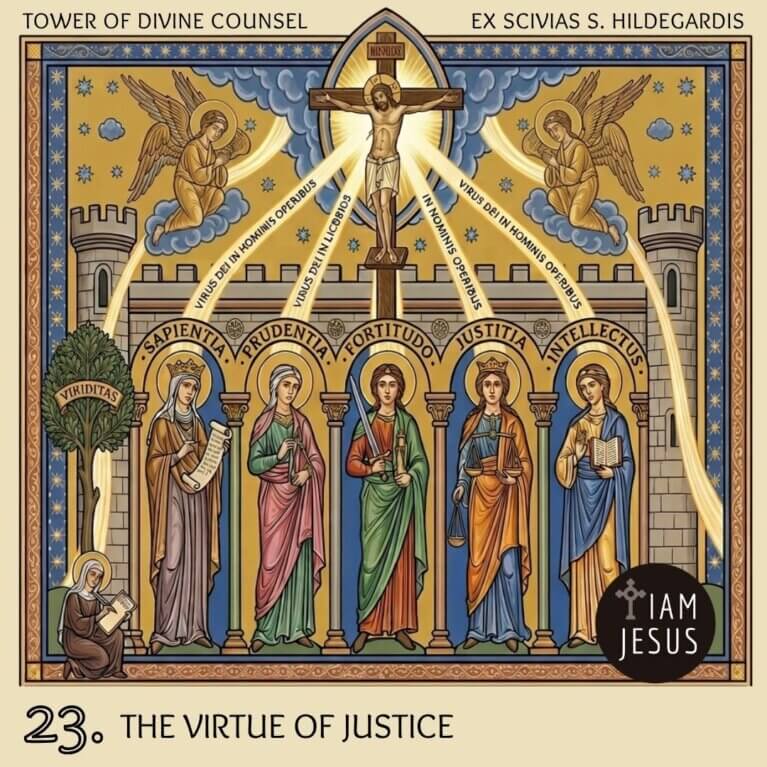
Overcoming Indifference and Prejudice
Today we contemplate the grace of acting with true fairness in an unfair world, learning how to surrender our hidden prejudices and complacent hearts to God. Join us for this Part 4, Week 23 meditation on the virtue of justice, from St. Hildegard of Bingen’s Liber Vitae Meritorum, to break through the darkness of social indifference and defend the dignity of every neighbor.
Opening Prayer
Lord, help me to resolve to act with justice toward God and man all the remaining days of my life. Convict my heart of injustice and give me compassion for my brothers and sisters who are in need. Lord, let me be an instrument of justice in this world.
Jesus, you know my heart and all the many ways I have failed to act with justice when I saw others being treated with injustice. Give me the courage to speak up in charity and to lend a hand toward those in need. Help me resolve to act with justice so that those who lack can be provided for and their dignity maintained. Let me be an instrument of justice toward the common good of my neighbors.
Lord, please also help me to give you proper worship and praise every day of my life because this also is right and just. Let me obey your precepts and honor you by supporting my Church and praying for my superiors with true charity. Help me to be righteous and just, treating all people fairly and above all, giving you deference in everything I do.
AMEN.
“Justice is the moral virtue that consists in the constant and firm will to give their due to God and neighbor. Justice toward God is called the virtue of religion. Justice toward men disposes one to respect the rights of each and to establish in human relationships the harmony that promotes equity with regard to persons and to the common good. The just man, often mentioned in the Sacred Scriptures, is distinguished by habitual right thinking and the uprightness of his conduct toward his neighbor.
“You shall not be partial to the poor or defer to the great, but in righteousness shall you judge your neighbor.”
“Masters, treat your slaves justly and fairly, knowing that you also have a Master in heaven.”
Catechism, 1807
An Introduction to Part Four
In Part One, we learned to release our grip on the world. In Part Two, we learned to release our grip on ourselves. In Part Three, we learned to surrender our very will to God. This week begins Part Four of St. Hildegard of Bingen’s Liber Vitae Meritorum, and it turns our gaze outward for the first time: toward our neighbor, our community, and the world entrusted to our care. There are eight virtue/vice pairings in the Part, and today you’ll meet the first: Injustice, the failure to give another person what they are rightfully owed—the gateway vice from which this entire chain descends, all the way to its final vice, Discord.
In her vision, the man representing God turns to face South and West. Where the first three Parts asked what was happening inside the soul, Part Four asks something different: now that your heart, your self, and your will belong to God, what are you doing with what He has placed in your hands? Justice, Strength, Holiness, Steadiness, Heavenly Desire, Sorrow of the Heart, Contempt of the World, and Concord are the portrait of a soul that has learned to hold what it has been given with open hands, rather than a closed fist.
Watch for two things as these eight weeks unfold. First, notice how each vice here is a failure of stewardship—not private sin hidden in the heart, but a broken relationship with someone or something entrusted to us. Second, notice the imagery of fruit and barren ground running through this Part: a soul that steals from its neighbor also starves its own field.
What is the Virtue of Justice?
At its core, the Catholic virtue of justice is the firm and constant choice to give God and our neighbor what is rightfully theirs. It means putting our relationship with God first and making sure we treat every single person with fairness, respect, and dignity.
St. Hildegard teaches us that living out this virtue goes beyond just knowing what is right—it requires daily Catholic action. In a world often broken by greed and inequality, St. Hildegard reminds us that God looks at the suffering and the outcast with the tender love of a father. He sees past external conditions like wealth, status, or background, and He asks us to do the exact same thing. The virtue of justice, St. Hildegard says, calls us to recognize the divine image in everyone we meet. Practicing this virtue means we cannot simply stand by and watch when others are treated unfairly. Instead, we are called to actively heal the injustices in our families, our parishes, and our communities, working every day to bring God’s righteous plan to life.
The Virtue of Justice on Fighting Prejudice
by St. Hildegard of Bingen
Words of David
“Beautiful of form above the children of men.” Psalm 44:3This is to say: In Him shines forth beauty beyond beauty, the noblest form free from any spot of sin, without a splash of human corruption, and lacking all desire for the sinful works demanded by fleshy human weakness. None of these ever touched this Man. …Humans, I say, are widely divergent in bodily form; they can be black, ugly, polluted, leprous, dropsical and full of defects; they can also be persuaded by devilish art into becoming inflamed with sorcery, stupid, blind to the good things of the Lord or forgetful of what they should praise and what they should blame. For they should do the works of justice, but they do the works of evil and omit the good, despising the cross and the martyrdom of their Lord. But God the Father contemplates this work of mire with the purpose of His goodness, as a father looks at his children when he hugs them to his breast. And, because He is God, He has the love of a tender father for his children. For so great is His heart’s inmost love for people that He sent His Son to the cross, like a meek lamb that is carried to the slaughter. And so the Son brought back the lost sheep, bearing them on His shoulder by assuming humanity; which caused Him great sufferings, for He deigned to die for His flock. But among these people there are many surrounded by ornaments and adorned pricelessly with virtue. They are the martyrs, the virgins, the innocents and the penitents, as I said before, and those who have obeyed their masters, and those who accuse themselves of their sins and tirelessly strive to punish themselves for them, denying the self in them. And who or where these elect are must not be stated; for the numbers of them all have been reckoned. Does anyone think it possible to see into the deep wisdom of the Most High and into the discernment of His knowledge, and count the number of those who are to be saved? His judgments are incomprehensible to all people. Your task is to run; for the kingdom of God is prepared for you. For as great as is the zeal of the faithful, washed in baptism and known in faith, to fulfill God’s justice, so great also shall be their reward.
St. Hildegard of Bingen, Scivias, Book 3, Vision 1, Chapter 8 (Trans. Hart/Bishop, Abridged)
A Note on Justice: The Fountain and the Blossoming Tree
Notice what Justice claims for herself: “de saliente fonte processi”—“I proceeded from a leaping fountain”—and “in ardente ariditate non cado, quia floriditas omnium arborum sum”— “I do not fall in burning dryness, because I am the blossoming of all trees” (Liber Vitae Meritorum, Part 4, Section 2, Para. 3, trans. Hozeski). Water and living fruitfulness, both claimed at once—the same pattern we’ve traced since Week One. She even calls herself Symphonia—a symphony— continuing the thread that runs through every Part of this book: the virtues sing, while the vices, as we’ll see throughout Part Four, can only make noise.
Reflection:
How can I act with justice and be pleasing to God? Do I treat all people justly and fairly, or do I prefer some over others and measure their worth based on external conditions? Am I a good neighbor? Am I a peacekeeper?
Evil is in the world, and sometimes it is overwhelming. We know that in dark times many of our brothers and sisters suffer injustice through the hands of cruel people with power. We often look at this injustice and judge the sinner who commits the wrong, who is unjust and unfair to the one who is oppressed. But do we act justly to amend the evil acts? How do we heal the injustice in our families, churches, communities, and our nation?
Do I Resolve to Act with Justice?
Am I guilty of being unfair? Do I have a lack of charity for one and not for another? Do I have preferences? Is my heart truly charitable toward all people?
We often look at the goodness of God’s mercy and we sometimes become complacent with ourselves. We fail to see where our own prejudice lies and how we can make unjust decisions that affect the lives of others in detrimental ways. When we pray for forgiveness, we often ask for God to forgive what we have done and what we have failed to do.
This week ask the Holy Spirit to open your eyes toward injustice around you. Pray for wisdom and understanding. Ask the Lord to show you what you can do, in your small way, to bring justice to a suffering soul that needs you. Perhaps you can act in a way that brings them comfort. You can pray fervently for them.
It is sobering to think about the justice of God and how he truly sees us. This week try to pray fervently for a contrite and merciful heart that loves God in humility and loves his children with justice. Listen for your conscience and hear what the Lord is speaking to you in your heart. What is he asking you to do?
Going Further:
If you want to do ‘extra’ you may spend some time reading the Book of Genesis chapters 37-45. It is the story of Joseph, who was unjustly sold into slavery by his jealous brothers. As you prayerfully read and reflect on the story, dialogue with the Lord. Silently contemplate what Jesus may be telling you, revealing to you from your own life. If you wish, you can journal about this story and reflect on what the Lord is telling you about justice and how to respond to injustice with charity.
Breaking through the Darkness of Social Indifference:
Take a moment to pause, silence your racing thoughts, and rest in the absolute stillness of this adoration chapel. Indifference is a quiet, dangerous erosion of the soul—an exhausting habit of complacency where we close our eyes to the suffering of our neighbors and measure their worth based on external conditions, wealth, background, or social status. When we let hidden prejudices govern our reactions, we look away from the outcast and compromise the divine image within them, separating our lives from God’s righteous plan. Before we open the Word of God, let us offer up a sincere prayer of petition—asking for the spiritual courage to smash this apathy, strip away our biases, and anchor our hearts in true Christian fairness.
Prayer to Act with Justice
Eternal Father, You are the Supreme Judge who looks upon the outcast and the broken with the tender love of a father, yet You know the complacent and judgmental corners of my heart. I confess that I have often fallen into the sin of injustice—preferring some people over others, holding onto secret prejudices, and remaining completely indifferent when I saw my brothers and sisters suffering wrong. Forgive me for the times I have stayed silent to protect my own comfort, and for the moments I evaluated a human soul by worldly standards instead of the priceless value of Your Son’s Sacrifice. By my own willpower, I cannot cure this hardheartedness. I desperately need the cleansing fire of Your grace.
Lord Jesus, grant me the supernatural virtue of justice. Infuse my soul with a constant and firm will to give You and my neighbor what is rightfully due. When I am tempted to judge by appearances or pass by someone in need this week, catch my thoughts and show me Your face in them. Deliver me from the toxic trap of self-righteousness. Give me a righteous mind, an upright conscience, and an active, servant’s spirit to heal the injustices in my family, my parish, and my community. Teach me to obey Your precepts perfectly and to stand firmly for the dignity of the vulnerable, so that I may live as an authentic instrument of Your eternal peace.
AMEN.
Take a slow, deep breath. Settle your mind, drop your daily checklist, and lay down any lingering biases you brought in with you today. As you prepare to encounter Jesus in this monumental passage from the Gospel of Matthew, remember that Christ draws an absolute, unshakeable line regarding how we treat the vulnerable.
Do not rush through these verses. Read the words slowly and step directly before the glorious throne of the King. Look at the dramatic separation taking place between the sheep and the goats. Notice that the metric of judgment isn’t based on empty talk or flashy worldly credentials, but on hidden, immediate acts of justice to the vulnerable—feeding the hungry, welcoming the stranger, clothing the naked, and visiting the imprisoned. Watch how Jesus completely identifies Himself with the suffering of the least of these. Ask the Lord to show you where your own indifference has made you blind to His presence, and where He is calling you to take radical action to defend a suffering soul this week. When you are ready, pick up your pen and write His promptings directly into your prayer journal.
The Judgment of the Nations
Now let’s contemplate the Lord by listening to him speak to us in the Gospels. Slowly meditate on the following passage, reflecting on his virtue of justice. Take your time. Pause over a word or phrase that speaks to your heart. Reread the passage again, and then ask Jesus to show you how you can imitate him in his inner love of the spiritual and better overcome human injustice in the world. Choose a word or phrase from this passage to write in your journal, and add your thoughts. Go back and prayerfully re-read it throughout the week.
from the Gospel of Matthew Chapter 25:31-46
When the Son of Man comes in his glory, and all the angels with him, he will sit upon his glorious throne, and all the nations will be assembled before him. And he will separate them one from another, as a shepherd separates the sheep from the goats.
He will place the sheep on his right and the goats on his left. Then the king will say to those on his right, ‘Come, you who are blessed by my Father. Inherit the kingdom prepared for you from the foundation of the world. For I was hungry and you gave me food, I was thirsty and you gave me drink, a stranger and you welcomed me, naked and you clothed me, ill and you cared for me, in prison and you visited me.’
Then the righteous will answer him and say, ‘Lord, when did we see you hungry and feed you, or thirsty and give you drink? When did we see you a stranger and welcome you, or naked and clothe you? When did we see you ill or in prison, and visit you?’
And the king will say to them in reply, ‘Amen, I say to you, whatever you did for one of these least brothers of mine, you did for me.’
Then he will say to those on his left, ‘Depart from me, you accursed, into the eternal fire prepared for the devil and his angels. For I was hungry and you gave me no food, I was thirsty and you gave me no drink, a stranger and you gave me no welcome, naked and you gave me no clothing, ill and in prison, and you did not care for me.’
Then they will answer and say, ‘Lord, when did we see you hungry or thirsty or a stranger or naked or ill or in prison, and not minister to your needs?’
He will answer them, ‘Amen, I say to you, what you did not do for one of these least ones, you did not do for me.’
And these will go off to eternal punishment, but the righteous to eternal life.”
Let us Pray:
Jesus, I resolve to act with justice this week and I ask you to help me see the least among me. Please help me recognize the ones in need of food, drink, in need of companionship, clothing, and imprisoned. Help me to be an instrument of your justice and to act with a firm resolve to be your hands and feet.
Lord, let me bring justice to those suffering from injustice, and let me be blessed and not accursed. Help me to recognize the Holy Spirit in everyday situations and bring joy to those in need by your grace. Let me love you and worship you as you deserve, obeying your precepts because it is right and just. AMEN.
A Prayer for an Increase in Virtue for Others
Lord Jesus Christ, you say that when two or more are gathered in your name, you are with us. Jesus, in your name I lift up every person who has joined this prayer challenge or will join it in the future. I ask you to give us all the grace we need to grow in virtue and holiness so that we may love and serve you in our lives and through the people we love and care for. Help us in our thoughts, our words, and our actions. Guide us all by your Holy Spirit and give us the strength to overcome every temptation from the evil one. We ask all this in the name of the Father, and of the Son, and of the Holy Spirit, AMEN.
Together as a group we will pray for each other and strive to make good resolutions and keep them. Remember, it’s your heart that God wants to capture. Your efforts are out of love for him and a desire to imitate him as best you can in holiness.
If you fail, do not quit trying. Be merciful to yourself and learn to love the process of striving to be more like Jesus every day. Just take it one day at a time, and stay in the present moment and keep your gaze on Jesus. Being virtuous is a process. No one is perfect, so just start anew every time you fail to act with justice.
Instrument of Justice: Your Week 23 Send-Off
Thank you for committing to Week 23 and for your incredible dedication throughout this entire virtue meditation journey. Confronting a complacent heart—shattering the subtle pull of hidden prejudices and choosing a life of active, unwavering justice—takes profound interior maturity, and Jesus sees every single moment you choose to stand up for human dignity over personal convenience. When you inevitably feel indifference creep back in, catch yourself preferring some people over others based on worldly standards, or find yourself staying silent in the face of wrong this week, do not let discouragement take root. Overcoming prejudice is a slow process of expanding your heart to see others as God sees them, not an overnight shift.
As you walk out of this chapel and step back into a loud, fragmented world that constantly tells you to ignore the vulnerable, look away from the outcast, and measure human worth by external status or success, guard your interior peace. True justice isn’t a rigid legal system or a set of empty ideals; it is an act of ultimate spiritual power that establishes harmony and promotes equity in all your human relationships. You are called to actively govern your biases, defend the dignity of the broken, and be an authentic instrument peace. Let’s look at what the Catechism says about justice:
“Conversion is accomplished in daily life by gestures of reconciliation, concern for the poor, the exercise and defense of justice and right, by the admission of faults to one’s brethren, fraternal correction, revision of life, examination of conscience, spiritual direction, acceptance of suffering, endurance of persecution for the sake of righteousness. Taking up one’s cross each day and following Jesus is the surest way of penance.”
Catechism, 1435
Make a Resolution
Take a moment to reflect on the virtue of justice. What are the ways you can freely practice this virtue this week? Ask the Lord to give you opportunities, and when you feel the Holy Spirit prompting you, take action. Write down your resolutions for this coming week in your prayer journal. Remind yourself to complete these resolutions daily for this entire week, and as the Spirit prompts you, feel free to write about your experiences with this virtue throughout the week.
In My Thoughts:
Jesus, this week I promise to take time daily to conform my thoughts by… (make your intention).
In My Words:
Jesus, this week I promise to take time daily to conform my words by… (make your intention).
In My Actions:
Jesus, this week I promise to take time daily to conform my actions by… (make your intention).
Pray the Litany of Virtues prayer.
Join our Virtue Meditation Prayer Challenge
Don't let spiritual overwhelm hold you back!
Let us guide you step-by-step through Saint Hildegard’s transformative path to holiness.
Receive one long-form meditation in your inbox each week—perfect for a powerful 35-minute holy hour.
