
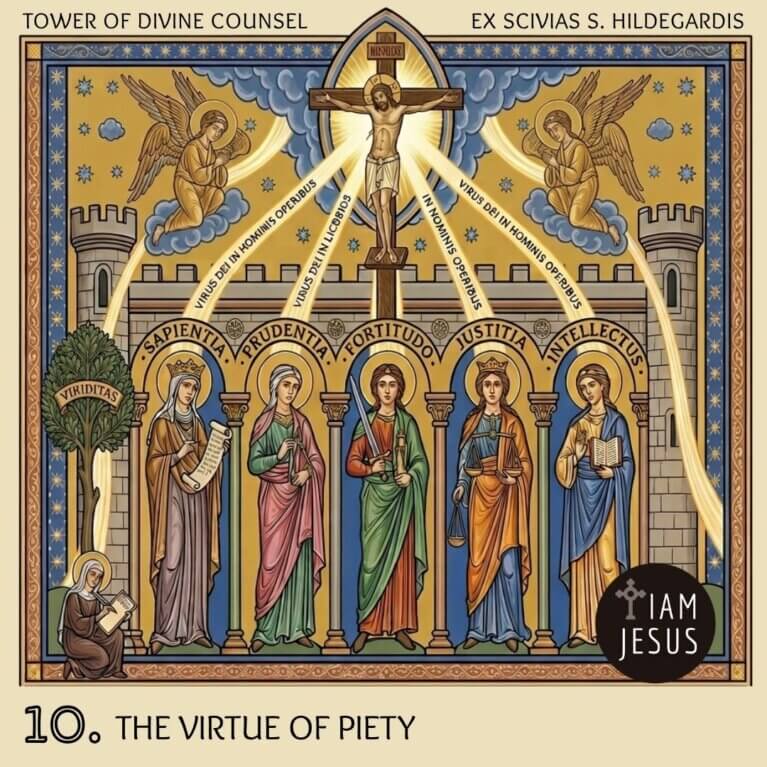
Overcoming Irreverence toward God
Today we contemplate the grace of authentic worship, learning how to dismantle the heavy traps of lukewarmness, distraction, and spiritual pride. Join our prayer community for this tenth weekly meditation inspired by St. Hildegard of Bingen to anchor your heart in divine reverence, receiving the spiritual focus to replace empty rituals with the true virtue of piety. This is the third virtue/vice pairing from Part 2 of the Book of the Rewards of Life.
Opening Prayer
Lord, I need to have an authentic piety that comes from the heart. I have been guilty of irreverence to God and I’ve also been guilty of false piety, too. Please, Lord, be merciful to me and help me understand the virtue of piety so I can have a heartfelt reverence toward you when I participate in worship at Mass. Please elevate my soul and help me avoid being distracted by the external things that go on at Mass. Let me worship you with a humble and contrite heart; I know it is right and just and you deserve my loving piety and devotion.
Do not let me compare myself with others while in Mass. I don’t want to judge them or find myself performing the prayers of the Mass with a cold and unfeeling heart. If you help me overcome all forms of false piety and grow in the virtue of authentic piety, I know my worship will be pleasing to you. I want to please you more than anything; it is an injustice when we show irreverence to God in Mass, and it is equally unjust when we worship with false piety and pride.
Jesus, I want to love you deeply from my heart, and not be focused on what is going on around me during church. Guard my heart and mind to stay focused on you with a loving and contrite spirit of humility. Please do not let my mind wander from worshipping you by distraction or judging the people and things around me. I renounce the sin of pride that makes me look at others and judge how they look and worship in Mass. Lord, please give me authentic piety. Help me root out all false piety that comes from the sin of pride. Please, Jesus, convict my heart with guilt every time I perform a pious act without humility, contrition, and love in my heart for you.
Lord, help me overcome false piety and irreverence to God. By your loving mercy, I can grow in holiness and have an authentic piety to God when I worship at Mass.
AMEN.
Believing in God, the only One, and loving him with all our being has enormous consequences for our whole life.
It means coming to know God’s greatness and majesty:
“Behold, God is great, and we know him not.” Therefore, we must “serve God first”.It means living in thanksgiving: if God is the only One, everything we are and have comes from him: “What have you that you did not receive?”
“What shall I render to the LORD for all his bounty to me?”Catechism, 222-224
What Is the Virtue of Piety?
In Catholic moral theology, piety is far more than just looking holy or reciting formulas; it is an incredible gift of the Holy Spirit that transforms how we relate to God. Impiety, or irreverence, sneaks into our lives when we treat sacred things as ordinary, let our minds wander aimlessly at Mass, or start judging how the people in the pews around us are praying. St. Hildegard warns us that false piety is one of the devil’s favorite traps because it is fueled by pride—it makes us perform holy actions just to be seen by others, leaving our hearts cold and empty.
Impiety says: “I do not want to obey either God or man… I will do whatever is for my own good, as anyone who is not a fool does.”
Liber Vitae Meritorum, Part 2, Section 5, Para. 9, trans. Hozeski
To shatter this false performance, we must beg for the authentic virtue of piety. In the Catholic tradition, true piety gives us a deeply affectionate, childlike love for God as our loving Father. It moves our worship from a chore we have to check off to a joyful response of gratitude. When we cultivate the virtue of piety, our outward actions match our interior devotion. It purifies our intentions, silences our tendency to judge others, and creates a humble space in our souls to meet Christ “eyelash to eyelash” at the altar.
A Note on Piety and Impiety: The Latin Root
This is the third pairing of Part 2—Amor Sui, “Love of Self”—the same self-turned love we’ve been tracing all through this Part of Liber Vitae Meritorum. Impiety follows Bitterness in St. Hildegard’s chain of vices: once a soul has hardened against others in bitterness, it’s a short step to hardening against God himself.
St. Hildegard’s own word for this vice is impietas. It’s the root of our English word “impiety,” but for her it means something deeper than simply skipping Mass—it describes a soul that has quietly made itself its own final authority, answering to no one, not even God.
In Latin, impietas belongs to a small family of words ending in –tas—much like our English words ending in -ty (purity, charity, reality). Words in this family, like Veritas (Truth) and Largitas (Bountifulness), are always grammatically feminine—and St. Hildegard confirms it herself: when Piety answers Impiety directly, she says, “Tu diabolica et crudelis es,” meaning “You are diabolical and cruel.” using the feminine form of both words. This is why we speak of Impiety as “she” throughout this meditation—because St. Hildegard’s Latin tells us so, every time.
St. Hildegard gives Impiety a vivid, unsettling appearance in her Liber Vitae Meritorum: a human form, but with a beast-like head rising between her shoulders, two serpent-heads breathing flame from the corners of her mouth, and a black veil worn “in the manner of a woman”—her own phrase for a soul that has wrapped itself entirely in mourning rather than let any light in (Liber Vitae Meritorum, Part 2, Section 5, Para. 8-9; Response of Piety, Section 6, Para. 10; trans. Hozeski, cross-checked against Pitra’s Latin, Analecta Sacra Vol. VIII, pp. 65-66).
The Drying of the Soul: From Bitterness to Impiety
St. Hildegard doesn’t place Impiety here by accident. In her vision, Impiety walks directly after Bitterness—Hozeski’s translation puts it plainly:
It walks after bitterness because where bitterness is in the minds of men, impiety joins it.
Liber Vitae Meritorum, Part 2, Section 44, Para. 53.
And it is worth noticing what Bitterness’s own answering virtue, Bountifulness, offers her: rain, dew, ointment, medicine—the language of water, of moisture, of viriditas, the living greenness St. Hildegard says flows from the Holy Spirit into every soul open to Him. Bitterness is offered that water and refuses it, hardening instead. Impiety is what a soul becomes one step further down the same road: not simply dried out, but now digging in—refusing obedience to God or man, instead insisting on its own good above all else (Liber Vitae Meritorum, Part 2, Section 5, Para. 9, trans. Hozeski). This is the danger of unanswered bitterness: left unhealed, it doesn’t stay still. It calcifies into willful refusal.
This is why Impiety feels so cold, so self-enclosed. She isn’t short on knowledge of God—she has simply stopped letting His Spirit move her. Every time we feel the quiet nudge of the Holy Spirit—an inspiration to forgive, to pray, to soften—and we dig in our heels instead, choosing our own comfort over His conviction, we are living a small moment of Impiety’s exact sin. And the cost is real: we lose the greenness, the energy, the viriditas God wants flowing through us, and in its place we grow exactly what Bitterness already was—dry, brittle, self-soothing instead of Spirit-led.
Piety and Her Appearance
by St. Hildegard of Bingen
And the third figure, on the left, manifests Piety, who never cherishes hatred or envy of human happiness, but always rejoices at and embraces human good fortune. By her freshness and her outpouring of generosity, abstinence is able to resist the Devil, who whispers to her from the left. For in the struggle for the banner, Piety is the full work of abstinence, and always is the victor.
Hence she is clad in a tunic of hyacinth red; for her splendid work surrounds her, yet in her beautiful patience she hides bloody injuries beneath it, suffering all of them according to My Son’s example in His Passion. On her breast is the picture of an angel, a wing out on either side. This means that each person should imitate the angels in his mind by loving each of God’s ordinances, and lift himself up into flight on one wing and on two, which is to say by the One God and by twofold virtue; meeting the good and the bad on both sides, not unduly exalted by the good or prostrated by the bad. He should gaze on God in purity of heart, and therefore rise upward and not cast himself down to earth.
And therefore its right wing stretches to the figure’s right shoulder; for on the right, the side of salvation, human happiness comes to the help of Piety, because My Son brought back Man to his true country. And its left wing stretches to her left shoulder; for on the left, the side of the Devil’s snares, a faithful person casts off the work of darkness by extending his wing for a flight upward to the refuge of My Son. And thus he is strong against all adversity and imitates the life of the just, as this virtue declares in her already quoted words.
St. Hildegard of Bingen, Scivias, Book 3, Vision 6, Chapter 30 (Trans. Hart/Bishop)
In the above passage from Scivias, St. Hildegard helps us recognize all the virtues present in a righteous soul possessing true piety. This is because piety is not just a virtue, but also a gift of the Holy Spirit. You see, God is all good and all-powerful; by his grace, he elevates his creatures to become more holy and righteous. We cannot merit this on our own, but by faith in God and by his freely given grace we are elevated to replace irreverence to God with authentic piety just by asking for this gift from our hearts.
Reflection:
The Scriptures teach us that piety is more than a virtue. It is a gift of the Holy Spirit.
a spirit of wisdom and of understanding,
A spirit of counsel and of strength,
a spirit of knowledge and a spirit of godliness,
and his delight shall be the fear of the LORD.” (Isaiah 11:3, Greek Text)
Piety empowers us to develop the habit and disposition of holiness. Piety makes us docile to the Holy Spirit’s guidance, motivating us to faithfully obey, respectfully honor, and love with gratitude our God who redeems us. When we have authentic piety we do good works and offer worship purely for the love of God, recognizing we owe everything to him alone.
Authentic Piety comes from the Heart
Now that we understand impiety or irreverence to God, let’s look at the virtue of piety. When we ask for authentic piety the Holy Spirit moves our hearts toward love and also convicts our hearts of sinful habits that need correcting.
St. Hildegard of Bingen beautifully describes the soul that possesses true piety. She defines a pious soul as one incapable of hatred or envy, one who is generous, possessing the patience of a saint. The soul with authentic piety practices abstinence, and overcomes the temptations of the evil one. The man with true piety can elevate himself above the things of this world when he worships God, and his worship comes from a pure heart full of love. The pious soul is not weak and can battle all kinds of adversity with peaceful perseverance because of his strong faith in Christ.
Piety responds to Impiety: “You are full of darkness, blasphemies and misdeeds… Where, therefore, is your power now?”
Liber Vitae Meritorum, Part 2, Section 6, Para. 10, trans. Hozeski
We are not to have false idols or put any person or thing above God. He commands us to keep the Lord’s day holy and set it aside for proper worship. Let’s continue this meditation on piety by focusing on our intentions in worship. Now will look at the difference between false piety and true piety. Where is your heart when you enter the church? How do you prepare yourself to meet Christ at the altar?
Think about your typical Sunday. How do you begin your day? Do you prepare in advance by meditating on the Daily Mass Readings?
Do you long for the reception of Our Lord in the Eucharist? Do you have intentions to offer from your heart?
What if I Cannot go to Mass?
Maybe you are in a situation that prohibits you from attending Mass. If so, are you in this situation by your own choice? If your answer is yes, ask yourself, “Am I guilty of breaking the first three commandments?” Take some time to pray about your situation this week, and ask the Lord what you can do so that you are able to return to the Mass.
If your answer is no, you are not separated from the Mass by your own free will, then what can you do during this time of suffering you are experiencing? Ask the Lord to send you the Holy Spirit this week to comfort you and help you suffer well.
It is our duty to be perfect as God is perfect, and so we need to strive for this perfection in our daily walk with Christ and in whatever situation we find ourselves in. Pray for docility toward the Holy Spirit and the desire to obey the teachings of the Church. Seek a solution to your problem and pray for spiritual discernment. Let the Lord speak to you through the Scriptures. If you seek God with your whole heart, eyelash to eyelash, he will give you the gift of piety and you will be led to worship him as he desires. God will not abandon you.
All Christians in any state or walk of life are called to the fullness of Christian life and to the perfection of charity. All are called to holiness: “Be perfect, as your heavenly Father is perfect.”
In order to reach this perfection the faithful should use the strength dealt out to them by Christ’s gift, so that . . . doing the will of the Father in everything, they may wholeheartedly devote themselves to the glory of God and to the service of their neighbor. Thus the holiness of the People of God will grow in fruitful abundance, as is clearly shown in the history of the Church through the lives of so many saints.
Catechism, 2013
How Can I Exhibit Authentic Piety in my Life?
Remember, piety comes from the heart and is a gift of the Holy Spirit. We must pray for this gift and our worship must come from a place of love and docility to the will of God. If we can do this, we will grow in the virtue of authentic piety.
Let’s consider how we might do this practically. Ask yourself, “Do I begin each day with respect for God and with obedience to his precepts? Am I beginning my day with prayer, asking for holiness and praying for God’s will to be manifested in my life? Do I do what I say I will do, or do I make promises that I am too weak to fulfill for God or for others? Do I love God enough to be faithful to him?” Take a few moments to consider your answers. Journal about it at the end of this meditation. Perhaps make a resolution you can keep this week.
You should know how to behave in the household of God, which is the church of the living God, the pillar and foundation of truth. Undeniably great is the mystery of devotion, Who was manifested in the flesh, vindicated in the spirit, seen by angels, proclaimed to the Gentiles, believed in throughout the world, taken up in glory.
1 Timothy 3:15-16
Going Further:
A great way to reflect on the difference between false piety and true piety, and the virtue of piety in general, is to meditate on the Parable of the Pharisee and the Tax Collector (Luke 18:9-14). In this parable Jesus shows us what false piety looks like and how it is attached to pride. This story also shows us how those with authentic piety pray.
In this meditation on true piety, try to put yourself in the place of the Pharisee and consider how you may have behaved similarly to him in the past. Then consider the prayer of the Tax Collector. Do you think like him and pray as he does? Take a few moments to pray from your heart about true piety verses false piety. You may want to journal about it this week. Has God spoken to your heart about the virtue of piety? What is he saying to you?
Entering into a Space of Holy Reverence
Take a moment to pause, quiet the noise of the outside world, and settle into the absolute stillness of this chapel. Real piety is far more than an outward performance, looking holy, or reciting empty formulas. True impiety and irreverence sneak in when we treat sacred things as ordinary, let our minds wander aimlessly at Mass, or start judging how the people in the pews around us are praying. Before we open the Word of God, let us offer up a sincere prayer of petition—asking for the grace to strip away all spiritual pride and performance, allowing the Holy Spirit to anchor our hearts in authentic worship.
A Prayer for Authentic Piety and Devotion
Eternal Father, You know how easily my restless heart gets distracted during worship. I confess that I have often fallen into the trap of irreverence—treating Your sacred space as ordinary, letting my mind wander during Holy Mass, and looking at others around me with a spirit of judgment and comparison. Forgive me for the times I have been guilty of false piety, performing holy actions or prayers just to be seen by others while my heart remained cold and empty. By my own human strength, I cannot cure this prideful blindness. I desperately need the cleansing fire of Your grace.
Jesus, grant me the supernatural virtue of authentic piety. Infuse my soul with the gift of the Holy Spirit so that I may develop a deeply affectionate, childlike love for You. When I step into Your church or participate in the Holy Sacrifice of the Mass, catch my wandering eyes and quiet my defensive walls. Purify my intentions, silence my tendency to criticize others, and grant me a humble, contrite spirit. I want my outward actions to perfectly match my interior devotion. Elevate my soul, Lord, so that I may worship You not out of empty duty or cold habit, but out of absolute gratitude. Give me the grace of true piety, so that I may turn away from all performance and meet You “eyelash to eyelash” at the altar.
AMEN.
Take a slow, deep breath. Settle your mind, drop your daily checklist, and prepare to listen to Jesus speak. As you get ready to read this passage from the Sermon on the Mount, recognize that Christ is looking straight past our outward appearances and peering directly into the hidden depths of our intentions.
Do not rush through these verses. Read the words slowly and let the absolute clarity of Christ’s warnings sink into your soul. Watch how He methodically dismantles the hypocrites who blow trumpets during almsgiving, stand on street corners to be seen praying, and look gloomy while fasting. Notice that their sin isn’t the holy actions themselves, but the false piety and pride driving them to win the praise of men. Ask Jesus to show you where you are still performing for human eyes, and where He is calling you to close the door and seek the Father in secret. When you are ready, pick up your pen and write His promptings directly into your prayer journal.
From the Sermon on the Mount
from the Gospel of Matthew Chapter 6
Teaching About Almsgiving
[Jesus said:] “Take care not to perform righteous deeds in order that people may see them; otherwise, you will have no recompense from your heavenly Father. When you give alms, do not blow a trumpet before you, as the hypocrites do in the synagogues and in the streets to win the praise of others. Amen, I say to you, they have received their reward. But when you give alms, do not let your left hand know what your right is doing, so that your almsgiving may be secret. And your Father who sees in secret will repay you.”
Teaching About Prayer
[Jesus said:] “When you pray, do not be like the hypocrites, who love to stand and pray in the synagogues and on street corners so that others may see them. Amen, I say to you, they have received their reward. But when you pray, go to your inner room, close the door, and pray to your Father in secret. And your Father who sees in secret will repay you. In praying, do not babble like the pagans, who think that they will be heard because of their many words. Do not be like them. Your Father knows what you need before you ask him.
The Lord’s Prayer
[Jesus said:] “This is how you are to pray:
Our Father in heaven, hallowed be your name, your kingdom come, your will be done, on earth as in heaven. Give us today our daily bread; and forgive us our debts, as we forgive our debtors; and do not subject us to the final test, but deliver us from the evil one.
If you forgive others their transgressions, your heavenly Father will forgive you. But if you do not forgive others, neither will your Father forgive your transgressions.”
Teaching About Fasting
[Jesus said:] “When you fast, do not look gloomy like the hypocrites. They neglect their appearance, so that they may appear to others to be fasting. Amen, I say to you, they have received their reward. But when you fast, anoint your head and wash your face, so that you may not appear to others to be fasting, except to your Father who is hidden. And your Father who sees what is hidden will repay you.”
Treasure in Heaven
[Jesus said:] “Do not store up for yourselves treasures on earth, where moth and decay destroy, and thieves break in and steal. But store up treasures in heaven, where neither moth nor decay destroys, nor thieves break in and steal. For where your treasure is, there also will your heart be.”
Let us Pray:
Prayer for Authentic Piety
Finally, let’s pray for those who have joined this prayer community.
A Prayer for an Increase in Virtue for Others
Lord Jesus Christ, you say that when two or more are gathered in your name, you are with us. Jesus, in your name I lift up every person who has joined this prayer challenge or will join it in the future. I ask you to give us all the grace we need to grow in virtue and holiness so that we may love and serve you in our lives and through the people we love and care for. Help us in our thoughts, our words, and our actions. Guide us all by your Holy Spirit and give us the strength to overcome every temptation from the evil one. We ask all this in the name of the Father, and of the Son, and of the Holy Spirit, AMEN.
Eyelash to Eyelash: Your Week 10 Send-Off
Thank you for committing to Week 10 and for your incredible dedication throughout this entire virtue meditation journey. Purifying your intentions, dismantling the traps of spiritual pride, and reclaiming authentic reverence takes profound interior courage, and Jesus sees every single hidden effort you make. When your mind inevitably wanders at Mass, or you find yourself slipping into judgment or comparison this week, do not let discouragement take over. Overcoming false piety is a slow process of daily conversion, not an overnight shift. Be gentle with yourself, take immediate accountability when you slip, and let His mercy renew your heart.
As you walk out of this chapel and step back into a loud, irreverent world that constantly treats sacred things as ordinary and rewards outward performance over interior truth, guard your peace. True piety isn’t a rigid duty; it is an act of ultimate childlike love that reorders your entire life. You are called to actively govern your focus, silence your inner critic, and worship God with a humble and contrite heart out there in the real world. To see exactly how the Church encourages us to use pastoral discernment to sustain, support, and purify this popular piety—sustaining a “storehouse of values” that radically affirms the dignity of every person as a child of God—look at the standard laid out right here in the Catechism:
Pastoral discernment is needed to sustain and support popular piety and, if necessary, to purify and correct the religious sense which underlies these devotions so that the faithful may advance in knowledge of the mystery of Christ. Their exercise is subject to the care and judgment of the bishops and to the general norms of the Church.
At its core the piety of the people is a storehouse of values that offers answers of Christian wisdom to the great questions of life. The Catholic wisdom of the people is capable of fashioning a vital synthesis. . . . It creatively combines the divine and the human, Christ and Mary, spirit and body, communion and institution, person and community, faith and homeland, intelligence and emotion.
This wisdom is a Christian humanism that radically affirms the dignity of every person as a child of God, establishes a basic fraternity, teaches people to encounter nature and understand work, provides reasons for joy and humor even in the midst of a very hard life. For the people this wisdom is also a principle of discernment and an evangelical instinct through which they spontaneously sense when the Gospel is served in the Church and when it is emptied of its content and stifled by other interests.
Catechism, 1676
Make a Resolution
Take a moment to reflect on the virtue of piety. What are the ways you can freely practice this virtue this week? Ask the Lord to give you opportunities, and when you feel the Holy Spirit prompting you, take action. Write down your resolutions for this coming week in your prayer journal. Remind yourself to complete these resolutions daily for this entire week, and as the Spirit prompts you, feel free to write about your experiences with this virtue throughout the week.
In My Thoughts:
Jesus, this week I promise to take time daily to conform my thoughts by… (make your intention).
In My Words:
Jesus, this week I promise to take time daily to conform my words by… (make your intention).
In My Actions:
Jesus, this week I promise to take time daily to conform my actions by… (make your intention).
Pray the Litany of Virtues prayer.
Join our Virtue Meditation Prayer Challenge
Don't let spiritual overwhelm hold you back!
Let us guide you step-by-step through Saint Hildegard’s transformative path to holiness.
Receive one long-form meditation in your inbox each week—perfect for a powerful 35-minute holy hour.
