
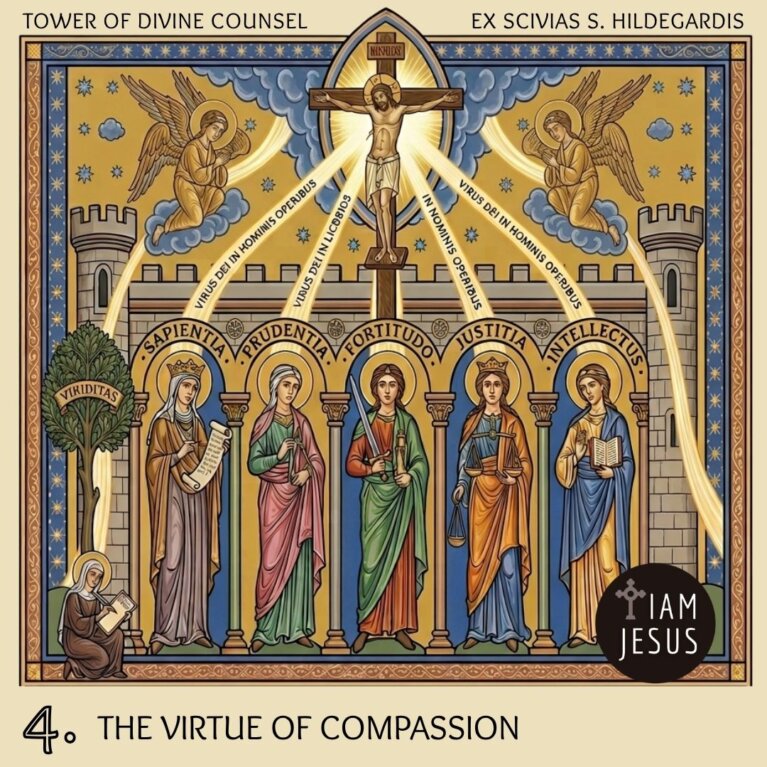
Overcoming Hardness of Heart
Today we contemplate the transformative grace of choosing divine mercy over rigid judgment, learning how to shatter the stubborn emotional walls we build around our neighbors. St. Hildegard of Bingen calls this virtue Misericordia—Mercy, though its deeper root means a heart moved by another’s suffering: Compassion. Join our prayer community for this fourth weekly meditation from Part 1 to anchor your soul in the virtue of mercy and compassion, allowing God’s grace to soften your heart like dew on dry ground and turn you into a living vessel of divine empathy.
Opening Prayer
Lord, today I am rejecting my hardness of heart and asking for the virtue of mercy. You see my true selfishness, and You know that without Your grace, I am completely incapable of merciful love. All my thoughts, words, and actions are fully known to You, even the ones I try to hide from others or justify to myself.
Forgive me for the times I have let pride lock me into rigid judgment. You know the relationships in my past where I struggled to apologize, make restitution, or reconcile because I wanted to protect my own ego. I no longer want to participate in empty amusements like restless jesting. It wears my heart thin and sometimes makes me numb to the hurt I cause others. I’m afraid it will eventually turn my heart hard. I want to love my neighbor exactly how You love me.
Jesus, I desire true holiness. Give me the grace to imitate Your mercy from this day forward. Soften my stubborn will, teach me how to forgive, and let me be a living example of Your compassion to everyone I meet this week.
When Saint Paul confesses: “For I do not do the good I want, but I do the evil I do not want” (Romans 7:19), he speaks to my heart.
Even this prayer is not mine to offer on my own merit if you had not already begun to soften me. Lord, I can’t ask for mercy at all without your grace. Let this very desire to pray be my proof that your grace has already reached me.
AMEN
“A good tree does not bear rotten fruit, nor does a rotten tree bear good fruit. For every tree is known by its own fruit. For people do not pick figs from thornbushes, nor do they gather grapes from brambles. A good person out of the store of goodness in his heart produces good, but an evil person out of a store of evil produces evil; for from the fullness of the heart the mouth speaks.”
Luke 6:43-45
What is the Virtue of Mercy?
In Catholic moral theology, hardness of heart—or obstinacy—is a severe tightening of the ego where a person willfully locks themselves into rigid judgment, refusing to apologize, extend forgiveness, or offer restitution. To shatter this stubborn interior wall, a soul cannot rely on simple human pity; it must beg for the supernatural virtue of mercy. While human compassion is merely the feeling of sorrow for someone else’s pain, true mercy is that compassion put into swift, decisive action. It is an active grace that conforms our hearts to Christ, driving us to actively forgive, break down our bitter defenses, and practically alleviate the misery of our neighbors.
Saint Hildegard of Bingen highlights this exact battle in Liber Vitae Meritorum. Modern readers browsing our Big List of Virtue Meditations will notice this week is titled the Virtue of Compassion. However, in her original twelfth-century Latin manuscripts, St. Hildegard uses the term Misericordia—which translates directly to the Virtue of Mercy, and she explicitly frames this virtue as the direct antidote to Obduratio (hardness of heart). She warns that the hard-hearted are blind to the suffering of those around them and foolishly believe their lives are their own possessions rather than gifts from God.
Hildegard’s Real Intent: The Battle of Misericordia
In her vision, St. Hildegard describes the hard-hearted not as a mere attitude but as a grotesque presence of darkness. It is a column of dense smoke as tall as a man, faceless except for two enormous black eyes, frozen in place like lead sunk to the bottom of rushing water (Liber Vitae Meritorum, Part 1, Section 70, Para. 83, trans. Hozeski).
St. Hildegard writes that when a soul turns its back on mercy, it cuts itself off from the very breath of life, drying up spiritually. She is precise about what hard-heartedness lacks. It is not simply unkind—it is untouched. The soul has not been touched by heavenly dew, has not let the precepts plow its mind like a field, has not let the Scriptures break its surface (Liber Vitae Meritorum, Part 1, Section 70, Para. 83, trans. Hozeski). Without that dew, the heart never softens into ground that can grow anything. It hardens instead into smoke—formless, dry, untouchable.
By actively choosing mercy over a hardened heart, we allow God’s grace to soften our stubborn wills, transforming an indifferent, self-seeking mindset into a living vessel of divine empathy and true reconciliation. Mercy is the dew returned. Where Hard-Heartedness is parched and faceless, Mercy answers: “I am the sweetest plant growing in the air. I have moisture and I am green” (Liber Vitae Meritorum, Part 1, Section 8, Para. 17, trans. Hozeski) — green with that viriditas, that living sap of God’s life, which Hard-Heartedness has cut itself off from entirely. It is this living greenness, not force or argument, that finally answers Hard-Heartedness and warns it to do good. (Liber Vitae Meritorum, Part 1, Section 70, Para. 83, trans. Hozeski).
Compassion is the interior feeling of sorrow for another person’s suffering, but the virtue of mercy is that very compassion put into supernatural action. Mercy is compassion with teeth. It doesn’t just sit back and feel bad for a broken soul; it drives us to actively forgive, to break down our rigid interior judgments, and to physically alleviate the misery of others for the love of Christ. By meditating on the virtue of mercy this week, we are asking God to transform our passive feelings of compassion into an active, life-changing charity.
Mercy is the Only Remedy for Hardness of Heart
Part One of Liber Vitae Meritorum is a vision built on sound. The blessed crowd in the fiery cloud create sounds of every kind of music; their voices rush like waters. St. Hildegard uses sound and noise to teach us that being in right relation to God’s will creates perfect harmony in the Kingdom of God. Mercy belongs to this same order. She does not name herself in musical terms the way Heavenly Love does, but she answers Hard-Heartedness from the same storm cloud that holds the harmony of the blessed. Mercy’s own self-description—moist, green, alive a plant growing in the air— is the language of viriditas, what St. Hildegard calls the breath and voice of God that moves through creation. She does not need to call herself a song. She is already part of the music simply by being alive.
Of every virtue and vice in Part 1, Hard-Heartedness stands alone. The other vices still keep some bit of sound or animal life — Impudence wags its tail, Anger speaks fiery words through a scorpion’s mouth, Slothfulness trembles, Foolish Joy wears the body of a goat. They all make noise. Not Hard-Heartedness; she is denied both noise and animalistic characterization, Hard-Heartedness has no body at all; she is just dense smoke, and has no animalistic characterization except two enormous black eyes (Liber Vitae Meritorum, Part 1, Section 70, Para. 83, trans. Hozeski). In addition, she does not act on appetite, the way every other vice does, because her failure is not of desire but of the soul’s will and intellect — a complete refusal to know or recognize the image of God in anyone, including herself (Liber Vitae Meritorum, Part 1, Section 70, Para. 83, trans. Hozeski). Of all the sins in this first vision, Hard-Heartedness alone is silent, motionless, and formless — the single sin so dark and removed from God that St. Hildegard cannot bring herself to make into a creature.
This is why Hard-Heartedness requires a supernatural remedy only God can give, mercy. A heart that has become so numb and whose intellect and will have become so rigid—with eyes that render her completely blind—cannot be talked, shamed, or disciplined back into seeing it. That strategy might work against Anger or Jesting, vices of misdirected appetite, but she cannot touch a soul’s will who has simply stopped looking. She has wandered so far from God in her intellect and will that she cannot find her own way back, and no human effort can drag her there. Hard-Heartedness refuses to recognize an image because she simply cannot see it. But Mercy heals this blindness, and once Hard-Heartedness sees the One wrapped in flesh, nursed at a breast, and walking among us, she cannot refuse. God comes to her with the supernatural remedy. The soul does nothing to deserve mercy, and could not have sight without it.
When Mercy comes from Heaven, St. Hildegard writes, God shines on the once-hardened sinner “like a gentle sunbeam”— for Mercy herself, in the figure of a woman, is “a fruitful mother of souls saved from perdition”
Scivias, Book 3, Vision 3, Chapter 8, trans. Hart/Bishop
From Jesting to Hard-Heartedness: When the Laughing Stops
St. Hildegard tells us exactly how we arrived here. Hard-heartedness “follows after jesting,” she writes, “because when a man has become exhausted from jesting, he becomes bored and gets hard-hearted” (Liber Vitae Meritorum, Part 1, Section 70, Para. 83, trans. Hozeski). Isn’t that exactly how our own hearts tend to go numb? We don’t usually arrive at real hardness of heart through some dramatic act of cruelty. We arrive at it the way St. Hildegard describes—worn thin by our own restlessness, exhausted from chasing one more laugh, one more distraction, until we are simply too tired to feel anything at all anymore. The jesting we indulged in in Week 3 wasn’t harmless; it was quietly using up the very attention and tenderness our hearts needed to stay soft. This is why Hard-Heartedness has no voice like the others, no trembling or fire in her—she isn’t a passion burning out of control. She’s what’s left over once a soul has burned through its own capacity to care.
Man is Called Two Ways, One Leading
to Life and the Other to Death
by St. Hildegard of Bingen
Each person has in himself two callings, the desire of fruit and the lust for vice. How? By the desire for fruit he is called toward life, and by the lust for vice he is called toward death. In the desire of fruit a person wishes to do good, and says to himself, “Do good works!” And this is the reply to evil, to avoid it and bring forth useful fruit.
But in the lust for vice, a person wants to do evil and says to himself, “Do the work of your own pleasure!” And this is the reply to good, the refusal to resist iniquity and the delight in attaining to vice, whereby the person despises Me and by not honoring Me treats Me as an impostor.
And because he turns away from good, and puts himself into no sorrow or affliction through fear of Me, such a one turns celestial things to scorn, as, enlightened by Me, the psalmist says: “They have set their mouths against Heaven, and their tongues roam the earth” (Psalm 73:9).
St. Hildegard of Bingen, Scivias, Book 3, Vision 5, Chapter 6 (Trans. Hart/Bishop)
Reflection:
God’s grace gives us the power to change, the ability to fight vice with virtue, and a heart to bear good fruit again. We don’t do this by our own efforts. We surrender our lives to Christ and we pray for the grace to do it and Jesus gives us that very grace because he is merciful. When we receive this grace we must act on it and do the work that Jesus commands in obedience to his word and the precepts of the Church. We must put our faith to the test by growing in the virtue of mercy through our words and actions. Others must see our change of heart by the works that we do which are good.
Pluck Out Hardness of Heart Like a Weed
Now let’s contemplate the corresponding vice that we need to remove from our lives by the root, like a weed. In Liber Vitae Meritorum, St. Hildegard of Bingen calls hard-heartedness the worst of faults. She defines the hard-hearted by three characteristics: they show no mercy, have no charity for others, and do not do good works. She also warns that God will confuse anyone who is hard-hearted and refuses to be softened by the precepts of the law or the judgment of rational people, just like he did to the Pharaoh of Egypt in Exodus (Liber Vitae Meritorum, Part 1, Section 93, Para. 109, trans. Hozeski).
If this is you, be diligent and persevere in your efforts to amend your life. God will give you the grace you need, so keep asking, keep seeking forgiveness when you fail, and keep trying to be merciful in your thoughts, words, and deeds. A truly repentant soul will allow the Lord to change his heart; he will take accountability for his sinful thoughts, words, and actions every day, and by the grace of God he will begin to change as a result.
How Can I Have a Heart for God?
Going Further:
If you would like to do an act of mercy this week and you are not sure you can physically participate by volunteering your talents or money, you may want to pray the Divine Mercy Chaplet every day for someone you know who needs God.
Let us Pray:
Finding the strength to do these good works and break the cycle of a hardened heart isn’t something you can force on your own. It requires a radical surrender to God’s healing love. Let those realities settle into your soul for a moment, and use this next prayer of petition to ask the Lord for a total transformation of heart:
In Your Mercy, Lord
A Prayer for Reconciliation
Eternal Father, in your mercy, you not only want to forgive me, but also reconcile with me. Through your mercy, you want to do this for me despite all the evil I have done to you through my sin, despite all I continue to do to you now in my lack of virtue, and despite all I will do to you in the future through my sinful nature.
Jesus, your love for me is magnanimous. You did not stay hidden from me; you took on flesh and walked among us, and then consummated it through your suffering and death on the Cross for my sake.
I do not deserve your kind treatment after what I have done to you in my life, both willfully and ignorantly. I don’t deserve your mercy and your offer of friendship. I am unworthy of you.
Your forgiveness would be enough. I could go on in my life without guilt, resting in the comfort that you forgave me.
But, Jesus, you want to offer me more than forgiveness. You want to restore me and give me a complete change of heart. Despite all I have ever done to you in my life that I am ashamed of, you want to call me friend again and you are willing to give me the grace needed to make it happen.
You want to help me love others as you love me. You promise to give me the power to grow in the virtue of mercy so that I can offer merciful love to others.
I am overwhelmed by this gesture from you because I know it is true. I have felt your forgiveness overwhelm me and stir my heart toward receiving this grace. I thank you from the bottom of my heart for a second chance at holiness. Please help me overcome the vice of hardness of heart and help me have the virtue of mercy.
AMEN.
Take a slow, deep breath and settle into the quiet of this chapel. As you prepare to read this Gospel passage, picture the scene: thousands of exhausted, dusty travelers who have walked for hours just to hear Jesus speak. They are far from home, completely out of food, and running on empty. Where the disciples see an annoying logistical problem to be dismissed, Jesus looks out with the eyes of supernatural mercy. He doesn’t just pity their spiritual confusion—He feels the literal, aching hunger in their stomachs and refuses to send them away empty-handed.
Do not rush through the text. Read the words slowly and let the absolute magnanimity of Christ sink into your soul. He treats these tired strangers not as a burden or an inconvenience, but with a deep, active compassion that provides for their every need. Ask Jesus to show you where your own heart has grown too hard or impatient to notice the hungry, exhausted souls right in front of you. When you are ready, pick up your pen and write His promptings directly into your prayer journal.
The Feeding of the Five Thousand
from the Gospel of Mark Chapter 6:34-43
When he disembarked and saw the vast crowd, his heart was moved with pity for them, for they were like sheep without a shepherd; and he began to teach them many things.
By now it was already late and his disciples approached him and said, “This is a deserted place and it is already very late. Dismiss them so that they can go to the surrounding farms and villages and buy themselves something to eat.”
He said to them in reply, “Give them some food yourselves.”
But they said to him, “Are we to buy two hundred days’ wages worth of food and give it to them to eat?”
He asked them, “How many loaves do you have? Go and see.” And when they had found out they said, “Five loaves and two fish.”
So he gave orders to have them sit down in groups on the green grass.
The people took their places in rows by hundreds and by fifties. Then, taking the five loaves and the two fish and looking up to heaven, he said the blessing, broke the loaves, and gave them to [his] disciples to set before the people; he also divided the two fish among them all.
They all ate and were satisfied.
And they picked up twelve wicker baskets full of fragments and what was left of the fish.
Let us Pray:
Jesus, you refused to let them go away hungry.
Jesus, I thank you for your mercy for me and for feeding me spiritual food throughout my life. Protect me and guard me from the vice of hardness of heart. Do not let me be lost. Do not let me miss out on opportunities and miracles that you want to give because I refuse to cooperate with your will.
Please protect me from pride and selfishness. Give me a pure heart, mind, and eyes that believe in your mercy. Help me imitate you in this scripture passage. I want to have the virtue of mercy and be magnanimous. I want to be one with God in my heart, mind, and through my actions in the present moment.
I don’t want to be selfish and self-seeking. I don’t want to be too proud. Help me understand your ways. Consecrate me in mercy. Send me, Lord, into the world and help me be merciful to my suffering brothers and sisters in Christ and to the people of the world.
Jesus, you are a gift to me. Thank you for being present to me. Give me the grace to be present to you and to grow in the virtue of mercy.
AMEN.
A Prayer for an Increase in Virtue for Others
Lord Jesus Christ, you say that when two or more are gathered in your name, you are with us. Jesus, in your name I lift up every person who has joined this prayer challenge or will join it in the future. I ask you to give us all the grace we need to grow in virtue and holiness so that we may love and serve you in our lives and through the people we love and care for. Help us in our thoughts, our words, and our actions. Guide us all by your Holy Spirit and give us the strength to overcome every temptation from the evil one. We ask all this in the name of the Father, and of the Son, and of the Holy Spirit, AMEN.
Reclaiming Your Heart: Your Week 4 Send-Off
Thank you for committing to Week 4 of this virtue challenge. Breaking down a hardened heart and choosing the path of mercy takes profound spiritual courage, and Jesus sees your hidden efforts. When you inevitably stumble, get impatient, or feel your defenses rising back up this week, do not let discouragement take over. Overcoming lifelong habits of rigid judgment is a slow, daily conversion. Be gentle with yourself, take immediate accountability when you slip, and run to Confession to let His grace wash you clean.
As you walk out of this chapel and step back into a self-centered world that constantly tells you to protect your own ego, put your walls up, and hold onto your grudges, remember who you are. You were not made for smoke and stone. You were made for dew—for the same living greenness that softened a hardened world when Mercy herself arose, fruitful and moist, in the Virgin’s womb. True mercy isn’t a passive feeling of pity; it is an active, supernatural force that drives you to see Christ in everyone you meet. You are called to actively manage your judgments, your words, and your actions out there in the real world. To see exactly how the Church expects us to put this active compassion into practice by serving those in need and extending radical forgiveness to those who have crossed us, look at the standard laid out right here in the Catechism:
“The duty of making oneself a neighbor to others and actively serving them becomes even more urgent when it involves the disadvantaged, in whatever area this may be. “As you did it to one of the least of these my brethren, you did it to me.”
This same duty extends to those who think or act differently from us. The teaching of Christ goes so far as to require the forgiveness of offenses. He extends the commandment of love, which is that of the New Law, to all enemies. Liberation in the spirit of the Gospel is incompatible with hatred of one’s enemy as a person, but not with hatred of the evil that he does as an enemy.”
Catechism, 1932-1933
Make a Resolution
Take a moment to reflect on the virtue of mercy and compassion. What are the ways you can freely practice this virtue this week? Ask the Lord to give you opportunities, and when you feel the Holy Spirit prompting you, take action. Write down your resolutions for this coming week in your prayer journal. Remind yourself to complete these resolutions daily for this entire week, and as the Spirit prompts you, feel free to write about your experiences with this virtue throughout the week.

In My Thoughts:
Jesus, this week I promise to take time daily to conform my thoughts by… (make your intention).
In My Words:
Jesus, this week I promise to take time daily to conform my words by… (make your intention).
In My Actions:
Jesus, this week I promise to take time daily to conform my actions by… (make your intention).
Pray the Litany of Virtues prayer.
Join our Virtue Meditation Prayer Challenge
Don't let spiritual overwhelm hold you back!
Let us guide you step-by-step through Saint Hildegard’s transformative path to holiness.
Receive one long-form meditation in your inbox each week—perfect for a powerful 35-minute holy hour.

One Response
The timing for this Virtue is no coincidence , for I am suffering with hard -heartedness. I know I cant overcome this sin without Gods help . Thank You for this incredible site.