
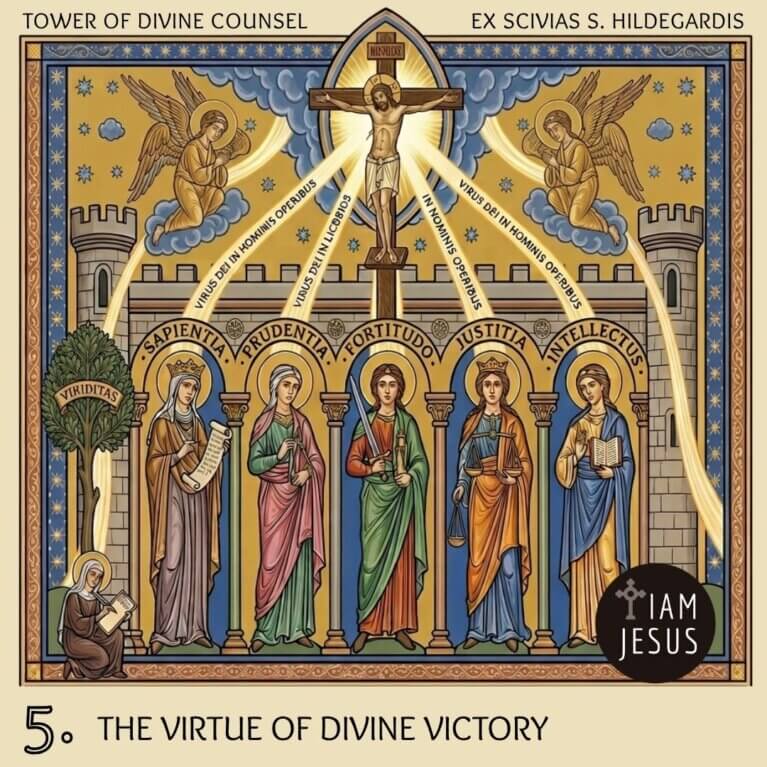
Overcoming Spiritual Sloth
Today we contemplate how to defeat lukewarmness and spiritual despondency—or as St. Hildegard of Bingen would put it, cowardice. Join our prayer community for this fifth weekly meditation from Part 1, inspired by St. Hildegard’s Book of the Rewards of Life. Anchor your soul in the virtue of divine victory—not the energy to do more, but the courage to do what’s right when it costs you something—letting Christ’s strength steady your spine, conquer fear, and fill your daily life with true spiritual joy.
Opening Prayer
Lord, today I ask for your help in overcoming spiritual sloth, which is both an affliction and a sin. Do not let me give in to cowardice — the quiet voice that tells me to stay silent, stay safe, and take the easy way out. Deliver me from the indifference that dresses itself as wisdom and from the fear that buries what You have given me.
Eternal Father, help me be victorious for Christ in my daily life through docility to the Holy Spirit. Help me remember His Passion so that I do not seek the safe route over boldly carrying my Cross for the sake of truth.
Please, Lord, let me have the virtue of Divine Victory in my life. I want to have the fire of the Holy Spirit every day. Let me remember your higher purpose for my life and be intimately connected to you. Jesus, please help me have heroic virtue. When I am afraid to speak truth, give me the courage to stand. Stir my heart to action for your glory. Please help me build a relationship with you that will give me heroic faith and a magnanimous heart. Let me hold the sword of truth with courage.
Eternal Father, please help me overcome my fear of consequences when faced with the opportunity to stand for the truth for the sake of souls in need. Let me trust you with my life and pray with love in my heart. Help me be victorious for Christ in my thoughts, words, and actions. Help me confess my sin of spiritual sloth and all the bad habits created by this affliction. I want to be victorious for Christ all my remaining days and live a joyful, spirit-filled, and meaningful life.
AMEN.
Be strong and steadfast; have no fear or dread of them, for it is the LORD, your God, who marches with you; he will never fail you or forsake you.
Deuteronomy 31:6
What Is Spiritual Sloth?
In Catholic moral theology, spiritual sloth—traditionally called acedia, or the “noonday devil”— is often described as a sickness of spiritual apathy and lukewarmness. But St. Hildegard saw something more specific underneath it. In her vision, this sin speaks for itself, and what she calls it is Ignavia—not weariness, but cowardice. St. Hildegard’s Ignavia is not a soul too tired to act; she is a soul calculating the safest possible path and mistaking it for wisdom. It is a profound sickness of the soul characterized by spiritual apathy, lukewarmness, and cowardice. When afflicted by ignavia, the soul would rather be comfortable than serve the poor, lie rather than argue, and protect oneself rather than stand for what is right. This is not what most of us imagine when we hear the word sloth. Ignavia is the sin of a person who hears something that needs to be challenged but stays silent because speaking might cost something. For Ignavia, peace is easier than truth, she wrongly believes staying safe is synonymous with staying faithful. It turns the spirit entirely inward, numbing the conscience until the soul ceases to fight its spiritual battles.
The voice that answers Ignavia in St. Hildegard’s vision does not promise more energy or more motivation — she promises a sword. St. Hildegard names her Divine Victory (Divina Victoria), and she responds to cowardice the way courage always must: not by feeling more inspired, but by acting in confidence that the battle is already decided. This is the same virtue St. Hildegard gives voice to elsewhere in her writings under a different name, fighting with a different weapon, but with the same unshaken certainty. Divine Victory is not the energy to do more. It is the courage to do the right thing precisely when doing so costs you something — to speak when silence would be safer, to stay when leaving would be easier, to risk the relationship, the reputation, or the comfort rather than betray what is true. It is the antidote not to laziness, but to fear.
Slothfulness Does Not Shine with the Fear of God
by St. Hildegard of Bingen
Slothfulness does not shine with the fear of God, nor does it burn with the fire of the uneasiness of honor, for it has covered over its knowledge with faults while it is alive. Knowledge is the breath of life in the soul that has been rewarded with grace. But sloth does not want to seek grace by doing good works. It has covered over its knowledge while it is alive when with great unhappiness it neglects the faith that it ought to have as its support and in which there is the hope of eternal life.
St. Hildegard of Bingen, Liber Vitae Meritorum (The Book of the Rewards of Life),
Part 1, Section 96, Para. 113 (Trans. Hozeski)
One can sin against God’s love in various ways:
First, indifference neglects or refuses to reflect on divine charity; it fails to consider its prevenient goodness and denies its power.
Second, ingratitude fails or refuses to acknowledge divine charity and to return him love for love.
Third, lukewarmness is hesitation or negligence in responding to divine love; it can imply refusal to give oneself over to the prompting of charity.
Fourth, acedia or spiritual sloth goes so far as to refuse the joy that comes from God and to be repelled by divine goodness.
Finally, hatred of God comes from pride. It is contrary to love of God, whose goodness it denies, and whom it presumes to curse as the one who forbids sins and inflicts punishments.
Catechism, 2094
Reflection:
St. Hildegard of Bingen names the virtue of being victorious for Christ as Divine Victory. This virtue combats a form of spiritual sloth that looks less like laziness and more like deliberate timidity — the quiet, calculated refusal to act, to speak, or to contend for anything that might cost us something.
St. Paul names it plainly in 2 Timothy 1:7: “For God did not give us a spirit of timidity but a spirit of power and love and self-control.” That spirit of timidity is exactly what St. Hildegard saw underneath what we might casually dismiss as “just being tired” or “not my place.” She saw something less passive and more deliberate: a soul that knows what the right thing is, has built a convincing system of reasons not to do it, and calls that system ‘wisdom.’
While modern English readers generally think of acedia when they hear sloth, it’s important to note that St. Hildegard gave this sin a different name in Latin—Ignavia—and she gave it’s antidote a name too, Divina Victoria, or Divine Victory. I want to slow down here for a moment because this distinction matters. Acedia, as the Church has long described it, is mostly a cooling of charity. Acedia makes a soul grow tired of God and they stop caring as a result. Ignavia is something a little bit sharper. It isn’t that the soul stopped caring. With Ignavia, the soul decides that the cost of caring isn’t worth the risk of consequences. One is a fading flame, and the other is a flame that is still burning, but is choosing cowardice over doing the right thing.
“…I will be pleasant to everyone so that I do not suffer… it is better to run away from the strong than to fight them.”
Liber Vitae Meritorum, Part 1, Section 9, Para. 19, trans. Hozeski
The Psychology of Cowardice: How It Distorts the Mind
St. Hildegard saw selfish cowardice as a flaw that quietly decides the right thing is someone else’s responsibility. Beyond the formal definition, the everyday ‘user experience’ of Ignavia is a quiet ongoing internal dialogue with the self, and ‘staying safe’ is the the priority. It doesn’t call itself cowardice.
We tell ourselves we are being diplomatic, patient, even prudent—anything but afraid. We convince ourselves that staying out of it isn’t a failure to act, but a wise choice not to make things worse. This justification covers over our conscience until we can no longer tell the difference between genuine peace and the absence of conflict we engineered to protect ourselves.
Slothfulness is described as having a body “like that of a worm” who twists “in its hole as an infant squirms in its clothes” and speaks with “a trembling voice” (Liber Vitae Meritorum, Part 1, Section 9, Para. 18, trans. Hozeski). St. Hildegard explains that foolish men are “foolish enough to think they are excellent” but when they hear “evil things they trudge on slothfully, muttering degrading comments” and eventually they replace their trust in God’s help for remaining “slothful in the sluggishness of neglect and the foolishness of worthlessness.” She says that like a worm, souls with slothfulness remain in the “filth of their own will, just like an earth worm” (Liber Vitae Meritorum, Part 1, Section 71, Para. 84, trans. Hozeski).
When we suffer from St. Hildegard’s definition of sloth, we fall into a rhythm of squirming like a worm with a trembling voice— “What if they do something to me for speaking out? It’s not my place to say anything, I might get fired. Someone else will handle it who is better at standing up. I have enough to deal with already, and I just don’t have the skillset to make a difference.” Left unchecked, this self-protective reasoning hardens into a permanent way of being. You will eventually train your mind to think this way in every conflict that arises in your life. All your decisions will hinge on the level of fear a conflict generates in your mind.
From Hard-Heartedness to Ignavia: When Numbness Learns to Justify Itself
St. Hildegard tells us plainly where this cowardice comes from.
Ignavia “follows hard-heartedness,” she writes, “for when a hardened person does not seek anything good, this person turns to slothfulness”
Liber Vitae Meritorum, Part 1, Section 71, Para. 84, trans. Hozeski.
Last week, we watched a heart go numb from sheer exhaustion—too worn out from jesting to feel anything at all. This week, that same numbness has learned to speak. It has found a voice, and the voice sounds reasonable: stay quiet, stay safe, it isn’t your place. Hard-Heartedness didn’t know how to care anymore. Ignavia knows exactly how to care—and calculates, every single time, that it costs too much. This is why she can twist and squirm like a worm in her own justifications, always moving, always reasoning, never actually standing up. She isn’t frozen the way Hard-Heartedness was. She’s simply decided, quietly and reasonably, that frozen is safer.
The Psychology of Victory: How It Heals the Mind
Divine Victory does not answer this fear with more willpower. She does not ask us to feel braver before we act—she asks us to act because the outcome is no longer in question. To put it bluntly, we use a sword with the virtue of divine victory. The sword is a spiritual weapon given as divine grace to combat fear when courage is necessary.
This justification covers over our spiritual intellect until we can no longer understand the meaning and purpose God has for our lives. We fall into a rhythm of bitter internal dialogue: “Oh well, I knew this would happen, there is nothing I can do about it. I prayed and nothing happened, so I don’t care anymore.” Left unchecked, this practical apathy breeds a profound interior sadness that can ultimately turn into contempt for God, rooted entirely in a preoccupation with our own ego.
The Remedy to Overcome Spiritual Sloth
What can I do to have a pure heart, mind, and a total trust in God and his divine providence? Let’s take a look at Divine Victory’s remedy. She gives a harsh response to the vice of Ignavia in Liber Vitae Meritorum: “You began to go astray when you spoke your first lie against God. You did not want to stay close to justice…your not having good intentions has deceived people. You are not honest.” Then she continues her battle cry: “I can cut out every injustice. I will strike your jaw with my sword…I fight against the devil and I destroy all his spoils with the mysteries of God’s Scriptures” (Part 1, Section 10, Para. 20, trans. Hozeski).
The answer is surrendering to faith in God and picking up the sword of truth, which Divine Victory clearly says is found in Scripture. Every stance I need to take for the sake of truth is laid out clearly in Scripture. I must recognize my limited finite point of view and take on true Fear of God so that I can overcome the devil’s mind games of making compromises for the sake of peace. I have to keep my gaze on Christ crucified. This is where I draw my strength. When evil thoughts tempt me to quit the battle God has asked me to fight for his glory, I will shift my focus from my point of view and assent to God’s. Divine Victory tells me to believe that God is with me and that He sees the path I am walking and he is guiding my steps toward the victory he has already won. I must walk with faith and confidence in God’s providence. God never loses. If I remain in God I will receive the victory through God. I know that all things will work together for good if I am called according to his purpose (Romans 8:28).
If I am docile to the Holy Spirit and I have surrendered to the will of God in my life, then God has already won the victory. Many heroes in Scripture exhibited the virtue of divine victory. Joseph was sold into slavery by his jealous brothers, wrongly accused, and thrown into prison (Genesis 37-50). Yet he kept his faith in God and showed diligence despite his suffering. He persevered in faith, the remedy to overcome spiritual sloth, and in the end, he saw the justice of God prevail through divine victory.
When we assent to God’s will and overcome the weakness of both mind and body, he can use us to accomplish his will. Our strength comes from God alone, who has already won the victory, so we must believe in him and not lean on our own understanding. There is no room for ego or fear of danger when striving to be victorious for Christ. If we have the faith to believe this then we have nothing to fear.
How Do I Know God’s Will?
You may doubt God’s will in a particular situation. Ask yourself: “Is my decision in agreement with official Church teaching and if it is, will it impede my responsibilities in life that I have been given by God through natural law? Am I making my decision based on fear?
I must let all my actions proclaim the Lord’s victory in every battle I face, so that even in adversity I maintain joy, and this joy will cause me to overcome weakness in my mind and weariness in my body. Divine Victory requires me to act with obedient love to the Holy Spirit’s divine actions in my present situation, always in accord with Church teaching and my duties and station in life.
Regardless of the evil I see, and the temptation to give up, I must persevere in the hope that the victory has already been won. Come Holy Spirit, let all my actions be oriented toward divine victory. I ask to be united with the will of God in my life through the virtue of divine victory in my thoughts, words, and actions. I proclaim the victory that Christ has won and ask for the peace of mind.
Going Further:
This week, read the story of Joseph in Genesis 37–50. Notice how many times Joseph had every reasonable excuse to give up, grow bitter, or protect himself — and how many times he simply kept moving faithfully forward instead. Pay particular attention to Genesis 50:20. Bring one moment from Joseph’s story into prayer and ask: where in my own life has God been working through something I only saw as an obstacle or a loss? What would it look like to trust His purpose the way Joseph did — not dramatically, but in one ordinary, faithful choice this week?
Let us Pray:
Now that we understand the virtue of divine victory, let’s begin with a prayer of petition for it.
A Prayer for Divine Victory
Eternal Father, I confess that I have often let spiritual sloth, selfish timidity, and indifference creep into my soul. Forgive me for the times I have made decisions based on what felt safe rather than what was true, buried the talents You gave me out of fear, or allowed my love for You to grow cold through indifference. I cannot stir my own heart into a holy fire by my own power; I desperately need Your grace.
Jesus, grant me the supernatural virtue of Divine Victory. Infuse my soul with the holy diligence and fire of the Holy Spirit so that I can shatter this heavy paralysis. Shift my gaze away from my own finite exhaustion and fix it entirely upon Your Cross. Give me a magnanimous heart that refuses to give up, a heroic faith that conquers complacency, and the joy that comes from an inner love of spiritual things. I want to be victorious for Christ in my thoughts, words, and actions all the remaining days of my life.
Amen.
Take a slow, deep breath. Settle your mind, drop your daily distractions, and prepare to listen to Jesus speak. As you get ready to read this passage, recognize that the master in this parable isn’t a distant, demanding tyrant—He is Christ, and He has already entrusted you with incredible spiritual treasures, gifts, and responsibilities to build up His kingdom.
Do not rush through these verses. Read them slowly and feel the heavy contrast between the first two servants, who acted with a spirit of divine victory, and the third servant, who succumbed entirely to spiritual sloth. Notice how Ignavia didn’t make the third servant wildly wicked; it simply made him afraid, inactive, and indifferent enough to bury his gift in the dirt. Ask Jesus to show you where fear and indifference is tempting you to bury your own talents, and where He is calling you to move with holy diligence. When you are ready, pick up your pen and write His promptings in your journal.
The Parable of the Talents
from the Gospel of Matthew Chapter 25
It will be as when a man who was going on a journey called in his servants and entrusted his possessions to them. To one he gave five talents; to another, two; to a third, one—to each according to his ability. Then he went away.
Immediately the one who received five talents went and traded with them, and made another five. Likewise, the one who received two made another two. But the man who received one went off and dug a hole in the ground and buried his master’s money.
After a long time the master of those servants came back and settled accounts with them. The one who had received five talents came forward bringing the additional five.
He said, ‘Master, you gave me five talents. See, I have made five more.’
His master said to him, ‘Well done, my good and faithful servant. Since you were faithful in small matters, I will give you great responsibilities. Come, share your master’s joy.’
[Then] the one who had received two talents also came forward and said, ‘Master, you gave me two talents. See, I have made two more.’
His master said to him, ‘Well done, my good and faithful servant. Since you were faithful in small matters, I will give you great responsibilities. Come, share your master’s joy.’
Then the one who had received the one talent came forward and said, ‘Master, I knew you were a demanding person, harvesting where you did not plant and gathering where you did not scatter; so out of fear I went off and buried your talent in the ground. Here it is back.’
His master said to him in reply, ‘You wicked, lazy servant! So you knew that I harvest where I did not plant and gather where I did not scatter? Should you not then have put my money in the bank so that I could have got it back with interest on my return? Now then! Take the talent from him and give it to the one with ten. For to everyone who has, more will be given and he will grow rich; but from the one who has not, even what he has will be taken away.
And throw this useless servant into the darkness outside, where there will be wailing and grinding of teeth.’
Let us Pray:
Jesus, you have entrusted me with your possessions. You’ve given me talents and asked me to care for them. Please help me be victorious. I want to use the talents for your glory, multiplying what you have given me for your kingdom. Please, Lord, keep me close to your heart. Do not let me have selfish-cowardice. Help me overcome my fears and lack of faith so that I may practice the virtue of divine victory.
Jesus, keep me in your name. Protect me and help me in overcoming sloth. Do not let me be lost. Do not let me be like the wicked, selfish servant. Please protect me from the temptation to be slothful. Give me a pure heart, mind, and eyes that look to heaven daily. Help me have divine victory like the good servant who was given five talents in this passage. I want to hear you say ‘come share in your master’s joy.”
I do not want to be indifferent and make decisions based on selfish cowardice. I want to see all my sufferings as steps toward divine victory. Let me possess the virtue of divine victory so that the talents you have given me will multiply your blessings.
Jesus, you are a gift to me. Thank you for being present to me. Give me the grace to have divine victory and to overcome sloth in my life. AMEN.
A Prayer for an Increase in Virtue for Others
Lord Jesus Christ, you say that when two or more are gathered in your name, you are with us. Jesus, in your name I lift up every person who has joined this prayer challenge or will join it in the future. I ask you to give us all the grace we need to grow in virtue and holiness so that we may love and serve you in our lives and through the people we love and care for. Help us in our thoughts, our words, and our actions. Guide us all by your Holy Spirit and give us the strength to overcome every temptation from the evil one. We ask all this in the name of the Father, and of the Son, and of the Holy Spirit, AMEN.
Together, we can strive to overcome all forms of sloth. I am praying for you, please pray for me as well. Let’s make good resolutions that will increase our faith in God and our desire to do good works for His kingdom. Remember, when your heart desires a relationship with God you have won half the battle against the sin of sloth. Make an effort every day to do things for God with courage, always seeking to act with faithfulness and courage.
Good habits take time to establish, so be patient with yourself. Stay in the present moment with Jesus, especially when you struggle with fearful and selfish thoughts. If you confess the vice of sloth, God will give you the grace to overcome it. Jesus is merciful, so be merciful to yourself. Being victorious for Christ is a process. You are winning the race, one small victory at a time. The more you practice divine victory, the more your heart is conformed to Christ.
Fueling the Fire: Your Week 5 Send-Off
Thank you for pushing through to the end of Week 5. Standing up to the heavy paralysis of spiritual sloth takes deliberate, daily courage, and Jesus sees every small effort you make to show up. When you inevitably feel lukewarm, or lack courage to do the right thing in a particular situation, do not let the spirit of ignavia take root. Overcoming sloth is a slow process of building consistent thought patterns to overcome timidity. It’s not an overnight transformation. Be patient with yourself, use holy diligence to fight through the dry seasons, and rely on Confession to constantly renew your strength.
As you leave this chapel and step back into a loud, frantic culture that constantly tries to distract your mind and numb your soul into indifference and inaction, grab your sword of courage. True victory for Christ means actively fighting to keep a holy fire burning — choosing faithfulness over comfort, one ordinary decision at a time.
Pope Francis captured this same interior courage when he spoke of the “healthy audacity” that faith requires — boldness aimed not at self-promotion, but at the willingness to keep moving forward when timidity tells us to stay still (Pope Francis, Address for the Opening of the Vatican Judicial Year, March 2024, Vatican News). We will return to this same audacity in Part 4, where that same personal courage meets its communal scale.
Make a Resolution
Take a moment to reflect on the virtue of divine victory. What are the ways you can freely practice this virtue this week? Ask the Lord to give you opportunities, and when you feel the Holy Spirit prompting you, take action. Write down your resolutions for this coming week in your prayer journal. Remind yourself to complete these resolutions daily for this entire week, and as the Spirit prompts you, feel free to write about your experiences with this virtue throughout the week.
In My Thoughts:
Jesus, this week I promise to take time daily to conform my thoughts by… (make your intention).
In My Words:
Jesus, this week I promise to take time daily to conform my words by… (make your intention).
In My Actions:
Jesus, this week I promise to take time daily to conform my actions by… (make your intention).
Pray the Litany of Virtues prayer.
Join our Virtue Meditation Prayer Challenge
Don't let spiritual overwhelm hold you back!
Let us guide you step-by-step through Saint Hildegard’s transformative path to holiness.
Receive one long-form meditation in your inbox each week—perfect for a powerful 35-minute holy hour.

One Response
This is so deep a teaching and helpful for my spiritual journey. Father, thank you for the grace to be a part of this challenge.