
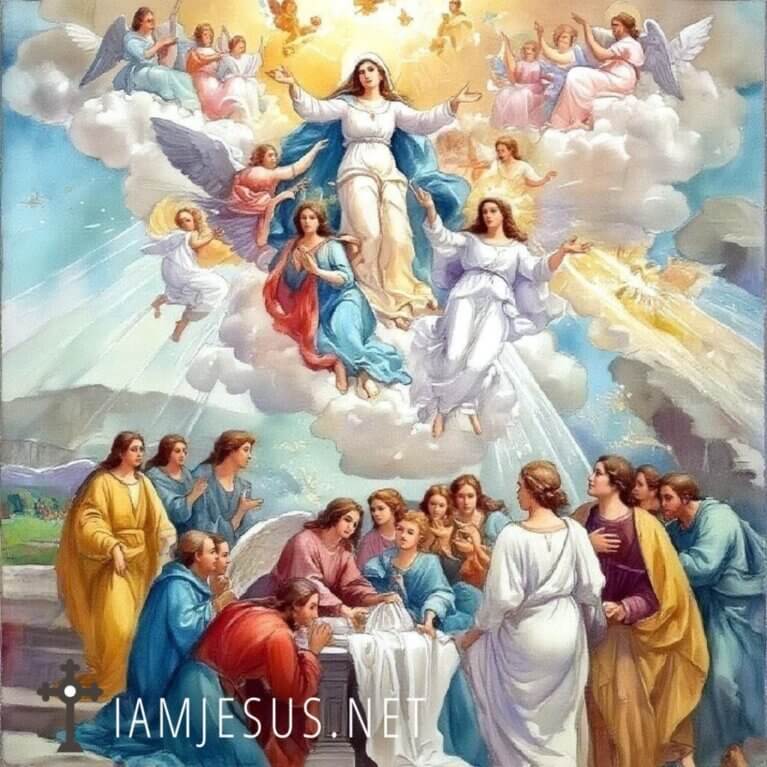
The Assumption of Mary, or “Her Glorious Assumption”, as it is poetically written in the Divine Praises prayer, captures an ancient traditional belief that the Virgin Mary was never entombed and her body was assumed into heaven, like the prophet Elijah. We will ponder this mystery and consider the traditions and historical evidence surrounding the Assumption of Mary in this 10th catechetical meditation.
"The knot of Eve's disobedience was untied by Mary's obedience; what the virgin Eve bound through her unbelief, the Virgin Mary loosened by her faith."
St. Irenaeus of Lyon, Against Heresies 3.22.4
The Preservation from Corruption Explained
Because Mary was blessed in her Immaculate Conception (the line just before this in the Divine Praises!), her body was preserved from the decay of the grave. Her glorious assumption is the natural fulfillment of her immaculate beginning.
Mary prayed with the disciples in the upper room for the descent of the Holy Spirit [Acts 1:14].
The early Church believed that the Virgin Mary was assumed into heaven.
In the 1st century we already began to see the tradition of collecting holy relics of the saints, yet historically, there are no relics of the Virgin Mary. She has two empty tombs: one in Jerusalem and another in Ephesus, these are both places where she lived.
The Bible records the phenomena of relics holding spiritual power in both the Old and New Testaments. This was widely known by 1st century Christians. We clearly see this in Acts 5:15-16 when the shadow of the Apostle Peter was believed to have the power to heal. We also see it in Acts 19:11-12 when the Apostle Paul’s handkerchiefs and aprons were used to heal the sick and cast out demons. We also see in the Old Testament in 2 Kings 13:21, that the relics of the Prophet Elisha had the spiritual power to revive a deceased man when his bones touched him.
There are no relics of the Virgin Mary, and this fact alone points to the plausibility of her bodily Assumption into heaven. Furthermore, there are no testimonies about her postmortem body or possession of her relics in antiquity. This is very noteworthy, because Mary was chosen to be the Mother of God and was present throughout Christ’s earthly life and ministry, yet there are no relics despite there being bodily relics (preserved to this day) from all the other apostles, (except John the Apostle).
Throughout her history, the Church has never claimed to have relics of the Virgin Mary’s body. This shows us the early Church believed Mary was indeed assumed into heaven, body and soul.
In 350 AD, St. Epiphanius wrote in Refutation of All Heresies, that he believed in her glorious Assumption and compared it to the prophet Elijah:
“And if I should say anything more in her praise, [she is] like Elijah, who was virgin from his mother’s womb, always remained so, and was taken up and has not seen death. She is like John who leaned on the Lord’s breast, “the disciple whom Jesus loved.” She is like St. Thecla; and Mary is still more honored than she, because of the providence vouchsafed her.” [Panarion 79.5.2].
The Most Blessed Virgin Mary, when the course of her earthly life was completed, was taken up body and soul into the glory of heaven, where she already shares in the glory of her Son's Resurrection, anticipating the resurrection of all members of his Body.
Catechism, 974
The Prophecy of Our Future
why we praise God for this. Mary’s Assumption isn’t just about her; it is a sign of hope for all of us. She is the first fully redeemed human to experience what we are all promised at the end of time: the resurrection of our bodies.
Praising the Assumption as Spiritual Warfare
The Divine Praises were originally written in 1797 by a Jesuit priest to make reparation for blasphemy. Praising her “Glorious Assumption” is a powerful way to push back against modern doubts regarding the sacredness of the human body and the reality of heaven.
After her Son's Ascension, Mary "aided the beginnings of the Church by her prayers" [Lumen Gentium 69]. In her association with the apostles and several women, "we also see Mary by her prayers imploring the gift of the Spirit, who had already overshadowed her in the Annunciation" [Lumen Gentium 59]. . . . also in her Assumption
Catechism, 965
Prayer for the Solemnity of the Assumption of Mary
Almighty and everlasting God, You have taken up body and soul into the heavenly glory the Immaculate Virgin Mary, Mother of Your Son. Grant, we beseech You, that, ever intent upon heavenly things, we may be worthy to be partakers of her glory. Through Jesus Christ Your Son, our Lord, who lives and reigns with You and the Holy Spirit, One God, forever and ever.
AMEN.
O Queen Assumed into Heaven, pray for us.
More Catechetical Meditations

Blessing Jesus in the Holy Sacrament of the Altar

Blessed Be the Most Precious Blood of Jesus
