
Overcoming Numbness and Spiritual Sluggishness
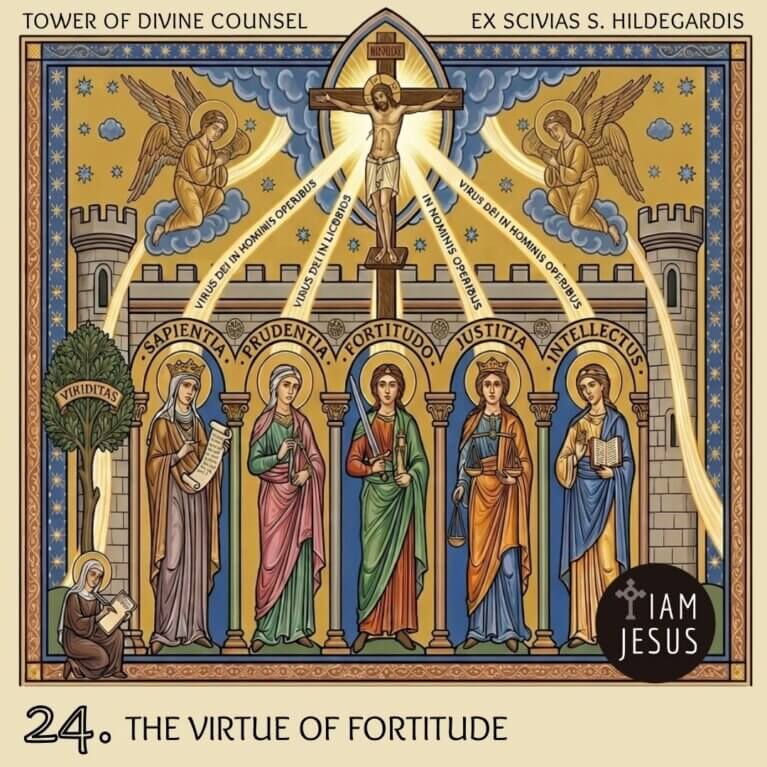
Today we contemplate the grace of choosing divine strength over shiftlessness, or spiritual numbness. When we practice the virtue of fortitude St. Hildegard of Bingen says it shatters faintheartedness. Join us for this Part 4, Week 24 meditation inspired by St. Hildegard to anchor your soul in the courage of Christ and fearlessly carry your cross.
Opening Prayer
Lord, give me fortitude to overcome my spiritual numbness. Sometimes I can be fervent but when a difficulty arises I often give up. I need courage to keep trying. Lord give me fortitude so that I do not give up, grow complacent, and find myself without purpose or confused. I do not want to be caught sleeping when I am put to the test. I don’t want to deny you when I should preach the gospel instead.
Lord you are single minded. You were obedient even unto death. You exhibit perfect fortitude. Jesus, you never waver because you draw your strength in love. Please give me the grace to grow in fortitude and have courage to do your holy will when I am faced with adversity. Help me overcome my sluggishness so that I fulfill my vocation and glorify you with the charisms you have given me. Help me resist all temptations and fears, so that I can overcome persecutions and trials with confidence.
AMEN
Fortitude is the moral virtue that ensures firmness in difficulties and constancy in the pursuit of the good. It strengthens the resolve to resist temptations and to overcome obstacles in the moral life. The virtue of fortitude enables one to conquer fear, even fear of death, and to face trials and persecutions. It disposes one even to renounce and sacrifice his life in defense of a just cause.
“The Lord is my strength and my song.” Psalm 118:14.
“In the world you have tribulation; but be of good cheer, I have overcome the world.” John 16:33.
Catechism, 1808
What Is The Virtue Of Fortitude?
At its heart, the Catholic virtue of fortitude is the spiritual stamina and courage that allows us to stand firm in difficulties and stay constant in doing what is right. It is often called the most “combative” of the virtues because it doesn’t leave us passive. Instead, fortitude gives us the moral backbone to resist everyday temptations, overcome obstacles in our life of faith, and bravely face our fears. It is the grace that transforms our human weaknesses into Christ-like strength, allowing us to carry our daily crosses without giving up.
Living out this virtue requires two important movements: one that fights inward, and one that fights outward. On the inside, fortitude helps us defeat personal enemies like anxiety, paralyzing fear, and spiritual discouragement when trials strike. On the outside, it shapes us into resilient sailors who can navigate life’s unexpected storms and persecutions. When we truly live out the virtue of fortitude St. Hildegard envisions for us, we refuse to stay comfortable or indifferent to the evil around us; it grants us the power to say a firm, Christian “no” to sin and spiritual numbness while confidently pursuing God’s holy will.
A Note on St. Hildegard's Virtue: Understanding "Torpor"
Here in Week 24 (Fortitude): We fight the vice of torpor—spiritual numbness and sluggishness, the fainthearted temptation to shrink back or give up the moment a trial gets difficult. Older English translations sometimes rendered this old-fashioned vice “shiftlessness”—but the Latin word St. Hildegard actually used is torpor.
- The Latin Context: Hildegard used torpor (spiritual numbness, sluggishness). In Scivias, St. Hildegard warns against those who find God’s yoke “too delicate to bear” out of fear, which is exactly what we studied in Week 5 with Slothfulness. Fortitude is the holy backbone that wakes us up and keeps us standing firm.
“…Oh human, when your salvation is complete in both worldly and spiritual matters, you will leave the present world and pass on to that which has no end. For when a person has such fortitude that he burns for Me more ardently than other people, and aware of the earthly dregs of stinking sin, is active in avoiding the snares of the ancient serpent, I do not take his spirit from his body before his fruits have fully ripened with sweetest fragrance. But if I find one who is of such frailty that in pain of his body and terror of the evil lurker he is too delicate to bear My yoke, I take him away from this world before his soul, wasting away in weakness, begins to dry up.”
Scivias, Book 1, Vision 3, Chapter 24 (Abridged)
St. Hildegard give Torpor her own voice too, in Liber Vitae Meritorum itself.
She says: “Why should I endure a narrow and laborious life? And why should I bear many tribulations, when I have not committed many sins? Every creature has its own way of being. Many people weep and wail and waste away their bodies, so that they can scarcely live, and yet they still have wicked habits, and add sin to sin. What good does all that labor do them? I, however, have a better life than others in softness and in fleeing labor, and I want no labor at all. If I flee labor and other things harmful to me, will God destroy me because of this?”
Liber Vitae Meritorum, Part 4, Section 3, Para. 5, trans. Hozeski
And Fortitude answers her directly.
She says: “O ashes of ashes, o spark of miserable decay, you were poisonous from your very first origin, just as your works are still useless now… You wretched one, without God’s wisdom, and rejected without God’s mercy, desire to have what no one will give you, since you wish to receive without labor what you cannot even grasp in your torpid laziness. But I serve the fortitude of the lion—the humanity of the Savior—in the royal bedchamber, and I sigh for all the good things of God, and I fly everywhere, just as one who spreads his cloak wide.”
Liber Vitae Meritorum, Part 4, Section 4, Para. 6, trans. Hozeski
From Injustice to Torpor: When Neglect Turns Numb
St. Hildegard tells us plainly why this vice comes next. Torpor, she writes, “follows injustice because it deserts justice and is not watchful in faith, but is blind in its mind” (Liber Vitae Meritorum, Part 4, Section 27, Para. 35, trans. Hozeski). A soul that has already learned to withhold what it owes others doesn’t stop there—it grows numb to owing anything at all, to God or to anyone else. Injustice was still an active choice, a refusal; Torpor is what happens once that refusal has been made so many times it no longer even registers as a choice. The stewardship this Part is asking us to practice starts failing here, quietly, long before anyone notices the fruit stops coming.
In Part 1 Week 5, we met Pope Francis’s “healthy audacity” as a personal virtue — the interior courage of one soul that stops calculating personal risk and starts trusting God’s purpose. Divine Victory answered Slothfulness at the level of the individual heart: one person, one laminated sign on one closed door, dismantled by faithfulness.
Here in Part 4, that same audacity meets its communal scale. Pope Francis named it fully when he spoke of the courage justice requires: “Without this healthy audacity, we run the risk of giving in to resignation and end up overlooking many abuses, small and large. Those who are courageous do not aim for their own prominence, but for solidarity with the brothers and sisters who bear the weight of their fears and weaknesses” (Pope Francis, Address for the Opening of the Vatican Judicial Year, March 2024, Vatican News). This is no longer one soul’s interior battle — it is the failure of an entire community of stewards who have chosen comfortable numbness over costly faithfulness.
St. Hildegard understood this architecture. The disordered heart of Part 1 does not stay private forever. Left ungoverned, timidity becomes Numbness — a way of life, a culture, a society that has quietly decided that solidarity costs too much. The antidote at this scale is not just personal courage but the virtue the Church has always called Fortitude — the strength to do what is right not only when it costs one person something, but when it costs an entire community something. This is Divine Victory writ large: not one sword held steady in one hand, but a community of souls who have each, individually, refused to let the laminated door stay shut — and who together become something the world cannot easily dismiss.
Now that you understand the nuances, let’s prayerfully meditate on this week’s passage on the rewards for souls who have fortitude:
What Kinds of Souls are in the Heavenly Kingdom?
by St. Hildegard of Bingen
There are those in this place who had embraced those things that were celestial in spirit while they served physically in time in the burden of actual life. There are also those who are now dead but who had clung in body and spirit to heavenly things when they subjected themselves to regular discipline and lifted their minds up in contemplation.
There are those who had presided over their subjects humbly when they taught them and gave them good examples by helping them both physically and spiritually.
There are those who had not wavered in their constancy to truth as their bodies weakened and died as they scorned idols and acknowledged their Creator.
And there are those who had honestly preserved the virginity they had vowed to God out of fear and love for him when they denied their flesh and blood.
St. Hildegard of Bingen, Liber Vitae Meritorum (The Book of the Rewards of Life),
Part 6, Section 35, Para. 57 (trans. Hozeski)
Reflection:
Lord, you promise to accompanying me through every trial and tribulation I encounter. St. Hildegard tells us that faithful people will be inspired by the Holy Spirit to have fortitude when we pray eagerly from our hearts for strength:
The fortitude that conquers the Devil and is joined to knowledge is inspired by the Holy Spirit when faithful people devoutly acknowledge God with ardent desire and embrace Him eagerly in the very depths of their souls.
Scivias, Book 3, Vision 8, Chapter 15
Let me have fortitude so that my heart to be filled with tremendous courage and stamina when I am faced with trials. I want my life to be one of great virtue so that I can glorify you in my thoughts, words, and deeds.
I know that death comes like a thief in the night. I have to overcome my shiftlessness and bear good fruit.
I breathe because you will it. My very life is a gift. Nothing happens to me that is beyond your will, whether it be your permissive will or your divine will. Please, God, give me fortitude to overcome my shiftlessness. When you speak to my heart in the quiet of prayer let me obey your words and live them with courage and fortitude. Please grant me the gift of fortitude and help me overcome all obstacles to prayer, good works, and my commitment to serving you each day of my life.
Going Further:
Meditate on Jesus’ words of warning to his followers in Mark 13:9-13. He explains discipleship will not be easy. Read the passage and then spend a few moments in silence with the Lord. Reread the passage again, stopping to ponder a word or phrase that speaks to you. If you feel the Lord speaking to you about a particular situation you may want to journal about it.
[Jesus says] “Watch out for yourselves. They will hand you over to the courts. You will be beaten in synagogues. You will be arraigned before governors and kings because of me, as a witness before them. But the gospel must first be preached to all nations. When they lead you away and hand you over, do not worry beforehand about what you are to say. But say whatever will be given to you at that hour. For it will not be you who are speaking but the holy Spirit. Brother will hand over brother to death, and the father his child; children will rise up against parents and have them put to death. You will be hated by all because of my name. But the one who perseveres to the end will be saved.”
Rejecting Faintheartedness:
Take a moment to pause, drop your defenses, and settle into the absolute stillness of this adoration chapel. Shiftlessness is a quiet, dangerous erosion of the soul—an exhausting habit of spiritual laziness, idleness, and moral cowardice—where we immediately shrink back or give up the moment a trial or a time of prayer becomes difficult.
You shall not fear the terror of the night nor the arrow that flies by day, Nor the pestilence that roams in darkness, nor the plague that ravages at noon. Though a thousand fall at your side, ten thousand at your right hand, near you it shall not come.
We see the same virtue of Divine Victory — now operating at the full scale of Fortitude — in the story of Esther and Mordecai. They stood up against the evil plot of Haman, trusting God’s purpose not just for themselves but for an entire people facing annihilation.
Esther did not have the luxury of private faithfulness. Her courage had to be public, visible, and costly — she risked her own life by approaching the king unsummoned, knowing she could be killed for it. She was not acting for her own benefit. She was acting for those who had no other advocate. As a poor orphan girl, she never could have imagined she would grow up to be queen and save the Jews in Persia — but God had placed her exactly where her fortitude was needed, at exactly the right moment.
This is the communal scale of the virtue we first met in Part 1 Week 5 as personal courage. There, one soul stopped calculating personal risk and trusted God’s purpose. Here, that same trust becomes solidarity — one person standing in the gap for those who cannot stand for themselves.
When we allow a faint heart to govern our actions, we complain bitterly that God’s yoke is too heavy to bear, preferring the safety of selfish comfort over the transformative pain of the cross. Before we open the Word of God, let us offer up a sincere prayer of petition—asking for the spiritual grit to wake up from our slumber, conquer our fears, and receive the unshakeable backbone of supernatural fortitude
Prayer For Supernatural Stamina
Eternal Father, You are the unshakeable pillar that holds up the universe, yet You know the weary, lazy, and fainthearted corners of my heart. I confess that I have often succumbed to the vice of shiftlessness—giving up when obstacles arise, growing complacent in my prayer life, and seeking comfort instead of the courage needed to do Your holy will. Forgive me for the times I have been caught sleeping when put to the test, and for the moments I have hidden my faith out of fear of human respect or persecution. I am too weak to conquer this spiritual sloth by my own fragile human energy. I desperately need the cleansing fire of Your grace.
Lord Jesus, grant me the supernatural virtue of fortitude. Infuse my human weakness with Your divine stamina so that I may stand firm in every difficulty and remain constant in the pursuit of what is good. When anxiety or discouragement flares up this week, catch my thoughts and give me the strength to look squarely at my cross. Deliver me from the paralyzing trap of spiritual numbness. Grant me a resilient mind, a brave conscience, and a fervent spirit that refuses to compromise with sin. Let my life bear good, fully ripened fruit that is pleasing to You, so that I may confidently fulfill my vocation and bring Your steady glory into a broken world.
AMEN.
Take a slow, deep breath. Settle your mind, clear away your daily distractions, and open your heart to the presence of God. As you prepare to encounter Jesus in this heavy passage from the Gospel of Luke, look past the familiar scene and peer directly into the ultimate standard of perfect fortitude.
Do not rush through these verses. Read the words slowly and step directly into the dark, cold shadows of the Mount of Olives. Watch how the disciples crumble under the weight of their grief, falling fast asleep instead of staying vigilant. Contrast their shiftlessness with Christ, who is in such deep interior agony that His sweat becomes like drops of blood falling to the ground, yet He refuses to shrink from the cross—firmly asserting, “not my will but yours be done.” Watch His unshakeable composure and charity even as the crowd approaches to betray Him. Ask the Lord to reveal where your own laziness has left you spiritually asleep, and where He is calling you to get up, pray, and stand firm this week. When you are ready, pick up your pen and write His promptings directly into your prayer journal.
Fortitude in the Garden
from the Gospel of Luke Chapter 22
Then going out he went, as was his custom, to the Mount of Olives, and the disciples followed him. When he arrived at the place he said to them, “Pray that you may not undergo the test.”
After withdrawing about a stone’s throw from them and kneeling, he prayed, saying, “Father, if you are willing, take this cup away from me; still, not my will but yours be done.”
And to strengthen him an angel from heaven appeared to him.
He was in such agony and he prayed so fervently that his sweat became like drops of blood falling on the ground.
When he rose from prayer and returned to his disciples, he found them sleeping from grief.
He said to them, “Why are you sleeping? Get up and pray that you may not undergo the test.”
While he was still speaking, a crowd approached and in front was one of the Twelve, a man named Judas. He went up to Jesus to kiss him.
Jesus said to him, “Judas, are you betraying the Son of Man with a kiss?”
His disciples realized what was about to happen, and they asked, “Lord, shall we strike with a sword?”
And one of them struck the high priest’s servant and cut off his right ear.
But Jesus said in reply, “Stop, no more of this!” Then he touched the servant’s ear and healed him.
Let us Pray:
Jesus, you felt agony in the garden so deeply that your blood dripped from your brow. You were alone, betrayed, and waiting for the soldiers to arrest you like a lamb to the slaughter.
Jesus, you accepted death with fortitude and courage. You assented to the Father’s will.
In spite of all the evil around you, and all the cowardice and shiftlessness of your disciples, you touched the servant’s ear and healed him.
I am deeply moved that you healed him in that moment of chaos.
Jesus, I love you. Thank you for loving me. AMEN.
A Prayer for an Increase in Virtue for Others
Lord Jesus Christ, you say that when two or more are gathered in your name, you are with us. Jesus, in your name I lift up every person who has joined this prayer challenge or will join it in the future. I ask you to give us all the grace we need to grow in virtue and holiness so that we may love and serve you in our lives and through the people we love and care for. Help us in our thoughts, our words, and our actions. Guide us all by your Holy Spirit and give us the strength to overcome every temptation from the evil one. We ask all this in the name of the Father, and of the Son, and of the Holy Spirit, AMEN.
Unshakeable Pillar: Your Week 24 Send-Off
Thank you for committing to Week 24 and for your incredible dedication throughout this entire virtue meditation journey. Confronting the vice of shiftlessness—shattering the urge to shrink from the cross out of faintheartedness and choosing a life of supernatural fortitude—takes profound interior grit, and Jesus sees every single hidden effort you make to stand firm when put to the test. When you inevitably feel spiritual laziness creep back in, catch yourself complaining that His yoke is too heavy, or feel tempted to sleep through your prayer commitments this week, do not let discouragement take root. Overcoming faintheartedness is a slow, daily process of letting grace fortify your human weakness, not an overnight shift.
As you walk out of this chapel and step back into a loud, soft world that constantly rewards spiritual sloth, cowers in the face of moral difficulty, and screams at you to avoid all personal discomfort, guard your interior peace. True fortitude isn’t a rigid, aggressive anger; it is an act of ultimate spiritual stamina that gives you the moral backbone to face your trials and persecutions with unshakeable confidence. You are called to actively govern your fears, wake up from your spiritual slumber, and let your life bear good. Now let’s look at the Catechism to learn more about fortitude:
Martyrdom is the supreme witness given to the truth of the faith: it means bearing witness even unto death. The martyr bears witness to Christ who died and rose, to whom he is united by charity. He bears witness to the truth of the faith and of Christian doctrine. He endures death through an act of fortitude.
“Let me become the food of the beasts, through whom it will be given me to reach God.” – St. Ignatius of Antioch, Ad Rom. 4,1: Ch 10,110.
Catechism, 2473
Make a Resolution
Take a moment to reflect on the virtue of fortitude. What are the ways you can freely practice this virtue this week? Ask the Lord to give you opportunities, and when you feel the Holy Spirit prompting you, take action. Write down your resolutions for this coming week in your prayer journal. Remind yourself to complete these resolutions daily for this entire week, and as the Spirit prompts you, feel free to write about your experiences with this virtue throughout the week.
In My Thoughts:
Jesus, this week I promise to take time daily to conform my thoughts by… (make your intention).
In My Words:
Jesus, this week I promise to take time daily to conform my words by… (make your intention).
In My Actions:
Jesus, this week I promise to take time daily to conform my actions by… (make your intention).
Pray the Litany of Virtues prayer.
Join our Virtue Meditation Prayer Challenge
Don't let spiritual overwhelm hold you back!
Let us guide you step-by-step through Saint Hildegard’s transformative path to holiness.
Receive one long-form meditation in your inbox each week—perfect for a powerful 35-minute holy hour.
