
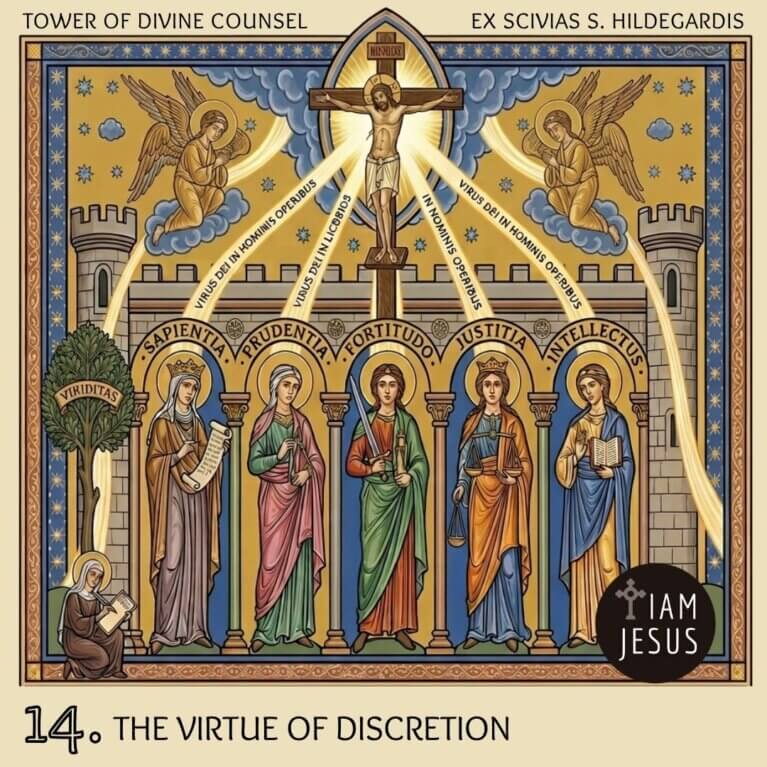
Overcoming Pull of Worldly Attachments
Today we contemplate the stabilizing grace of a balanced and disciplined spirit, learning how to master our daily impulses and protect our souls from the chaos of overindulgence. Join our prayer community for this fourteenth weekly meditation inspired by St. Hildegard of Bingen’s Book of the Rewards of Life—Part 2—to cultivate the supernatural virtue of discretion, conquer the restless pull of worldly attachments, and find true interior freedom by choosing to avoid all forms of immoderation.
Opening Prayer
Lord, please help me learn how to use good discretion. I need grace to overcome all forms of immoderation. I know the virtue of discretion will help me be more content and happy. Please give me the grace I need to use good discretion and live with moderation in my daily activities.
Jesus, you know my heart and how I desire things because I believe they will give me pleasure and make me happy. I spend time and money on these things, but they often leave me feeling restless and unfulfilled. I’ve realized over the years that indulging myself with things that give me pleasure usually leads to negative consequences.
Holy Spirit, I humbly ask for your gentle guidance. Please convict my conscience with the voice of truth and common sense to help me avoid excessive spending on things I want but don’t need. Convict my conscience over excessive media consumption so that I do not spend too much time on devices, through online discussions, video consumption, reading news, or social media scrolling. Help my use good discretion to avoid consuming content immoderately.
Holy Spirit, I also ask for gentle guidance to help me restrain myself when I’m socializing with others. Help me to desire to listen over wanting to be heard. Convict my conscience when I am about to say or do something immoderate. Help me see myself as God sees me, and have a servant’s heart. I am guilty of having spoken freely without respect for privacy. I am sorry for not using good judgment in the past. Thank you for loving me and giving me an opportunity for true freedom from immoderation. I know that if I use good discretion I will have true happiness that is not tied to self-indulgent behavior. This will help me will grow in holiness, and I will finally have true spiritual happiness. I will no longer be tempted by a selfish attachment to worldly pleasures.
The deeper I come to understand your love for me, the more I am aware I need to use good discretion and not be so concerned about fulfilling selfish wants and needs according to my desires. I see how my sinful habits of immoderation have caused me both financial and relationship problems in my life. I repent for every selfish action in my life that was immoderate, excessive, and has led to a bad consequence.
I know that you love me and if I ask for the grace to change you will give it to me. Jesus, you have always been there for me. You have never betrayed me or forsaken me. Please increase in me the virtue of discretion so that I might avoid all forms of immoderation.
AMEN.
“Charity and respect for the truth should dictate the response to every request for information or communication. The good and safety of others, respect for privacy, and the common good are sufficient reasons for being silent about what ought not be known or for making use of a discreet language. The duty to avoid scandal often commands strict discretion. No one is bound to reveal the truth to someone who does not have the right to know it.”
Catechism, 2489
What Is the Virtue of Discretion?
In Catholic moral theology, falling into habits of excess—whether through impulsive spending, social media doom-scrolling, or loose speech—is a symptom of a soul seeking worldly comfort over divine intimacy. When we indulge our base appetites without restraint, we cloud our conscience and drift away from the Holy Spirit’s gentle guidance. Saint Hildegard warns that when a person rebels against the good gifts of God, immoderation shoots up everywhere, leading the soul straight toward vanity and spiritual blindness.
To combat this downward spiral, we must actively cultivate the supernatural virtue of discretion. Linked intimately with holy temperance, this virtue gives the human will total mastery over instincts, keeping our desires balanced and honorable. Practicing the virtue of discretion means training ourselves to say a firm “no” to our passing cravings out of pure love for Christ. By guarding our privacy, restraining our tongues, and choosing to avoid all forms of immoderation, we protect our peace, anchor our actions in common sense, and unlock a lasting spiritual happiness that self-indulgent behavior can never provide.
Concerning Immoderation
by St. Hildegard of Bingen
The seventh image truly stands for immoderation, which suitably follows after unhappiness. When a man rebels against the good things of God, immoderation shoots up everywhere it is able. It will not, however, be strong because whatever is against God will not stand but will be destroyed… This means that bent by his own strength, man leans toward the lower part of the worst ways of his own will. He thinks about the various vanities so that he can draw himself to them. He does this to disturb the honesty of righteous guidance, which leads nowhere, and to fulfill the pleasures of his own desires. Immoderation showed this in his earlier speech. True discretion answers him. Let men be encouraged to see moderation in all things.
St. Hildegard of Bingen, Liber Vitae Meritorum (The Book of the Rewards of Life),
Part 2, Section 49, Para. 58 (Trans. Hozeski, Abridged)
Note: Hozeski’s translation uses masculine pronouns here as a generic stylistic convention; Pitra’s Latin confirms Immoderatio is grammatically feminine. She is addressed directly as “speculatrix” the feminine form of “watcher.”
St. Hildegard gives Immoderation her own voice too. In her vision, she says:
“When my heart rejoices, why should I limit it? When my veins are full of pleasure, why should I cut them?…. Every creature comes into existence with its own nature and acts according to that nature. I will do the same.”
Liber Vitae Meritorum, Part 2, Section 13, Para. 21, trans. Hozeski
And Discretion answers her directly:
“O watcher of snares, with your snares you bite into all the things that are honest and rational since you are like a young animal who knows no moderation… you walk as if you were an empty husk of grain blown about by the wind. I, however, walk in the light of the moon and the sun.”
Liber Vitae Meritorum, Part 2, Section 14, Para. 22, trans. Hozeski
From Unhappiness to Immoderation: The Drying Continues
St. Hildegard places Immoderation directly after Unhappiness in her vision: “immoderation… suitably follows after unhappiness” (Liber Vitae Meritorum, Part 2, Section 49, Para. 58, trans. Hozeski). This is the next stage of the decline we’ve traced since Impiety. Unhappiness gave up on joy entirely and blamed God for her own exhaustion; Immoderation is what fills that emptiness once a soul stops looking to God for happiness—an appetite that grabs at anything within reach because nothing has ever been enough. Where Discretion “walks in the light of the moon and sun,” moving in step with God’s own order, Immoderation is “an empty husk of grain blown about by the wind”—no direction of her own at all, just whatever gust of craving passes through her next.
Reflection:
The virtue of good discretion asks us to deny our base desires and live holy lives of discipline. When we have good discretion we can restrain our appetites and use temperance. We can deny the desires of our hearts when we are tempted because we know they cannot be trusted and we have the strength to say no to ourselves. Good discretion helps us gain mastery over the sins of the flesh. When we have good discretion we don’t rely on our inclination and strength. We use moderation instead, and we rely on the Lord to direct us because we learn that his way is best. The Apostle Paul says Christians with good discretion live “sober, upright, and godly lives in this world” (Titus 2:12).
What is Immoderation?
There is a verse in 1 Corinthians 13 that talks about putting away childish things. This is immoderation. It comes at the end of a long section describing love’s true meaning. Verse 11 says, “When I was a child, I used to talk as a child, think as a child, reason as a child; when I became a man, I put aside childish things.“
According to St. Hildegard of Bingen, if we want to grow in the virtue of discretion we need self-control. This is something lacking in children who are often impulsive, selfish, and emotional. But as children grow and mature they should be taught the virtue of good discretion and how to self-regulate.
What are Examples of Immoderation?
Ask the Lord to send you the Holy Spirit to reveal to you the areas in your life where you lack good discretion.
Do you obsess about things you desire? Can you regulate your wants and deny yourself things for the sake of God and your well-being? Or do you find yourself indulging in things you know are bad for you? Do you have guilt about something in particular? When we learn how to self-regulate it brings us closer to the Lord because we deny our desires out of love for him. This puts God ahead of everything else.
How to Have Good Discretion
St. Hildegard of Bingen warns us to remember the God who created us and not lean on our own false confidence in life. You can’t walk according to your own desires. Without the guidance of God you will work to “raise yourself on high to throw yourself into the abyss, and stand in prosperity to fall into calamity” Scivias, Book 2 Vision 2, Trans. Hart/Bishop.
The virtue of good discretion allows us to manage our affairs carefully. St. Hildegard advises the person of faith to “leave childish behavior and grow up to the fullness of virtue and persevere in its strength, leaving the pride of his desire, which pants after foolish vice; but let him with anxious care meditate on what may be useful for him” Scivias, Book 2 Vision 2, Trans. Hart/Bishop.
Going Further:
Meditate this week on 1 Corinthians 13, the chapter of love, and on Titus 2, the chapter on temperance and Christian living.
Quieting the Noise of Excess:
Take a moment to pause, close your eyes, and drop the frantic pace of your day. Immoderation is a sneaky habit of excess—a restless attempt to find comfort in worldly distractions rather than divine intimacy. Whether we are overspending on things we don’t need, doom-scrolling on our devices, or letting our tongues run wild in social settings, we are operating out of a false, childish confidence that pushes God to the margins. Before we open the Word of God, let us offer up a sincere prayer of petition—asking for the spiritual maturity to stop chasing passing whims, master our impulses, and anchor our souls in holy moderation.
Prayer for Good Discretion and Holy Moderation
Eternal Father, You know how easily my restless heart gets carried away by passing impulses. I confess that I have often fallen into the traps of immoderation—spending excessively on material wants, wasting hours scrolling mindlessly through media, and letting my mind consume content that drains my peace. Forgive me for the times I have lacked self-control in my conversations, speaking freely without respect for privacy, and choosing the toxic desire to be heard over the humility of listening. By my own willpower, I cannot tame these wild appetites. I desperately need the cleansing fire of Your grace.
Lord Jesus, grant me the supernatural virtue of discretion. Teach me to leave childish behaviors behind and grow into the full maturity of virtue. When my cravings flare up this week, catch my impulses before I act, giving me the clear mind and strength to say a firm “no” to myself out of love for You. Deliver me from the false confidence that tells me I can walk according to my own desires without consequence. Break my attachments to worldly pleasures and teach me to use discreet language that protects the common good and avoids scandal. Grant me a servant’s heart, a pure conscience, and a quiet spirit, so that I may live a sober, upright, and godly life, finding my ultimate happiness in You alone.
AMEN.
Take a slow, deep breath and settle into absolute stillness. Let go of your daily checklist, your anxieties, and the urgent craving to distract your mind. As you prepare to encounter Jesus in this reading, remember that true discretion isn’t about rigid, heartless rules—it is about keeping our eyes completely fixed on what is good, honorable, and true.
Do not rush through these verses. Read the words slowly and step directly into the tense atmosphere of the synagogue. Watch how the Pharisees use the sacred law as a weapon, trying to trap Jesus with a trick question about the Sabbath. Look at the perfect discretion of Christ: He does not get defensive or loud. Instead, He uses perfect common sense and divine wisdom to elevate the dignity of the suffering human soul above their small-minded trap. Then, notice how He handles their murderous plotting—He doesn’t fight back in anger, but quietly withdraws to fulfill His saving mission in secret. Ask the Lord to show you where your own lack of restraint is clouding your judgment, and where He is calling you to practice His quiet, perfectly disciplined discretion. When you are ready, pick up your pen and write His promptings directly into your prayer journal.
The Man with a Withered Hand
from the Gospel of Matthew Chapter 12:8-21
Moving on from there, he went into their synagogue.
And behold, there was a man there who had a withered hand. They questioned him, “Is it lawful to cure on the sabbath?” so that they might accuse him.
He said to them, “Which one of you who has a sheep that falls into a pit on the sabbath will not take hold of it and lift it out? How much more valuable a person is than a sheep. So it is lawful to do good on the sabbath.”
Then he said to the man, “Stretch out your hand.” He stretched it out, and it was restored as sound as the other.
But the Pharisees went out and took counsel against him to put him to death.
When Jesus realized this, he withdrew from that place.
Many [people] followed him, and he cured them all, but he warned them not to make him known. This was to fulfill what had been spoken through Isaiah the prophet: “Behold, my servant whom I have chosen, my beloved in whom I delight; I shall place my spirit upon him, and he will proclaim justice to the Gentiles. He will not contend or cry out, nor will anyone hear his voice in the streets. A bruised reed he will not break, a smoldering wick he will not quench, until he brings justice to victory. And in his name the Gentiles will hope.”
Let us Pray:
Jesus, you withdrew from that place. You warned them not to make you known. Please, Lord, help me to have good discretion and to obey you. Protect me from the vice of having immoderation and leaning on my own false confidence.
Jesus, keep me in your name. Protect me and guard me from temptation. Do not let me be like the Pharisees who went out and took counsel against you and put you to death. They thought they were right. Do not let me have false confidence in myself or act according to my desires because I will think I am rising to the heights when I am actually falling into the abyss. I can do nothing without you. Please protect me from all temptations of immoderation. Give me a pure heart, mind, and eyes that assent to your will. Help me imitate you in the way you acted with perfect discretion in this scripture passage.
I do not want to live according to my own heart’s desires. Consecrate me in the truth. Send me, Lord, into the world and help me be one with the Holy Trinity and one with my brothers and sisters in Christ.
Jesus, you are a gift to me. Thank you for being present to me. Give me the grace to be present to you and to grow in the virtue of discretion. AMEN.
A Prayer for an Increase in Virtue for Others
Lord Jesus Christ, you say that when two or more are gathered in your name, you are with us. Jesus, in your name I lift up every person who has joined this prayer challenge or will join it in the future. I ask you to give us all the grace we need to grow in virtue and holiness so that we may love and serve you in our lives and through the people we love and care for. Help us in our thoughts, our words, and our actions. Guide us all by your Holy Spirit and give us the strength to overcome every temptation from the evil one. We ask all this in the name of the Father, and of the Son, and of the Holy Spirit, AMEN.
Beyond the Abyss: Your Week 14 Send-Off
Thank you for committing to Week 14 and for your incredible dedication throughout this virtue meditation series. Confronting the habits of immoderation—breaking the pull of impulsive spending, mindless scrolling, and unrestrained speech—takes profound spiritual grit, and Jesus sees every single hidden effort you make to master your impulses. When you inevitably feel a sudden craving flare up, find yourself wasting time on a device, or catch yourself speaking carelessly this week, do not let discouragement take over. Overcoming excess is a slow, daily process of building healthy boundaries, not an overnight shift. Be gentle with yourself, take immediate accountability when you slip, and run to the Sacrament of Reconciliation to let His grace renew your strength.
As you walk out of this chapel and step back into a hyper-stimulated world that constantly screams at you to indulge every desire, exhaust your attention, and broadcast your life without restraint, guard your interior peace. True discretion isn’t a collection of rigid, heartless rules; it is an act of ultimate spiritual freedom that anchors your soul in holy moderation. You are called to actively govern your appetites, protect the privacy of others, and find your primary rest in Jesus Christ. To see exactly how the Church expects us to cultivate holy temperance—modulating the attraction of pleasures, ensuring the will’s complete mastery over instincts, and maintaining a healthy discretion to live sober, upright, and godly lives—look at the sacred standard laid out right here in the Catechism:
“Temperance is the moral virtue that moderates the attraction of pleasures and provides balance in the use of created goods. It ensures the will’s mastery over instincts and keeps desires within the limits of what is honorable. The temperate person directs the sensitive appetites toward what is good and maintains a healthy discretion: “Do not follow your inclination and strength, walking according to the desires of your heart.” Temperance is often praised in the Old Testament: “Do not follow your base desires, but restrain your appetites.” In the New Testament it is called “moderation” or “sobriety.” We ought “to live sober, upright, and godly lives in this world.”
To live well is nothing other than to love God with all one’s heart, with all one’s soul and with all one’s efforts; from this it comes about that love is kept whole and uncorrupted (through temperance). No misfortune can disturb it (and this is fortitude). It obeys only [God] (and this is justice), and is careful in discerning things, so as not to be surprised by deceit or trickery (and this is prudence).”
Catechism, 1809
Make a Resolution
Take a moment to reflect on the virtue of discretion. What are the ways you can freely practice this virtue this week? Ask the Lord to give you opportunities, and when you feel the Holy Spirit prompting you, take action. Write down your resolutions for this coming week in your prayer journal. Remind yourself to complete these resolutions daily for this entire week, and as the Spirit prompts you, feel free to write about your experiences with this virtue throughout the week.
In My Thoughts:
Jesus, this week I promise to take time daily to conform my thoughts by… (make your intention).
In My Words:
Jesus, this week I promise to take time daily to conform my words by… (make your intention).
In My Actions:
Jesus, this week I promise to take time daily to conform my actions by… (make your intention).
Pray the Litany of Virtues prayer.
Join our Virtue Meditation Prayer Challenge
Don't let spiritual overwhelm hold you back!
Let us guide you step-by-step through Saint Hildegard’s transformative path to holiness.
Receive one long-form meditation in your inbox each week—perfect for a powerful 35-minute holy hour.

4 Responses
Hi beloved blessed it’s imanuel I lost the phone was robbed. that was receiving emails from iam Jesus. Was praying virtues of 35weeks was on week 17. Could you be on my aid. God bless you.
Imanuel, I am very sorry to hear about this! When we strive to follow God there is always something that comes against us to make us stop. I will pray for your situation, and for the one who robbed you. Do not worry about being behind. It is wonderful that you are persevering. May God continue to bless you and keep you close to his heart. God bless you!
This is such a beautiful compilation of virtue and vice, incorporating the inspirations of God to St. Hildegard of Bingen, the Catechism, scripture and journal prompts. Thank you, thank you! May you be eternally blessed!
Thank you! This series changed my life. There are 35 in all. St. Hildegard of Bingen is truly wonderful to read and study.