
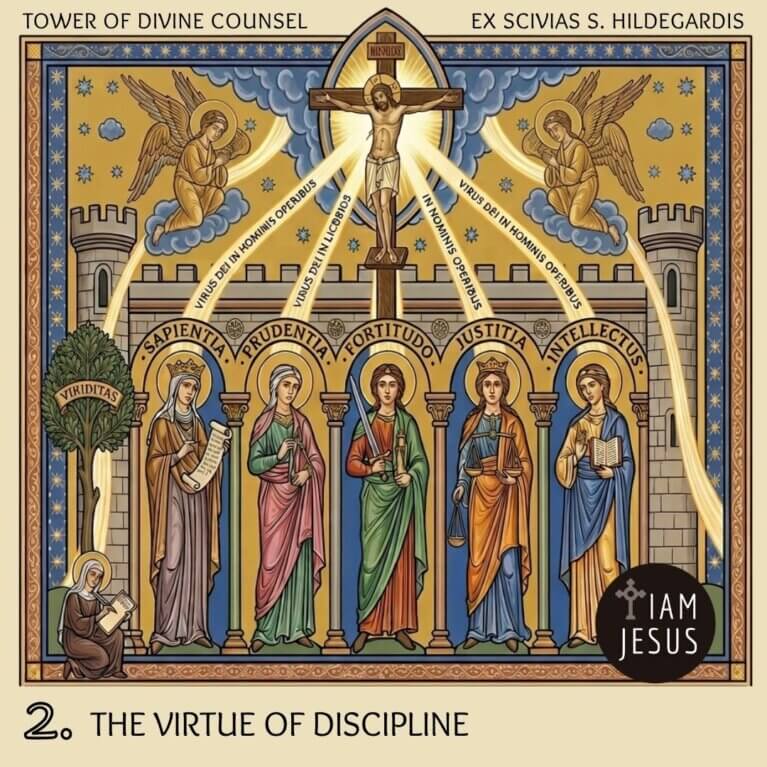
Developing Spiritual Discipline
To enter into true spiritual maturity, the soul must learn to quiet the chaotic impulses of the senses. Today, we step into St. Hildegard’s scriptorium to cultivate the virtue of discipline—the holy guard of custody over our desires—so we can break free from the trap of emotional, unrestrained behavior and anchor our will firmly in the peace of Christ in this second meditation from Part 1 of the Book of the Rewards of Life.
Opening Prayer
I need discipline, Lord. Today I am renouncing the vice of irrational exuberance. This is a struggle for me. I often do what I want and not what I should. I often make decisions without exercising good judgment. I think I can trust my judgment but I am often mistaken. I want the outcome I want, and I put my energy and effort into getting it without considering the consequences. But Lord, this is not how you desire me to operate. I need discipline. I need to be able to stop myself from doing the things I know I will later regret. Father, I need to have the virtue of discipline to keep me from falling into the same sins over and over again.
Jesus, you know my faults and how much I need discipline. I want true freedom from this irrational exuberance and all the attachments created through this vice. Lord, if you give me the virtue of discipline and help me overcome my unrestrained exuberance, I will start seeing myself through your eyes rather than my own. Help me see myself as destined for eternal life with you. I need discipline to view my life in the right light and act according to your will. I don’t want to be guilty of impudence.
The more I understand your love for me, the more aware I am that I need discipline. I have so many hidden sins. You see them all, and you know my heart. You know everything I lack.
I know that you love me and if I ask for the grace to change you will give it to me. You have been there with me during every irrational act I have committed in the heat of emotion. You have never betrayed me or forsaken me. Please, Lord, increase in me the virtue of discipline, so that I might overcome my tendency toward irrational behavior.
AMEN.
Temperance ensures the will’s mastery over instincts and keeps desires within the limits of what is honorable. The temperate person directs the sensitive appetites toward what is good and maintains a healthy discretion: “Do not follow your inclination and strength, walking according to the desires of your heart.”
Catechism, 1809
What is Irrational Exuberance?
In Catholic moral theology, irrational exuberance—often tied to the vice of impudence—is a state of emotional unrestraint where a soul blindly follows its sudden impulses, passing whims, or intense sensory desires without consulting reason or God’s law. It is a direct symptom of concupiscence, the wounded inclination left by original sin that causes our lower appetites to rebel against our higher intellect and will.
To conquer this chaotic state, a soul must actively cultivate the virtue of discipline, which is closely bound to the cardinal virtue of temperance. Acting as the spiritual architect of inner order, the virtue of discipline trains us to guard our senses and halt our impulses the very moment a temptation presents itself. By freely practicing this holy restraint, we quiet the emotional noise of the world, tame our unruly passions, and restore the rightful mastery of grace over the impulses of the flesh.
Man has the Knowledge of Good and Evil
and so has no Excuse
by St. Hildegard of Bingen
So you have the knowledge of good and evil, and the ability to work. And so you cannot plead as an excuse that you lack any good thing that would inspire you to love God in truth and justice. You have the power to master yourself and not want and take pleasure in injustice; you can punish yourself and flee from the illicit lusts you delight in, and so honor My martyrdom by fighting against your burning desires and bearing My cross in your body. And why have you this great power? So that you may avoid evil and do good. And you will answer to Me for your knowledge of good and evil, as you know yourself to be human. But you despise good and do evil, and burn with carnal desire; good seems grievous to you, and evil is easily awakened in you. And so you choose not to restrain yourself, but sin freely.
What did I not do for you when I, the Son of Man, suffered on the cross in frail flesh, and trembled in great anguish? Because of that, I require of you a self-martyrdom; you must suffer for the lusts of your flesh and your other unruliness, your illicit desires contrary to My will and the bad actions that come from them. And you cannot excuse yourself by saying you do not know your good from your bad actions.
St. Hildegard of Bingen, Scivias, Book 3, Vision 10, Chapter 2 (Trans. Hart/Bishop)
I Need Discipline to Overcome
My Irrational Behavior
St. Hildegard gives Impudence her own voice too. In her vision, she says:
“What good is something that makes a person laugh only moderately? The soul is filled with beautiful air that makes it sound like a symphony. But what human being can be mortal forever? Not one! Therefore, humans should be happy while they can be.”
Liber Vitae Meritorum, Part 1, Section 3, Para. 12, trans. Hozeski
And Discipline answers her directly:
“You are like the devil. You have the squalid humor of a jokester who should be blown away by the wind. You are like the worms that dig in the earth… I however, wear the girdle of sanctity and the mantle of honesty. I am the honorable offspring of the royal marriage of knowledge and justice.”
Liber Vitae Meritorum, Part 1, Section 4, Para. 13, trans. Hozeski
From Worldly Love to Impudence: Learning to Love Rightly
Notice how gently St. Hildegard moves us from last week into this one. She doesn’t say Impudence grows out of Worldly Love the way a wound festers into an infection—she simply says Impudence “accompanies” her, walking alongside her because a heart that has already chosen the world will, more often than not, simply do as it pleases (Liber Vitae Meritorum, Part 1, Section 68, Para. 81). Isn’t that exactly how our own early stumbles in the spiritual life tend to go? We don’t fall into one single sin and spiral downward in a straight line. We wander. We’re pulled toward the world in one moment and careless in the next, restless in a dozen small directions, because we haven’t yet learned what it truly means to love God above everything else. That’s this whole first Part of Hildegard’s vision—the slow, patient work of learning to love God rather than the world, one gentle correction at a time.
Look closely at what Impudence reaches for to defend herself: she says the soul is filled with “beautiful air… like a symphony.” She’s borrowing the language of breath—the same breath that belongs, in truth, only to the Holy Spirit. And St. Hildegard doesn’t let this pass quietly. Discipline answers her with that very same image, turned back on her: Impudence deserves to be “blown away by the wind”—because what she calls breath was never the Spirit’s breath at all. It was only empty wind, with nothing behind it, and empty wind cannot hold anyone up for long. This is worth holding onto as we walk through all thirty-five of these weeks together: every vice will try to borrow something real from God—His fire, His water, His breath, His green and growing life—and every time, it will turn out to be counterfeit, unable to bear the weight of what it claims. Ask the Lord this week to show you where you’ve mistaken empty wind for His true breath in your own soul.
Reflection:
What is the virtue of discipline? How can we turn away from unrestrained irrational exuberance and more closely imitate Jesus? Let’s look at the vice of impudence that tempts us against the virtue of discipline. By understanding what attacks this holy restraint, we can better recognize when we are being tempted against it.
Unrestrained exuberance is the opposite of discipline. It is irrational. It is also a destructive behavior that originates from an unhealthy attachment to something created, and it is a vice that has to be purified through the virtue of discipline. The soul with the vice of impudence will easily fall into situations that will later cause deep regrets. The only way to root it out is to cultivate the virtue of discipline, learning to do what is right and avoid what is wrong no matter what temptation is thrown at you. Just say no when the desire presents itself.
Irrational exuberance makes the soul dive into things without proper discipline or contemplation, and he will often justify the sin for the sake of his heart’s desires. The soul with unrestrained exuberance decides on a course of action and then begins that path without considering his relationship with God and whether God approves of his activities. He lacks discipline. He’s impudent.
The Desires Of the Heart
When the soul doesn’t remain disciplined to do what is right in God’s eyes, he puts all his energy into the desires of his heart. This leads him toward sin, like a trap. We are wired to live in obedience to God, so this vice causes man to seek his own counsel due to his evil inclinations, which cannot be trusted.
St. Hildegard writes in Liber Vitae Meritorum that those who lack discipline also lack reason. This is because they are entangled in the vanity of their sinful habits. This makes them irrational because they do not first test all of their actions to see if they are just. They just act according to their desires. They will hide their perverse actions in darkness and secrecy, lying to themselves to justify their sin and keeping it hidden completely from the faithful. They do this because they are not holy in any way, although some may pretend outwardly to be holy. The man with unrestrained exuberance is naked in God’s presence and knows it. He is without spiritual joy because he covets earthly and fallen things rather than eternal things. Deep down he knows this truth about himself and he knows that God knows it too, so he has deep loathing and shame.
Rupturing Our Relationship with God
When we sin it ruptures our relationship with God. When our sin is mortal, or of grave matter, committed with full knowledge, and with full consent, we have to first restore our relationship with God. Then he will give us the grace necessary for us to grow in virtue. We can do this by seeking his forgiveness. The next step to continue this restoration is to fix the damage that our sin has caused. For each soul the fix is unique and must be done in obedience to God’s will. It is best to do this through spiritual direction, if possible.
Exuberance is usually a sexual sin. If you lack discipline, you must learn to respond to your temptation quickly because it will build in strength the longer you hesitate. Your strength to fight decreases the longer you wait to respond to the temptation.
There are four stages of sexual sin. The first stage is desire, the second is deception, the third is disobedience, and the fourth is death. If you struggle with any kind of lust, you need to discipline yourself to respond when you begin the desire phase. Surrender your mind at the first thought and ask God for the virtue of discipline to overcome your exuberance. Do not allow yourself to succumb to the devil’s deception.
Gluttony can also be tied to exuberance. Eating is a response to desolation, and it is often rooted in a childhood wound. As with sexual sin, a person who suffers from gluttony ought to respond to the temptation immediately when the desire presents itself. Do not entertain the tempting thought. As with sexual sin, a person who suffers from gluttony ought to respond to the temptation immediately when the desire presents itself. Do not entertain the tempting thought; instead, immediately declare your reliance on the virtue of discipline.
Take Courage
God will give you the grace to be disciplined when you have confessed your sin of exuberance. Demons are encouraged by secrecy. We have to ask for help when we need it so that we are not secretly suffering demonic attacks. When we confess our sins to one another and the secret is told, the power of the demons is diminished. When these evil inclinations are confessed to a priest or a spiritual person who can be trusted, we will have the grace to overcome the desolation.
Never keep secrets. Always tell someone holy and trusted who can help you overcome your sinful habits. The enemy of our souls looks for areas in our lives where we lack virtue and this is where the enemy attacks us. If we are weak in the present moment this is where he attacks. When we remain disciplined and close to God it weakens the enemy. Sexual sin destroys attentiveness to God’s commands and ultimately prevents salvation.
The Bible says: “For the grace of God has appeared, saving all and training us to reject godless ways and worldly desires and to live temperately, justly, and devoutly in this age, as we await the blessed hope, the appearance of the glory of the great God and of our savior Jesus Christ, who gave himself for us to deliver us from all lawlessness and to cleanse for himself a people as his own, eager to do what is good” (Titus 2:11-14).
Going Further:
If you have not yet made a public confession of your sin of exuberance, you can begin by preparing. You can confess your sin to God privately. You can begin by taking some time this week to prayerfully read Psalm 51 and then journal about it in a prayer to God. When you are forgiven you can throw away your confession. Once it is confessed it is forgotten by God. If you confess your sins he is faithful and just to forgive you your sins. God loves you deeply and completely. There is no sin too great for the mercy of God. Just open your heart and come out of the secrecy and confess it once and for all. God wants to restore you and heal you and help you grow in the virtue of discipline.
Grounding the Erratic Impulses:
Take a moment to pause, quiet your mind, and settle into the absolute stillness of this adoration chapel. Irrational exuberance is a subtle, deceptive trap of the ego—an exhausting pattern of emotional highs, chaotic impulses, and scattered focus that pulls us away from steady spiritual progress. When we allow our senses to run wild without restraint, we lose our interior peace and substitute temporary emotional excitement for true devotion. Before we open the Word of God, let us offer up a sincere prayer of petition—asking for the profound humility to master our impulses, guard our senses, and anchor our souls in holy discipline.
Prayer For Spiritual Discipline
Lord Jesus Christ, You are the perfect model of order, restraint, and absolute obedience to the Father’s will, yet You know the scattered, restless, and undisciplined corners of my heart. I confess that I have often succumbed to the spirit of irrational exuberance—letting my emotions rule my actions, chasing passing spiritual highs, and neglecting the steady, quiet duties of a faithful life. Forgive me for the times I have left my senses unguarded and allowed external distractions to rob me of Your presence. I cannot master my chaotic impulses by my own fragile willpower. I desperately need the cleansing fire of Your grace.
Holy Spirit, come and bring holy order to my restless soul. Grant me the supernatural virtue of discipline. Teach me to practice a strict custody of my senses, closing my eyes and ears to vanity so that I may listen only to Your voice. When sudden impulses, emotional instability, or the urge to wander flare up this week, catch my thoughts and anchor my mind in eternal truth. Grant me the grit to remain steadfast in prayer even when I feel dry or uninspired, turning my daily life into a beautifully ordered sanctuary that honors Your presence.
AMEN.
Take a slow, intentional breath. Let the weight of your petition rest in the hands of the Father, and step away from the chaotic impulses that so easily pull you away from Him. You have asked for the grace of discipline; now, prepare your heart to receive it in the absolute stillness of His presence.
As you slowly read the Gospel, picture Jesus sitting right beside you, looking at you with a love that sees your struggles and desires to heal them. In this parable, watch how the master pursues the hesitant, the broken, and the wandering souls. Don’t rush through the words. If a single phrase strikes your heart, linger there. Let the Holy Spirit steady your mind, quiet your desires, and show you how to joyfully answer His invitation to the great feast.
The Parable of the Great Feast
from the Gospel of Luke Chapter 14
One of his fellow guests on hearing this said to him, “Blessed is the one who will dine in the kingdom of God.”
[Jesus] replied to him, “A man gave a great dinner to which he invited many. When the time for the dinner came, he dispatched his servant to say to those invited, ‘Come, everything is now ready.’
But one by one, they all began to excuse themselves. The first said to him, ‘I have purchased a field and must go to examine it; I ask you, consider me excused.’
And another said, ‘I have purchased five yoke of oxen and am on my way to evaluate them; I ask you, consider me excused.’
And another said, ‘I have just married a woman, and therefore I cannot come.’
The servant went and reported this to his master. Then the master of the house in a rage commanded his servant, ‘Go out quickly into the streets and alleys of the town and bring in here the poor and the crippled, the blind and the lame.’
The servant reported, ‘Sir, your orders have been carried out and still there is room.’
The master then ordered the servant, ‘Go out to the highways and hedgerows and make people come in that my home may be filled.
For, I tell you, none of those men who were invited will taste my dinner.’”
Let us Pray:
Jesus, in your mercy you have provided me with a just judgment for the sins I have committed in my life. My lack of discipline has caused me to sin against you habitually. You have intervened in my life and made me come in so that I might be saved. I thank you for this grace, even though it has come to me through suffering.
God, you are a good Father and you love me. When I am stuck in a destructive sin, you will intervene and sometimes you may take my temptations to sin away from me by making it impossible for me to continue doing them. I understand that sometimes your justice comes as an illness or other chastisement that makes me physically incapable of committing vices that I would otherwise never voluntarily leave.
You can take away any vice from your children who are praying for help, like the souls in the parable. You sought them out in the highways and hedgerows. You made them come in. These are the souls of reluctant Christians who are stuck in their sin and loathing themselves. You compel them by circumstance through your mercy to come to the great feast, and because their hearts are not hard, they come reluctantly, not fully believing they are welcome, still very much ashamed and loathing themselves.
Broken and unable to resist, I come to the feast right now because I have no other recourse and I need your grace. Please, Lord, I accept your invitation. Heal me of my sins against discipline, grant me an increase in the virtue of discipline, and give me the grace to grow in holiness.
Jesus, keep me in your name. Protect me and guard me from the vice of unrestrained exuberance. Do not let me be lost. Do not let me be like those who were invited but refused to come and taste your dinner. Please protect me from my sinful habits. Give me the discipline to resist the temptation in the moment of desire. Help me remember this scripture passage. I do not want to be lost. I want to be one with God in my heart, mind, and through my actions.
I need discipline. Consecrate me in the truth. Send me, Lord, into the world and help me be one with the Holy Trinity and with my brothers and sisters in Christ.
Jesus, you are a gift to me. Thank you for being present to me. Give me the grace to be present to you and to grow in the virtue of discipline. AMEN.
A Prayer for an Increase in Virtue for Others
Lord Jesus Christ, you say that when two or more are gathered in your name, you are with us. Jesus, in your name I lift up every person who has joined this prayer challenge or will join it in the future. I ask you to give us all the grace we need to grow in virtue and holiness so that we may love and serve you in our lives and through the people we love and care for. Help us in our thoughts, our words, and our actions. Guide us all by your Holy Spirit and give us the strength to overcome every temptation from the evil one. We ask all this in the name of the Father, and of the Son, and of the Holy Spirit, AMEN.
Striking a Divine Balance: Your Week 2 Send-Off
You’ve spent this hour giving your chaotic impulses over to God and studying St. Hildegard’s warnings. Now it’s time to practice it. Discipline isn’t a spiritual punishment or a rigid rulebook; it is the key to your mental and emotional freedom. God gives you the grace here in adoration, but He expects you to actively manage your daily habits.
When you leave this chapel and walk back into your life filled with constant notifications, stress, and distractions, remember your dignity. You are an eternal soul, not a slave to passing moods, impulses, or physical cravings. You are a child of God destined for eternal life. Protecting your soul requires discipline. To see how God expects us to master our instincts before they master us, look at the baseline standard laid out in Sacred Scripture:
Therefore, since we are surrounded by so great a cloud of witnesses, let us rid ourselves of every burden and sin that clings to us and persevere in running the race that lies before us while keeping our eyes fixed on Jesus, the leader and perfecter of faith. For the sake of the joy that lay before him he endured the cross, despising its shame, and has taken his seat at the right of the throne of God.
Consider how he endured such opposition from sinners, in order that you may not grow weary and lose heart. In your struggle against sin you have not yet resisted to the point of shedding blood.
You have also forgotten the exhortation addressed to you as sons: “My son, do not disdain the discipline of the Lord or lose heart when reproved by him; for whom the Lord loves, he disciplines; he scourges every son he acknowledges.”
Endure your trials as “discipline”; God treats you as sons. For what “son” is there whom his father does not discipline? If you are without discipline, in which all have shared, you are not sons but bastards. Besides this, we have had our earthly fathers to discipline us, and we respected them. Should we not [then] submit all the more to the Father of spirits and live? They disciplined us for a short time as seemed right to them, but he does so for our benefit, in order that we may share his holiness.
Hebrews 12:1-10
Make a Resolution
Take a moment to reflect on the virtue of discipline. What are the ways you can freely practice this virtue this week? Ask the Lord to give you opportunities, and when you feel the Holy Spirit prompting you, take action. Write down your resolutions for this coming week in your prayer journal. Remind yourself to complete these resolutions daily for this entire week, and as the Spirit prompts you, feel free to write about your experiences with this virtue throughout the week.
In My Thoughts:
Jesus, this week I promise to take time daily to conform my thoughts by… (make your intention).
In My Words:
Jesus, this week I promise to take time daily to conform my words by… (make your intention).
In My Actions:
Jesus, this week I promise to take time daily to conform my actions by… (make your intention).
Join our Virtue Meditation Prayer Challenge
Don't let spiritual overwhelm hold you back!
Let us guide you step-by-step through Saint Hildegard’s transformative path to holiness.
Receive one long-form meditation in your inbox each week—perfect for a powerful 35-minute holy hour.

One Response
Am grateful in how to more disciplined in our lives journey of life