

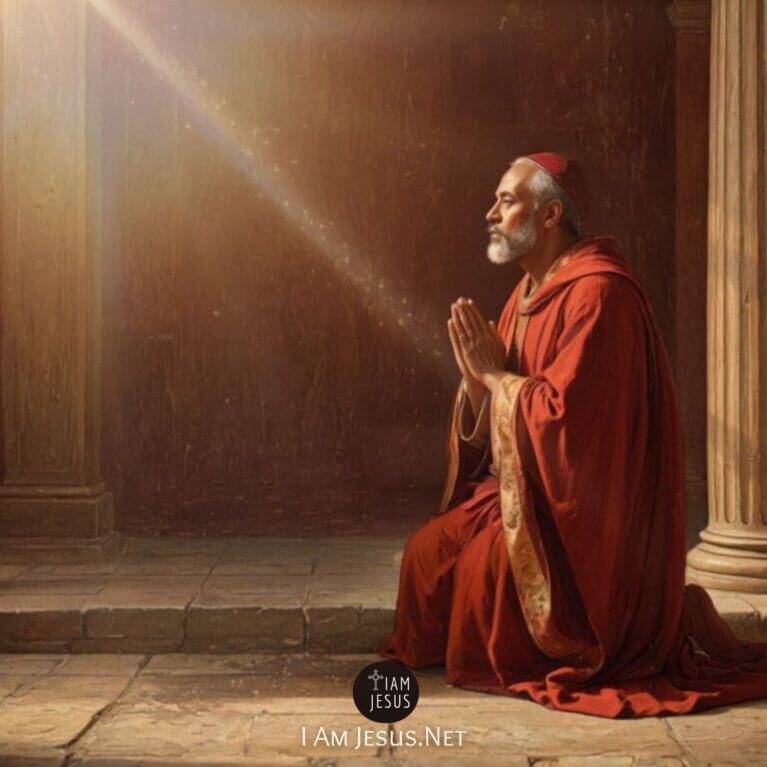
The prayer to Our Almighty Father was written inside a letter by St. Augustine of Hippo to Anicia Faltonia Proba, who was a wealthy Roman widow known for being a devout Christian.
St. Augustine describes Anicia Proba in the letter as, “a widow, rich and noble, and the mother of an illustrious family”. She writes him after being disturbed by a passage in Romans 8:26 that says, “we know not what we should pray for as we ought” and asks how to pray.
We Don’t Pray as we Should Because We Don’t Like to Suffer
He explains to her that people don’t know how to pray as we should because humans are faced with tribulations that are hard and painful. He says these trials go against “the natural feelings of our weak nature” and explains to Proba that this weak nature makes us want to pray that God will remove tribulations from us. This is a problem because sometimes tribulations are beneficial to our souls.
St. Augustine says we must learn to submit to the will of God when we are faced with these trials, and then remain faithful throughout them. He tells her that we can’t think we are abandoned by God because he doesn’t remove a trial from us. St. Augustine tells Proba to patiently endure the evil because God’s strength is perfected in our weakness. Then he teaches her the Prayer to Our Almighty Father.
Why Pray St. Augustine’s Prayer to Our Almighty Father
This prayer by St. Augustine helps the soul recognize the need to surrender to the will of God in all things, trusting in his providence and Fatherly protection. It recognizes that God knows best and cares for our spiritual good, and sometimes this means suffering trials that help us grow in virtue. The prayer opens our hearts to love God and asks him to help us do this properly so that our hearts and ears are open to his voice.
Prayer to Our Almighty Father asks God not to hide his face from us, as is written in Psalm 27:
The name of the Savior God was invoked only once in the year by the high priest in atonement for the sins of Israel, after he had sprinkled the mercy seat in the Holy of Holies with the sacrificial blood. The mercy seat was the place of God's presence. When St. Paul speaks of Jesus whom "God put forward as an expiation by his blood," he means that in Christ's humanity "God was in Christ reconciling the world to himself."
CCC 433
Prayer to Our Almighty Father
by St. Augustine of Hippo
Almighty Father,
Come into our hearts, and so fill us with Thy love that forsaking all evil desires, we may embrace Thee, our only good. Show us, O Lord our God, what Thou are to us. Say to our souls, I am your salvation, speak so that we may hear. Our hearts are before Thee; open our ears; let us hasten after Thy voice. Hide not Thy Face from us, we beseech Thee, O Lord. Open our hearts so that Thou may enter in. Repair the ruined mansions, that Thou may dwell therein. Hear us, O Heavenly Father, for the sake of Thy only Son, Our Lord Jesus Christ, who lives and reigns with Thee and the Holy Spirit, one God now and forever.
AMEN.

St. Augustine on Prayer
“It is our duty to ask without hesitation for ourselves and for our friends, and for strangers — yea, even for enemies; although in the heart of the person praying, desire for one and for another may arise, differing in nature or in strength according to the more immediate or more remote relationship.
But he who says in prayer such words as, O Lord, multiply my riches; or, Give me as much wealth as You have given to this or that man; or, Increase my honours, make me eminent for power and fame in this world, or something else of this sort, and who asks merely from a desire for these things, and not in order through them to benefit men agreeably to God’s will, I do not think that he will find any part of the Lord’s Prayer in connection with which he could fit in these requests.
Wherefore let us be ashamed at least to ask these things, if we be not ashamed to desire them. If, however, we are ashamed of even desiring them, but feel ourselves overcome by the desire, how much better would it be to ask to be freed from this plague of desire by Him to whom we say, Deliver us from evil!” Letter 130, Chapter 12