St. Hildegard of Bingen (1098-1179)
St. Hildegard of Bingen was a rare historical figure from the Middle Ages. She lived at a time when the Scriptures were neglected, clergy were lukewarm, and Christian people were poorly catechized. St. Hildegard wrote nearly 400 letters in her 81 years. She was a distinguished theologian who wrote commentary on Scripture and the Rule. She also was highly educated in natural medicine, and was known as a healer.
I Am Jesus website has a Big List of Virtue Meditations based on the work of St. Hildegard of Bingen’s writings. We encourage you to try our weekly mental prayer meditations on her writings, which also feature excerpts from the Catechism and select Gospel readings.

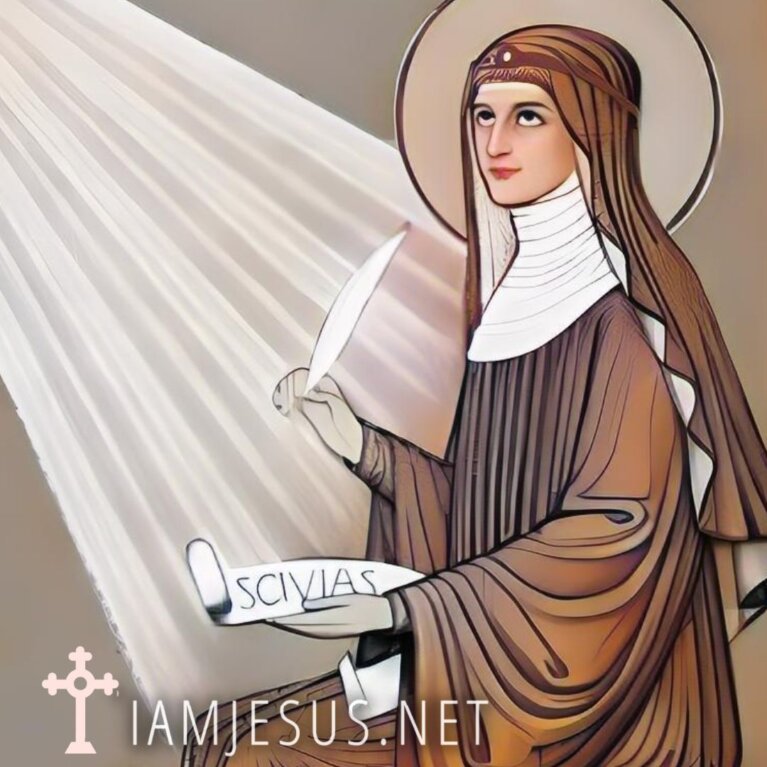
Remarkably, St. Hildegard was also an accomplished poet, musician, dramatist, and preacher. Her work, Scivias (Know the Ways of the Lord), took a decade to complete and she gave a copy to Pope Eugenius III who gave her a papal seal of approval after having read the unofficial copy. The book is a prophetic proclamation of allegorical visions, an exegetical study, a theological summa. It is also a multimedia work that combines illumination, music, and drama to enhance the message it contains. St. Hildegard likely worked with scribes who would have created the iconic images in Scivias under her personal direction.
Early Years of St. Hildegard's Life
St. Hildegard first had visions at age three, but it was not until she was five that she understood that they were sent from God.
When she was eight years old, she was offered by her family as an oblate to the church where she became the pupil of a nun named Jutta von Sponheim whom she lived with. Jutta was an anchoress and the abbess of a Benedictine monastery in Disibodenberg, in what is now Germany. Jutta taught St. Hildegard to read and write, pray the psalms in Latin, and shared botanical knowledge with her while gardening together. St. Hildegard learned to play the psaltery (harp), which led her to learn more about music, eventually composing her own songs.
She became a nun at the age of 15 and died at age 81.
Her Mystical Visions
St. Hildegard’s vision field always had a strange luminosity that she called “the reflection of the living light.” In this light she would experience mystical visions that included human forms and architectural models and she interpreted them with the help of a “voice from heaven.” Though she was unable to describe exactly what she saw, she said that she was able to experience the light of God through all five of her senses. She reported being “fully awake in mind and body” and without any impairment of her normal sense functioning. This meant that she was not suffering from seizures, ecstacies, or trance-like states when she experienced these visions.
Her prophetic call came in 1141 when she experienced a fiery light that permeated her entire heart and brain. This light gave her infused knowledge of all the books of Scripture. She explains that this gift came to her not by her own merit but because the time in which she lived was a desperate time for the Church.
St. Hildegard became famous for her charisms and this caused her to develop regular correspondences with dignitaries and pilgrims from the outside world. She would confidently rebuke princes, bishops and popes if she believed their actions were wrong.
St. Hildegard could foretell the future due to infused knowledge from God. This allowed her to understand a remarkable amount of information. In total, she had 26 visions. She wrote hundreds of letters to kings and popes with prophecies and warnings.
She built a large monastery with running water for her and the other nuns. While St. Hildegard was revered as a saint for centuries and listed as a saint in the Roman Martyrology, she was not officially canonized until 2012, 833 years after her death. She is the patron saint of ecology, musicians, and writers.
Life as a Benedictine Nun
The works of St. Hildegard are compiled in three volumes: first, musical compositions used for liturgy, as well as a musical morality play entitled Ordo Virtutum; second, nearly 400 letters written to popes, emperors, abbots and abbesses – one of the largest collections to have survived the Middle Ages, including sermons she preached through the 1160’s and 1170’s; and third, material relating to natural medicines and cures, information she gathered through her experience gardening and tending to the sick.
St. Hildegard’s visionary theology covered many religious topics. Her book Scivias, is concerned with salvation history from the beginning of creation until the final judgement. Toward the end of her life, St. Hildegard commissioned the Scivias to be decorated with artwork depicting the visions. This work survived the ages but while being stored in Dresden for safekeeping during WWII, the book was lost after an evacuation. The only remaining version is a hand-painted copy from the 1920’s.
The music written by St. Hildegard was mainly for use in liturgy and chanting. However, one of St. Hildegard’s greatest works is a morality play entitled Ordo Virtutum, which has parts for the human soul, sixteen virtues, and even the voice of the devil. In her other works, St. Hildegard often wrote of the Virgin Mary and the saints who gave her great inspiration.
St. Hildegard’s understanding of the natural world came from the story of creation, in which God tells man to rule over and subdue his creation. She believed in the healing properties of many items found in nature because God had made them to provide health to mankind. She read many books and did experiments with the herbs and various plants she grew, learning as much as she could and recording her observations. Many of her writings show an understanding of disease, illness, and health uncommon for her time. She wrote of home remedies to treat common ailments, how to treat agricultural injuries such as cuts, burns, fractures, and dislocations, and she stressed the importance of preventing infections by boiling water before use.
Hildegard's Mystical Theology Explained
As a result of a lifetime of mystical visions, St. Hildegard’s theology takes shape in a deep and profound way. St. Hildegard’s work revolves around the opinion that humanity was redeemed by Christ, who assumed our human nature in order to reconcile us to God. In this view, God places sinful humanity against his heart with divine love, restoring his creatures who repent of their misdeeds to new life. These redeemed souls, in St. Hildegard’s view, will replace the “tenth choir” of angels that fell with Lucifer.
Her teachings move the reader seamlessly from the realm of daily life into the invisible heavenly reality. This movement from microcosm to macrocosm takes place through the liturgy. St. Hildegard uses the sung prayers and rituals of her religious community to prompt us to realize the cosmic significance of each of our mundane actions in the Mass. St. Hildegard shows us that through our worship we can actually transform the world and purify it. This will hasten its consummation in the new heavens and new earth.
St. Hildegard teaches us that our level of worship deeply matters on a cosmic level. The status of our hearts in relation to our love of God and desire for holiness can make or break us. She warns Christians of this fact through a typology she creates of various kinds of communicants. There are five types of Mass attenders who present themselves for holy Communion in her vision: faithful believers, those who disbelieve, those who are lustful or guilty of the sins of the flesh, those who are envious and full of malice, and those who are warlike and oppress others. She warns that those who communicate in the Mass will either gain eternal salvation or will be contribute to their own judgment depending on the state of their soul when they receive Christ.
She explains that humans are valiant and meritorious soldiers of God because they have to battle against their own fallen natures. She teaches that people must work with great constancy by avoiding evil and doing good through proper worship of God. She says, “it is right that the Creator of all things should, before and above everything, be worshipped worthily as God. Thus, our salvation requires the active participation of our free will as members of the army of God.”
This is why her work focuses deeply on proper worship and on Christians learning how to live a virtuous life. In short, our moral knowledge must be reflected in the way we live our lives. If we want to be saved we must imitate Christ and live our lives through good works and living righteously.
St. Hildegard’s Teaching on Virtue
The virtues are vital throughout her theological lessons. They are not just qualities that humans must obtain in life, but rather they are “brilliant stars given by God, which shine forth in human deeds.” What does she mean, exactly? To understand we look at the Latin word viriditas which means greening power and the idea of virtue as a divine quality. So in a nutshell, when we pray and ask the Holy Spirit to give us the grace to have the energy or power to develop a divine quality by our human will, God responds by generously giving us the energy and power necessary to help us perform right actions that please him.
Virtues don’t just spontaneously happen in a person, and we certainly cannot become virtuous without the help of God. This is why it is prudent for you to pray for the grace to be virtuous. Through prayer and consent of your own free will, St. Hildegard believes sinful habits and vices can be overcome and replaced with corresponding virtuous habits and qualities.
St. Hildegard teaches us that we have to cooperate with God to receive the power we need to overcome the vices we have. Through God’s grace we receive the energy we need to grow in the virtue that counteracts the vice we are trying to conquer. This is how we overcome the wickedness and snares of the devil. She explains that it is not enough for believers to have faith in God. Through their dedication to growing higher and higher in virtue the man will grow like a “flourishing palm tree, from virtue to virtue, and by these virtues his righteous faith is exalted and adorned as bulwarks do a city.”
In summary, St. Hildegard states that the only way to defeat evil is through the soul’s conformity to God’s will by obedience. God tells St. Hildegard that “both the elect and the reprobate are subjected to a just scrutiny and examined most diligently and strictly on their obedience to My precepts; and all should trust Me to feed them in all their needs.”
Her Equivalent Canonization
On October 7, 2012 Pope Benedict XVI issued an apostolic letter on the life and works of St. Hildegard of Bingen. In this letter Pope Benedict XVI confirmed a decision made in consultation with the Congregation for the Causes of Saints to make Hildegard of Bingen, a professed nun of the Order of Saint Benedict, to be an official canonized saint and Doctor of the Universal Church.
In this same letter he stated: “In Saint Hildegard of Bingen there is a wonderful harmony between teaching and daily life. In her, the search for God’s will in the imitation of Christ was expressed in the constant practice of virtue, which she exercised with supreme generosity and which she nourished from biblical, liturgical and patristic roots in the light of the Rule of Saint Benedict. Her persevering practice of obedience, simplicity, charity and hospitality was especially visible. In her desire to belong completely to the Lord, this Benedictine Abbess was able to bring together rare human gifts, keen intelligence and an ability to penetrate heavenly realities.”
St Hildegard of Bingen’s Feast Day is the 17th of September. She is the Patron Saint of ecology, musicians and writers. Learn about her life and works here. Enjoy listening to ten of the Scivias songs she composed in honor of the saints by clicking on the video below:
Discover the Lives of More Mystical Saints
The path to holiness is paved by those who walked before us. Dive deeper into our collection of inspiring biographies, mystical visions, and heroic testimonies to find holy role models who can guide your own daily walk with Jesus.