
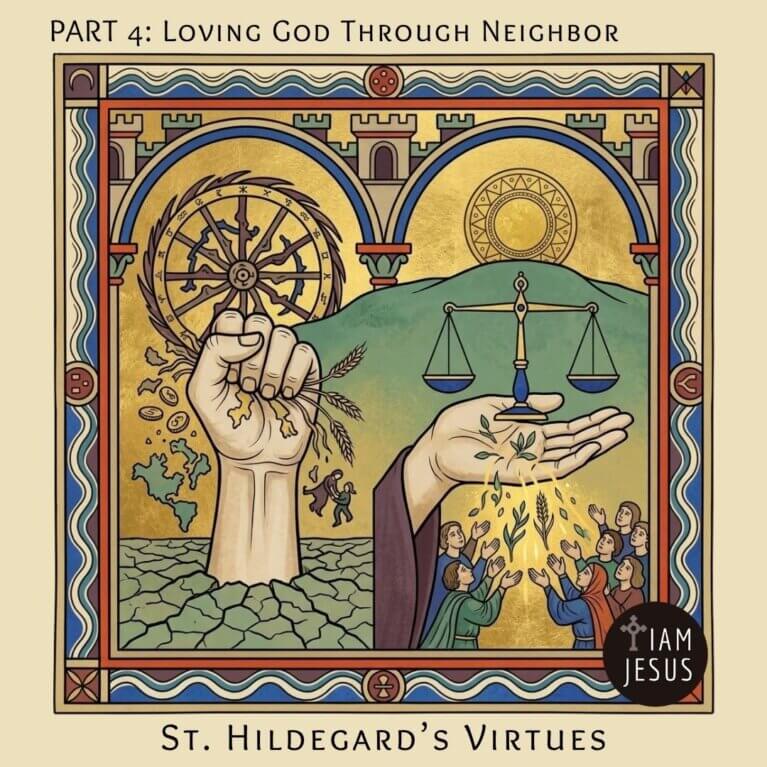
Eight Virtue/Vice Pairings For Loving God Through Neighbor
We continue with Part 4: the windows and doors to the world around us are built through our love of neighbor, and once we have come to love God over the world and ourselves, and are aligned with His will, we are ready to bear good fruit. On this page, we will unpack the surface-level, theological, symbolic, and mystagogical meaning in the fourth part of St. Hildegard of Bingen’s Liber Vitae Meritorum.
Surface Level
The Eight Pairs and the Chain of Stewardship
Parts 1 through 3 traced the journey of disordered love inward—into the heart, the self, and the will. Part 4 turns the camera outward. Now we see what that interior disorder does to the world around us: to our neighbors, our communities, our institutions, and the created order entrusted to our care. The gateway vice of Part 4 is Injustice—not a personal failing hidden in the heart, but a failure in right relationship, a refusal to give others what they are owed.
From Injustice, the chain moves through Numbness (the moral conscience gone quiet), Forgetfulness (the soul that has lost track of what it owes), Changeableness, Care of Earthly Things, Obstinacy, and Desire, until it arrives at Discord—the most cosmically ambitious vice in the entire book, a vice that does not merely fail in one area but claims to invert all right relationship simultaneously, like a wheel spinning free of its axle.
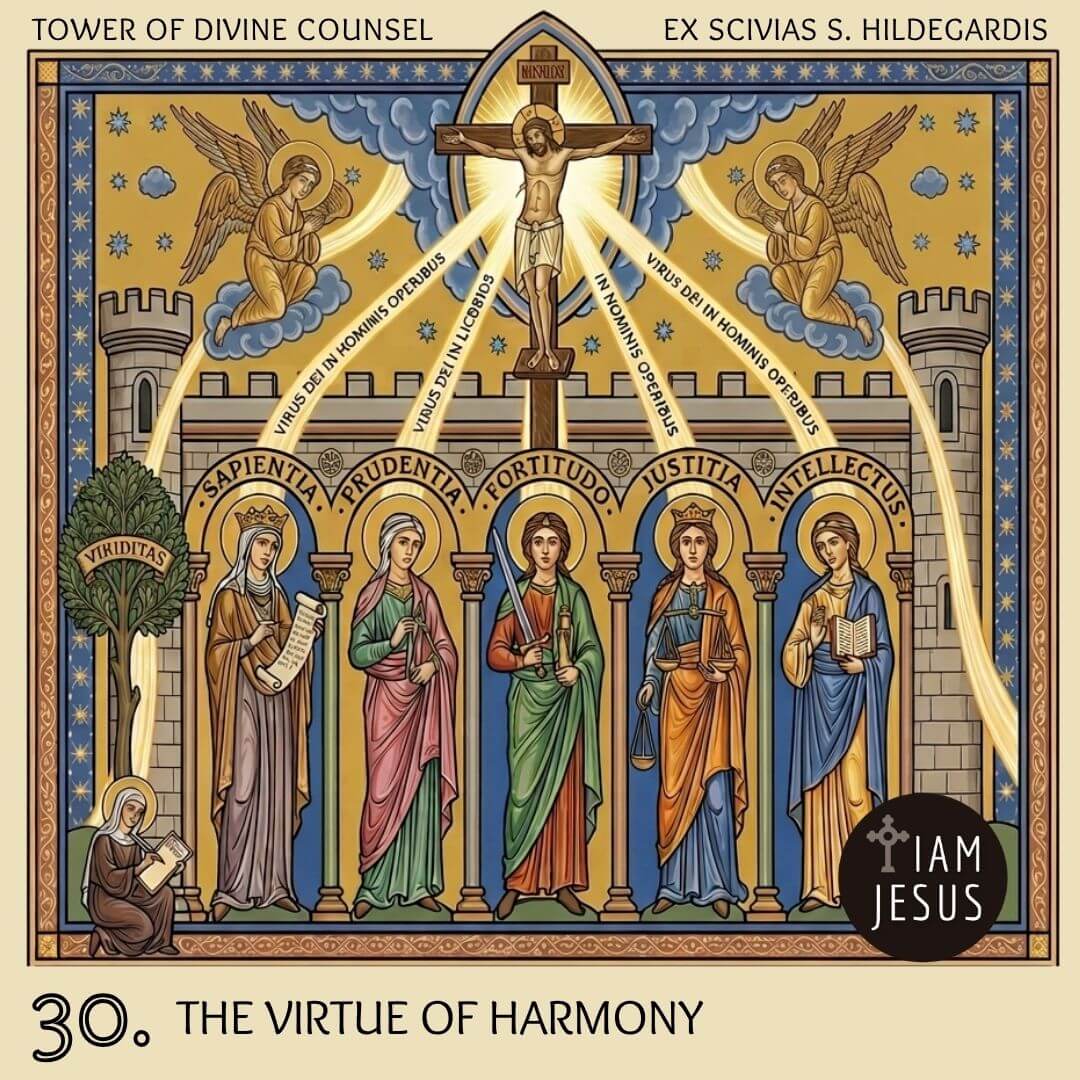
Eight virtues answer this chain: Justice, Strength, Holiness, Steadiness, Heavenly Desire, Sorrow of the Heart (Compunction), Contempt of the World, and Concord. Together they are a portrait of a soul that has learned to hold what it has been given with open hands—serving freely, living consistently, and discovering that the joy of the steward who gives well is deeper than any joy the hoarder ever finds. These eight meditations will show you what it looks like to love God through the people and the world he has placed in your care.
Theological Level
Justice, Stewardship, and Catholic Social Teaching
Part 4 is where St. Hildegard’s vision intersects most directly with Catholic social teaching—the Church’s sustained reflection on how the virtues of the interior life must express themselves in the ordering of human community. The Catechism of the Catholic Church defines justice as “the moral virtue that consists in the constant and firm will to give their due to God and neighbor” (CCC 1807). Justice, in this tradition, is not a feeling or an aspiration but a firm will— exactly what St. Hildegard places at the gateway of Part 4.
When justice fails at the root, the entire chain of communal life begins to tilt: moral sensitivity dulls (Numbness), memory of obligation fades (Forgetfulness), commitment wavers (Changeableness), earthly goods crowd out eternal ones (Care of Earthly Things), resistance to correction hardens (Obstinacy), and disordered desire fills the space where justice used to stand (Desire). Discord, the terminus, is the social and cosmic expression of all of this together: a world in which no one is giving anyone their due, and every relationship has been inverted.
Saint Augustine’s City of God is directly relevant here: he describes the earthly city as precisely the civilization in which justice has been dethroned and self-interest has taken its place. Part 4’s chain is that argument made visible in St. Hildegard’s visionary register—and Part 4’s virtues are the portrait of what the City of God looks like when it is being built, one act of just stewardship at a time, by souls who have learned to give what they have been given.
A Note to Watch For
Notice what’s different this time. In Part 3, we only saw him—a fiery face, described from a distance, and silent. Here, for the first time since Part 2, we hear his voice again—speaking against Discord, not against you: “I will cast you down and blot you out with the fortitude of God, just as the devil was cast down when the light first began” (Liber Vitae Meritorum, Part 4, Section 17, Para. 25). His fire is aimed at the vice, not at the soul struggling against it. Look closely at his weapon: Fortitude. This is the very virtue you developed in Week 24, to answer Torpor. This is no accident. Zeal of God doesn’t fight for you with some power you’ll never touch—he fights with the same strength he’s already been growing in you through your cooperation with grace. That same Fortitude is your weapon to yield throughout your spiritual ascent, and as we see here, Discord cannot stand against it when the Zeal of God rushes in to fight for you. Christ, as Zeal of God is truly making himself known to you in an intimate way in Part 4.
Symbolic Level
The Wheel, the Sun, and the Fruits of the Earth
Part 4’s most striking symbolic image belongs to Discord, the terminus vice: “I turn everything upside down,” she says, “like a wheel.” This is the image of cosmic disorder—not one relationship broken, not one institution failing, but all of them spinning free of their proper order simultaneously, the way a wheel without an axle spins in any direction with no coherent motion. Discord does not merely disrupt; she claims to have overturned everything at once.
Concord, the virtue that answers her, offers the opposite image: the sun that cannot be extinguished. “You cannot blot out the sun and the stars, can you? No. For the brightness of the sun tramples you under foot like dust.” This is St. Hildegard’s symbolic confidence in the permanence of God’s order—not because human beings always maintain it, but because the source of that order is beyond any vice’s reach. Discord can scramble and invert, but she cannot put the sun out.
Throughout Part 4’s meditations, watch for the imagery of earth and fruit—specifically the contrast between stewardship that bears fruit and hoarding that leaves the ground barren. St. Hildegard’s four-elements framework is at work throughout this Part in the imagery of the earth element: soil that is tended produces abundance, while soil neglected or exploited becomes arid and fruitless. Every act of just stewardship is, in her symbolic language, an act of cultivation. Every act of injustice is an act of depletion.
Mystagogical Level
The Steward Who Builds the City of God
At the deepest level, Part 4 is about participation—the soul’s participation in something larger than its own interior life. The Augustinian tradition that formed St. Hildegard teaches that the City of God is not built by God alone but by souls who have learned to love what God loves and to give what God gives: freely, generously, and without clutching at what passes through their hands.
In the tradition of Catholic mysticism, the soul that has journeyed through Parts 1 through 3—whose love has been reoriented toward God, whose self has made room for something greater, whose will has surrendered—is now ready to become an instrument of God’s love in the world. Part 4 is the outward expression of that interior transformation. Justice, Holiness, Steadiness, and Concord are not merely moral obligations; they are the way a surrendered soul leaves its mark on creation — building, one just act at a time, the City that St. Augustine described and St. Hildegard saw.
The bridal mysticism dimension of Part 4 is perhaps the least obvious but the most profound: the bride who has found her Bridegroom does not retreat into private happiness. She goes where he goes, loves what he loves, and gives what he gave—which is everything. Part 4’s eight meditations are an invitation to discover that loving God through neighbor is not a reduction of the love story. It is its fullest expression in the world.
Why These Virtues, Specifically, Build the City of God
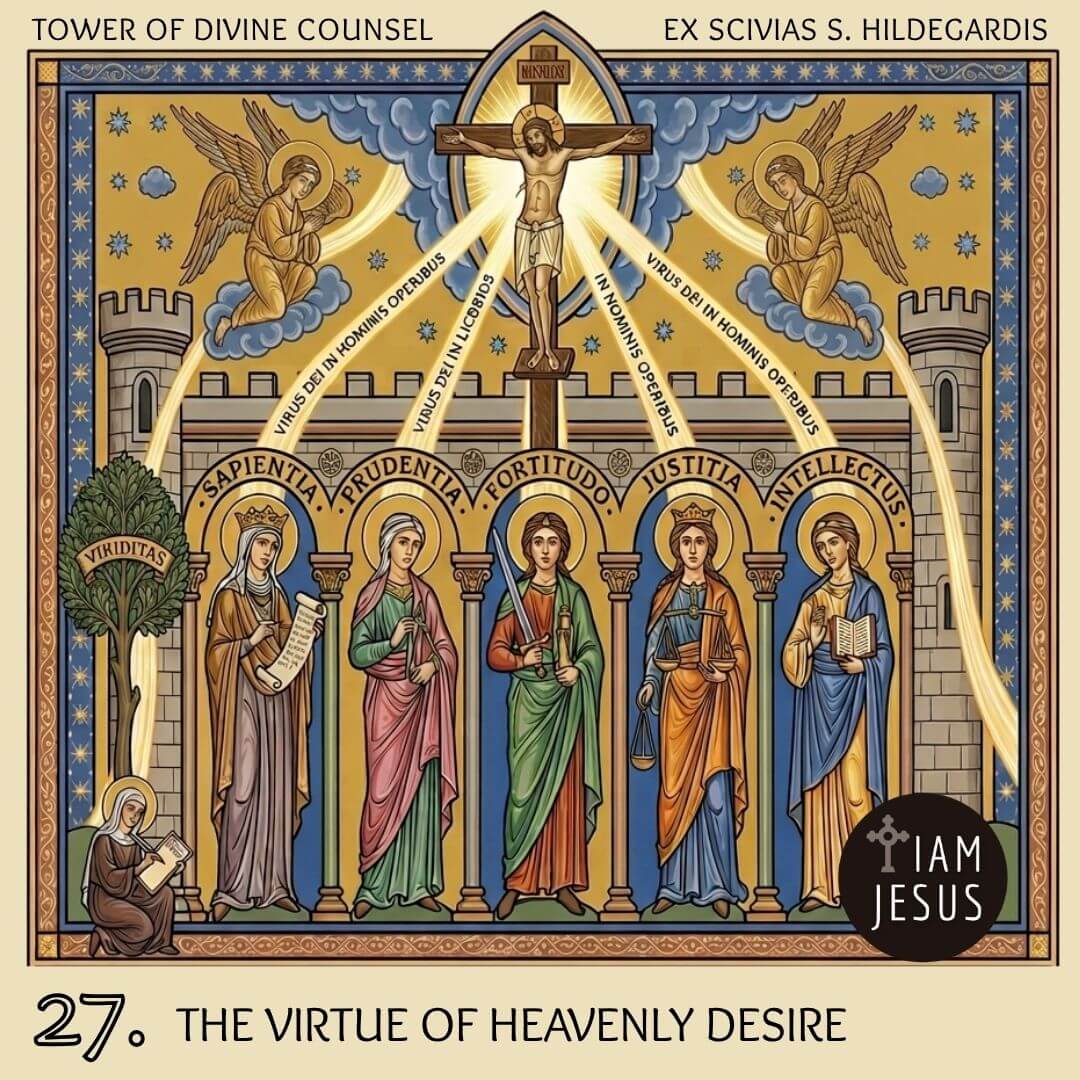
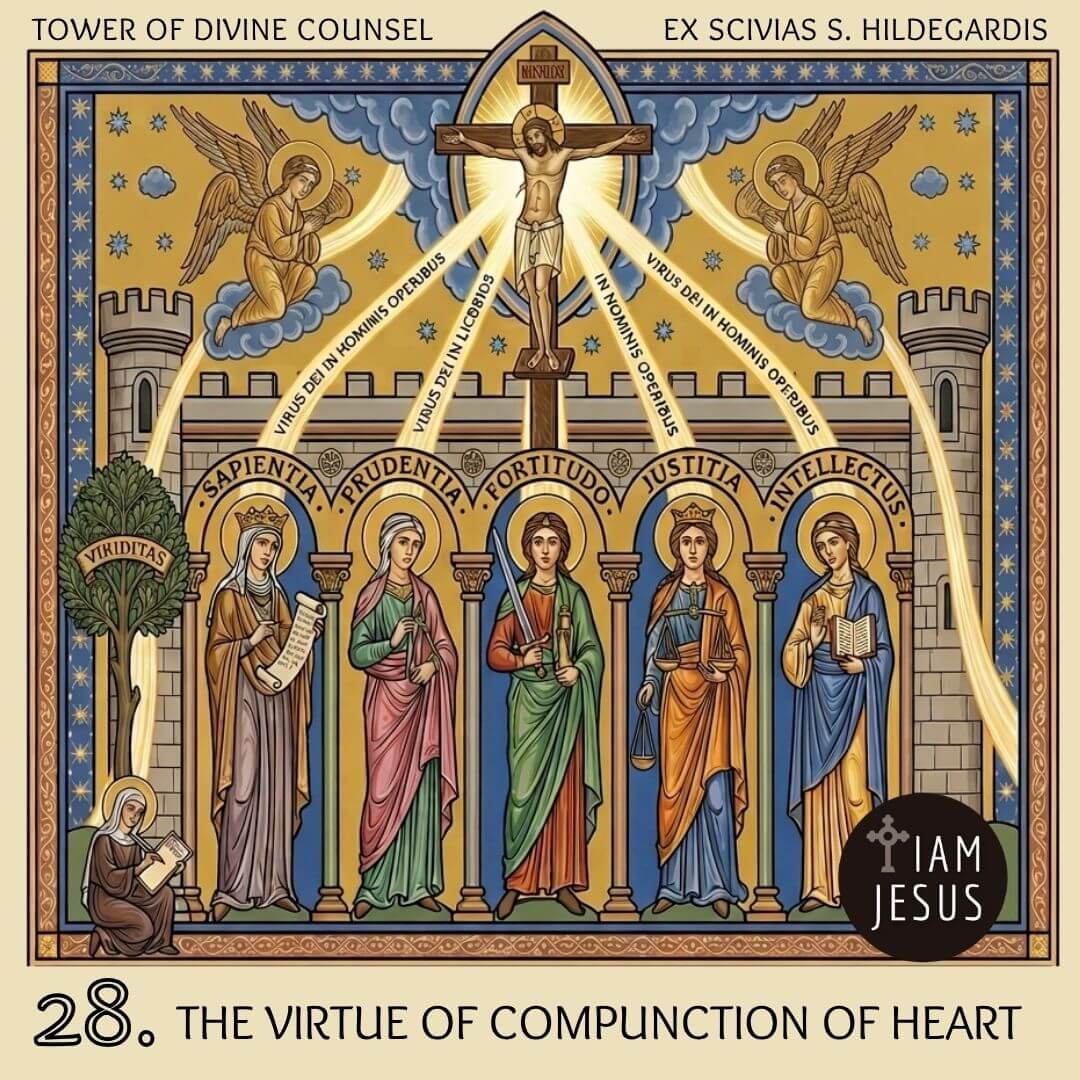
It’s worth asking why these eight virtues—Justice, Strength, Holiness, Steadiness, Heavenly Desire, Sorrow of the Heart, Contempt of the World, and Concord—are the ones St. Hildegard chooses to answer a chain of vices about being a good neighbor and charitable stewardship for the benefit of others. The answer is in her own closing theology.
Late in her visions, she writes that a faithful soul “feeds on the greenness of the heavenly virtues… so that he sprouts the seeds of good works by which he grasps the fruit of holiness.”
Liber Vitae Meritorum, Part 6, Section 23, Para. 24, trans. Hozeski
Viriditas—the living greenness she sees running through every virtue—was never meant to stay private. It sprouts. It becomes something to be given away.
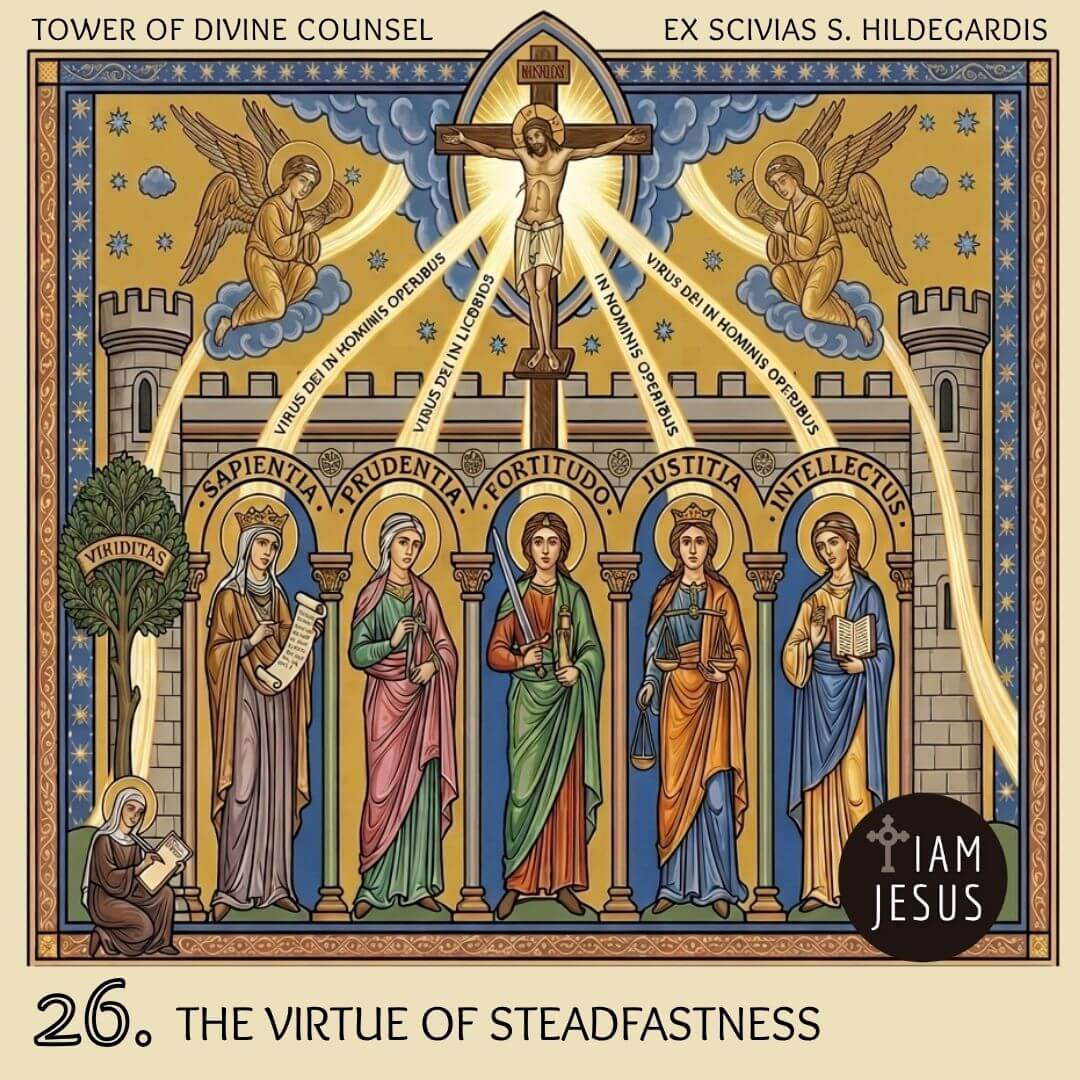
You can watch this happen directly in Holiness’s own words in Part 4: she doesn’t just possess grace, she “covers the sons of men” with it — an interior gift immediately becoming an outward one. But notice, too, what Steadiness and Sorrow of the Heart are doing right alongside her. Neither one talks about serving a neighbor directly—instead, each one answers a vice that has simply stopped working. Changeableness quits before anything can grow to completion. Obstinacy refuses to labor for a grace she isn’t certain she’ll receive. Steadiness and Sorrow of the Heart aren’t describing the fruit itself; they’re guarding the root. A soul that won’t stay steady, and won’t labor, never gets far enough to have anything left over to give away. Before viriditas can reach a single neighbor, it first has to survive the ordinary, unglamorous work of simply sticking to it and not quitting.
That’s the real shape of Part 4: eight virtues, each doing a different part of the same job—some holding the soul steady enough to keep working, some naming the fruit once it finally appears.
Part 4 — The Chain of Stewardship
Ready to transform your relationships and carry the peace of Christ into the world around you? Take the next step in your spiritual journey by diving into the Part 4 meditations below. In this chapter of our series, St. Hildegard guides our gaze outward into the Chain of Stewardship, showing us exactly how to heal discord, shatter complacency, and pour out God’s grace onto our neighbors and communities. Set aside a quiet moment for your Holy Hour today, explore the reflections in the grid below, and discover how cultivating these time-tested virtues can build God’s Celestial City right in your daily life.
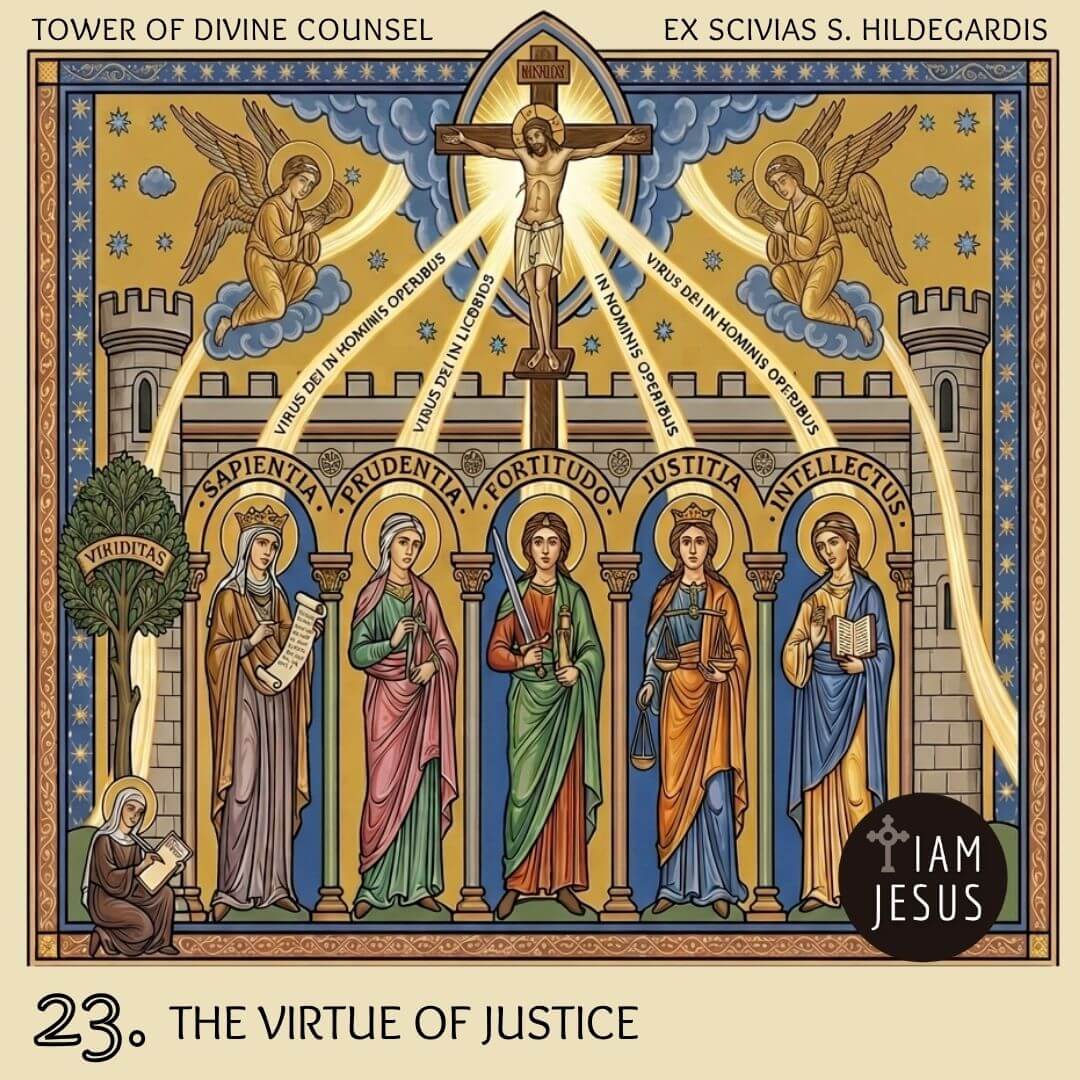
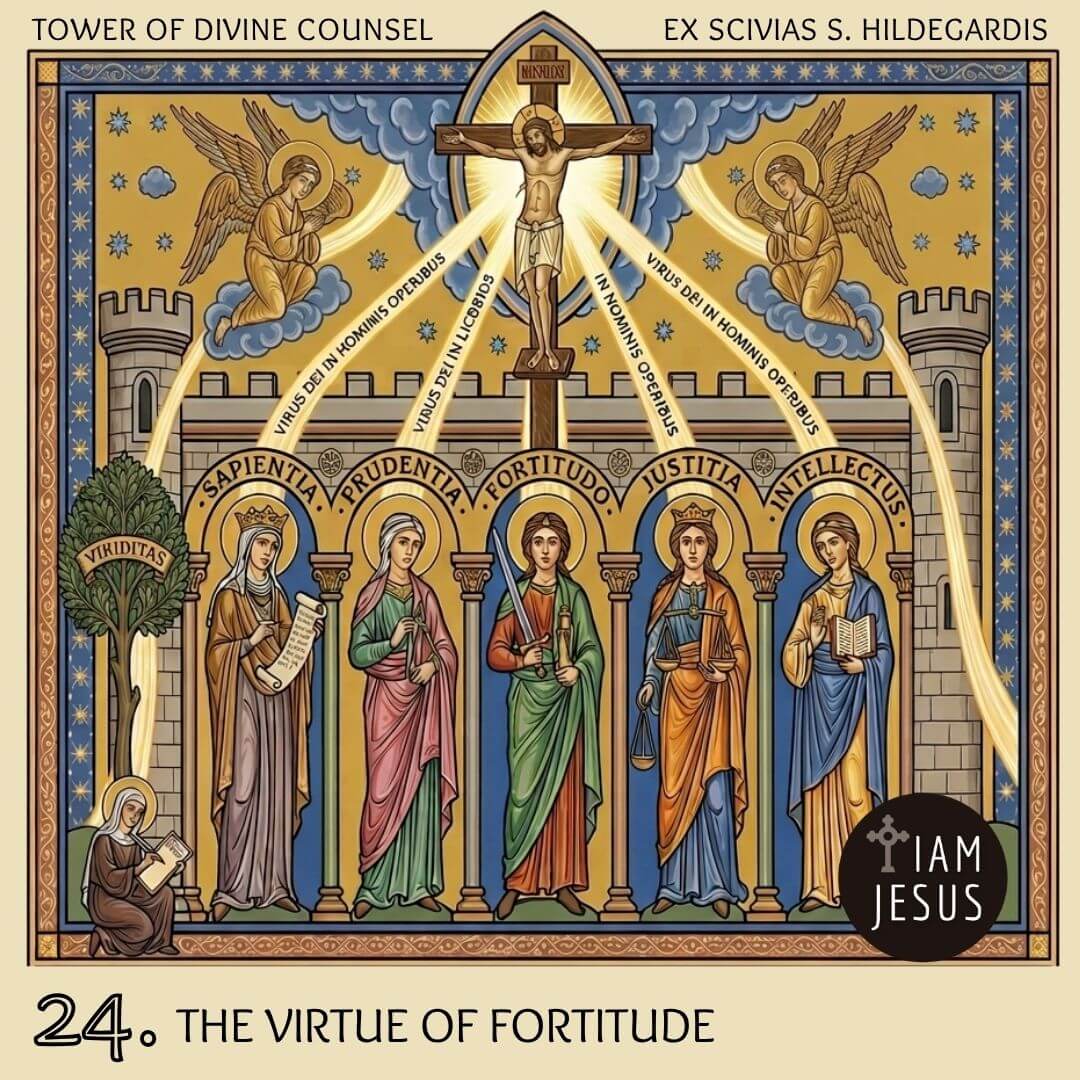
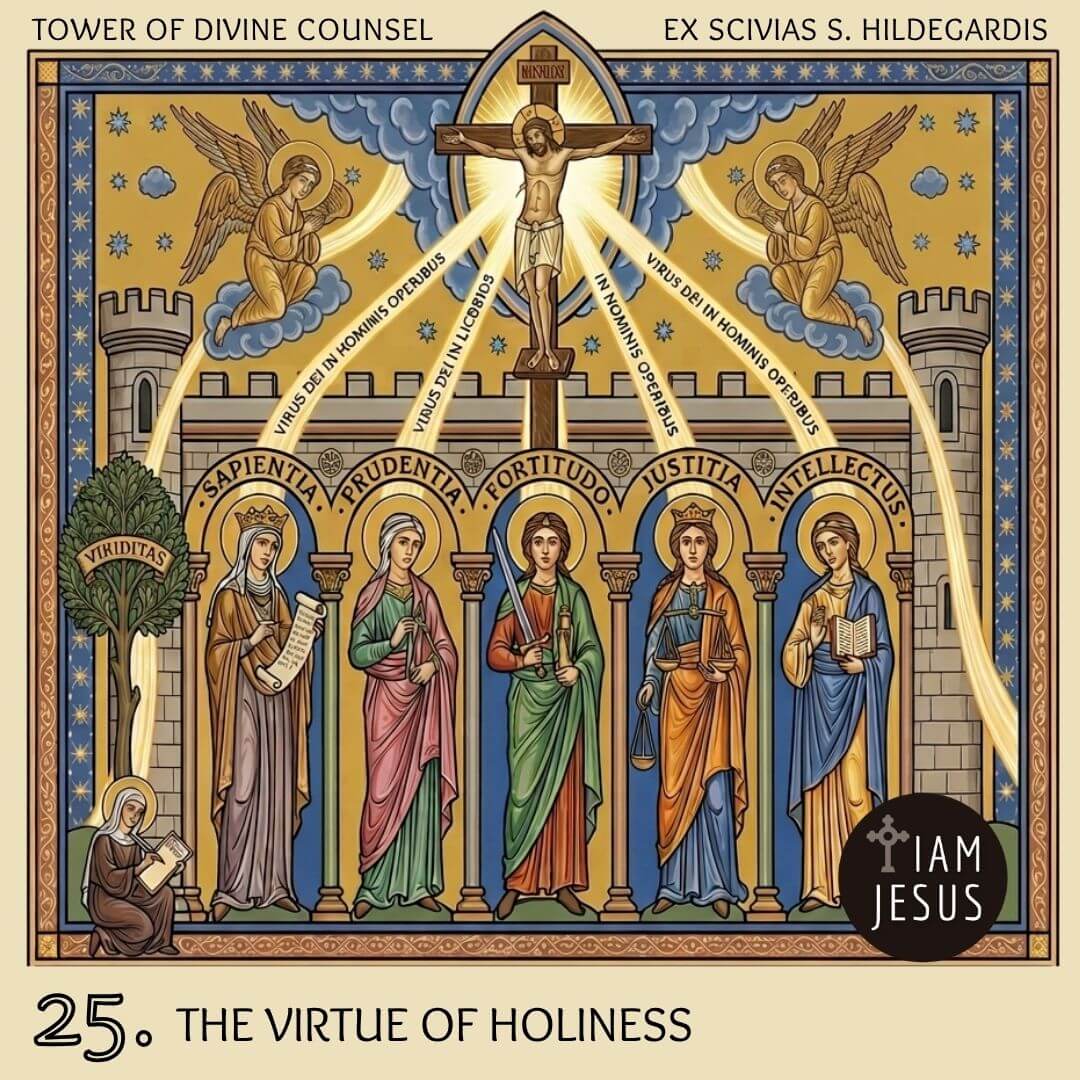
Visit St. Hildegard Virtues the Complete Library Page
This meditation is part of a 35-week prayerful journey through Saint Hildegard of Bingen’s masterpiece, The Book of the Rewards of Life. If you are seeking to step away from the noise and anxiety of the modern world, we invite you to return to our complete St. Hildegard Virtues library, where you can explore the full roadmap for your weekly Holy Hour reflections. There, you will discover all six parts of this sacred series, designed to help you break free from the fog of vice, cultivate the renewing life-force of the Holy Spirit, and build your interior life as a living stone in God’s Celestial City.