
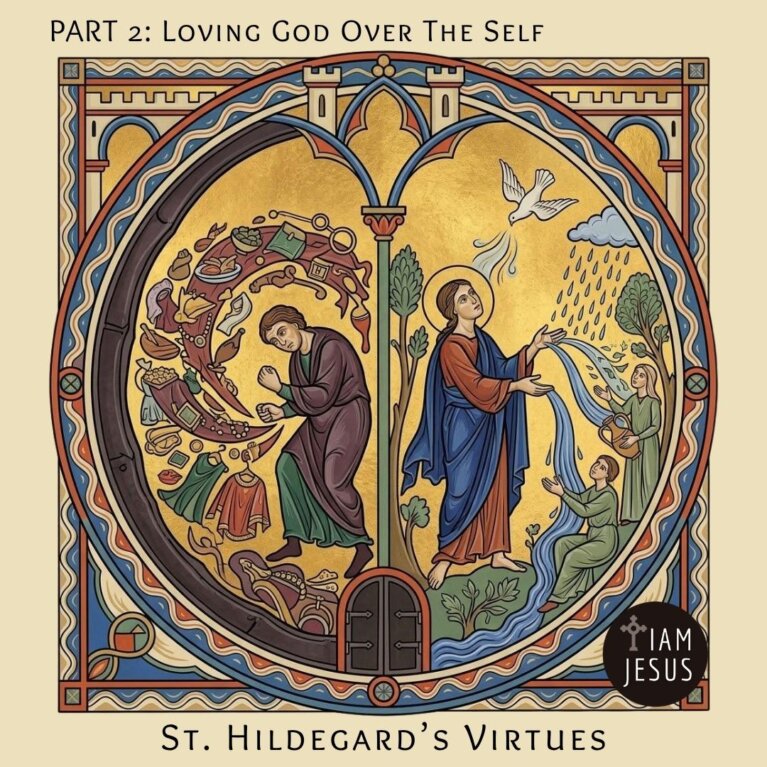
Eight Virtue/Vice Pairings For Putting God First Above all Else
We continue with Part 2 of the Book of the Rewards of Life. On this page, we will unpack the surface-level, theological, symbolic, and mystagogical meaning in the second part of St. Hildegard of Bingen’s book. In Part 1 we learned to love God over the world, and in this part we begin to let go of self-love and learn to put God first in our lives.
Surface Level
The Eight Pairs and the Chain of the Self
Part 2 takes us deeper than worldly attachment—into the territory of letting go of self-preoccupation. The eight pairs in this Part trace a chain that begins with something as ordinary as your appetite. Given free rein, the vice of Gluttony can cause use to rely on self-soothing when we should be relying on God instead. If we succumb to self-soothing it eventually opens us to the other vices in the chain: Bitterness, Impiety, Falseness, Strife, Unhappiness, and Immoderation, until it arrives at the most sobering portrait in the entire Book of the Rewards of Life: Destruction of Souls.
What holds this chain together is not the body—though the chain begins with a bodily appetite. What holds it together is the soul that has quietly made itself the center of everything. Every vice in Part 2 is a downstream consequence of that one interior decision: I am the measure of all things. Every virtue in Part 2 is a portrait of what it looks like when something larger than the self becomes the center: Abstinence, True Bountifulness, Piety, Truth, Peace, Blessedness, Discretion, and Salvation of Souls.
These eight meditations will ask you to look honestly at where self-interest operates in your own interior life—not to shame you, but to show you that the soul with room for something greater than itself is not a diminished soul. It is an enlarged one, finally big enough to contain the grace God has always been waiting to pour in.
Theological Level
Disordered Self-Love and the Sin Against the Holy Spirit
Saint Augustine identified disordered self-love as “amor sui usque ad contemptum Dei,” which is translated as “love of self to the point of contempt for God.” This self-love is the foundation of what he called the earthly city: the civilization (and the soul) that has made itself its own god. Part 2 is St. Hildegard’s sustained vision of exactly this, and how it begins in the soul. She traces this progression from its first expression in the human appetite for self-soothing all the way to its most extreme form in Destruction of Souls.
The Catholic theological tradition has always taught that the most dangerous form of self-love is not simple vanity or selfishness, but the definitive closure of the soul to God’s mercy—what the tradition calls the sin against the Holy Spirit, or final impenitence. This is not a sin committed in a moment of weakness; it is the culmination of a pattern, a gradual hardening of the will against the very offer of grace. St. Hildegard’s vision of Destruction of Souls captures this with remarkable precision: this is the only vice in the entire book that does not receive a purgatorial remedy. While every other vice’s section ends with a path of repentance, Destruction of Souls’ section describes souls who “had sent themselves into destruction”— reflexive, willed, self-chosen language found nowhere else in the book.
The good news that Part 2’s virtues carry is equally precise: God does not condemn anyone. Every soul that wants mercy can receive it. The eight virtues of Part 2—beginning with Abstinence’s gentle correcting rain and climaxing in Salvation of Souls’ baptismal flood—are eight portraits of what a soul that has made room for God looks like. That is the theological invitation of this Part: not self-punishment, but making room.
Symbolic Level
Rain, Dew, and the Dried-Up Root
Part 2’s symbolic language is dominated by water—or rather, by its presence and absence. Where vice drains and parches, virtue nourishes and replenishes. Abstinence describes herself as “the fitting rain, so that flesh does not sprout in vices.” True Bountifulness—whose Latin name Largitas means generous overflow—announces herself as “bountiful in rain and dew and in ointment and medicine,” stacking four forms of water-nourishment in a single breath to answer Bitterness’s hard, chewing dryness.
Watch for the water imagery as you move through Part 2’s meditations—it is not decoration but diagnosis. When a vice is parched, bitter, or drying, and when a virtue flows, rains, or makes green, St. Hildegard is showing you the same thing in symbolic form that she names directly in theology: the soul that has made itself the center has cut itself off from its own source of life.
A Note to Watch For
After these eight vices, the same lion from Part 1 appears again — this time roaring against them directly, and this time, St. Hildegard tells us plainly who he is: “Christ, nevertheless, like a very strong lion, leads all the devil’s attempts and efforts toward sin to nothing and destroys the devil completely” (Liber Vitae Meritorum, Part 2, Section 52, Para. 61). He’s still here, still fighting — and now, for the first time, named. Also take note that in this Part, she tells us that the Lion is “the form of the Zeal of God.”
Mystagogical Level
The Soul That Has Come Home to Something Greater
At the deepest level, Part 2 asks the question that lies beneath all spiritual growth: what is my soul actually big enough to contain? A soul that has made itself the center can only hold itself — and that, St. Hildegard shows us, is not enough. The chain from Gluttony to Destruction of Souls is the portrait of a soul that tried to fill itself with itself, and found that the more it consumed, the emptier it became. This is the mystical logic of self-love: it promises fullness and delivers an ache that grows with every attempt to satisfy it.
The virtues of Part 2 are the portrait of a soul that has discovered the only love large enough to fill it. True Bountifulness does not merely give a little — she overflows in rain and dew and ointment and medicine, because she is drawing from a source that cannot run dry. Salvation of Souls answers Destruction of Souls with the image of a deer running to the fountain — the ancient image from Psalm 42, the soul that has remembered its thirst and run toward the only water that satisfies.
In the bridal mysticism tradition, this is the moment the bride stops trying to be her own bridegroom and turns, finally, to the One who has been waiting. Part 2 is an invitation to stop trying to fill yourself with yourself — and to discover that the space you make by letting go is exactly the size of the God who wants to fill it. These eight meditations are an invitation to that discovery, one virtue at a time.
Eight Different Answers to the Same Ache
Watch what each of Part 2’s virtues offers a soul that has tried to fill itself with itself. Abstinence doesn’t scold Gluttony for wanting—she simply becomes “the fitting rain,” so that what was starving for indulgence can finally stop sprouting vice and start growing something real. True Bountifulness answers Bitterness’s hard, chewing dryness the same way, but doubled: she names herself “bountiful in rain and dew and in ointment and medicine”—four kinds of water in a single breath, because a soul curved inward on itself needs more than a single kindness to soften.
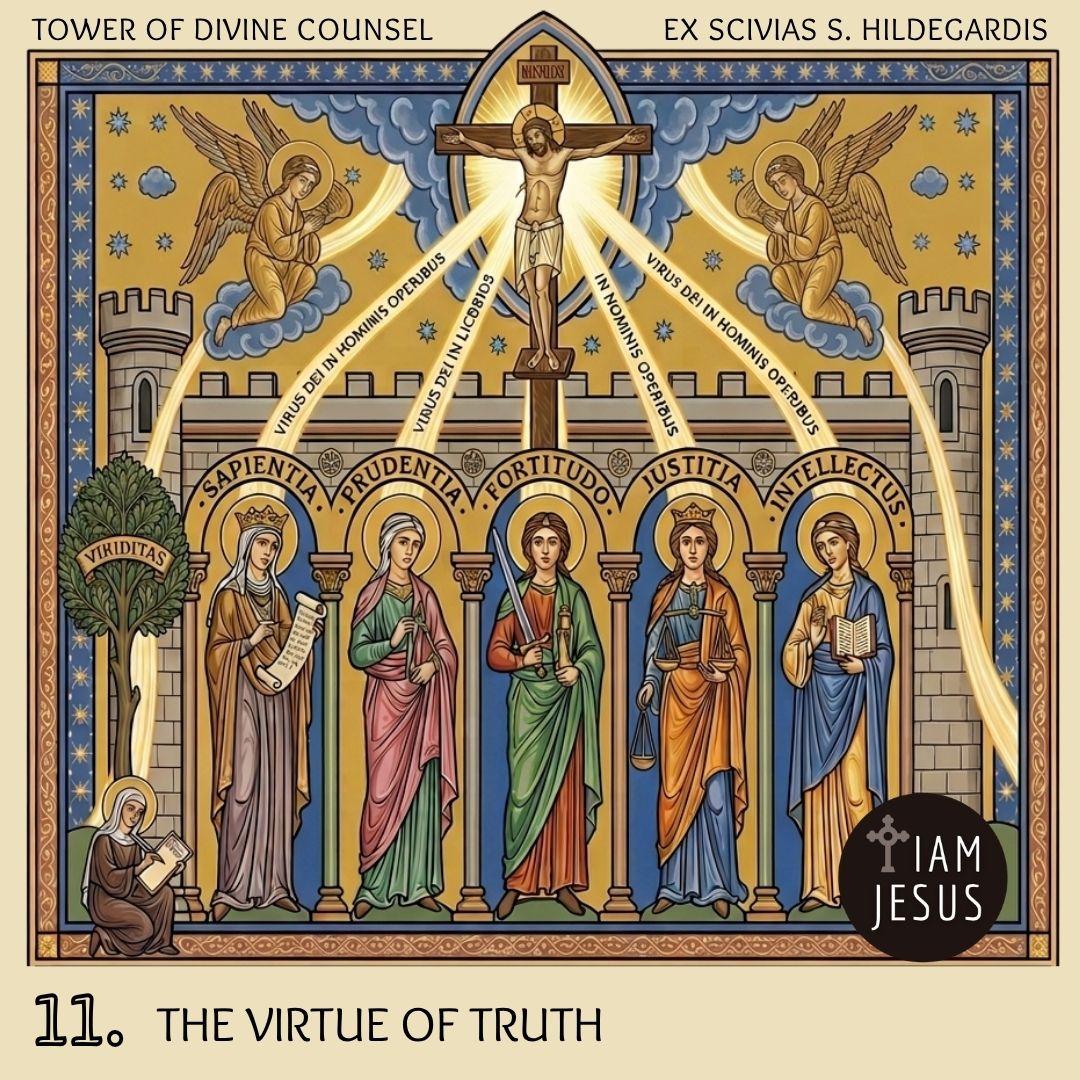
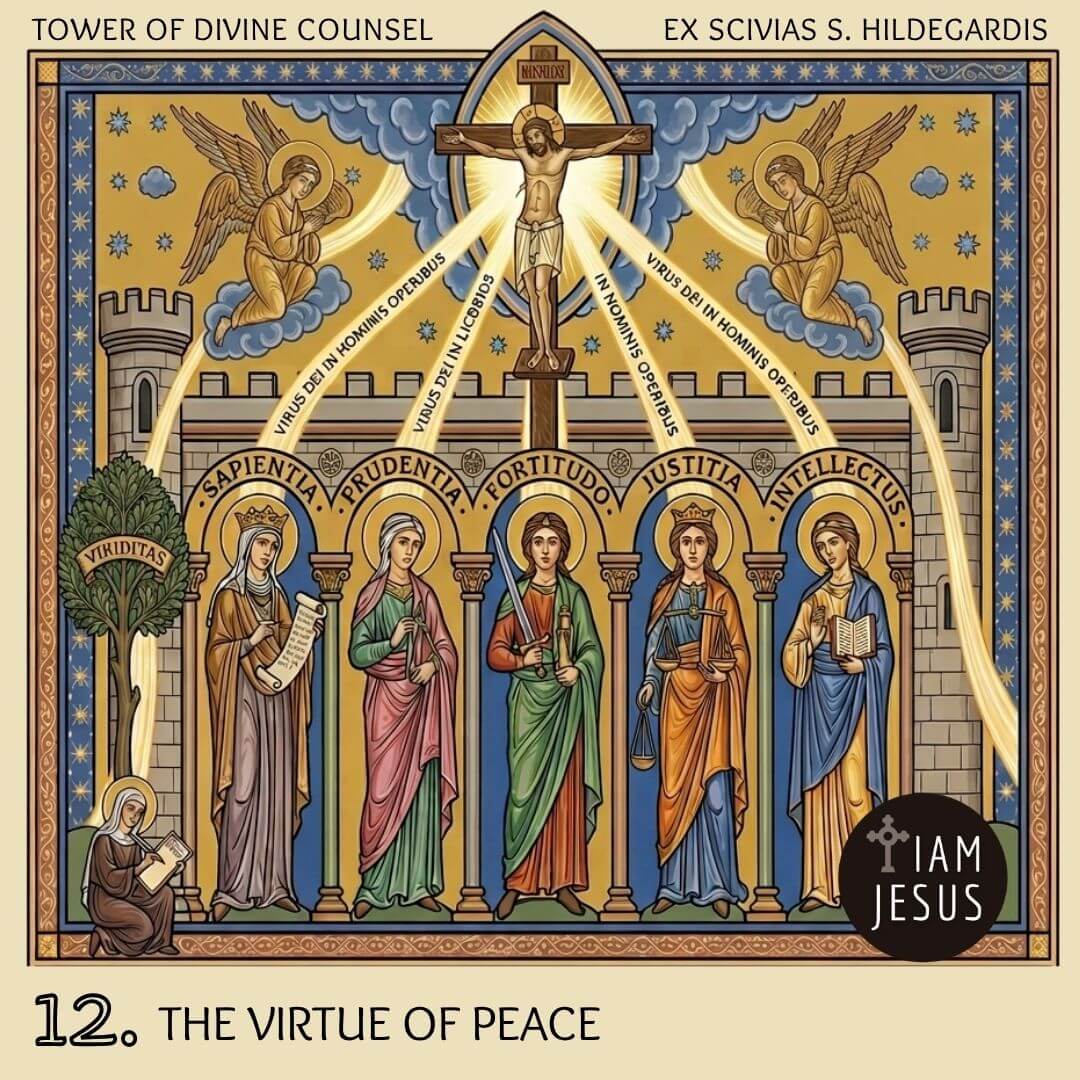
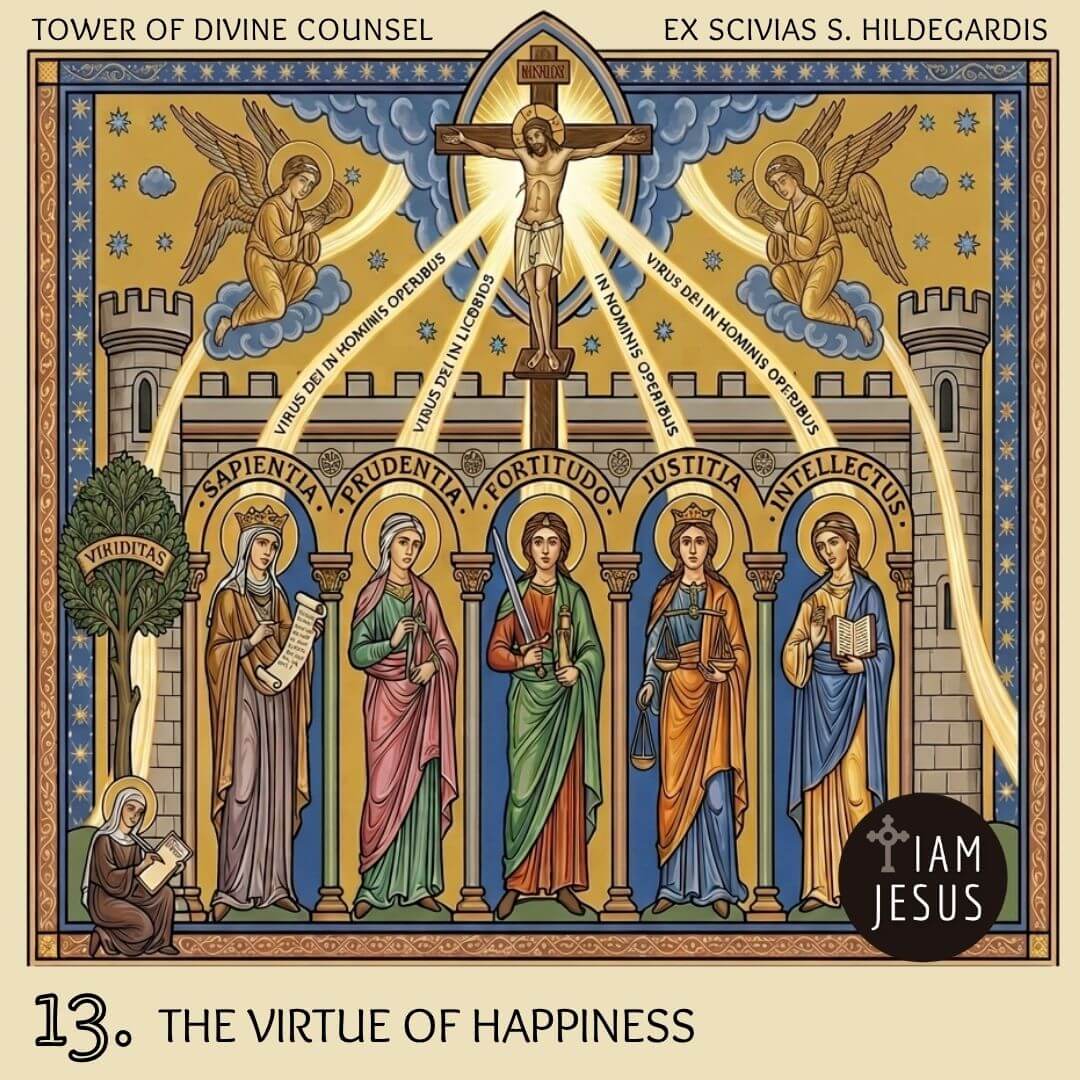
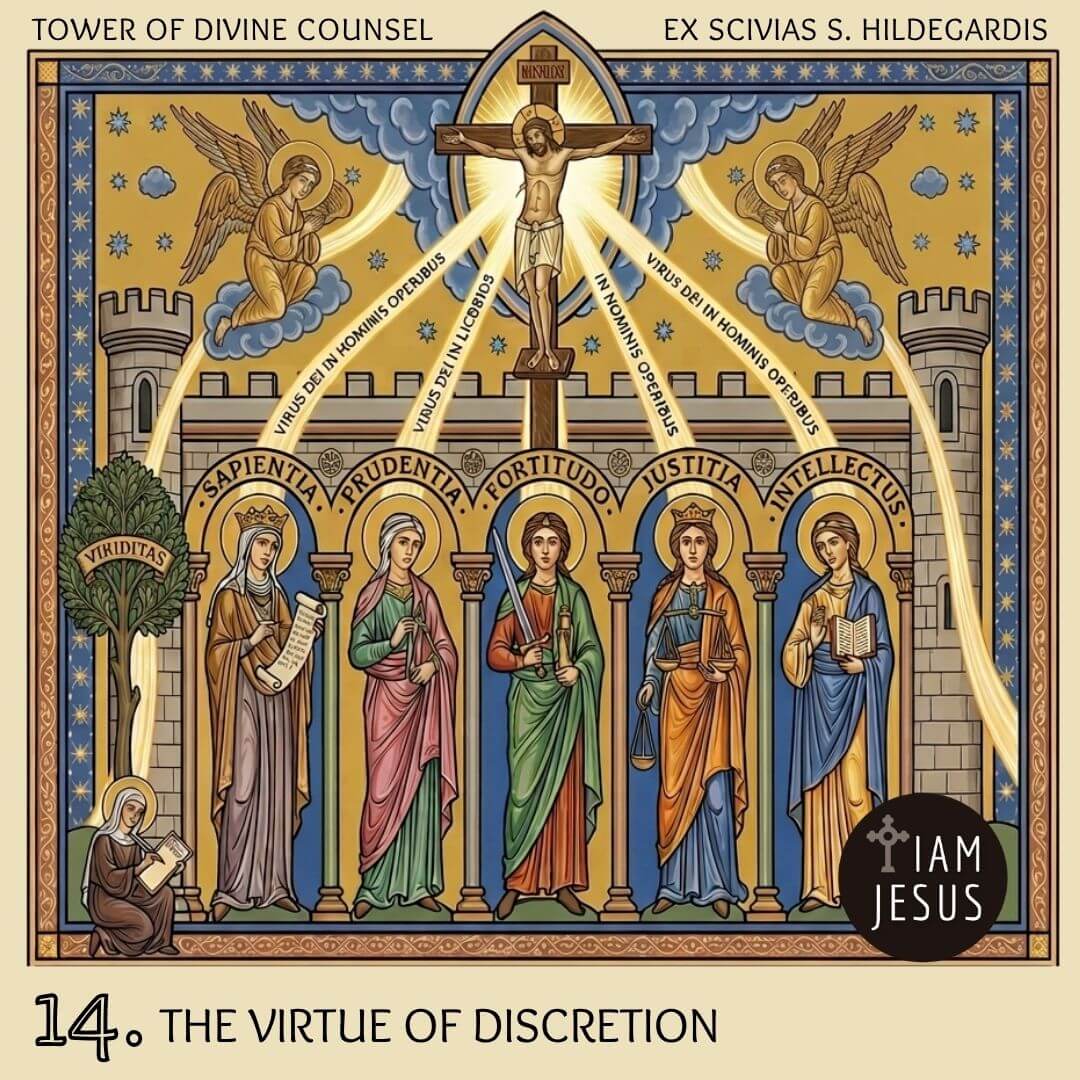
Truth gives Part 2 its sharpest diagnosis. She doesn’t argue with Falseness—she simply names what Falseness has become: “without any of the greenness of God’s grace.” That’s viriditas used as a diagnosis, not a decoration—proof that a soul centered on itself isn’t just dishonest, it’s dried out at the root. Peace answers Strife’s manufactured heat the same way every fire-claiming vice gets answered in this book: not with a counter-fire, but with medicine and fragrance, a warmth that heals instead of scorches. Blessedness meets Unhappiness’s bitterness by simply staying joyful — playing her own harp before God, content, because a soul that has stopped measuring itself against others has nothing left to be unhappy about. Discretion answers Immoderation’s grasping excess with exactly what excess lacks: proportion, the wisdom to know when enough is enough.
And at the very end of the chain, Salvation of Souls answers the one vice in the whole book with no way back—Destruction of Souls—not with an argument, but with an image: a deer running toward a fountain it finally remembers being thirsty for. Eight virtues, eight different responses to the same root sickness—a soul that made itself the measure of everything—and every one of them offers the same real cure: regenerative water, when the soul has run dry.
Part 2 — The Self: Who is at the Center?
Ready to look honestly within and make room for a love greater than yourself? Take the next step in your spiritual journey by diving into the Part 2 meditations below. In this illuminating chapter of our series, St. Hildegard shines a light onto the Chain of the Self, tracing how subtle self-interest and a hardened heart cut us off from God’s living water. Set aside a quiet moment for your Holy Hour today, explore the reflections in the grid below, and discover how trading parched, self-centered vices for the renewing dew of holy virtues can enlarge your soul and fill you with transforming grace.

Visit St. Hildegard Virtues the Complete Library Page
This meditation is part of a 35-week prayerful journey through Saint Hildegard of Bingen’s masterpiece, The Book of the Rewards of Life. If you are seeking to step away from the noise and anxiety of the modern world, we invite you to return to our complete St. Hildegard Virtues library, where you can explore the full roadmap for your weekly Holy Hour reflections. There, you will discover all six parts of this sacred series, designed to help you break free from the fog of vice, cultivate the renewing life-force of the Holy Spirit, and build your interior life as a living stone in God’s Celestial City.