
Seven Virtue/Vice Pairings That Open Your Heart to God
We begin our study of St. Hildegard of Bingen’s virtues with Part 1. This Part lays the firm foundation every soul needs to begin an interior life of grace. On this page, we will unpack the surface-level, theological, symbolic, and mystagogical meaning in the first Part of St. Hildegard of Bingen’s Liber Vitae Meritorum.
Surface Level
The Seven Pairs and the Chain of Heart
Part 1 introduces us to seven virtue-and-vice pairs that all share one common thread: the question of where your heart is aimed. St. Hildegard opens her great vision with the most fundamental battle your soul faces—not a dramatic moral crisis, but something quieter and more ordinary. The gateway vice in this first chain is Worldly Love. She doesn’t announce herself as evil in St. Hildegard’s vision. Worldly Love simply reaches for what feels good, natural, and what she believes is deserved. And from that single misdirection, if we are not careful, St. Hildegard shows us how a chain of other vices can begin to spin off Worldly Love and to develop: Impudence follows, then Jesting, then Hard-Heartedness, then Slothfulness, then Anger, and finally Foolish Joy. The last vice in Part 1, Foolish Joy, is the most sobering portrait of all, a soul so settled into its own comfort that it has stopped noticing God’s absence entirely.
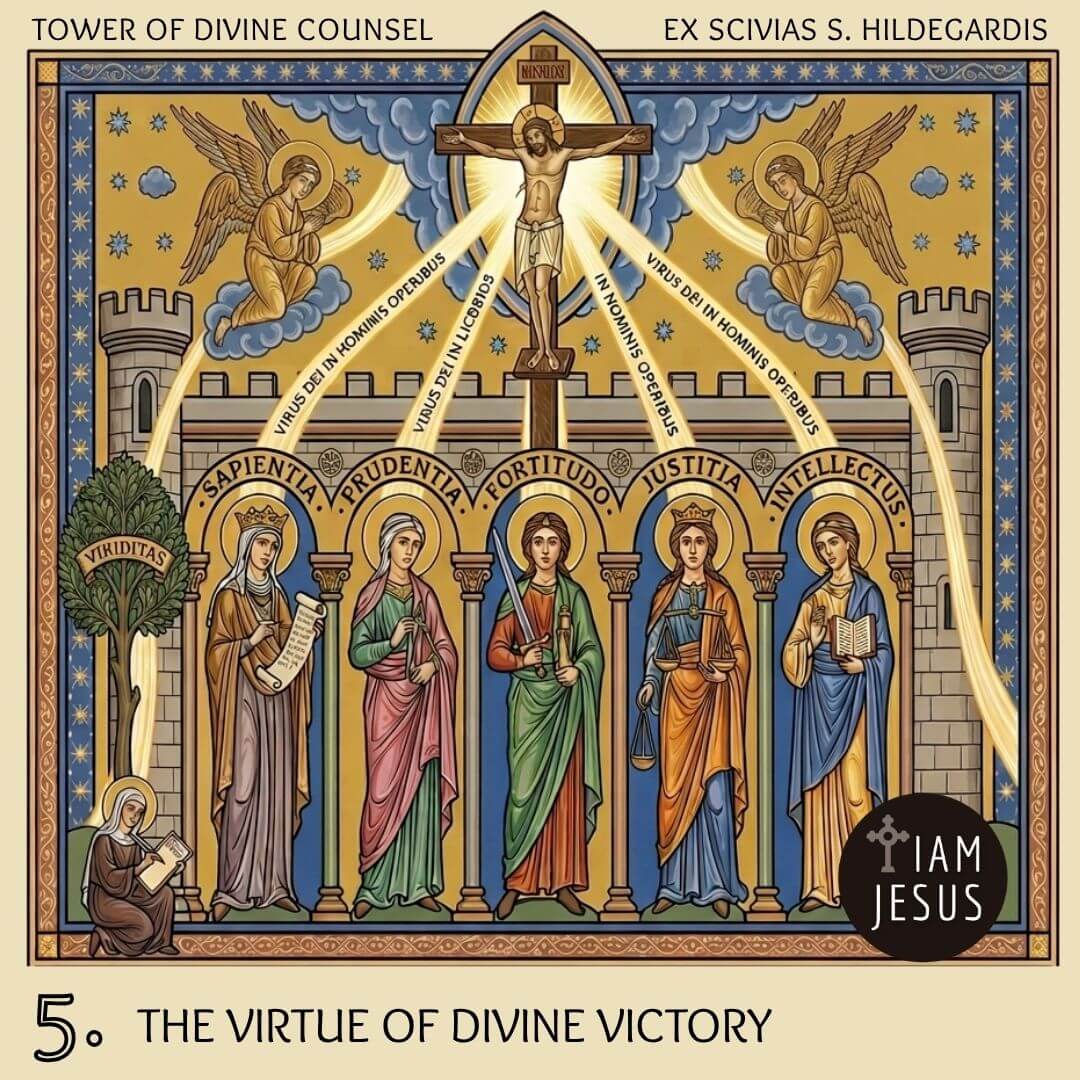
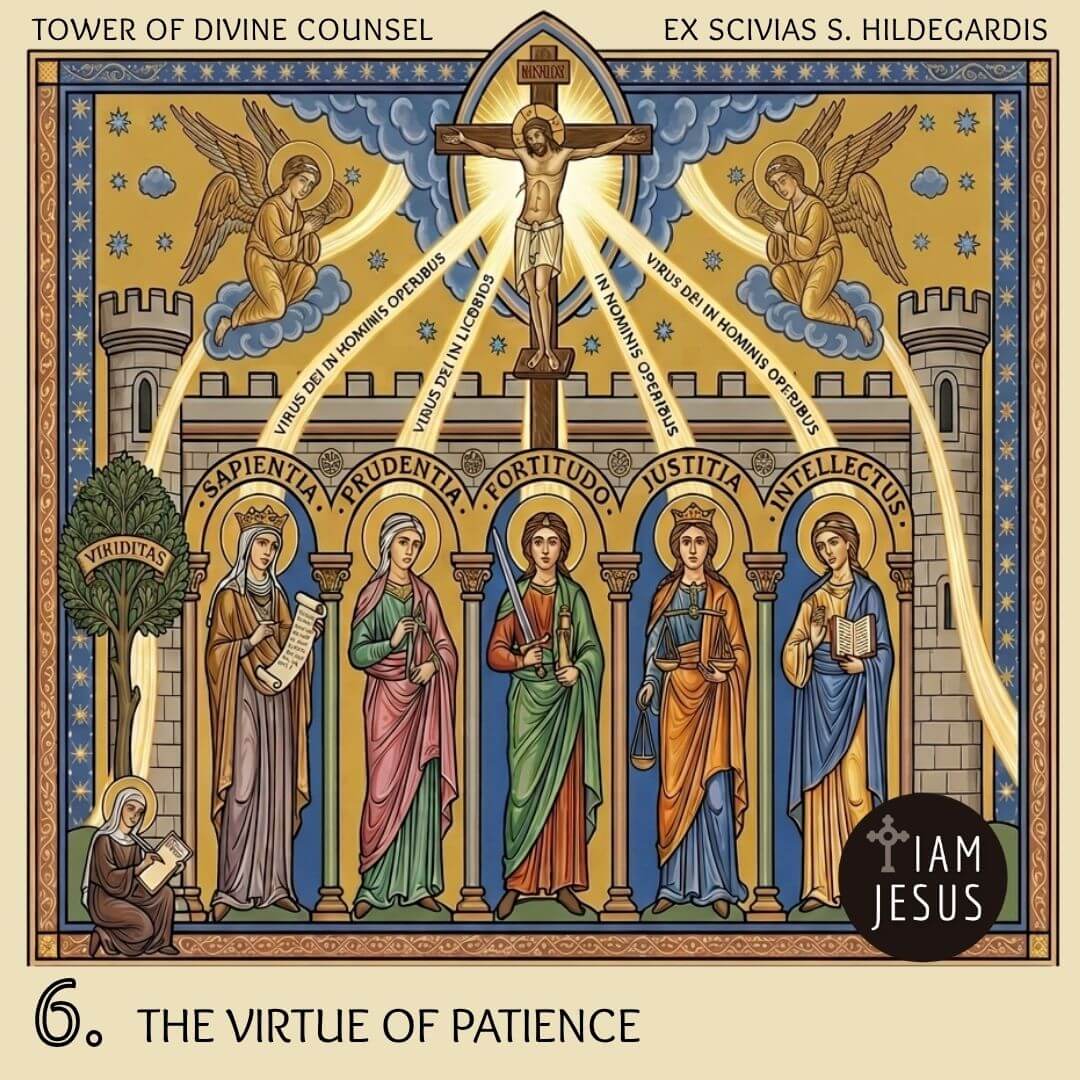
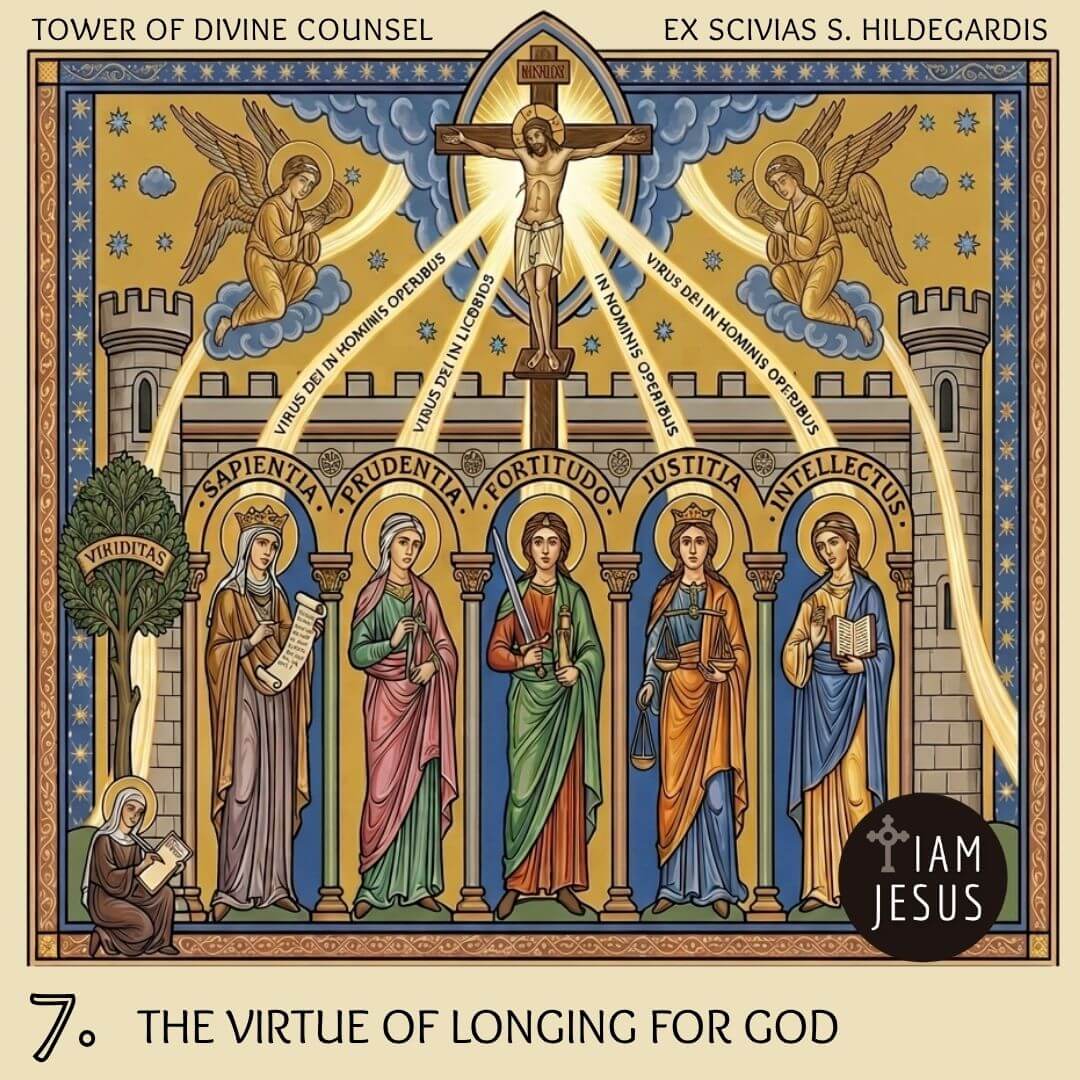
Each of these seven vices has a virtue waiting to answer it: Heavenly Love, Discipline, Shyness, Mercy, Divine Victory, Patience, and Heavenly Joy. As you move through these seven meditations, you will learn to recognize the chain in your own interior life—not to condemn yourself, but to see clearly, perhaps for the first time, exactly where the drift begins and what it can potentially lead to if you are not careful. And you will discover that the virtues have been there all along, ready to answer the vices that are trying to thwart your spiritual growth. The moment you are willing to listen, the virtues have your answer.
Theological Level
Augustine’s Two Cities and the Ordering of Love
St. Hildegard was formed in the Benedictine tradition, which was saturated in the theology of Saint Augustine of Hippo. Augustine’s most fundamental insight — the one that underlies everything in Part 1 — is that the human soul is built to love, and that the soul’s entire moral life is determined by what it loves most. He called this the ordo amoris: the right ordering of loves. When love is aimed at God first, everything else falls into its proper place. When it is aimed at the world — at comfort, pleasure, approval, possession, or ease — everything else begins, slowly and quietly, to tilt.
This is precisely what St. Hildegard shows us in Part 1. The Latin name she gives the gateway vice, Amor saeculi, means Love of the World. And the gateway virtue, Amor caelestis, means Heavenly Love. This virtue/vice pairing is built on the same word: amor. It is the same love, but the opposite object. The entirety of Part 1’s theology is contained in this distinction. Catholic moral teaching has always affirmed that disordered love is the root of sin—not pleasure itself, or the body, neither creation, but love misdirected away from the One who made us. The Catechism of the Catholic Church teaches that “the root of all sin is in the heart” (CCC 1873) — and this is exactly what St. Hildegard’s first Part shows us, vice by vice, virtue by virtue, all the way to the settled indifference of Foolish Joy.
Symbolic Level
The Tree, the Darkness, and the Well of Blessing
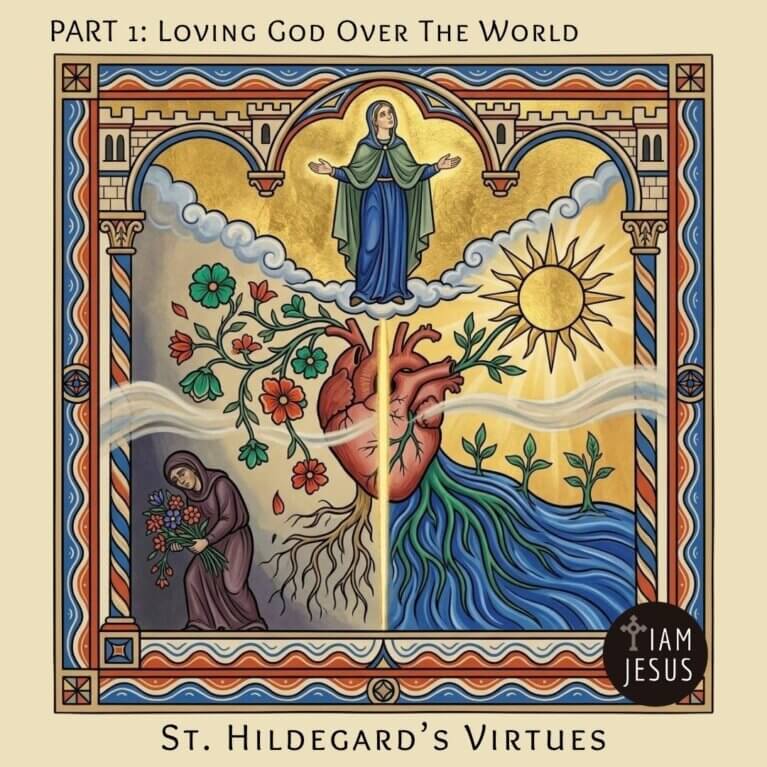
St. Hildegard’s visions are full of vivid, deliberate imagery, and Part 1 introduces us to the visual language she will use throughout the entire book. The very first image she sees is a man—dark, naked, with no covering of virtue—clinging to the base of a great flowering tree, plucking its blossoms with delight. As he finishes speaking, the root of the tree dries up, and the tree falls into darkness, taking him with it.
This image is not accidental. The tree is the soul’s life, rooted in what it loves. The flowers are all the beautiful, desirable things the world offers. And the root—the root is already dry while the flowers still look gorgeous. This is St. Hildegard’s most important symbolic move in all of Part 1: the corruption is always at the root, invisible to anyone whose attention is fixed on the surface beauty above. The soul trapped in Worldly Love cannot see its own drying root because it is too busy admiring the flowers it has collected.
The virtues in Part 1 answer with contrasting imagery: the cool drink of sweetest water from the well of blessing, the dawn’s light breaking over darkness, roses and lilies gathered in an open lap. These are images of a soul that has found its source in something that cannot dry up. Watch for the four elements as you move through these meditations—fire, air, water, and earth appear in the visions of the virtue/vice pairings, sometimes in their true, life-giving form, and sometimes in their corrupted counterfeits. Learning to tell the difference is one of the great gifts Part 1 offers us, so when you see one of these elements, pay very close attention.
A Note to Watch For
There is one more figure quietly present in this very first vision, before a single vice has even been named: a lion, moving with the sun, sending souls back to joy. Later in this same Part, once all seven pairings are complete, the man draws a three-edged sword — and the sword itself speaks: “I have zeal of zeal against the North, and against all who dwell there… I judge everyone’s works” (Liber Vitae Meritorum, Part 1, Section 15, Para. 27, trans. Hozeski). St. Hildegard doesn’t explain either of them yet. Keep them both in mind. They’ll return.
Mystagogical Level
The Bride Who Has Found Her Beloved
At the deepest level, Part 1 is a love story. It is the story of a soul that was made to love God above all things—made, as Saint Augustine said, with a restlessness that can only be quieted in God—and the long, quiet process by which that love can be redirected toward lesser things, until the soul barely remembers what it was restless for in the first place.
St. Hildegard writes in the tradition of Catholic bridal mysticism—the understanding that the soul’s relationship with God is not merely obedience to a lawgiver, but the love of a bride for her Bridegroom. The very name of the gateway virtue—Amor Caelestis, Heavenly Love—is love itself, rightly aimed. When the virtue of Heavenly Love speaks in St. Hildegard’s vision, she does not argue or lecture. She simply describes what she is: drawing from the well of blessing, sitting in the light, looking at the King of Kings. She is a soul that has found her Beloved and rests in his sight.
This is the invitation Part 1 extends to every reader: not merely to avoid Worldly Love, but to discover that Worldly Love is a counterfeit. Heavenly Love is infinitely more beautiful than and it offers true peace and union with God. The flowers the vice plucks are real and lovely—but they are cut flowers, already dying. The well of blessing, on the other hand, is inexhaustible. As you enter these seven meditations, ask the Lord to show you not only where your love has been misdirected, but toward whom it was always meant to flow. Your discovery is the beginning of everything.
Seven Virtues: One Well that Never Runs Dry
Watch how each virtue in Part 1 answers a heart aimed at the wrong thing—not by arguing, but simply by showing the abundance of a life centered on loving God over the world. In Week 1 you will be introduced to the first pair. Heavenly Love doesn’t compete with Worldly Love’s grasping; she simply says what she has: “since I have all viriditas in my hands”—real greenness, not the counterfeit Worldly Love claims as her own root dries up mid-sentence. As we continue in Week 2, we are introduced to Discipline, who answers Impudence’s wagging, restless energy the same way. Every counterfeit vice gets answered in this book: what Impudence called freedom is exposed as just noise blown away by the wind.
And Heavenly Joy, last of all virtues in Part 1, answers Foolish Joy’s restless grasping at everything the world offers—comfort, status, pleasure—not with a competing claim, but with sighing itself: a soul whose whole desire has narrowed to longing for God alone, the one appetite Foolish Joy’s constant reaching never satisfies. Seven virtues, seven different elements or images, and every one of them the same discovery: the well of blessing was never going to run dry. The heart just had to stop looking for water somewhere else.
Part 1 — The Heart: What Do You Love?
Saint Hildegard’s first seven virtue-and-vice pairs are not meant to overwhelm you with guilt, but to offer you an interior compass. They invite you to pause, look closely at the hidden currents of your daily habits, and intentionally redirect your desires back to the Creator. Transformation doesn’t happen all at once—it begins with a single, deliberate choice to seek God’s grace in the quiet of your heart. Select the first card below to begin Week 1, and let Saint Hildegard guide your soul back to its true home.

Visit St. Hildegard Virtues the Complete Library Page
This meditation is part of a 35-week prayerful journey through Saint Hildegard of Bingen’s masterpiece, The Book of the Rewards of Life. If you are seeking to step away from the noise and anxiety of the modern world, we invite you to return to our complete St. Hildegard Virtues library, where you can explore the full roadmap for your weekly Holy Hour reflections. There, you will discover all six parts of this sacred series, designed to help you break free from the fog of vice, cultivate the renewing life-force of the Holy Spirit, and build your interior life as a living stone in God’s Celestial City.