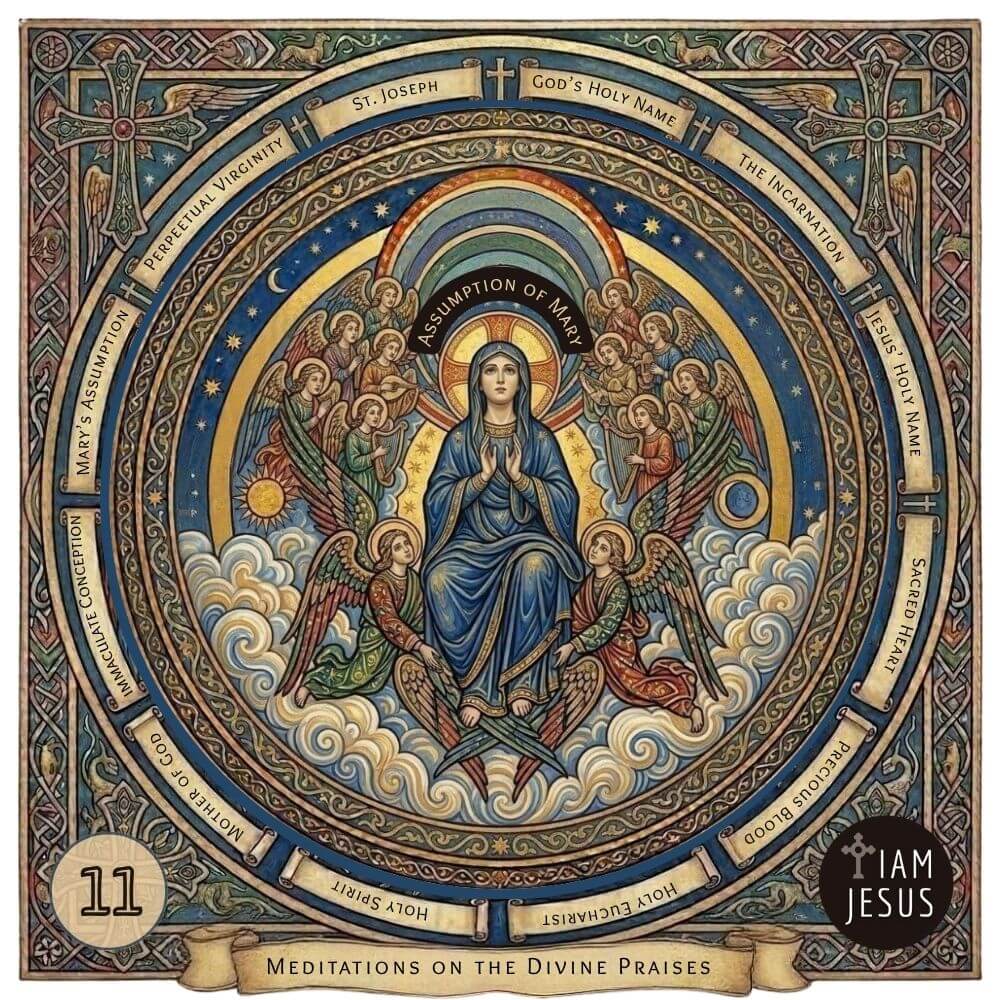
Join us for our 5th catechetical meditation of the Divine Praises prayer as we dive deep into the profound reality of the Sacred Heart in the Eucharist. Today we meditate on blessing Jesus Christ’s Most Sacred Heart in the Eucharist. In our second meditation we contemplated the dogma of the Incarnation and how Jesus Christ is both fully God and fully human, united in one person. This core belief about Jesus is the foundational belief for accepting the truth that his most Sacred Heart is present in the Eucharist.
Let’s begin by contemplating this passage from Luke 22:19-20:
“Then [Jesus] took the bread, said the blessing, broke it, and gave it to them, saying, “This is my body, which will be given for you; do this in memory of me.” And likewise, the cup after they had eaten, saying, “This cup is the new covenant in my blood, which will be shed for you.”
Jesus is present in the Eucharist and it is not just a symbol that we take to commemorate his sacrifice on calvary. In this catechetical meditation, we will contemplate how we know, with confidence, that the Eucharist literally contains the living Heart of Jesus.
The Rise of a Heresy that Depicts God as Unapproachable to Most
Fr. John Hardon, S.J. explains how the devotion to the Sacred Heart of Jesus came to be. This devotion was introduced during a time when a heretical movement called Jansenism was making a huge rise in 17th-century Europe. The Jansenists promoted two heresies. The first heresy the Jansenists professed had to do with salvation and the second with reception of the Eucharist.
Salvation seemed unattainable for many as the Jansenists promoted the need to do severe penances for sins committed and they also held a strict approach to reception of Communion. You may recognize artwork from this period that often depicts Jesus on the cross with his arms closer together, hanging vertically rather than spread open and hanging horizontally. Jansenists, like the Calvinists, falsely taught that Christ only died for the few, and it was predestined. Jansenists claimed you had no free will to deny grace if you were one of the few destined for sainthood.
In the second heresy, Jansenism taught that extreme penances had to be performed before a person could approach the Eucharist. They warned that no person should receive Communion unless they were completely free from all worldly attachments. They stressed that we must be as pure as the saints in heaven before we dare take Communion on Earth. This led to very few Catholics wanting to receive Communion regularly, and many despairing over whether or not they were the chosen ones. As a result, fewer people would take Communion and in many cases, people would abstain for long periods, even refusing reception on Easter Sunday.
The Beginning of a Devotion to the Most Sacred Heart in the Eucharist
During this time St. Margaret Mary Alacoque was visited by Jesus at Paray-le-Monial. He gave her instructions for a devotion to his Sacred Heart, and this became an antidote to Jansenism. The devotion to the Sacred Heart of Jesus emphasized God’s love and mercy. This countered the Jansenist heresy that emphasized our sinfulness, and the angry wrath of God.
As bodily nourishment restores lost strength, so the Eucharist strengthens our charity, which tends to be weakened in daily life; and this living charity wipes away venial sins. By giving himself to us Christ revives our love and enables us to break our disordered attachments to creatures and root ourselves in him:
Since Christ died for us out of love, when we celebrate the memorial of his death at the moment of sacrifice we ask that love may be granted to us by the coming of the Holy Spirit. We humbly pray that in the strength of this love by which
Christ willed to die for us, we, by receiving the gift of the Holy Spirit, may be able to consider the world as crucified for us, and to be ourselves as crucified to the world. . . .Having received the gift of love, let us die to sin and live for God.
Catechism, 1394
Miracles Prove the Eucharist is the Heart of Jesus Christ
The first recorded Eucharistic miracle was in Lanciano, Italy in the 8th century. One of the most scientifically studied modern miracles happened in Buenos Aires, Argentina in 1996. Samples were taken to be studied by Dr. Frederick Zugibe, a world-renowned forensic pathologist and cardiologist. He validated that the samples he studied held human heart tissue that was vital and alive, which is impossible by human scientific standards. He confirmed the presence of inflamed human heart tissue and living white blood cells.
These are just two of hundreds of other Eucharistic miracles around the globe. These miracles prove that when we receive the Eucharist at Holy Communion, we receive the very heart of Christ. The Eucharist is given to us so that we can enter into an intimate relationship with the one we are communicating with, Jesus Christ.
Catholics believe that Jesus Christ is truly present in his Body, his Blood, his Soul, and his Divinity in the Holy Eucharist. The Bible reveals to us that he exists in eternity in his glorified body at the right hand of God the Father. We know this because he appeared in his resurrected body to his disciples, revealing the marks on his hands and feet [John 20:20 and Luke 24:39], and then he ascended into heaven in this same glorified body [Acts 1:9]. We also know this because Jesus taught us that we must eat his Body and drink his Blood so that we would have life in us, and that it is true food and true drink [John 6:53-58]. For this reason, we understand that the Gospel that Jesus preached was about the new covenant in his blood. The Eucharist is the new covenant and through our participation in communion with Christ we become like him.
Blessed be His Most Sacred Heart: Pierced with a Lance for Us
Now since it was preparation day, in order that the bodies might not remain on the cross on the sabbath, for the sabbath day of that week was a solemn one, the Jews asked Pilate that their legs be broken and they be taken down.
So the soldiers came and broke the legs of the first and then of the other one who was crucified with Jesus. But when they came to Jesus and saw that he was already dead, they did not break his legs, but one soldier thrust his lance into his side, and immediately blood and water flowed out.
An eyewitness has testified, and his testimony is true; he knows that he is speaking the truth, so that you also may [come to] believe.
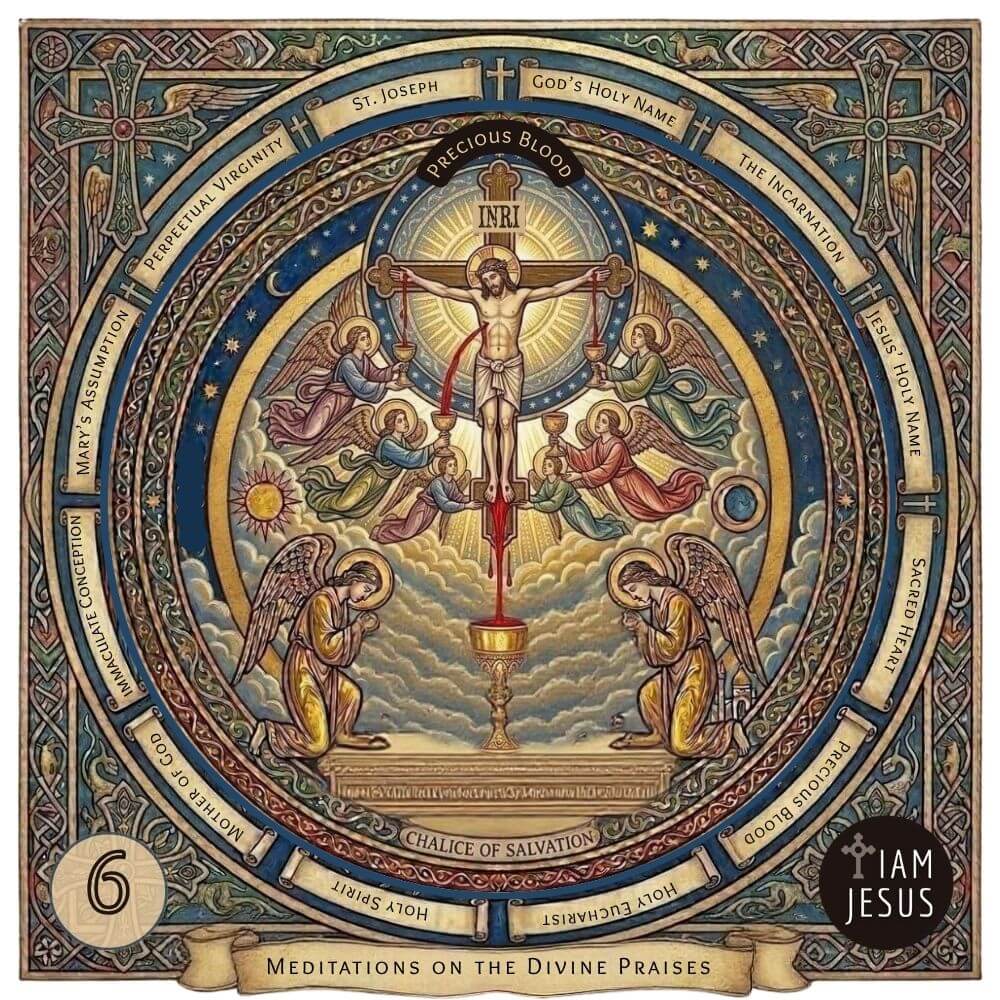
From the pierced side of Christ on Calvary, the Church was born, and the fountains of sacramental grace were opened to the world. The blood and water that poured forth from His Sacred Heart continue to flow into every chalice at every Catholic altar in the moment of Consecration. This is not a mere memory of a past event; it is Christ truly present. When we receive the Eucharist, we receive the Body, Blood, Soul, and Divinity of Christ. But most of all, we receive his Divine Heart, literally.
By the same charity that it enkindles in us, the Eucharist preserves us from future mortal sins. The more we share the life of Christ and progress in his friendship, the more difficult it is to break away from him by mortal sin. The Eucharist is not ordered to the forgiveness of mortal sins—that is proper to the sacrament of Reconciliation. The Eucharist is properly the sacrament of those who are in full communion with the Church.
Catechism, 1395
Now let’s contemplate the humble heart of Jesus in Matthew 11. Slowly meditate on this passage, reflecting on what “meek and humble of heart” means. Take your time. Pause over a word or phrase that speaks to your heart. Reread the passage again, and then ask Jesus to give you the grace to learn how to love from him. Praise him from your heart and tell him you’d like to take his yoke upon yourself. If you’d like to, take a moment to journal about your experience with the Sacred Heart of Jesus in the Eucharist.
Humble Heart of Jesus Christ
Let us Pray:
Having rested in the gentle invitation of Christ’s words, let us now move into a deeply personal conversation with Him. Armed with the truth of scripture and the legacy of the saints, we turn our gaze from the page to the Tabernacle. Let us lift up our hearts to bless, adore, and speak directly to the living Sacred Heart of Jesus in the Eucharist.
The 5th Catechetical Meditation of the Divine Praises prayer
Let Us Bless the Sacred Heart of Jesus in the Eucharist
Heart of Jesus, I love you. Please enter my heart and dwell there, making me an image of your love. Heart of Jesus, purify me. Let me imitate your love and mercy in all the activities of my daily life. I bless the Sacred Heart of Jesus in the Eucharist, whom I love with all my heart. I thank you for the gift of communicating with you. I thank you for your loving mercy toward me every time I go to receive you in the Sacrament of the Altar. I offer you my adoration and praise in thanksgiving for the gift of your Heart of love in my life. Without your Sacred Heart in the Eucharist, I have no life within me. I bless you with my very life in service to your Kingdom. AMEN.
In Conclusion:
We pray “Blessed be the Sacred Heart of Jesus” because we recognize that he is truly present in his mystical body in the holy Eucharist. We know when the priest says the prayer of consecration that we are receiving the very heart of our Lord who comes to us to transform us into saints. We may see the bread and wine before us, but we know that the Holy Spirit has come and that the Sacred Heart of Jesus in the Eucharist is present and ready to transform us with his love and mercy. This is truly a miracle of God that we should give thanks and praise for every day and should strive to receive as often as possible.
We remember the words that Jesus tenderly spoke from the Cross when he said, “Father, forgive them, they know not what they do” [Luke 23:34].
The Divine Praises in English
Blessed be God. Blessed be His Holy Name. Blessed be Jesus Christ, true God and true Man. Blessed be the Name of Jesus. Blessed be His Most Sacred Heart. Blessed be His Most Precious Blood. Blessed be Jesus in the Most Holy Sacrament of the Altar. Blessed be the Holy Spirit, the Paraclete. Blessed be the great Mother of God, Mary most Holy. Blessed be her Holy and Immaculate Conception. Blessed be her Glorious Assumption. Blessed be the Name of Mary, Virgin and Mother.
Blessed be St. Joseph, her most chaste spouse. Blessed be God in His Angels and in His Saints forever. AMEN.
The Divine Praises in Latin
Benedictus Deus. Benedictum Nomen Sanctum eius. Benedictus Iesus Christus, verus Deus et verus homo. Benedictum Nomen Iesu. Benedictum Cor eius sacratissimum. Benedictus Sanguis eius pretiosissimus. Benedictus Iesus in sanctissimo altaris Sacramento. Benedictus Sanctus Spiritus, Paraclitus. Benedicta excelsa Mater Dei, Maria sanctissima. Benedicta sancta eius et immaculata Conceptio. Benedicta eius gloriosa Assumptio. Benedictum nomen Mariae, Virginis et Matris. Benedictus sanctus Ioseph, eius castissimus Sponsus. Benedictus Deus in Angelis suis, et in Sanctis suis. AMEN.
The Divine Praises Prayer on YouTube
Pondering the Divine Praises: The Complete Series
The Divine Praises Series is a 14-part prayer journey made to help you deeply reflect on each line of this beautiful prayer. Through simple stories, scripture, and heartfelt reflections, this series explores the holiness of God, the Sacred Heart of Jesus, and the special place of the Blessed Virgin Mary. It is the perfect companion for a quiet hour in the adoration chapel or for your daily prayer time at home.