
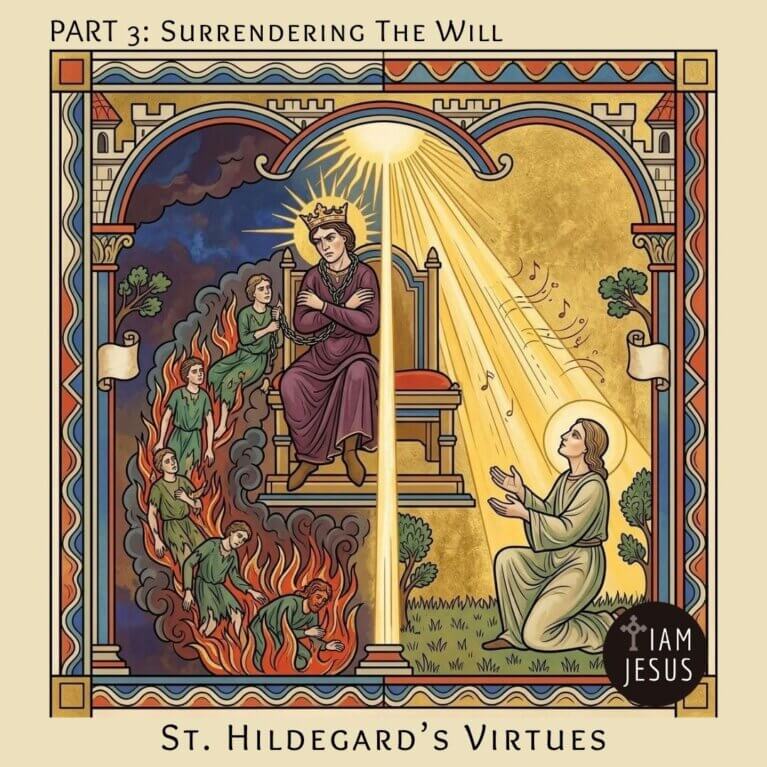
Seven Virtue/Vice Pairings For Surrendering Yourself to God
We continue with Part 3: the total surrender of your will to God for love of God, as envisioned in the Celestial City of God. On this page, we will unpack the surface-level, theological, symbolic, and mystagogical meaning in the third part of St. Hildegard of Bingen’s Liber Vitae Meritorum, which naturally follows learning to love God more than the world and your own self.
Surface Level
The Seven Pairs and the Chain of the Will
Part 1 showed us how to reorient our hearts that are aimed at the wrong thing back toward God. Then Part 2 showed us how to put God at the center of our lives over ourselves. Part 3 goes deeper into the faculty that makes disordered love possible: our free will. The will is the soul’s capacity to choose, to submit or resist, to open toward God or close itself against him. St. Hildegard places Pride at the gateway of Part 3 and names it plainly: “the matter and womb of all evils.” Every other vice in this chain grows from that root.
From Pride’s refusal to submit, Envy follows—the will that cannot bear others’ good. Then Empty Glory comes, which craves recognition for its own greatness. After this comes Disobedience, which refuses correction from anyone. Then Unfaithfulness arrives, which has lost the capacity to trust. Then Despair finally sets in. It is here where St. Hildegard makes her most precise observation: once the soul believes it is already lost, it removes the last restraint on the flesh. That is how Luxury arrives at the end of Part 3. The flesh is the vehicle; the corrupted will is the cause that makes a soul lacking virtue descend into Lust.
Seven virtues answer these seven vices: Humility, Charity, Fear of the Lord, Obedience, Faith, Hope, and Chastity. Together they are a portrait of what the surrendered will looks like from the inside—and what it gains. These seven meditations will show you that surrender is not diminishment. In St. Hildegard’s vision, it is the beginning of genuine freedom from the slavery of a sinful nature and bad habits.
Theological Level
Pride as the Root of All Vice and the Theology of Surrender
St. Hildegard’s naming of Pride as “the matter and womb of all evils” places her squarely in the mainstream of Catholic moral theology. Saint Gregory the Great, whose writings shaped the entire medieval understanding of the seven deadly sins, identified Pride as the queen of all vices—the one that makes every other vice possible by establishing the will’s fundamental refusal to answer to God. Saint Thomas Aquinas followed suit, teaching that Pride is the beginning of all sin because it is the disordered desire to excel beyond one’s proper measure— including beyond one’s creaturely measure before God.
What St. Hildegard adds to this tradition through her visionary register is a vivid portrait of exactly how Pride’s chain runs—not as an abstract theological argument, but as a lived sequence of interior experiences that any contemplative person recognizes. The will that won’t submit becomes the will that can’t trust, and the will that can’t trust becomes the will that has given up hope, and the will that has given up hope has nothing left to restrain its appetites. The placement of Luxury at this chain’s terminus is St. Hildegard’s most theologically precise structural choice in Part 3. She is showing us that disordered desire of the flesh is not a failure of the body but a failure of the will.
The virtues of Part 3 correspond exactly to this analysis: Humility restores the will’s right posture before God; Obedience restores its capacity to submit; Faith and Hope restore its capacity to trust and to look forward; and Chastity—last of all—is the virtue of a will that has been fully surrendered, expressing that surrender in the integrated life of body and soul together.
A Note to Watch for
Notice what’s different this time. The lion from Parts 1 and 2 doesn’t reappear here by name, and this time, he doesn’t speak at all—the same figure is present, but only seen, only felt, from a distance: “an image with the form of a human… has a fiery face because the zeal of God consumes all unjust things with the fervor of its judgment, just like a fire” (Liber Vitae Meritorum, Part 3, Section 44, Para. 55). Every other Part in this book gives him a voice. This is the only one where he stays silent. Perhaps that fits: the will’s own surrender is the one battle a soul fights in an interior place no one else can fully see or hear.
Symbolic Level
Fire — True and Counterfeit
Part 3’s dominant symbolic element is fire—but fire in two forms, and learning to tell them apart is the heart of Part 3’s symbolic teaching.
Luxury, the terminus vice of Part 3, is described in St. Hildegard’s Latin as “tota ignea”—entirely fiery. She does not merely claim warmth; she embodies it, openly and destructively. Her burning dries out everything near her “like an open window,” turning heat that should nourish into heat that depletes. This is the counterfeit fire of Part 3’s terminus: real heat, real intensity, real power—but turned in on itself and away from God, and therefore consuming rather than warming.
Chastity—the virtue that answers Luxury directly—gives us the image of true fire. “I sit in the sun,” she says, “and I look at the king of kings when I perform all my good works freely.” The sun is St. Hildegard’s image of divine fire: the source of true warmth and light, inexhaustible and life-giving, the fire that inflames the soul with love of God rather than burning it with disordered desire. And crucially, St. Hildegard names Chastity’s life a symphony of honesty and modesty. Where Luxury is noise and scorching heat, Chastity is music and sunlight.
Watch for fire imagery throughout Part 3’s meditations. In the vice speeches you will often find it burning destructively or claimed falsely. In the virtue responses, you will find it blazing with the warmth of God’s own love. The question Part 3’s symbolism asks at every turn is the one the whole book is asking: is this fire real, or is it a counterfeit?
Mystagogical Level
The Bride Who Has Learned to Let Go
In the tradition of Catholic bridal mysticism, surrender is not defeat; it is the moment the love story begins in earnest. The soul that has spent its time gripping its own will, insisting on its own glory, refusing correction, losing trust, abandoning hope, and finally giving the body over to whatever sensual pleasure remains, that soul has been, all along, trying to be its own bridegroom. And that is the one role it was never designed to play.
The deepest truth Part 3 offers is the one Chastity speaks when she describes her own origin: “I have sprung from the highest Word of the Father.” She is not a rule imposed from outside. She is a living virtue that flows from the Trinity itself—the fruit of a will that has found something worth surrendering to. In the mystical tradition, this is the soul discovering that the Bridegroom she was created for is infinitely more beautiful than the autonomy she was trying to protect.
Saint John Paul II’s Theology of the Body is deeply resonant with St. Hildegard’s Part 3, which teaches that the human body and its sexuality are designed for self-giving love, not self-serving use. What St. Hildegard shows in Part 3 is that this self-giving begins in the will, long before it reaches the body. A surrendered will produces a surrendered life. And a surrendered life, in St. Hildegard’s vision, sits in the sun, looks at the King of Kings, and sings. These seven meditations are your invitation to begin that surrender—one act of the will at a time.
What Surrender Actually Looks Like In Seven Different Moments
Look at what each of Part 3’s virtues does the instant the will stops fighting God. Humility doesn’t argue with Pride; instead she simply says where she’s already dwelling: “I am the pillar of cloud,” moving wherever God moves, because that’s what a will finally at rest looks like. Charity doesn’t defend herself against Envy’s comparisons. Instead she just breathes, “I am that air which nourishes all viriditas,” because a surrendered will has nothing left to protect. Fear of the Lord doesn’t compete with Empty Glory’s hunger for recognition. Instead she rests in “the honor of God” alone, content to matter less so God can matter more.
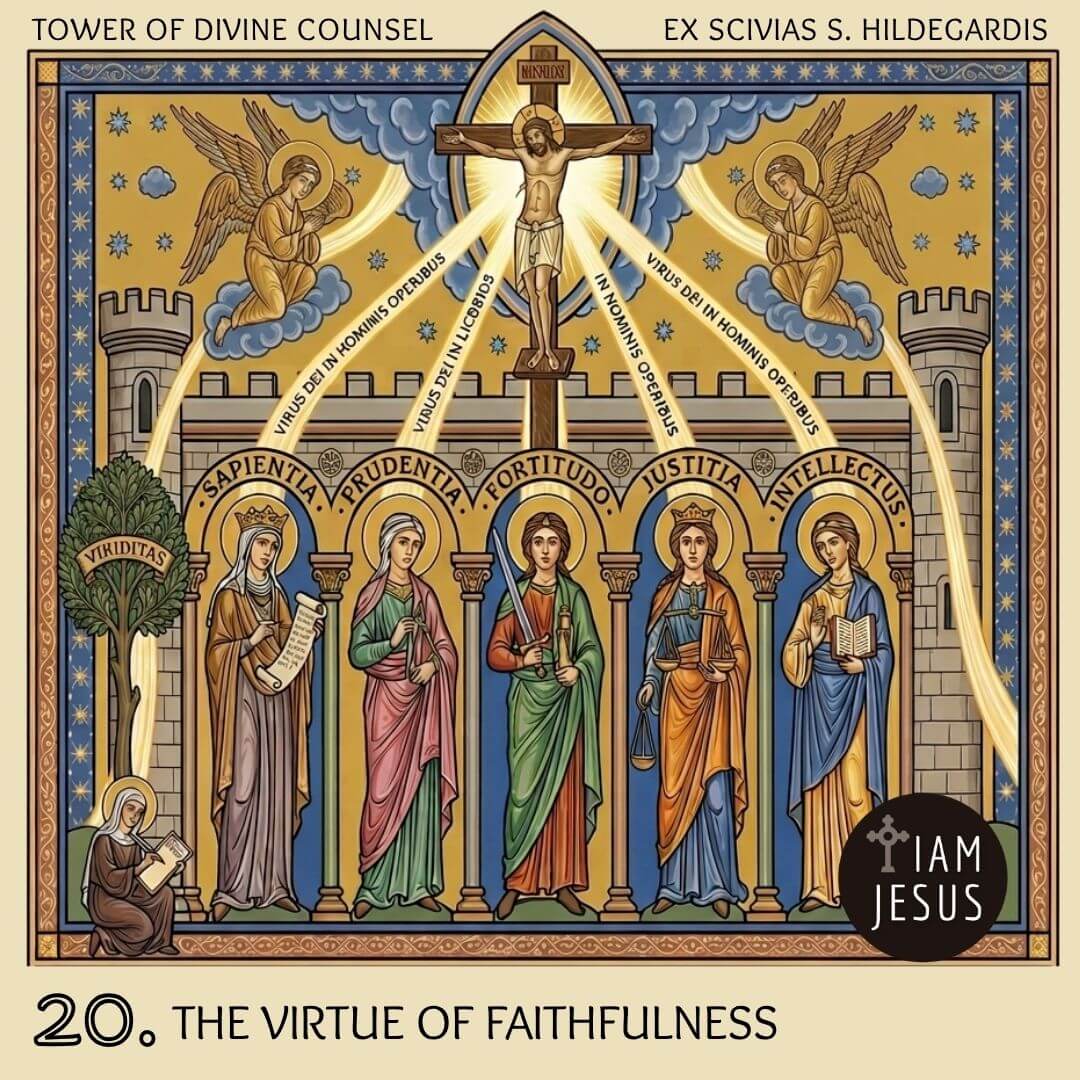
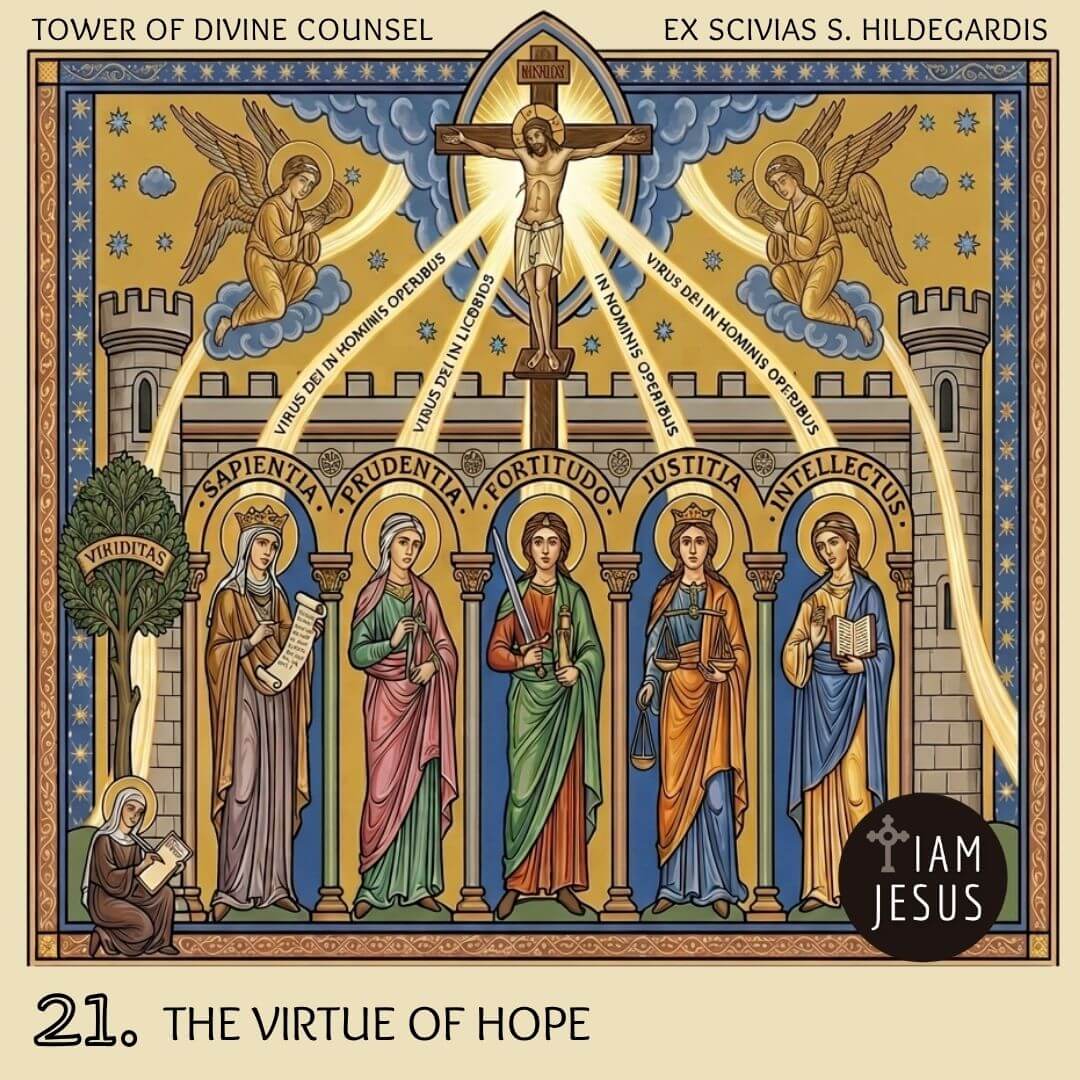
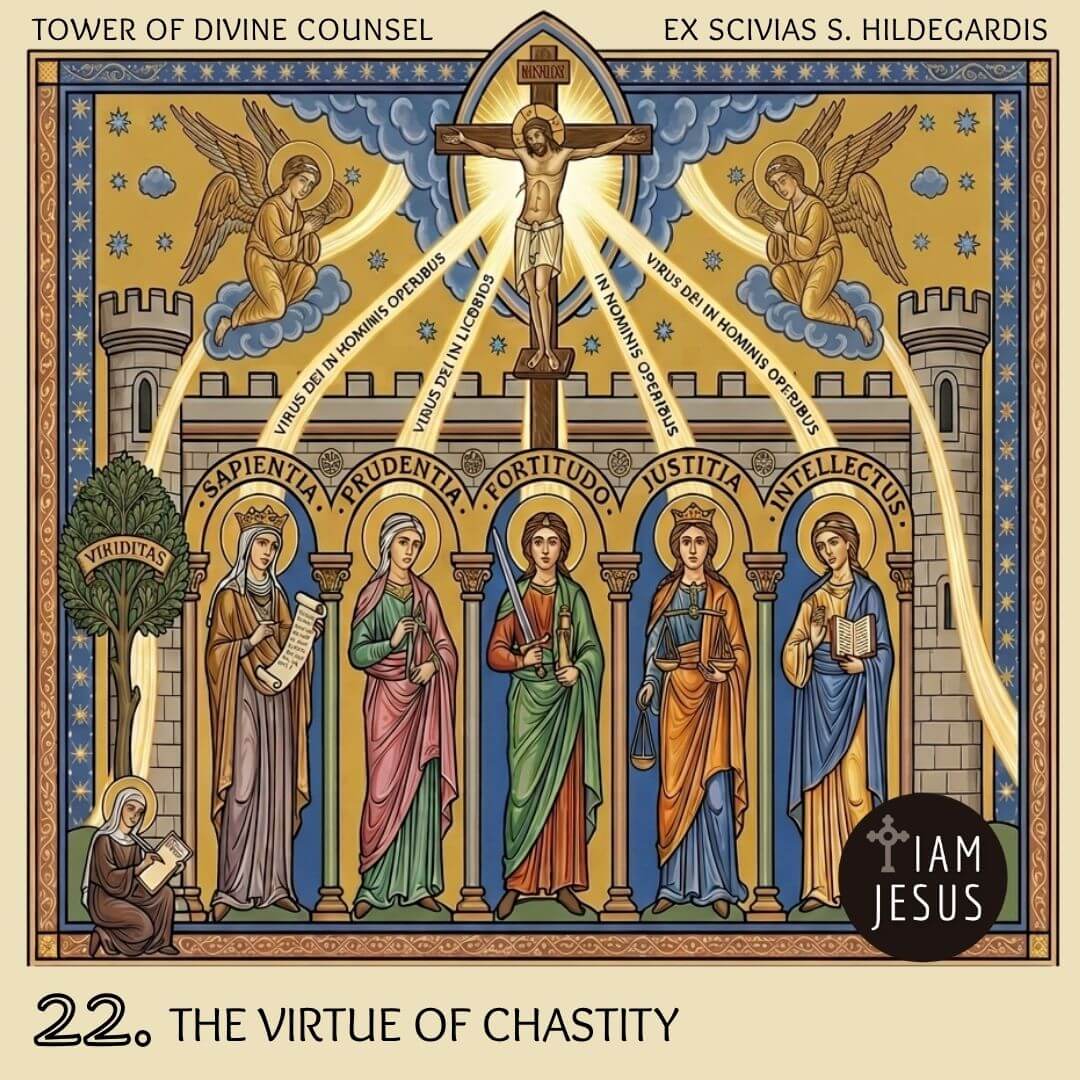
Obedience says it most plainly of all: “I touch nothing, I wish for nothing, I desire nothing, unless it is in God.” That’s not loss. That’s what a will looks like once it has finally stopped needing to be its own author. Faith answers Unfaithfulness not with a counter-argument but with a mirror. She says, “I am a mirror of God” because a surrendered will doesn’t need its own light, only something true to reflect. Hope answers Despair by simply staying rooted: “I draw all the earth to myself,” alive and growing precisely where despair had already given up. And Chastity, last of all, gives the whole chain its final image: “I sit in the sun, and I look at the king of kings” — a will so entirely surrendered that it has nothing left to do but sit still and gaze at the One it belongs to.
Seven different vices, seven different temptations to keep the will clenched around itself— and seven virtues that all answer the same way, in their own particular register: by simply letting go, and discovering that what was on the other side of surrender was never emptiness. It was viriditas, sunlight, and rest.
Part 3 — The Will: Who Do You Obey?
Ready to reclaim your freedom and surrender your life entirely to God? Take the next step in your spiritual journey by exploring the Part 3 meditations below. In this profound chapter of our series, St. Hildegard takes us deep into the human will—the ultimate faculty where we choose to either open our hearts or resist Divine grace. Set aside a quiet moment for your Holy Hour today, dive into the reflections in the grid below, and discover how trading the heavy chains of pride and self-will for the joyful path of humility can completely transform your soul.
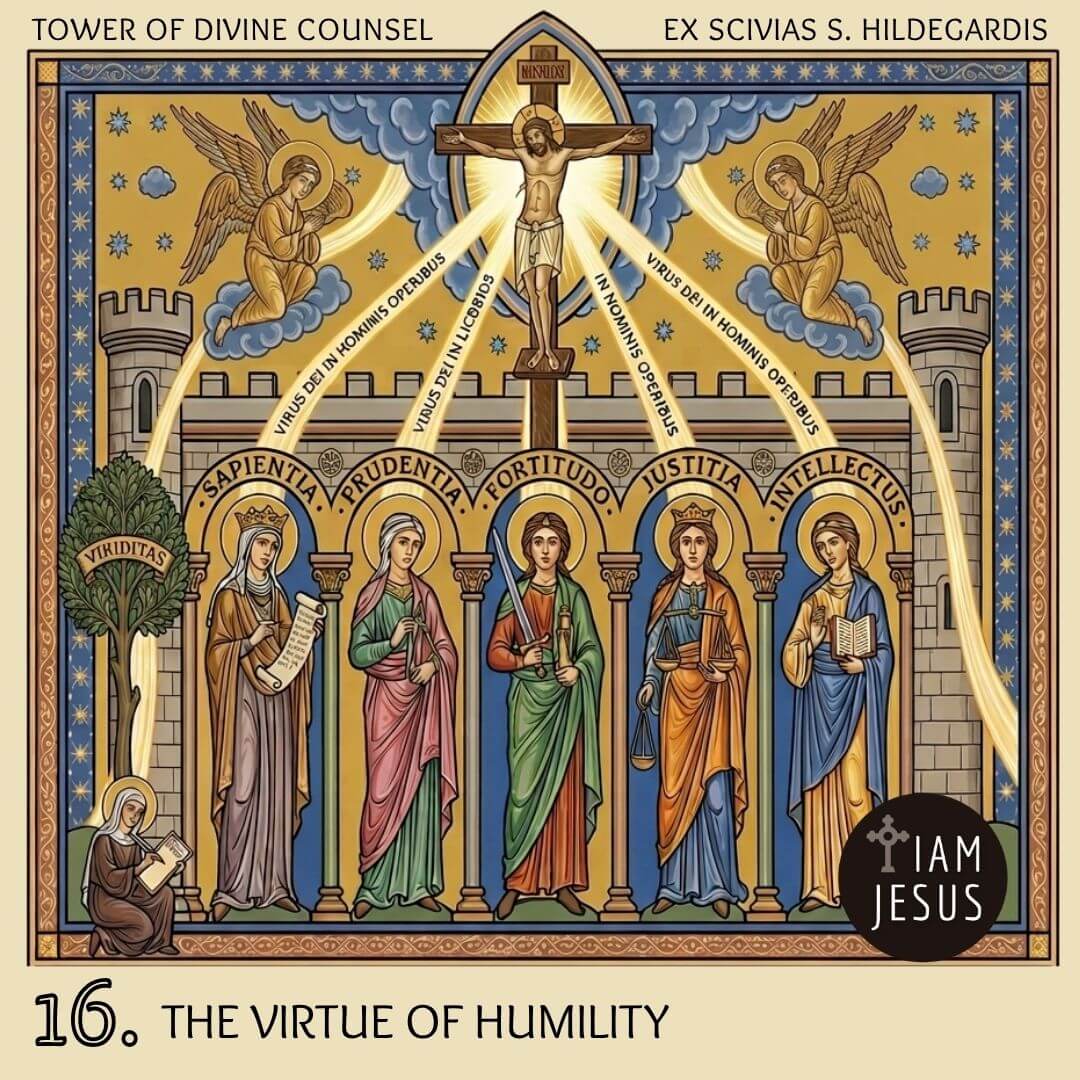
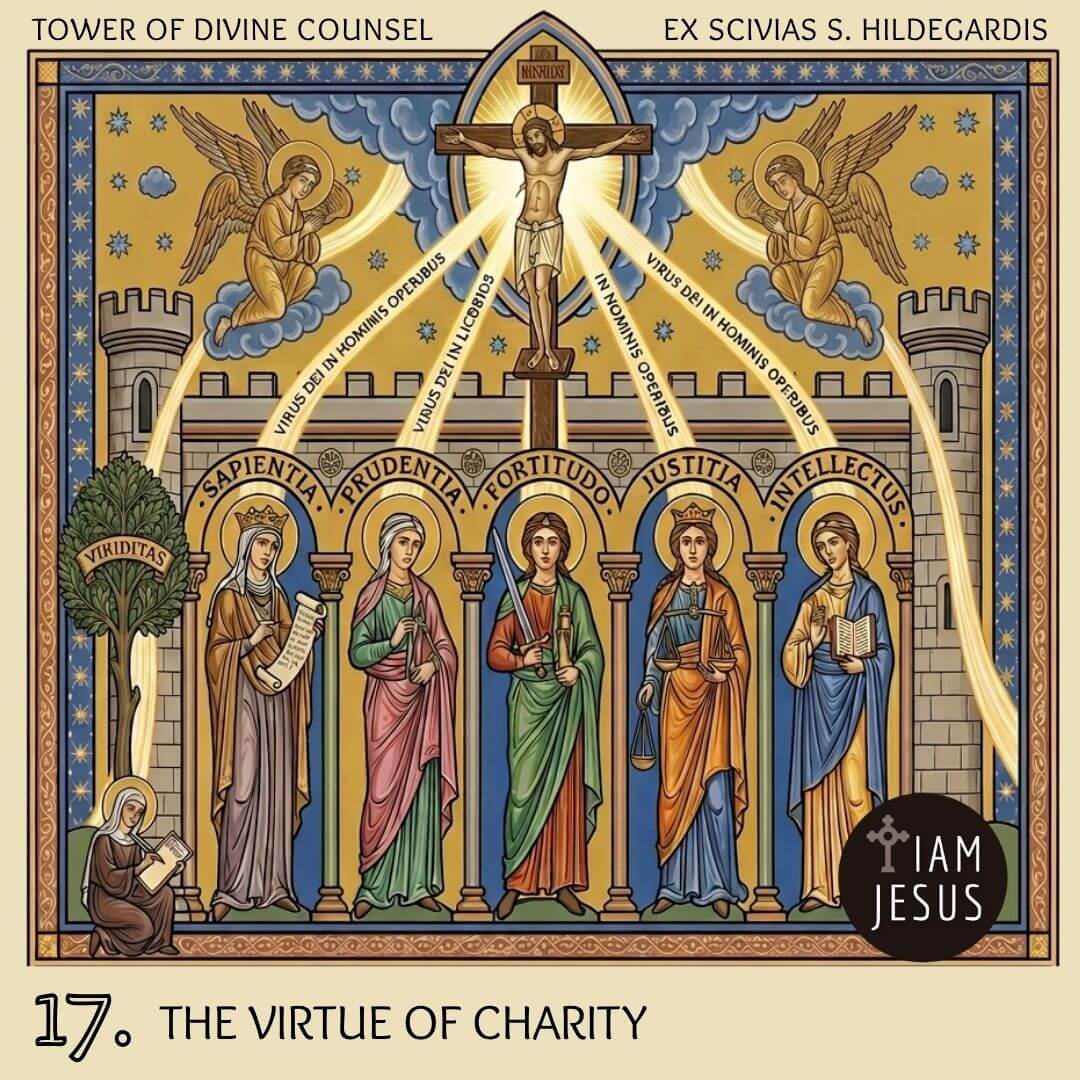

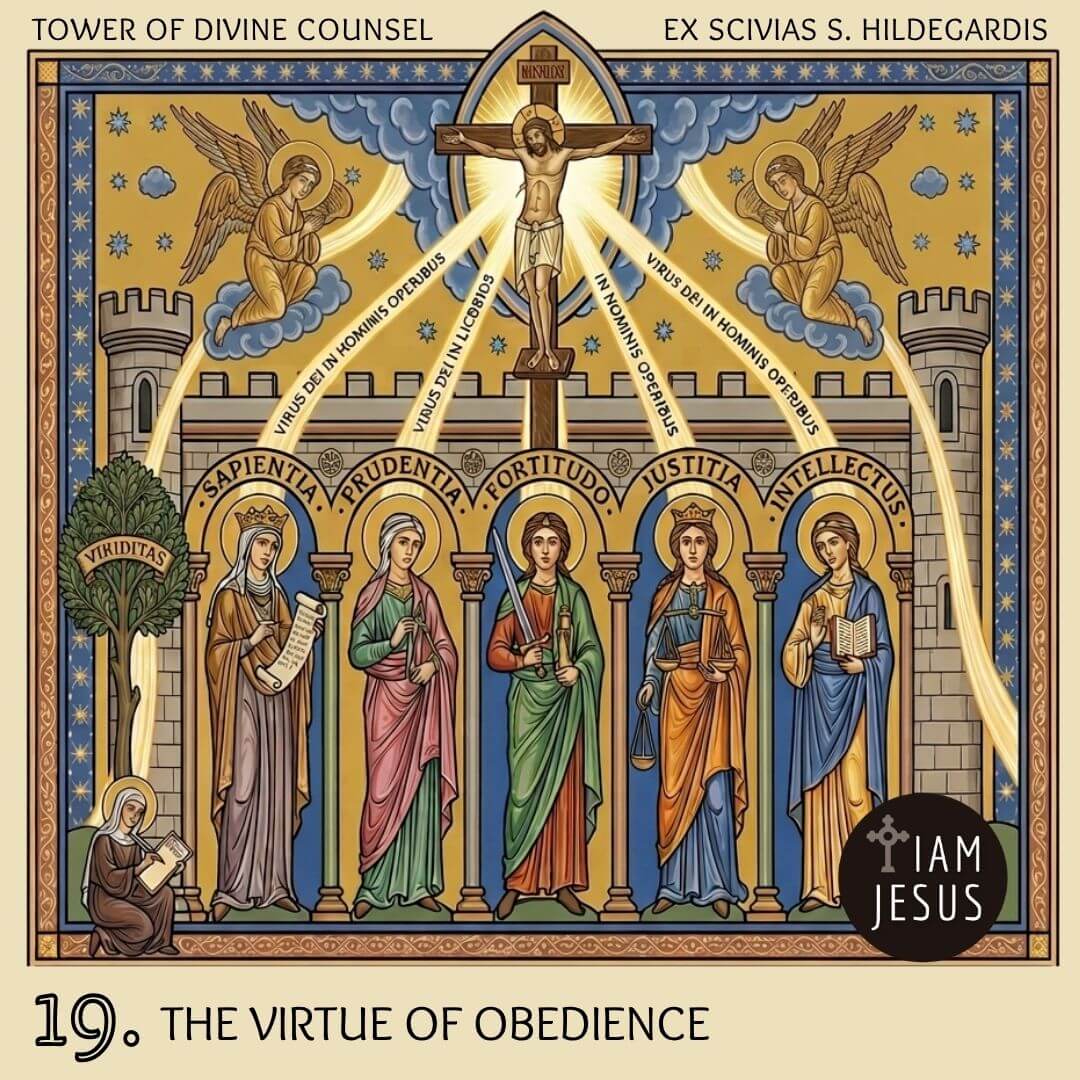
Visit St. Hildegard Virtues the Complete Library Page
This meditation is part of a 35-week prayerful journey through Saint Hildegard of Bingen’s masterpiece, The Book of the Rewards of Life. If you are seeking to step away from the noise and anxiety of the modern world, we invite you to return to our complete St. Hildegard Virtues library, where you can explore the full roadmap for your weekly Holy Hour reflections. There, you will discover all six parts of this sacred series, designed to help you break free from the fog of vice, cultivate the renewing life-force of the Holy Spirit, and build your interior life as a living stone in God’s Celestial City.