
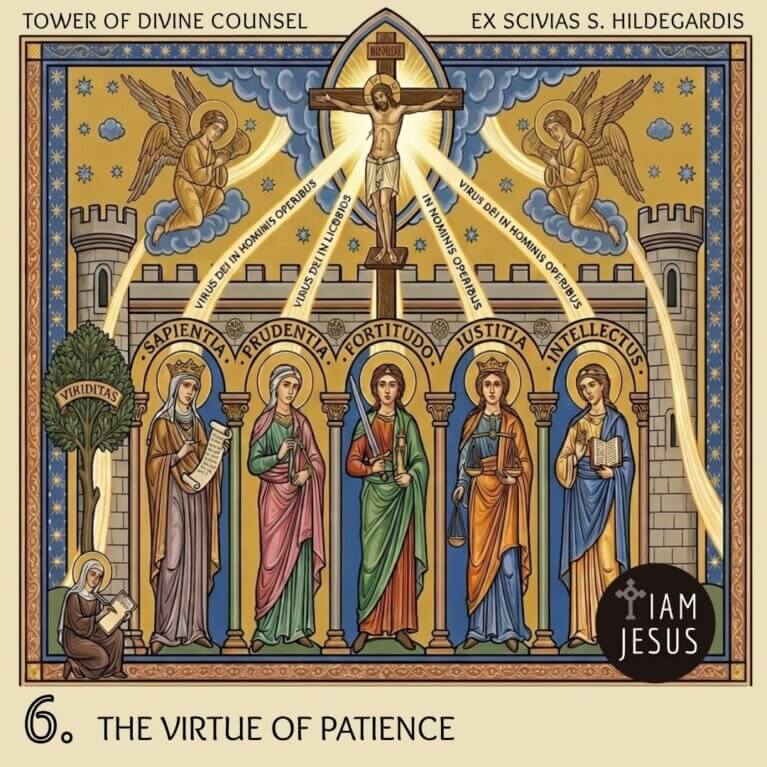
Overcoming Anger and Frustration
Today we contemplate how patience halts the vice of anger. When anger sets your blood on fire, Patience is the balsam. Anger burns; Patience heals. Use this sixth reflection from Part 1 of Liber Vitae Meritorum to anchor your heart in her quiet strength and meet daily frustrations with profound peace.
Opening Prayer
Lord, please help me in controlling my anger and hurt. I see how damaging anger is to the soul and how the virtue of patience can heal it.
Please take away any anger I have hidden in my heart toward the people who have deeply wounded me throughout my life. When those who have hurt me suffer, I should never be joyful about it. You desire mercy and not a sacrifice, Lord (Matthew 9:13). Please give me a pure heart full of patience and love toward my aggressors, and those that have sought to trample on my soul. I do not want the spirit of retaliation or vengeance in my heart, or to have a secret joy when my aggressors encounter suffering.
Let me see my enemies with the eyes of mercy and with a patient hope that they will confess and have a conversion of heart. Please God give me a pure heart that loves them like you do. I surrender any desire for justice to your divine providence, Lord. I say with my heart that justice belongs to you alone.
Give me patience and love so that I’m not pretending to be at peace while secretly holding malice, envy, or unforgiveness in my heart. Come Holy Spirit and increase in me in the virtues of patience and love for each person who has injured me in any way in my past. Help me persevere in patience toward those who still wish to harm me now.
I want to have a heart that desires mercy and is slow to anger. Lord help me grow in the virtue of patience so that I might become more holy and just. I do not want to commit senseless retaliation or rejoice in the suffering of my enemies. With your help, I can obtain the virtue of patience and grow to love my aggressors, giving me the holy desire to pray for their conversion.
AMEN.
“By living with the mind of Christ, Christians hasten the coming of the Reign of God, “a kingdom of justice, love, and peace.” They do not, for all that, abandon their earthly tasks; faithful to their master, they fulfill them with uprightness, patience, and love.”
Catechism, 2046
What Is the Virtue of Patience?
In Catholic moral theology, anger—when unchecked by reason—is a capital vice that acts like a consuming fire, blinding the intellect and destroying supernatural charity within the soul. Saint Hildegard vividly describes this distortion, warning that anger “gnaws away every virtuous grain” and splits the harmony between body and soul. To combat this destructive force, we must actively cultivate the virtue of patience.
Far from being a passive resignation or a mere tolerance of evil, the Catholic virtue of patience is an act of profound spiritual strength. It is a derivative of fortitude and charity that enables the soul to endure bittersweet temporal trials and personal injuries without falling into sadness, bitterness, or the toxic desire for vengeance. By anchoring our hearts in the virtue of patience, we choose to govern our sudden irritations and entrust perfect justice to Divine Providence—transforming our personal wounds into an imitation of Christ, who answered the ultimate violence of the Cross with radical, silent mercy.
Anger is the Worst fault
by St. Hildegard of Bingen
The angry man gnaws away every virtuous grain and devours everything that is germinating. Anger is similar to a stubborn thief. It gnashes its teeth at people because of their worthy gifts from God. For anger instigates controversy wherever it can, and it casts its lot not only in incest but also in the breaking of all the laws of God.
Anger is like a dragon that burns up everything wherever it goes. And it is like a thief who steals things, for anger seizes whatever it can snatch and steal. In anger, wisdom is unwise, and patience strains with impatience, and moderation rushes with the lack of moderation.
Anger is also the bitterness that vomits forth the goodness and sweetness in the precepts and laws of God. It is the murderer who divides body and soul and does not allow them to be together. It is also a hard and immovable rock because it grinds away all good and every justice, whence it is in hell since it wants to agitate the things of heaven.
When it has overcome a man, it leads him beyond itself, and it overcomes him with such great madness because it thinks about neither earthly things nor heavenly things while it grinds away and scatters about the one who was made in the image of God. It draws great torments to itself.
St. Hildegard of Bingen, Liber Vitae Meritorum (The Book of the Rewards of Life),
Part 1, Section 108, Paragraph 126 (Trans. Hozeski)
Reflection:
St. Hildegard saw Anger with a man’s face, but everything else about her was monstrous. Her mouth was a scorpion’s, her eyes so distorted that the whites overwhelmed the pupils. Her arms and hands were human, but gnarled, with long fingernails reaching forward as if to claw. Her chest and back were shaped like a crab’s shell. Her shins were a locust’s, her feet a viper’s. She was tangled inside a great turning wheel, gripping the top rim with her hands and bracing the bottom rim with her feet—never walking forward, only spinning in place. She was trapped by the same fury that she thought was carrying her somewhere. This is the monstrous shape anger takes in a soul.
Anger’s own words: “I will cast down and trample underfoot anything that hurts me… For I will wound you with my sword and I will beat you with my clubs.”
Liber Vitae Meritorum, Part 1, Section 11, Para. 22, trans. Hozeski
From Ignavia to Anger: When Silence Finally Breaks
St. Hildegard doesn’t say Anger grows directly out of Ignavia the way Hard-Heartedness grew out of Jesting’s exhaustion. She calls Anger a “neighbor” to Slothfulness instead—living alongside her, not produced by her in a straight line. And that fits, doesn’t it? Last week we met a soul that calculated the cost of standing up and chose silence instead, again and again. But nothing stays buried forever. All that swallowed anger, all those moments we told ourselves it wasn’t worth the conflict—it doesn’t simply disappear. It waits next door, and eventually it finds its way out, usually sideways, and usually at the worst possible moment. Ignavia and Anger aren’t cause and effect so much as two rooms in the same house: the soul that won’t speak up when it should, and the soul that finally explodes when it shouldn’t. Both are still, in the end, refusing to hand the moment over to God.
Have you ever felt yourself spinning out of control? Anger is a trap. You feel you need to let it out or you will just burst, and in the moment it might feel so freeing to just let it all out, but then afterward you feel trapped by the fury you thought was setting you free.
We have all done something rash in the heat of the moment. Anger can escalate so badly sometimes that you’ll even be blinded by your emotional state and lose control of your ability to remain rational. Sometimes anger grows slowly over time, like a secret resentment toward someone who constantly devalues you, and one day you decided to execute justice with your tongue. Maybe your anger at a person even came to physical blows. Every act of losing control and lashing out in anger always results in remorse afterward.
Our conscience knows we shouldn’t lose control of our temper. It blinds us from justice and leads us to irrational acts. Anger operates out of fear. Patience, however, is a virtue of merciful love. Patience brings about perfect justice through peaceful perseverance in a time of trial. We stand up for what is right in God’s eyes, peacefully, and with merciful love. We desire the justice that God wills and not our own angry revenge.
The Bible tells us the Lord is slow to anger and abounding in mercy, and that he doesn’t deal with us according to what we deserve (Psalm 103:8-10). How can we grow in patience and imitate this holy, persevering kind of love? The Bible offers many examples of holy patience. The most extreme is perhaps the prophet Jeremiah.
The Tower Anger Builds
Patience says something easy to rush past: “When you build your tower I will destroy it with one word and scatter everything in it. You will be destroyed; I, however, will remain for eternity”
Liber Vitae Meritorum, Part 1, Section 12, Para. 23, trans. Hozeski
Anger doesn’t just lash out — she builds. Every grudge held, every score kept, every moment of “I’ll show them” adds another stone. It feels like strength. It feels like protection. But it is a tower with no foundation in God, and Patience promises it will not stand.
This is not a new image in Scripture. It is the tower of Babel — a monument built by human pride, reaching upward without God, and scattered the moment it forgot who it was building for (Genesis 11:1-9). Anger’s tower is Babel in miniature: a private monument to being wronged, built one resentment at a time.
St. Hildegard will show us later in this series exactly where an unchecked tower like this can lead — a soul so given over to itself that it no longer has a body at all, only walls, windows, and grasping hands reaching for nothing but itself. We are not there yet. But it is worth remembering, here at Week 6, that God gives us patience precisely so that we can’t lay the foundation for a tower we will later build to completely shut ourselves off from grace.
The Holy Virtue of Patience in the Prophet Jeremiah
Known as the weeping prophet, Jeremiah served the Lord with patience and love for over 50 years. His prophecies eventually came true and his countrymen eventually did repent but this was not until after Jeremiah’s life had violently ended. He never saw the fruits of the mission God had given him. Jeremiah spent his life begging the people of his generation to repent and turn from their evil ways. He constantly warned that the Lord would seek justice against them for their sins. Jeremiah never backed down and he did not compromise his message of repentance. He persevered with patience.
Opposing Anger and Malice
Jeremiah’s countrymen couldn’t handle the truth of his messages. Their anger and malice led them to commit many evils against him. His own family plotted to kill him (Jeremiah 1:8, 11:21-23, 12:6). His countrymen struck him and put him in the stocks (Jeremiah 20:1-3), a mob attacked him (Jeremiah 26:1-9), and the King even threatened him (Jeremiah 36:26). But Jeremiah never wavered. With great patience and love for God and his people, he continued his mission. Finally, the people stoned him to death in Egypt after years of uncontrolled anger and rage escalated to the point of murder.
God’s Patience
God waits patiently for our repentance. God is patient, merciful, and slow to anger. He calls us and waits for our response. He sends people to minister to us and help us see the error of our ways, so we might repent and turn toward a life of virtue. He doesn’t deal with us harshly. He lets us make bad decisions that lead to bad consequences, and even then, when we cry out to him, he offers us mercy and love. We serve a good God who deserves our praise.
In this way the prophet Jeremiah prefigures Christ. Jeremiah shows us how patience and love lead to sacrifice. Jesus shows us how sacrifice becomes an act of extreme radical love. In the face of pure evil, Jesus responds to the violent hatred of his executioners with peaceful perseverance, and even forgiving them while dying on the Cross.
St. Hildegard describes patience as the virtue that “produces the flowers and fruits of all the virtues.” Patience allows us to persevere while we are suffering. We accomplish patience when the virtue of charity is already in our hearts because patience is born from the virtue of charity.
St. Hildegard gives Patience her own voice, and what she says is striking. She does not call herself strong, or stern, or unshakable, though she is all of those things. She calls herself balsam—poured out over the wound anger leaves behind. ‘I am the sweet air that brings forth greenery, producing the flowers and fruits of all the virtues,’ she says. ‘Everything I begin, I complete, since I persevere'” (Liber Vitae Meritorum, Part 1, Section 12, Para. 23, trans. Hozeski).
Patience in suffering is not the same as tolerating a person’s evil behavior. Human suffering is present in the world due to the effects of original sin. Yes, God may allow suffering for a season of your life. He will allow it as a consequence for your unrepentant sin, to keep you from greater suffering, or to bring about a greater good. But God never condones evil nor does he expect you to tolerate evil and go along with it for his sake. The virtue of patience is not a prolonged tolerance for the evil behavior of another person. Remember, the virtue of patience is exemplified in the life of the prophet Jeremiah who shows us how to have peaceful and prayerful perseverance throughout our lives despite every evil obstacle we encounter.
It’s not enough for us to receive God’s transformational love; as Christians, we also have to give unconditional love to others, especially those who have injured us, and we stand firm in our faith with the virtue of patience. Sometimes our efforts may not be received in the way we would hope, and sometimes a very long period must pass before there is a change of heart and the opportunity for reconciliation.
Sometimes, like with the prophet Jeremiah, we do not have a reconciliation or witness repentance by a loved one in our lifetime. Our patient perseverance should always come from a peaceful place of merciful love. We may receive anger but we must not retaliate with anger. Our patient love will plant a seed that may germinate and later sprout. This is why we hope beyond hope for the conversion of our loved ones away from God.
Have patience!
Going Further:
If you feel yourself in exile, meditate on Jeremiah 29 this week. In verses 1-23 we read a message from the Lord of Hosts to the exiles in Babylon. He tells them the time period of their exile, tells them how to live, and gives them hope for their future. It is a message of love and mercy, and it is asking for the virtue of patience while in exile. Reflect, contemplate, dialogue with the Lord, and possibly journal about what this passage says, relating it to your own life.
Let us Pray:
Now that we understand the virtue of patience, let’s begin with a prayer of petition asking for it.
A Prayer for Transforming Anger into Patient Love
Eternal Father, You know the exact layout of my wounds. You see the deep hurts, the betrayals, and the bitter memories that make my blood boil and tempt me to strike back in anger. I confess that I have often let sudden irritation and secret resentments hijack my heart, blinding me from Your justice and driving me to execute my own revenge with my tongue. By my own human strength, I cannot tame this fire. I desperately need Your grace to soften me.
Jesus, grant me the supernatural virtue of patience. When I am triggered, misunderstood, or unjustly attacked this week, catch my words before they escape my lips. Grant me the grace to pause, breathe, and anchor my soul in Your quiet strength. Strip away all malice, envy, and the sick desire to see my aggressors suffer. Infuse my heart with the virtue of charity—the true root of patience—so that I can meet the chaos of this world with peaceful perseverance. I surrender all desire for vengeance to Your Divine Providence and ask for a heart that hopes, prays, and longs for the conversion of my enemies.
AMEN.
Take a slow, deep breath and rest in the stillness of this moment. Let the anxieties, frustrations, and sudden irritations of your week fade into the background. As you prepare to listen to Jesus speak in this Gospel passage, look closely at the battlefield between human anger and divine patience. Picture a woman who has endured the heavy, crushing burden of her physical deformity for eighteen long years without complaint—a living testament to silent perseverance.
Do not rush through these verses. Read the words slowly and notice the dramatic contrast in the synagogue. Watch how the religious leader explodes with self-righteous, indignant rage over a miracle, while Jesus responds with calm, authoritative, and restorative patience. Christ does not let the hostile, angry environment stop Him from showing mercy. Ask the Lord to reveal where sudden irritation or harsh judgment is paralyzing your own relationships, and where His patient touch needs to straighten your soul. When you are ready, pick up your pen and write His promptings directly into your prayer journal.
Jesus Heals a Crippled Woman on the Sabbath
from the Gospel of Luke Chapter 13:10-17
He was teaching in a synagogue on the sabbath. And a woman was there who for eighteen years had been crippled by a spirit; she was bent over, completely incapable of standing erect.
When Jesus saw her, he called to her and said, “Woman, you are set free of your infirmity.” He laid his hands on her, and she at once stood up straight and glorified God.
But the leader of the synagogue, indignant that Jesus had cured on the sabbath, said to the crowd in reply, “There are six days when work should be done. Come on those days to be cured, not on the sabbath day.”
The Lord said to him in reply, “Hypocrites! Does not each one of you on the sabbath untie his ox or his ass from the manger and lead it out for watering? This daughter of Abraham, whom Satan has bound for eighteen years now, ought she not to have been set free on the sabbath day from this bondage?”
When he said this, all his adversaries were humiliated; and the whole crowd rejoiced at all the splendid deeds done by him.
Let us Pray:
Jesus, in your merciful love you took pity on the crippled woman who patiently suffered her infirmity for 18 years. Lord, she did not ask for healing. She was content with her infirmity, believing it was God’s will for her life. But she was bound by Satan. She came to the synagogue to worship God on the Sabbath, and it was there that she met you.
You were merciful to her and recognized her patience in suffering. You saw that she had a pure heart. You called to her and healed her, causing her to praise God from her heart.
Lord, we clearly see anger in the proud synagogue leader’s response. He was indignant. He rebuked you. Please, Lord, let me not speak rashly when I feel afraid or threatened. Let me have patience and discernment in situations so that I do not rashly judge like the proud synagogue leader.
Lord I see your response to the proud angry leader. You did not tolerate his evil remarks, instead you rebuked them by defending the woman who was healed and set free from the bondage of Satan. Lord, let me remember your strength in the face of evil and let me be strong and patient and persevere when I too am in the face of evil.
Please Lord, help me have patience to endure the trials that are given to me and a heart full of gratitude when my trials have ended. Please let me be merciful and full of love toward my enemies with a heart that desires to pray for their conversion.
AMEN.
A Prayer for an Increase in Virtue for Others
Lord Jesus Christ, you say that when two or more are gathered in your name, you are with us. Jesus, in your name I lift up every person who has joined this prayer challenge or will join it in the future. I ask you to give us all the grace we need to grow in virtue and holiness so that we may love and serve you in our lives and through the people we love and care for. Help us in our thoughts, our words, and our actions. Guide us all by your Holy Spirit and give us the strength to overcome every temptation from the evil one. We ask all this in the name of the Father, and of the Son, and of the Holy Spirit, AMEN.
Thank you for committing to Week 6 and making it this far in your virtue journey. Controlling sudden outbursts of anger and healing deep-seated hurts takes profound spiritual courage, and Jesus sees your hidden efforts. When you inevitably get triggered, feel your blood boil, or fall back into sudden impatience this week, do not let discouragement take over. If you slip up, do not beat yourself up—growing in holiness is a daily process. Take immediate accountability, bring it to Confession, and let His grace renew your strength.
As you leave this chapel and step back into a chaotic world, protect your interior peace by practicing holy patience in the initial moments of temptation. If you feel yourself starting to react, try holding your tongue immediately and praying, “Jesus, mercy” several times before you speak. If a situation becomes overwhelming, remove yourself right away to find a quiet place for prayer. Our Lord is incredibly patient, full of kindness, and slow to anger with us; let us show that same radical, patient love to ourselves and to the neighbors who cross us this week.
As you walk out of this chapel and step back into a chaotic, reactionary world that constantly rewards anger, short tempers, and instant retaliation, guard your interior peace. True patience isn’t a sign of weakness; it is an act of ultimate spiritual power. You are called to actively govern your sudden irritations, breathe through the chaos, and protect your soul from the biting fires of resentment.
St. Hildegard says this herself, in a different one of her writings, where Patience declares: “I am the pillar that can never be made to yield, for my foundation is in God.” The other virtues answer her: “You who stay firm in the rocky cavern—you are the glorious warrior who endures all.” Patience is not the absence of a fight. It is the only kind of warrior who never loses, because she never needed to strike first.
Patience and the Virtues, Ordo Virtutum, p.5, trans. Dronke
To see exactly how the Church expects us to live out this radical endurance while navigating our daily responsibilities—reminding us that true followers of Christ fulfill their earthly duties with uprightness, patience, and love to hasten the coming of His Kingdom—look at the standard laid out right here in the Catechism:
By recalling the commandment, “You shall not kill,” our Lord asked for peace of heart and denounced murderous anger and hatred as immoral.
Anger is a desire for revenge. “To desire vengeance in order to do evil to someone who should be punished is illicit,” but it is praiseworthy to impose restitution “to correct vices and maintain justice.” If anger reaches the point of a deliberate desire to kill or seriously wound a neighbor, it is gravely against charity; it is a mortal sin. The Lord says, “Everyone who is angry with his brother shall be liable to judgment.”
Catechism, 2302
Make a Resolution
Take a moment to reflect on the virtue of patience. What are the ways you can freely practice this virtue this week? Ask the Lord to give you opportunities, and when you feel the Holy Spirit prompting you, take action. Write down your resolutions for this coming week in your prayer journal. Remind yourself to complete these resolutions daily for this entire week, and as the Spirit prompts you, feel free to write about your experiences with this virtue throughout the week.

In My Thoughts:
Jesus, this week I promise to take time daily to conform my thoughts by… (make your intention).
In My Words:
Jesus, this week I promise to take time daily to conform my words by… (make your intention).
In My Actions:
Jesus, this week I promise to take time daily to conform my actions by… (make your intention).
Praying for the virtue of a Merciful Heart
You may also want to pray St. Faustina’s Mercy Prayer. The Mercy Prayer asks God for a compassionate heart filled with love for your neighbor. This prayer asks the Lord to give you merciful eyes, ears, tongue, hands, feet and heart. Pray the Mercy Prayer.
Join our Virtue Meditation Prayer Challenge
Don't let spiritual overwhelm hold you back!
Let us guide you step-by-step through Saint Hildegard’s transformative path to holiness.
Receive one long-form meditation in your inbox each week—perfect for a powerful 35-minute holy hour.
