
I Do Not Live on Bread Alone, Jesus Feeds My Soul
Are you ready to spend some time with the Lord? If you are new to mental prayer, we invite you to visit our guide on how to pray to learn more.
We begin Week 1 of our Sunday Lenten Challenge with this opening prayer:
Trust And Believe
Lord,
I believe you want to give me the grace to go deeper in prayer this Lent. Help me to be present to you so that I’ll intimately pray these next 15 minutes with my heart fully open and willing to receive that grace. Please help me open my heart and pray with more intensity. I want to be able to visualize myself with you so I can feel your presence more intimately in my life this Lent. Lord, give me the grace I need as I strive to complete these 6 days of Sunday Lenten meditations. I am choosing to take up my cross and humbly follow you all the way to Calvary and I want to do it with my whole heart.
AMEN.
How He Feeds My Soul
Let’s contemplate the mercy of God this Lent. What does it mean to have your soul fed? To be filled with God’s loving mercy? Let’s meditate on these things in the presence of Christ and offer ourselves to Him in prayer.
Prayer to the Holy Spirit
Holy Spirit,
I believe you are truly here and present to me right now. I desire to be present to you.
Thank you for being so faithful to me, even in my darkest moments. Help me recognize your voice and give me the grace to obey it.
You are faithful to me even when I am not. Please do not let me take your covenant of love for granted. Do not let me forget the price Jesus has paid for my soul.
Every time I have sinned and repented I experience your faithful covenant. Thank you for always forgiving me. I am grateful to you for sustaining me through every trial in my life. Please give me fortitude and the willingness to obey you. I reject any unrighteous thoughts. I reject my unrighteous moods, and I thoroughly reject my disobedience to your divine will for my life.
Breath on me as I spend these next 15 minutes fixated on today’s Mass readings. Holy Spirit, help me pray with humility, honesty, love and affection. I want to grow in virtue and holiness.
Thank you, Holy Spirit, for every consolation, desolation, time of silence, difficult trial, and temptation of the evil one. I understand that you love me and that everything in my life happens by God’s holy will, whether it be divine providence or God’s permissive will due to my sin and negligence.
Please humble me as I walk with Jesus toward Jerusalem. Help me prove my faithfulness and do so with great love in my heart.
AMEN.
Say Nothing Just Take Him In
Spend 1-3 minutes in silence gazing at the Lord with love and gratitude, in a prayer of silent contemplation.
Make a Movie in Your Mind
The sun bakes down on your shoulders as you walk the dusty trail toward the Jerusalem Temple, your sandals kicking up small clouds of earth. You are holding a basket woven from local reeds containing golden wheat and barley, plump grapes, sweet figs, deep red pomegranates, glistening olives, and sticky dates.
When your turn arrives in the bustling sanctuary courtyard, you step forward to face the presiding priest. You lift the woven basket as the priest steps toward you and places his hands beneath yours, supporting the weight of the harvest. Together, you elevate the basket toward the altar as you recite the foundational creed of your people, your voice steady with awe: “A wandering Aramean was my father…”
You feel deeply connected to your history as you recount your people’s journey from humble, nomadic roots through Egyptian bondage, and finally into the security of the promised land. Placing the basket beside the altar, you step back and bow in deep thanksgiving, knowing that the sweet fruit before you is living proof that the promises made to your ancestors have been kept…
Our Merciful God Hears Our Cries
Deuteronomy 26:4-10
The priest shall then take the basket from your hands and set it in front of the altar of the LORD, your God. Then you shall declare in the presence of the LORD, your God,
“My father was a refugee Aramean who went down to Egypt with a small household and lived there as a resident alien. But there he became a nation great, strong and numerous.
When the Egyptians maltreated and oppressed us, imposing harsh servitude upon us, we cried to the LORD, the God of our ancestors, and the LORD heard our cry and saw our affliction, our toil and our oppression.
Then the LORD brought us out of Egypt with a strong hand and outstretched arm, with terrifying power, with signs and wonders, and brought us to this place, and gave us this land, a land flowing with milk and honey. Now, therefore, I have brought the first fruits of the products of the soil which you, LORD, have given me.”
You shall set them before the LORD, your God, and you shall bow down before the LORD, your God.
Let us take a moment to reflect on the message in the first reading.
The Israelite in Deuteronomy doesn’t just bring God a basket of fruit — he brings God the best of what he has, the first and finest of a harvest God himself provided. And notice: he doesn’t just set it down and walk away. He speaks. He tells the whole story of his own deliverance out loud, before the priest, with his own mouth. Nothing has changed today. When the gifts are carried up the aisle at every Mass —the bread and wine— you are that Israelite. You are bringing God your best, the fruit of your heart’s labor, and He takes your small offering and gives you back infinitely more than you gave. But like the Israelite, you can’t just set your gift down passively and expect grace to happen to you. God asks you to cooperate. This means bringing your gifts, speaking your confession, and offering yourself along with your gift.
This is exactly what Paul means when he tells the Romans that the word of faith is “in your mouth and in your heart.” We believe with the heart, and confess with the mouth (Romans 10:8-10). Faith isn’t meant to stay silent and interior, tucked away where it costs you nothing. Like the Israelite standing before the priest with his basket, you are asked to give voice to what God has done for you, and to give it freely, trusting him rather than testing him.
You show that trust by offering yourself to God simply because he asks, without demanding proof or a sign first.
Be Completely Real
Ask yourself if you are really bringing God your first fruits, or if you could do better. The next time you come to Mass, take some time to pray before, during, and after communion a heartfelt offering of yourself back to God in thanksgiving for his gift. Try to do like the Israelites and bring a basket full of you best gifts and lay them at the altar.
Let us continue our mental prayer with today’s Gospel:
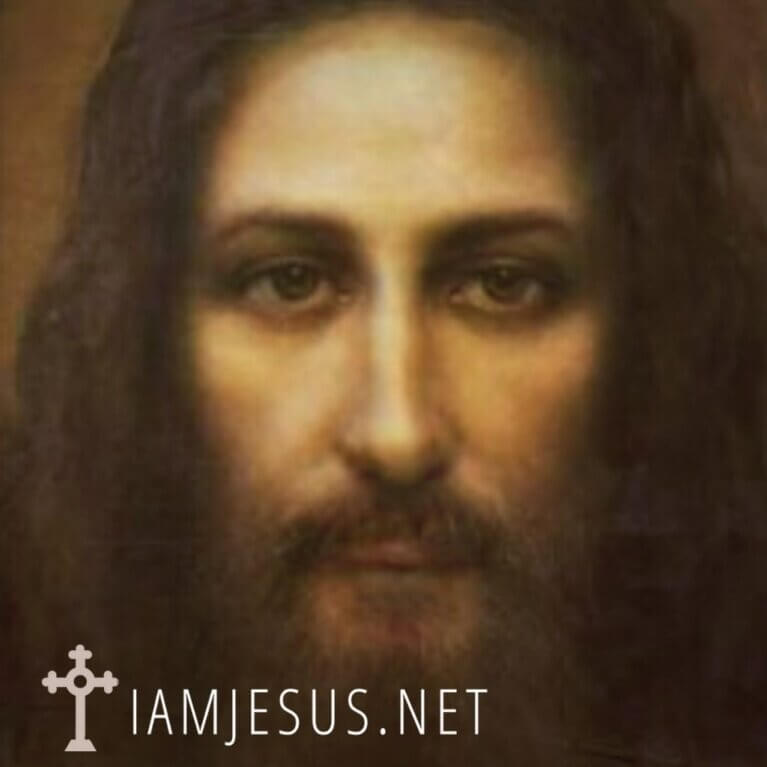
Visualize Christ
You stand at the edge of the wilderness, where the last patch of green scrub gives way to bare, sunburnt stone stretching toward Mount Quarantania. The wind here is dry and constant, carrying dust that stings your eyes and settles on your lips like ash. Before you go any further, you notice him. It’s Jesus, still damp from the Jordan and walking alone. You see him pausing at the threshold of the barren desert.
Then he turns and looks directly at you. For a moment nothing else exists but his gaze. His look is not stern; instead it’s soft and full of tenderness, the way a father looks at a child he knows will stumble and needs tender guidance. He lifts his hand toward you, quietly, and blesses you, as if to say stay close to me, even here, especially here. Then he turns back toward the wild, empty silence and walks forward into the heat, alone. You know where he is going. He is taking up the battle for you….
into the Desert to Pray
Luke 4:1-13
Filled with the holy Spirit, Jesus returned from the Jordan and was led by the Spirit into the desert for forty days, to be tempted by the devil. He ate nothing during those days, and when they were over he was hungry.
The devil said to him, “If you are the Son of God, command this stone to become bread.”
Jesus answered him, “It is written, ‘One does not live by bread alone.’”
Then he took him up and showed him all the kingdoms of the world in a single instant. The devil said to him, “I shall give to you all this power and their glory; for it has been handed over to me, and I may give it to whomever I wish. All this will be yours, if you worship me.”
Jesus said to him in reply, “It is written: ‘You shall worship the Lord, your God, and him alone shall you serve.’”
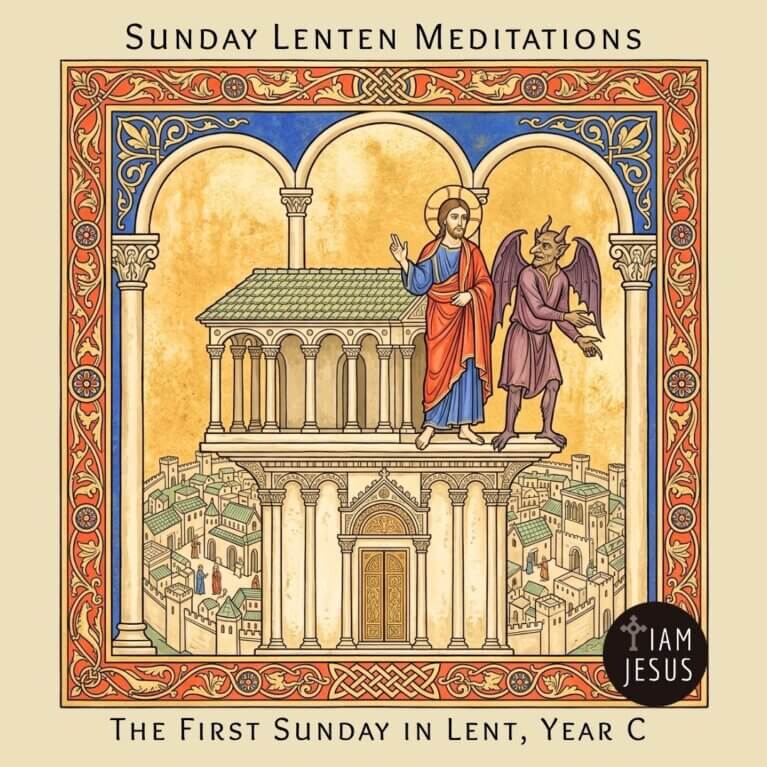
Then he led him to Jerusalem, made him stand on the parapet of the temple, and said to him, “If you are the Son of God, throw yourself down from here, for it is written: ‘He will command his angels concerning you, to guard you,’ and: ‘With their hands they will support you, lest you dash your foot against a stone.’”
Jesus said to him in reply, “It also says, ‘You shall not put the Lord, your God, to the test.’”
When the devil had finished every temptation, he departed from him for a time.
When we picture Jesus at the edge of the desert, giving you that gaze of mercy before walking forward alone, we begin to understand something deeper about why he entered the wilderness at all. He didn’t need to fast for forty days or feel the ache of real hunger to defeat the devil — he chose to, so that his victory would be won from inside the very weakness you and I live in every day.
Scripture tells us that our great high priest is not one unable to sympathize with our weaknesses, but one tested in every way as we are (Hebrews 4:15). This is mercy in its most intimate form: God did not stay at a safe distance from your hunger, your exhaustion, or your vulnerability to temptation. He walked directly into it, so that when you are famished, worn down, or cornered by the enemy, you have a Savior who has been there too. Jesus is not a distant judge, but he is the one who looks at you with love before he walks into that desert to face temptation.
When we see Jesus take this stand against the devil, we remember how the Israelites brought their baskets full of their best offerings to God and praised him for all his blessings. Obedient love brings its basket and speaks its confession; temptation asks God to prove himself first. Jesus, hungry and weak as he was, still refused to test the Father — and it’s that same merciful gaze he gave you at the desert’s edge that gives you the strength to reject that temptation too.
Jesus affirms this with his final answer to the devil, “You shall not put the Lord, your God, to the test.”
Are You Listening?
Have you ever taken the time to remember God’s blessings through the major moments of your life? You have your own Gospel story, a story of God’s love and fidelity to you personally.
This week we learned about the importance of proclaiming with our mouths what is in our hearts when we bless and honor God for all the goodness he has given us. Paul reminds us that there is no distinction — Jew or Greek, faithful your whole life or only just returning — because everyone who calls on the name of the Lord will be saved (Romans 10:12-13). That gaze Jesus gave you at the edge of the desert was never reserved for someone holier or stronger than you. It was for you, specifically, in whatever situation you find yourself in today.
Try taking a few moments right now to make your own confession of faith — not just believed quietly in your heart, but spoken, out loud if you’re able, the way the Israelite spoke his over the basket. Call on him. He is already looking at you just like on the edge of that desert — with mercy and not judgment.
Jesus, thank you for entering the wilderness before me, and for never leaving me to face my own temptations alone. Give me the grace to recognize your merciful gaze even in my hardest, most barren moments, and the courage to call on your name when the enemy tries to make me doubt your love. Let my mouth confess what my heart already knows to be true: that you are Lord, and that you alone are worthy of my worship. AMEN.