
Pride refuses to submit. Humility already has.
Envy can’t bear to see someone else honored. Charity never needed to be.
Every warning sign we’ve traced in this series shares one root, and every one of them has the same answer. Not a clever argument. Not a competing claim to authority. Just a will that finally stops needing to defend itself, and discovers what was waiting on the other side. This is Part Four, the final piece in our False Prophecy series.
What Does Surrender to God Actually Look Like?
From childhood, St. Hildegard of Bingen received what she called visions of the “living Light.” But she didn’t rush to proclaim them. For years, she told no one, not because she doubted God, but because she doubted herself. She feared her visions might be nothing more than her own imagination rather than anything from God, and that fear kept her quiet far longer than pride ever would have allowed.
When she finally did write her visions down, at her confessor’s direction, she didn’t publish them or start teaching from them. She wrote directly to St. Bernard of Clairvaux, the most respected churchman of her age, and asked him plainly whether he believed what she’d experienced was genuinely from God. She described herself in that letter as “untaught and untrained,” someone who could barely read on the most elementary level, and asked for his honest judgment rather than his flattery.
St. Bernard’s response was cautious. He didn’t fully vouch for the content of what she’d seen. He simply encouraged her to continue. And that was enough for her, because what she wanted wasn’t a rubber stamp. She wanted a trustworthy answer, whatever it turned out to be.
From there, her writing went to her archbishop, and eventually to Pope Eugenius III himself, who had a portion of her work read aloud before the assembled bishops at the Synod of Trier in 1147. Only after that formal, public examination did the Pope authorize her to continue writing and speaking. She didn’t declare her own authority. She waited for it to be recognized, by the very authority Christ left His Church to make exactly this kind of judgment.
That’s what real humility before real mystical experience looks like. Not silence forever, and not self-proclaimed authority either, but a soul willing to hand over what it received and wait for someone else to say whether it was genuine. Nearly nine hundred years later, the Church still holds her writing up as a model of authentic sanctity, precisely because she never once tried to skip that step.
Humility in Action: How Pride’s Chain Reaction Gets Answered
Once humility takes root and clears the ground pride was occupying, the very next thing that has to be answered is envy, the hunger to see yourself honored above everyone else. This is exactly where charity does her work.
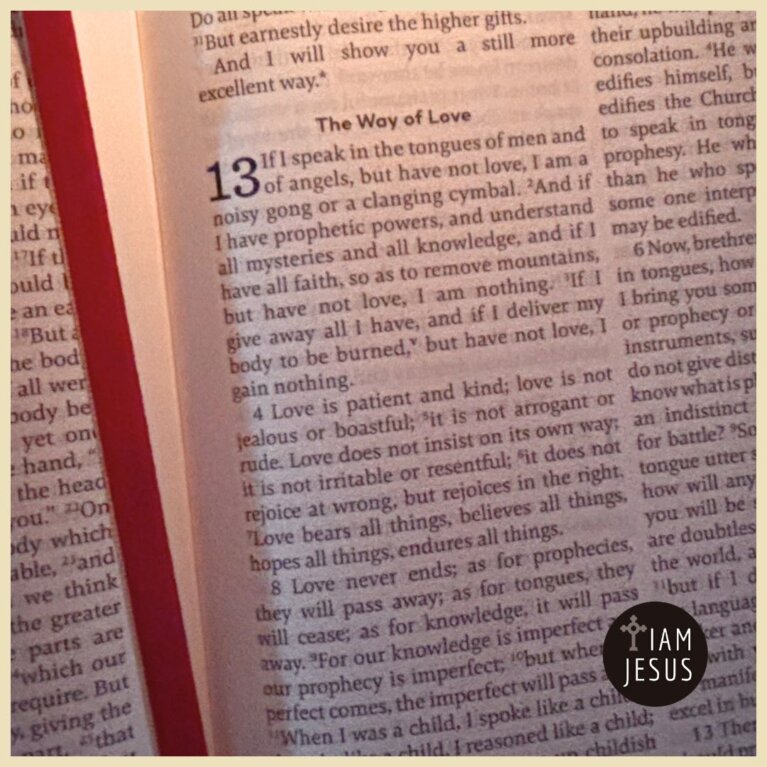
Charity doesn’t defend herself against comparison. She doesn’t need to be seen as greater than anyone else. Scripture describes her plainly: “Love is patient, love is kind. It is not jealous, it is not pompous, it is not inflated, it is not rude, it does not seek its own interests” (1 Corinthians 13:4-5). A soul that has genuinely learned to love this way has no room left for envy, because envy needs comparison to survive, and real charity has stopped comparing altogether.
Here’s why getting this one right matters so much. If envy is never actually subdued, it doesn’t just stay envious. It keeps moving. Unanswered envy curdles into a hunger for recognition, a need to be praised, admired, and set apart from everyone else. That’s where fear of the Lord has to step in.
Real fear of the Lord isn’t being afraid of God the way you’d be afraid of an enemy. Scripture calls it something closer to reverence and wisdom: “The fear of the LORD is the beginning of wisdom” (Proverbs 9:10), and the Psalmist calls it “the beginning of wisdom” as well, adding that “prudent are all who practice it” (Psalm 111:10). It’s the fear of ever offending Someone who loves you completely, the same instinct that makes you careful with someone precious to you, not because you dread them, but because you can’t bear the thought of hurting them. A soul with real fear of the Lord has no room left for chasing praise, because it’s too busy watching over its own heart, careful not to grieve God even in small ways.
That fear is what quietly starves the hunger for recognition before it ever gets the chance to grow. Without it, that hunger, once it’s tasted admiration, stops tolerating correction from anyone. Refusing correction long enough costs a soul its ability to trust anyone at all, including God. A soul that can’t trust eventually gives up hope. And a soul that’s given up hope removes the last restraint on itself entirely.
That’s not an abstract worry. Remember Palmar de Troya from our last piece. It began with one man who couldn’t be content simply sharing what he’d seen; he needed to be honored as a bishop, then as pope, then as the sole legitimate voice of Christ on earth. There was no fear of offending God anywhere in that story, only a hunger to be honored that grew bigger at every stage. That hunger curdled into open defiance of every correction Rome offered him, then into a movement that broke entirely from the Church he claimed to be restoring, and, a generation later, into a successor who abandoned his vows outright once nothing was left to hold him to them. One unanswered hunger for recognition, with no fear of God to check it, ran that far.
Charity and fear of the Lord together could have stopped that whole collapse before it ever gathered speed. Scripture actually ties these two together directly: “The fear of the Lord is glory and exultation, and gladness, and a crown of joy” (Sirach 1:11), while charity is “the greatest” of the virtues that remain (1 Corinthians 13:13). A soul that gives freely and reveres God completely has already lost its taste for everything that unanswered hunger leads to next.
Where This Comes From
Everything we’ve traced across this series, pride’s chain reaction, and the humility, charity, and reverence that answer it, comes from St. Hildegard, who was later declared a Doctor of the Church for the depth and soundness of her teaching. She wrote extensively on the virtues and how they answer one another, work that has stood the test of nearly nine hundred years precisely because it never asked anyone to take her word alone. She submitted every word of it to the Church’s own authority first, the same submission we saw her practice with St. Bernard of Clairvaux and Pope Eugenius III earlier in this piece, and only then did her writing become something the whole Church could safely learn from. If you’d like to spend real time with her full teaching on all thirty-five virtues, we’ve built an entire series called the St. Hildegard Virtues, the Complete Library, at whatever pace you’d like to take it.
That’s really the whole thesis of everything we’ve covered together. Test what you’re given. Submit it to real authority. Watch for good fruit patiently. Choose devotions that are already approved by the Church and catechize yourself. Be fully formed in the faith in the same ordinary way the saints were formed: through Scripture, through the Sacraments.
Explore the False Prophecy Series
Discernment isn’t a single lesson, it’s a practice, and each piece in this series builds on the last. If this one struck a chord, the rest are waiting for you below, along with our full report for anyone who wants to go even deeper.

Want to go deeper? Read our full report on discernment and false prophecy: How to Recognize a False Prophecy: Catholic Discernment