Miraculously Saved from the Ashes of WWII
St. Hildegard of Bingen’s 12th century visionary art is phenomenal to behold and has been miraculously preserved in a way that is only possible through the Holy Spirit’s guidance. Discover the story of her visionary art and how it was preserved, and also why our website does not display her artwork on our meditation pages.
A Miraculous Rescue and Recovery
When you look upon the striking, iconic images of St. Hildegard’s visions today — such as the fiery tongues of divine inspiration pouring into her mind — you are witnessing a historical miracle of preservation. The original illuminated manuscript, the legendary Rupertsberg Scivias Codex (ca. 1175), was hidden in a Dresden bank vault for safekeeping during World War II.
Tragically, amid the catastrophic bombings of 1945 and the chaotic aftermath of the war, the priceless original codex completely vanished and is presumed permanently destroyed. However, Divine Providence had already set a rescue mission in motion. Years before the war, between 1927 and 1933, the historic manuscript was temporarily loaned to the Abbey of St. Hildegard in Eibingen. For six meticulous years, four dedicated Benedictine nuns hand-copied the text word-for-word and painstakingly replicated all 35 vivid miniatures stroke-for-stroke. Because of their heroic precision, the nuns’ hand-painted recreation became the only surviving full-color record of Hildegard’s visions in the world, saving her visual legacy from total erasure.
In recent years, this legacy has been brilliantly revitalized by the exhaustive academic research of scholar Sara Salvadori. In her landmark volumes, Salvadori maps out the complex, hidden theological and geometric architectures within these illuminations, showing how they flawlessly connect the human soul to the macrocosm of God’s creation. Today, you can explore these historic masterworks through the Abbey of St. Hildegard’s Official Scivias Gallery, or immerse yourself in Sara Salvadori’s Academic Architectural Review.
Experience the Reproduction
To truly understand the awe-inspiring beauty of the artwork saved from the ashes of WWII, you can watch a video of the facsimile. This is a valuable visual library resource of her original works. See the early 20th century reproduction work of the Benedictine daughters from the Abbey of St. Hildegard in Eibingen who hand-painted them.
Our Own Artwork for This Series
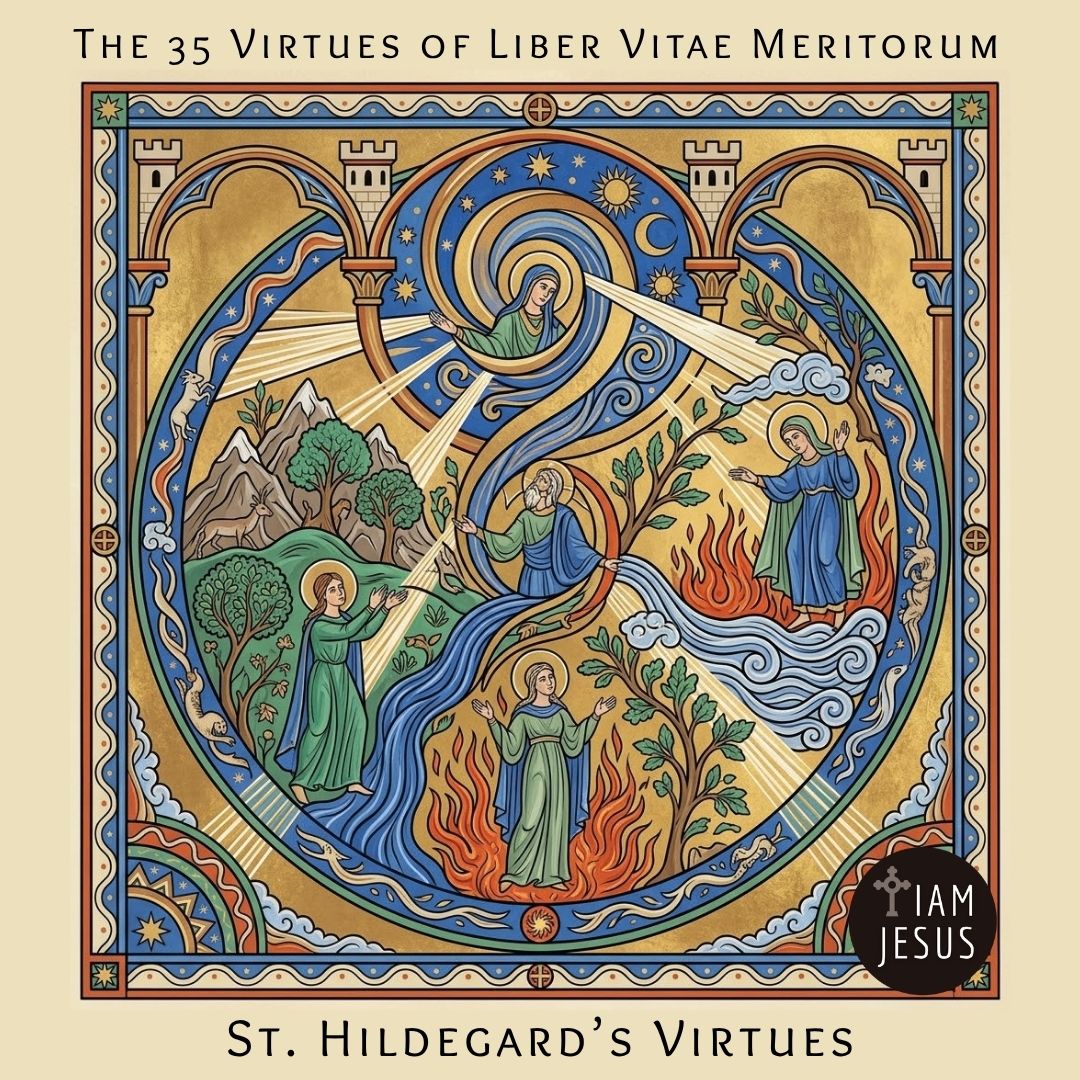
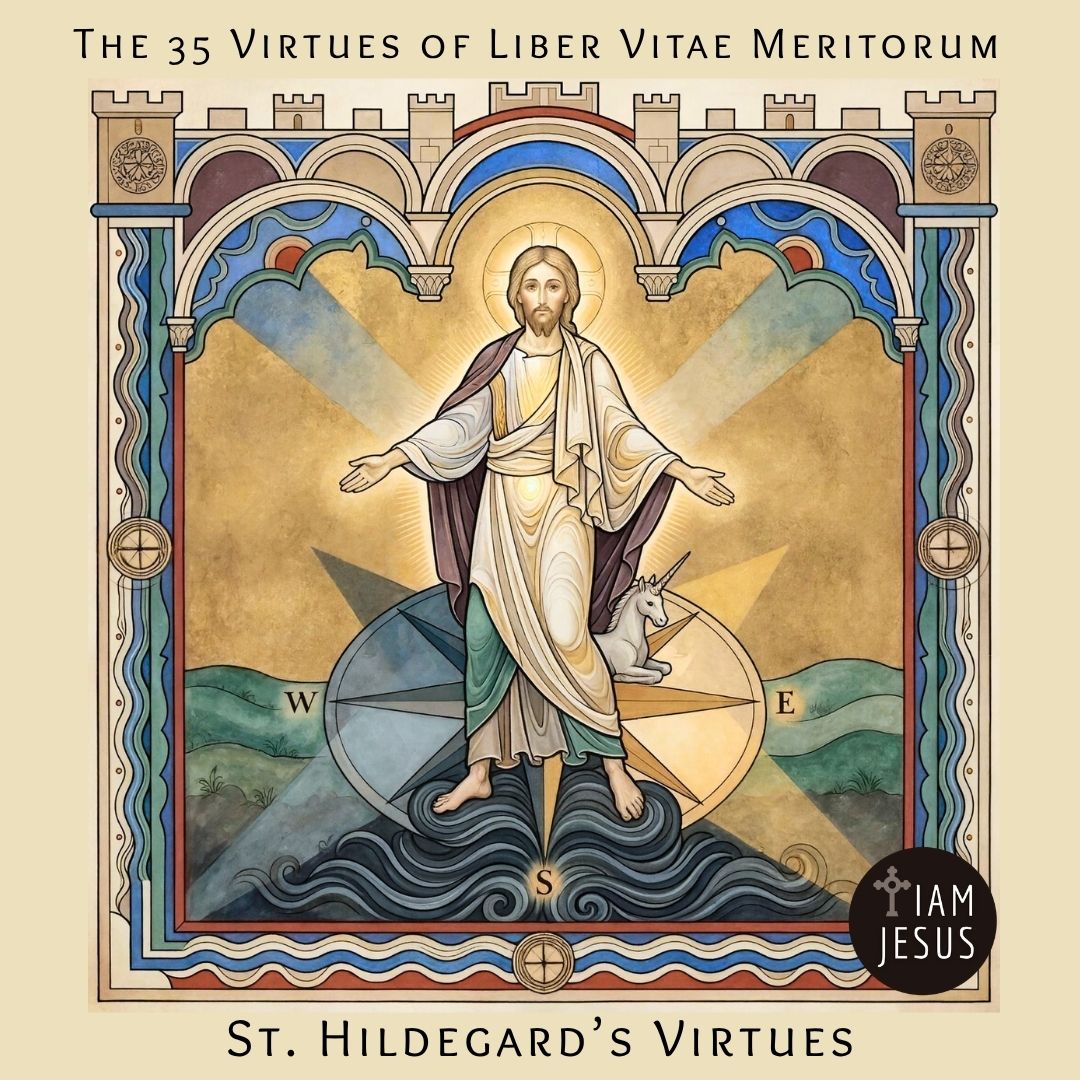
While the breathtaking original 12th-century illuminations are preserved as rare museum facsimiles and are in the public domain, the high-resolution photographs and digital scans of the early 20th-century Eibingen facsimile are strictly copyrighted by the modern publishers and the Abbey itself. We cannot legally use them on IAmJesus.net without licensing them. In addition, the 35 original images in Scivias depict massive, complex theological visions—like the Universe, the Pillar of the Savior, or the True Trinity—and there aren’t dedicated images in the collection for St. Hildegard’s virtues and vices from the Liber Vitae Meritorum. With this in mind, we made the editorial decision to create custom artwork throughout this series, inspired by her writings and focused on each individual virtue/vice pairing. All the artwork you see in the St. Hildegard Virtues series is designed in-house for our prayer community.
St. Hildegard’s texts often describe vices as complex, multi-headed wild beasts and monstrous creatures. To keep your chapel prayer time focused and free from distraction, we have reimagined these concepts for a modern audience and chosen to soften the imagery of the vices into human forms rather than hideous demonic-looking creatures.
Each meditation features a singular, striking image: the radiant Virtue standing victoriously in the celestial realm above, and its corresponding Vice struggling within the dark, foggy, heavy clay of the earthly realm below — designed to help you visualize the interior battlefield of your own heart as you pray.
[Copyright note, retained: all artwork across the St. Hildegard Virtues series is strictly protected by copyright and provided free for personal, private prayer use only; it may not be reproduced, redistributed, resold, or used commercially without express written permission.]
Explore More from the St. Hildegard Virtue Series
This article is one piece of a larger body of work exploring St. Hildegard of Bingen’s Liber Vitae Meritorum and the theology behind her vision of the virtues. If St. Hildegard’s visionary art resonated with you, the pieces below go further into the sources, structure, and terminology that shape the entire series.