
St. Hildegard of Bingen's Complete Vision
After thirty-five weeks of naming vice and growing in virtue, Part 6 brings you home. On this page, we’ll unpack the surface-level, theological, symbolic, and mystagogical meaning in the sixth and final part of St. Hildegard of Bingen’s Liber Vitae Meritorum.
Part 6 is not a sixth chain of vices. There are no more vices to name, no more virtue-and-vice debates to witness. The thirty-five pairs are complete. What Part 6 offers instead is the answer—the full, positive, luminous vision of what all thirty-five of those virtue struggles were always building toward.
After five Parts showing us every way a soul can go wrong—love misdirected, self made central, will turned against God, stewardship abandoned, purpose lost—St. Hildegard is shown, at last, what it looks like when a soul goes right. And she shows it to us in the same four elements that appeared, in corrupted or absent form, throughout every vice and every virtue in the five Parts before.
Surface Level
No More Chains — Only the View From the Summit
Every Part before this one gave you a chain to walk: vice after vice, virtue after virtue, one temptation answered before the next appeared. Part 6 doesn’t. There’s no new set of pairs here, no new vices to name. Instead, St. Hildegard gives you two things: her own teaching on how the four elements—fire, air, water, and earth—correspond to the virtues living in a faithful soul, and then, at last, her final vision: the man moving through the four zones of the whole earth, with a unicorn resting quietly at his side. This is not a new battle. It’s the view from the top of the mountain you’ve been climbing since Week One—the moment you finally get to see the whole shape of the journey at once.
Theological Level
Viriditas, Fulfilled — And the Judge Who Is Also Your Companion
Everything you’ve learned about viriditas—the living greenness of the Holy Spirit that we’ve traced through every single virtue in this book—reaches its own conclusion here. St. Hildegard tells us plainly: a faithful soul feeds on this greenness “so that he sprouts the seeds of good works by which he grasps the fruit of holiness.” Every small victory over Worldly Love, over Pride, over Discord—every moment you let a virtue answer a vice instead of giving in—was already this fruit, quietly ripening. Part 6 is also where St. Hildegard shows us the last things: the devil finally and completely unable to act, a new heaven and a new earth, souls fully alive in God. But—and this matters enormously for how you receive it—the One who judges at the end of this book is the same One who has been fighting for you, fiercely and tenderly, since the very first page. This isn’t a stranger arriving to render a verdict. It’s Christ himself, still winning the same fight he’s been winning all along.
Symbolic Level
The Lion, The Sword, and The Unicorn
If you’ve read closely, you may have already caught him: a lion, standing beside the man in this vision from the very first pages of Part 1, appearing again after the vices of Part 2, then present as a Sword and a Club in Parts 3 and 4—always fighting, always destroying what the devil tries to build. St. Hildegard names him plainly: Christ, “like a very strong lion.” And now, at the very end, she gives us the big picture: a Unicorn—untamable, unconquerable by any force in the world—rests gently against the man’s leg. The medieval Church loved this image for exactly this reason: a unicorn could never be captured by force, only tamed by resting in the presence of purity. This is Christ himself, the same fierce Lion who has been protecting you this entire journey, now revealed in the gentlest possible way—not diminished, but finally close enough to touch.
The Lion
St. Hildegard sees him first before a single vice has even been named: “a lion in the sun,” moving with the sun as it rises and sets, sending “many back to joy” (Part 1). After the vices of Part 2 conclude, she names him without hesitation: “There is a lion standing by the man… Christ, nevertheless, like a very strong lion, leads all the devil’s attempts and efforts toward sin to nothing and destroys the devil completely” (Part 2). This is the same Lion Scripture has always promised — the one Jacob foresaw crouching, unrousable, over the tribe of Judah [Genesis 49:9]; the one whose heart alone was likened to a lion’s for its courage and protection [2 Samuel 17:10]; the one who appears at last, triumphant, in the vision of heaven itself: “the Lion of the tribe of Judah, the Root of David, has triumphed” [Revelation 5:5]. St. Hildegard’s Lion is not the devouring adversary of 1 Peter 5:8—she takes that same predator’s image and turns it back against the true predator, hunting the devil the way the devil was said to hunt souls.
The Sword
The sword from Part 1 returns here too — no longer swinging to strike, but sheathed in the gentlest possible form. If you’ve read all thirty-five weeks honestly, this is not a stranger arriving to judge you. This is the same one who has fought for you—as a sword, yes, but He also came as a lion, a fiery face felt in silence, a voice defending you, and a brazen club in Part 5—scattering the vices that opposed your ascent toward holiness.
The Unicorn
And then, at the very end of the whole journey, one final image, named without any ambiguity at all: St. Hildegard tells us plainly who he is: “The unicorn, who is the Son of God… struck the devil down with his sword of chastity” (Liber Vitae Meritorum, Part 6, Section 4, Para. 5). The medieval Church loved this image for exactly this reason: a unicorn could never be captured by force, only tamed by resting quietly in the presence of purity—a picture of the Incarnation itself, the untamable Son of God made reachable through the Virgin’s own purity. Notice, too, that his weapon is chastity—the very virtue that closed Part 3 of this book. The same fierce Lion who has fought for you this whole journey is revealed here in his gentlest form: not diminished, but finally close enough to touch. The tradition of Jesus symbolically represented as a Unicorn was so thoroughly embedded in monastic education by the 12th century that it would be more surprising if St. Hildegard didn’t know about the Unicorn representing the Incarnation of Christ than if she did. Beginning in the 2nd Century, monks began compiling bestiaries—illuminated manuscripts that cataloged various animals, birds, and mythical creatures as a theological tool to draw parallels between animal behaviors and Christian moral teachings.
A Note on The Significance of the Number Seven and Number Eight
Seven is the number of completion in Catholic tradition—God rested on the seventh day [Genesis 2:2]; the Church counts seven sacraments, seven gifts of the Holy Spirit [Isaiah 11:2]. Eight is the number of new creation—the eighth day standing beyond the completed week, the day of the Resurrection, which is why baptismal fonts were traditionally built as octagons. St. Augustine and other Church Fathers wrote of the eighth day as a symbol of eternity itself. Parts 1 and 3 have seven pairings; Parts 2 and 4 have eight. I’d like to add an honest note: the word “lion” itself is confirmed only in Parts 1–2, so this numerology can’t be tied to the lion image specifically across all four Parts—but the broader Zeal-of-God role and the word “regeneration” do appear at the threshold of all four.
Mystagogical Level
You Were Never Walking Alone
This is why St. Hildegard saves this vision for last, rather than opening her book with it. If she had shown you the Judge first, you might have spent these thirty-five weeks afraid of him. Instead, she let you meet him quietly, one virtue at a time—as Mercy, as Patience, as Faith, as Concord—long before she ever told you his name. By the time you arrive here, at the very end, you already know him. The Lion was never a stranger standing at a distance, waiting to see if you’d pass some final test. He was beside you in every single week, in every quiet moment you chose grace over habit, in every prayer you offered when you felt like you were failing. Part 6 isn’t an ending to brace for. It’s a homecoming—the moment you finally get to see, all at once, that the God who asked you to grow in virtue was never doing it to judge you from afar. He was pursuing you, patiently and completely, the entire time. And he was never going to stop.
The Four Elements as the Language of Grace
Throughout the Book of the Rewards of Life, Hildegard uses the four elements of the medieval world—fire, air, water, and earth—as her visual language for what God does in a soul through grace. Every vice showed us these elements in some form of corruption: false warmth, parched air, dried earth, fruitless soil. Every virtue responded with the element’s true form: genuine fire that inflames without destroying, living air that carries the Spirit’s breath, water that truly nourishes, earth that genuinely bears fruit.
In Part 6, St. Hildegard names this language directly and plainly, for the only time in the entire book:
- Fire — as fire inflames the body, so the virtues inflame the soul with the love of God.
- Air — as a person blows out breath, so the virtues draw the soul in toward heavenly things.
- Water — as water moistens and softens the body, so the virtues water and refresh the soul.
- Earth — as the earth quickens the flesh and gives it life, so the virtues make the soul bear good fruit.
This is the key to the whole book. Every virtue, across all thirty-five pairs, has been doing one or more of these four things. Every vice has been preventing, counterfeiting, or destroying one or more of them. Now, at the end, St. Hildegard names the structure she has been showing us all along.
The Vision of Heaven
Part 6 also contains St. Hildegard’s most beautiful vision of what awaits the soul that has fought for virtue and found its rest in God. She sees the holy ones clothed in ‘the beautiful dawn and the splendor of the sun’—fire in its most glorious form. She sees them giving forth ‘the sweetest air of the softness of the sweetest flowers of all different colors, like the aroma of balm’—air become fragrance, breath become beauty. She sees them crowned and adorned with living gems, their voices ‘filled with every kind of music,’ singing a new song without any hesitation. This is the City of God that Saint Augustine described in philosophical terms — made visible, sensory, and present in St. Hildegard’s mystical sight. This is what love aimed at God looks like when it has run its full course. Not a list of rewards for good behavior, but a soul fully alive in every element God gave it—flaming with love, breathing with freedom, green with fruitfulness, rooted in the earth of God’s own being.
A Note on Gehenna
Part 6 also describes Gehenna—and it does so in language that echoes the most extreme vice in the entire book, Destruction of Souls. ‘Those who did not seek the grace of God and did not want to look at God or desire to have life will remain here,’ St. Hildegard writes. Notice the verbs: did not want. Did not desire. Not ‘were rejected’ or ‘were condemned’ — but chose, over time, not to want what God was always offering. This is consistent with everything the Church has always taught about the nature of damnation: it is not something God imposes but something a soul, by persistent and willed refusal of grace, arrives at on its own.
Part 6 names it plainly, so that the reader who has followed all thirty-five pairs understands what was ultimately at stake in each one. The Book of the Rewards of Life makes one continuous argument, across six Parts and thirty-five pairs, about the human soul and its relationship to God: You were made for God. Every disorder this book describes is a misdirection of the love that was designed for God—aimed instead at the world, the self, the will’s own glory, earthly goods, or passing pleasures.
When love is misdirected at its root, everything downstream tilts with it: the body, the will, the relationships, the sense of purpose. The soul doesn’t fall all at once; it drifts, slowly, through a chain of choices that each seem reasonable at the time, until it arrives at indifference, or bitterness, or despair, or scattered purposelessness — or, in the worst case, the willed closure to grace that no longer even wants to be opened. But in every pair, before the vice has even finished speaking, the virtue is already answering. Not with argument but with being — with fire, with breath, with water, with green living fruit.
The virtues do not defeat the vices by out-reasoning them. They simply appear, and in their presence, the counterfeit is exposed. The dry root is seen for what it is. The false warmth is felt for what it lacks. And Part 6 shows us the destination that was always waiting: a soul rightly ordered, rightly loved, rightly fruitful—clothed in dawn, fragrant as balm, rooted in God, singing the new song. That is what you were made for. That is what every grace, every sacrament, every virtue, every honest prayer, every act of repentance is building toward.
St. Hildegard saw it. She is offering you the vision.
Revisit the Series
Now that you’ve completed all six parts, perhaps you’d like to review the themes and symbolism of the first five parts again to see the deeper connections of what you’ve already studied. St. Hildegard’s Liber Vitae Meritorum is so rich in meaning that it can be studied again and again and you’ll still draw more meaning from it each time.
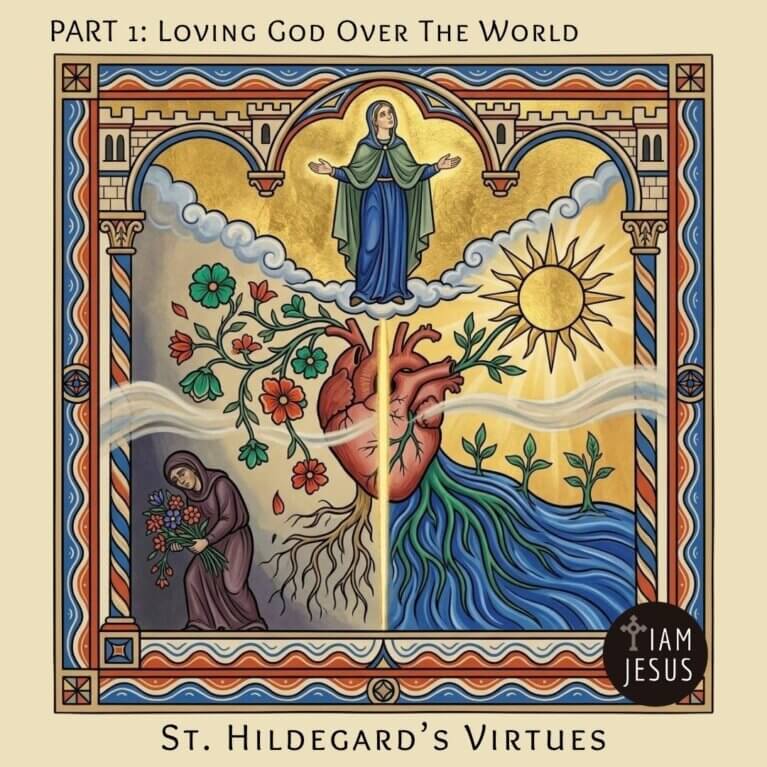
Part 1
Loving God Over the World
Where Your Heart Is, There is Your Life.
Every soul is built to love. The Question St. Hildegard asks in Part 1 is not whether you love, you do, deeply and constantly, but where that love is aimed. In these 7 meditations, St. Hildegard shows us what a heart aimed at God actually looks like from the inside and what happens when it wanders.
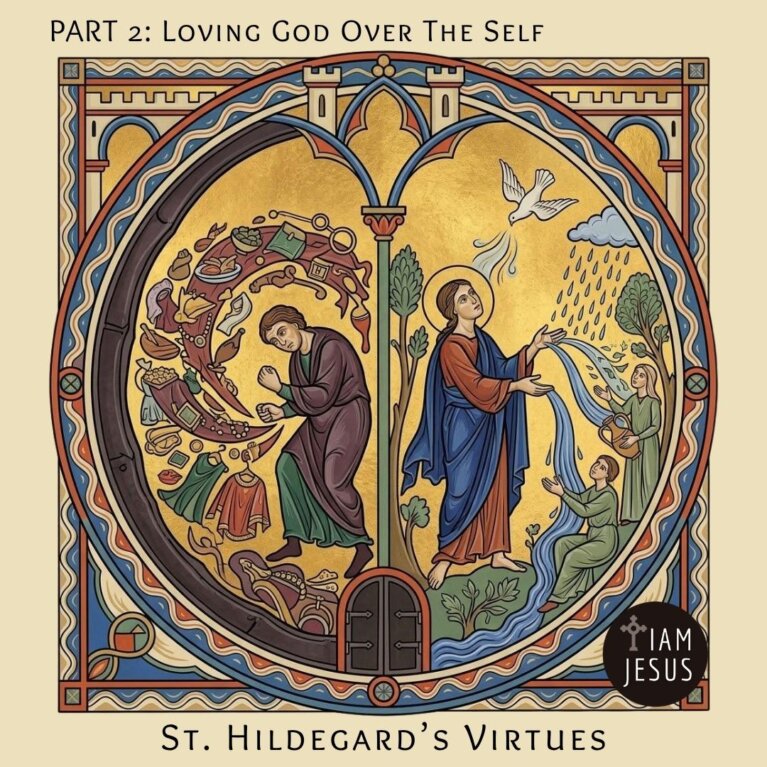
Part 2
Loving God Over the Self
Making Room for Something Greater.
There is a love more fundamental than love of the world and St. Hildegard names it in Part 2: the disordered love of self that quietly becomes the center of everything. In these 8 meditations we learn to put God and the needs of our neighbors first, and discover something much bigger.
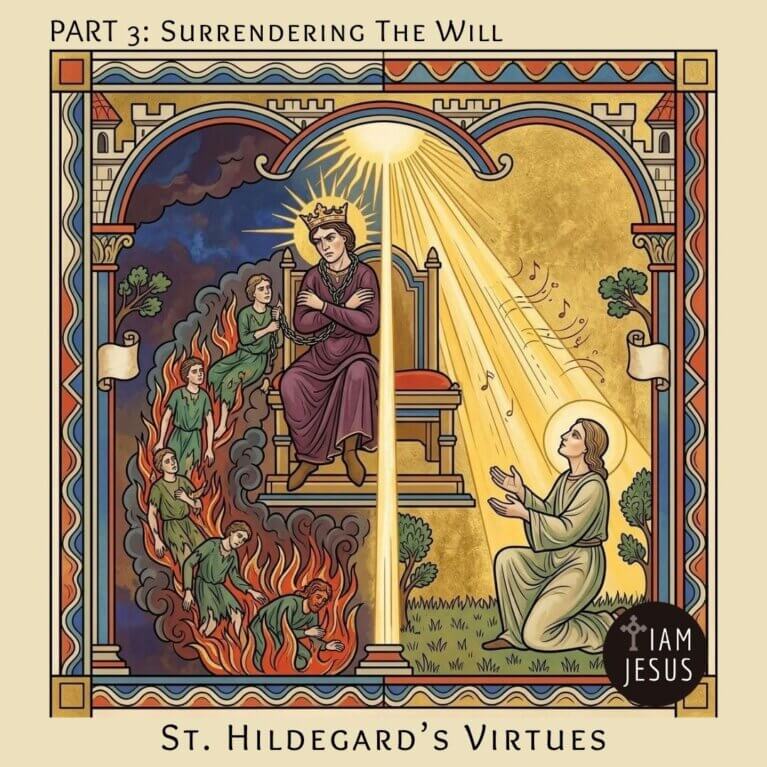
Part 3
Surrendering the Will to God
The Freedom That Comes from Letting Go
In Part 3, St. Hildegard shows us how failing to surrender our will to God begins with Pride and ultimately ends with Luxury surrendering to all kinds of sensual desires. In these seven meditations we discover that by surrendering our will we gain tremendous freedom and are filled with light.
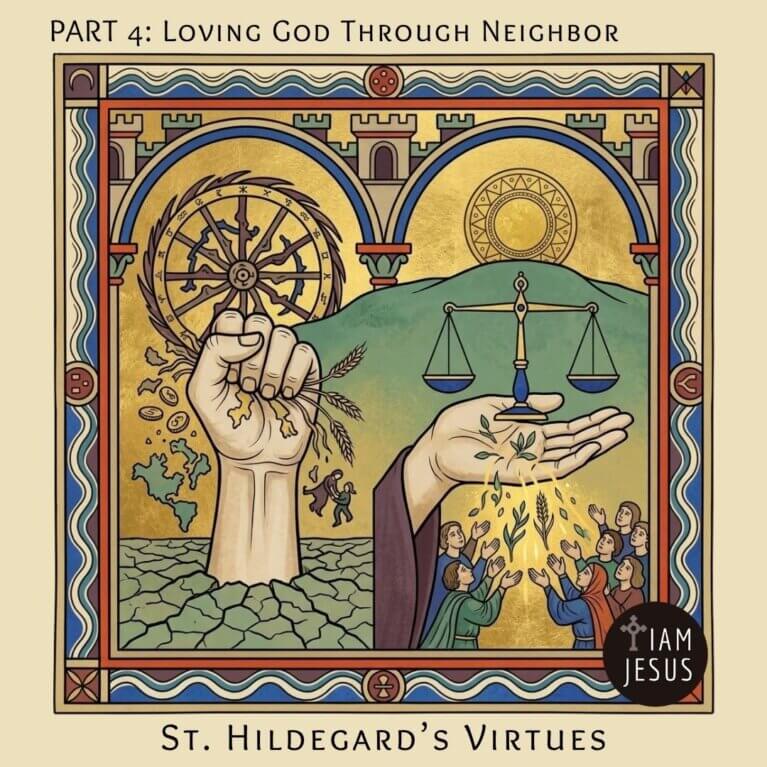
Part 4
Loving God Through Our Neighbor
The Soul that Gives What It Has Been Given.
Everything we have is entrusted to us. Our gifts, our time, our resources, our relationships, our positions are given to us for a purpose and in Part 4 we contemplate 8 virtues that help us remember how to be of service to something greater than our own desires.
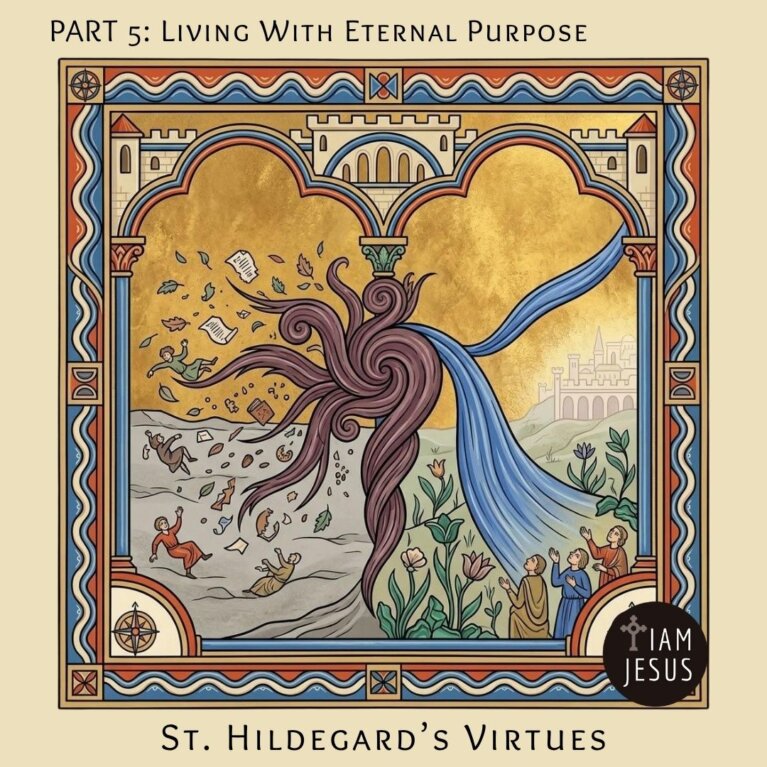
Part 5
Living with
an Eternal Purpose
The Soul that Knows Why it is Here.
The deepest question we can ask is, "What is the point of my existence?" In Part 5 St. Hildegard shows us through 5 meditations, what it is like when a soul and a community is oriented toward its true end, and it discovers its true purpose in life: that it was made for God.
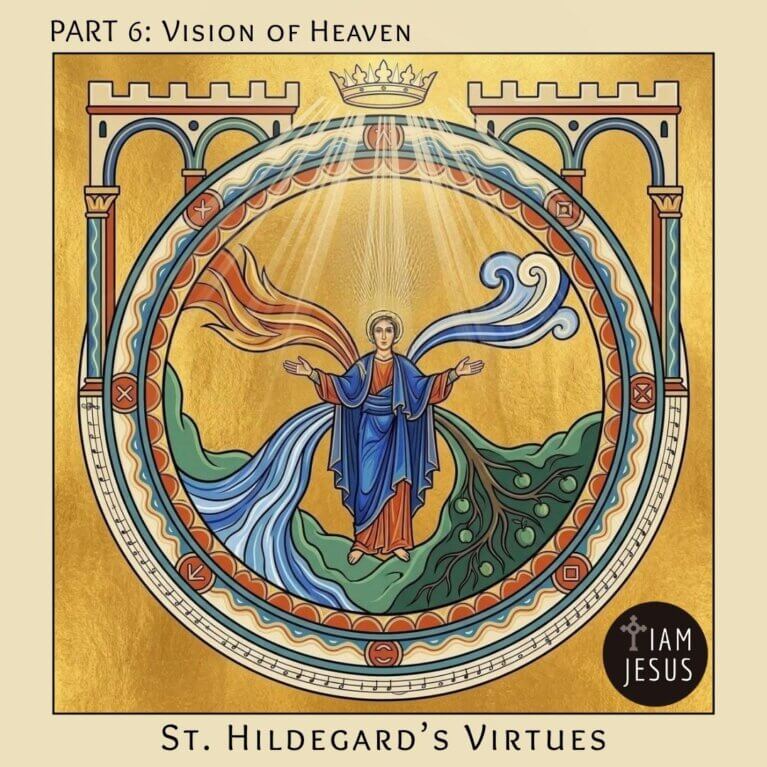
Part 6
The Vision of Heaven: God's Intention
The Soul Enters into Harmony with God.
After contemplating how a drifting heart, self-absorption, rebelliousness, poor stewardship & a lack of purpose harms us, we finally come to understand in Part 6 that when we are enflamed with holy love, the 4 elements of creation will work as God designed them.